
Rodrigo Ramírez Rodríguez at Bodega OMR
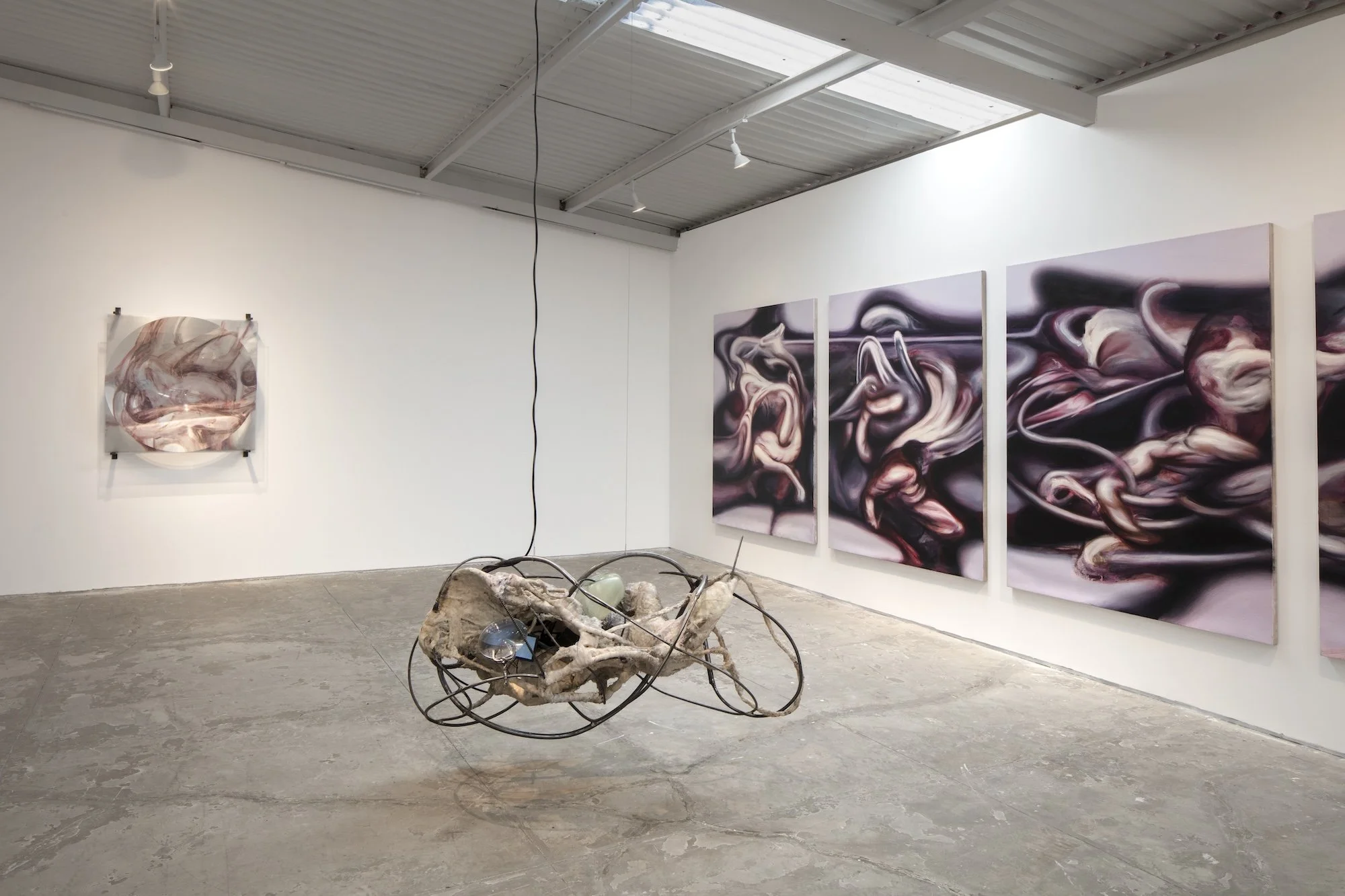
Rodrigo Ramírez Rodríguez. Por abrasión y contagio, installation view. Photo by Ramiro Chaves. Courtesy of the artist and Bodega OMR
I drift toward the portal at the back of the warehouse like a moth drawn to light. Stacks of wooden crates labeled “Frieze London” and “Art Basel Miami Beach”—recent coordinates in the international circulation of artworks—surround me. Beyond the storage aisles, inside the logistical heart of OMR, a gallery long credited with catalyzing contemporary art in Mexico, Por abrasión o contagio by Rodrigo Ramírez Rodríguez (b. Mexico, 1988) appears as an interruption: a luminous cavity within the machinery of transport and storage.
Across the exhibition, erosion bridges the geological and the anatomical. The cutaneous becomes landscape, and landscape becomes a threshold of bodily perception. In the curatorial text, Octavio Gómez Rivero frames this relation through two interconnected cosmologies centered on this notion. On one hand, drawing on Ariana Reines, he describes the desert as a historical metaphor for the virtual: an infinite, immeasurable field that, with the arrival of the internet, shifted from background to surface, becoming a fluid medium saturated with electromagnetic waves, desire, and data. On the other hand, he turns to the Tzeltal concept of “the other side,” understood as a virtual and intensive realm that exists both outside and inside the body—in the heart as well as in areas where blood does not flow, such as hair, nails, and teeth—where souls remain unstable and in continuous transformation. Together, these frameworks describe a fold between inner and outer worlds, where bodily experience and environmental forces continuously overlap. Ramírez Rodríguez’s work gives material form to this fold, producing images and objects that never fully belong to the body nor completely detach from it.
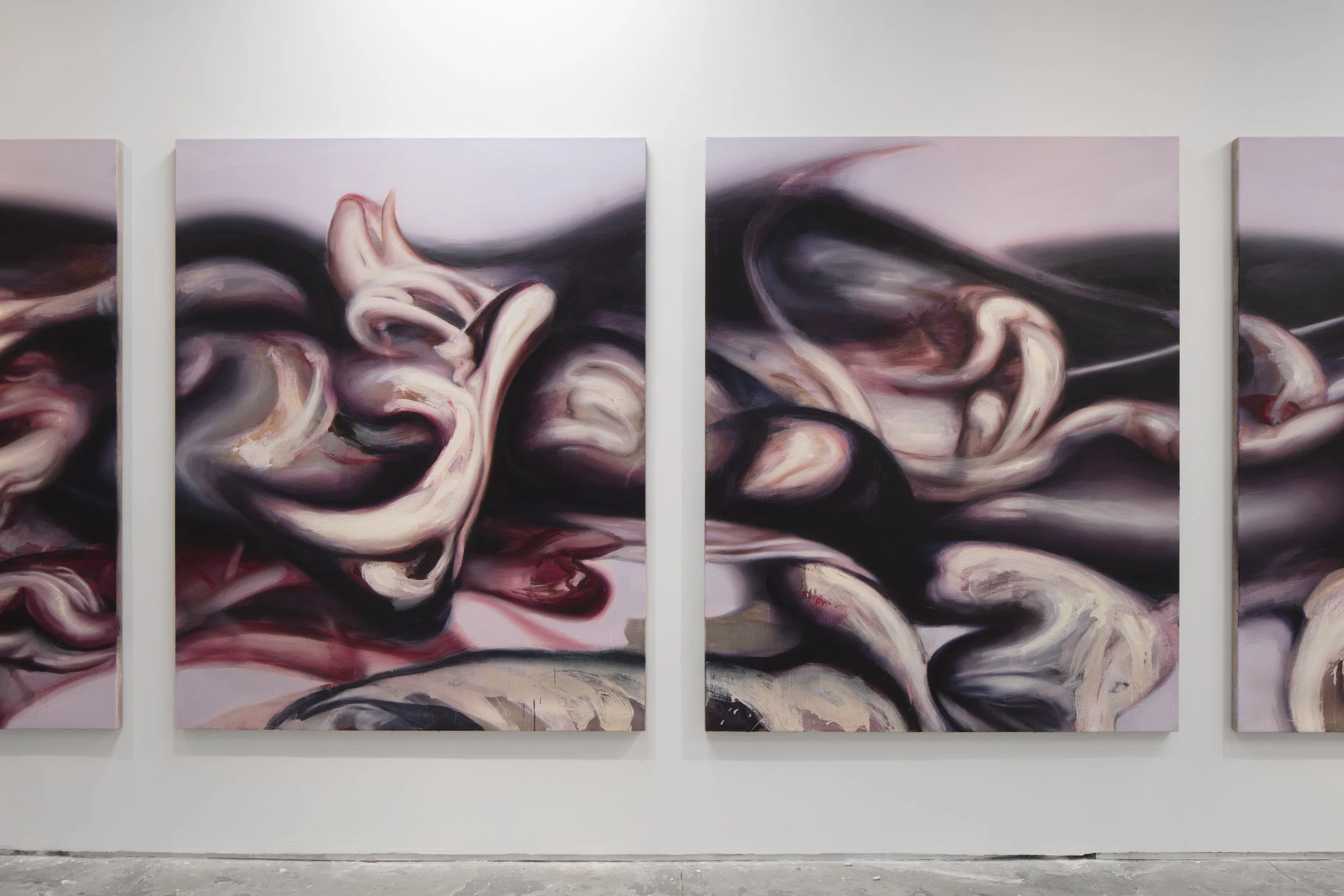
Rodrigo Ramírez Rodríguez. Detail from the series Erosión de una superficie sensible (2025). Oil on linen. 78 ¾ x 63 x 1 ⅝ inches each. Photo by Ramiro Chaves. Courtesy of the artist and Bodega OMR
The paintings exemplify this concept through their physical presence. Visceral, metabolic, almost animate, they address the skin before they address the eye. Erosión de una superficie sensible (2025), a series of ten large, oil-on-linen works, reads as variations of a single continuous surface undergoing abrasion, sedimentation, and peeling. Color advances and recedes, pooling in some areas while thinning in others, as if responding to invisible pressure. The works are less concerned with depicting erosion than with making its effects perceptible to the viewer.
The series is loosely inspired by Tintoretto’s Crucifixion (1565), not as a quotation of imagery but instead evoking its general sensibility towards scale, density, and movement. Other references emerge in similarly indirect ways: Bacon’s distorted bodies, Goya’s somber corporeal scenes, and the charged, fractured figures of José Clemente Orozco. None of these sources is illustrated or reenacted. They register instead as residual presences folded into the painted surfaces and translated into texture, chromatic density, and compositional instability. The paintings follow a logic that Heinrich Wölfflin identified with the Baroque: forms that remain open, depths that shift, and edges that resist closure. Ramírez Rodríguez adapts this sensibility to a neobaroque register in which the image never settles, privileging perceptual drift over fixed structure.
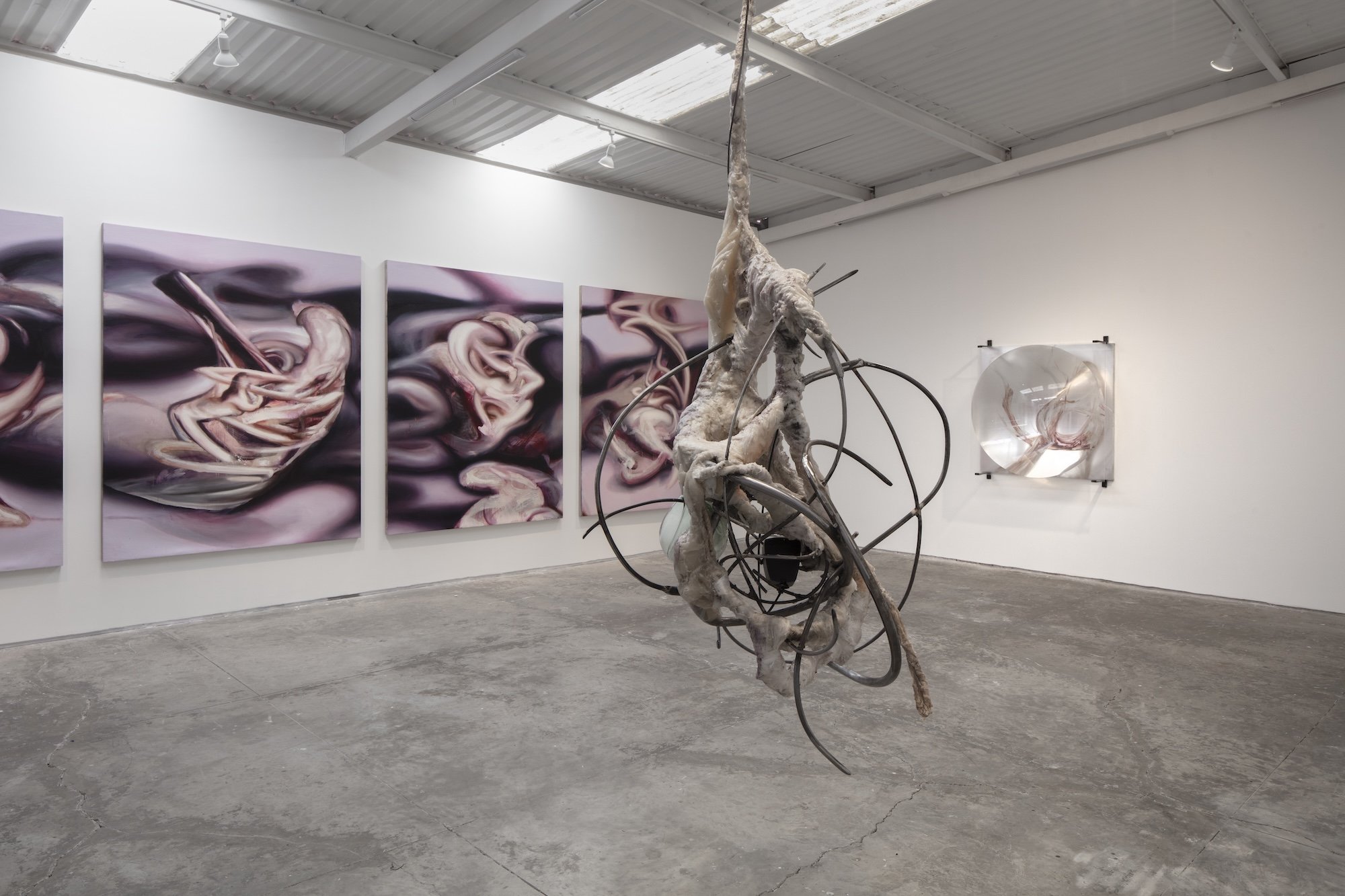
Rodrigo Ramírez Rodríguez. Por abrasión y contagio, installation view. Photo by Ramiro Chaves. Courtesy of the artist and Bodega OMR
If the paintings establish a vibrating perceptual field, the sculptures articulate it spatially. Paisaje interior 1 (2025) and Paisaje interior 2 (2025), made from resin, steel, and beeswax, serve as points of orientation within the exhibition, bringing into focus the unstable boundary between interior and exterior spaces as well as the slippage between bodily and geological form. In Paisaje interior 1, a video distorted by a convex lens alternates between wide shots of the Californian desert and close views of the artist’s skin and that of his partner, paired with a soundscape where wind recordings resemble the pulse of an ultrasound. This shift between planetary scale and intimate epidermis extends the exhibition’s inquiry into perception beyond vision, introducing bodily rhythm that quietly underlines the work.
The remaining sculptures, distributed across the walls, continue this inquiry through combinations of bronze, blown glass, steel, and resin. Their framework oscillates between skeletal supports and irregular, soft surfaces, suggesting a continual negotiation between containment and leakage. Material change is not secondary here but structural: beeswax dries, resin settles, glass refracts unpredictably. Duration becomes part of the work’s meaning, emphasizing slow transformation over stable form.
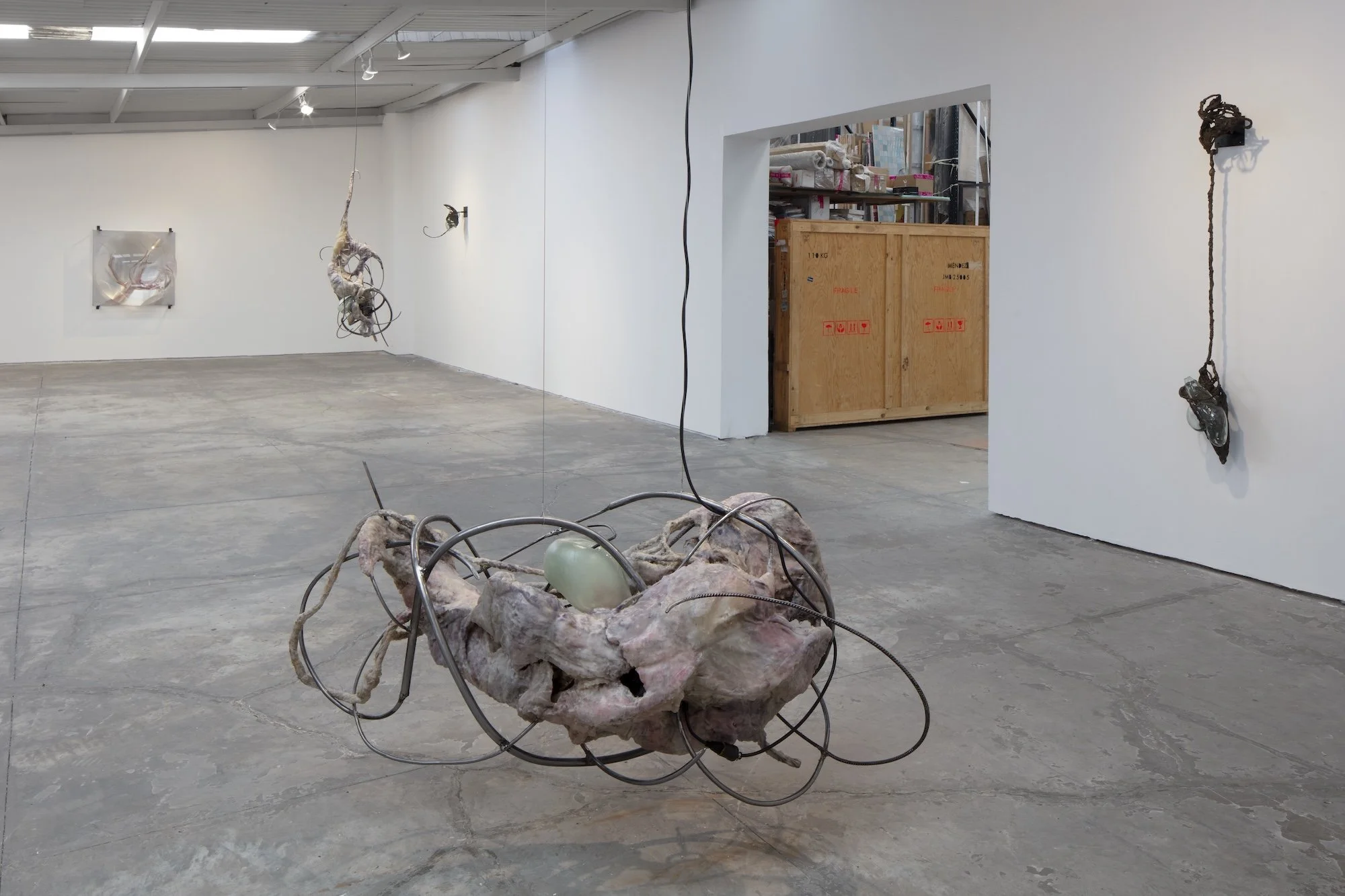
Rodrigo Ramírez Rodríguez. Por abrasión y contagio, installation view. Photo by Ramiro Chaves. Courtesy of the artist and Bodega OMR
The optical lenses embedded in Todo lo que puede ver 1 (2025) and Todo lo que puede ver 2 (2025), which are oil-on-aluminum hybrids between painting and sculpture, further disrupt visual certainty. Historically associated with clarity and control, the lenses distort rather than resolve perception: they bend contours and alter scale, encouraging the viewer to adjust position repeatedly. Looking becomes less an act of mastery than one of adjustment—an embodied negotiation between eye, object, and space.
Within the local artistic context, Por abrasión o contagio aligns with a broader interest in mutable materials and posthuman questions shared among the artist’s contemporaries. The recurrent use of wax and encaustic processes—present in the work of painters such as Manuela García—resonates with Ramírez Rodríguez’s metabolic surfaces and their slow transformations. At the same time, the exhibition shares conceptual ground with projects like Mineralia indisciplinada at Museo Universitario del Chopo, which similarly displace the anthropocentric body through geological and material imaginaries.
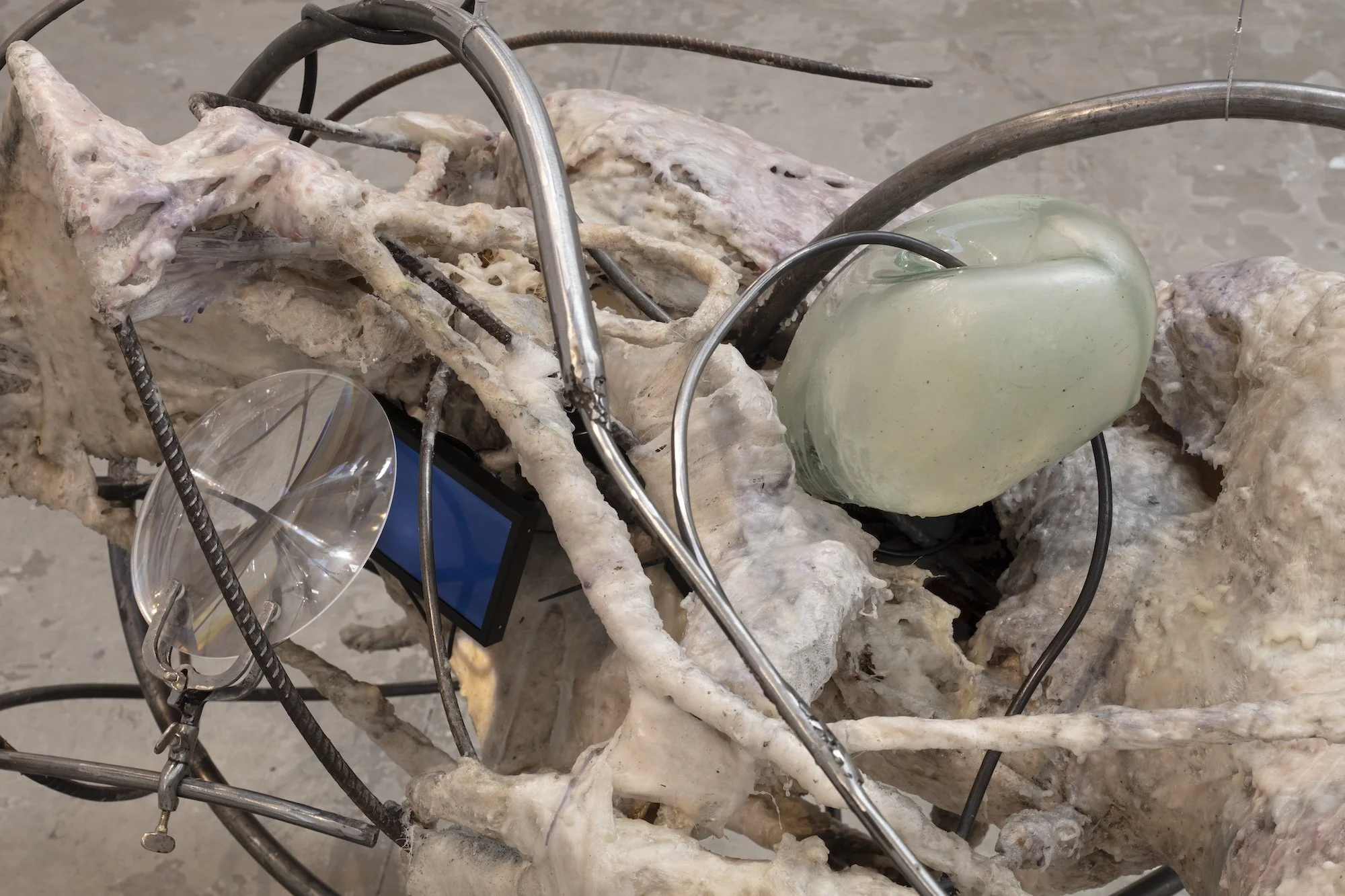
Rodrigo Ramírez Rodríguez. Detail from Paisaje interior 1 (2025). Resin, steel, and beeswax sculpture. 68 ½ x 25 ⅝ x 19 ¾ in. Photo by Ramiro Chaves. Courtesy of the artist and Bodega OMR
Seen in relation to his previous solo exhibition, While Being Plasmic Membranes at Swivel Gallery, Por abrasión o contagio marks a shift of scale and spatial focus. The earlier project centered the body as a dramatic figure, staging flesh and psychic tension across the canvas. Here, that focus expands outward: the body no longer anchors the work as a singular image but disperses into surface, landscape, and environment shaped by erosion and atmospheric forces. Instability and transformation remain consistent concerns, though their expression moves from theatrical figuration toward a more environmental and topographic register.
At Bodega OMR, the crates and labels outside the gallery serve as a quiet reminder that the works themselves are in transit. Inside the space, however, circulation pauses long enough for another kind of contact to occur. Por abrasión o contagio does not offer stable images or settled explanations. It remains instead at the cutaneous edge where perception happens: the narrow zone where surfaces erode, affects accumulate, and something prior—or posterior to—language dilates and contracts, asking for attention.
Por abrasión o contagio is on view at Bodega OMR from November 13 to December 17, 2025.
