Womanhood as an Abstraction
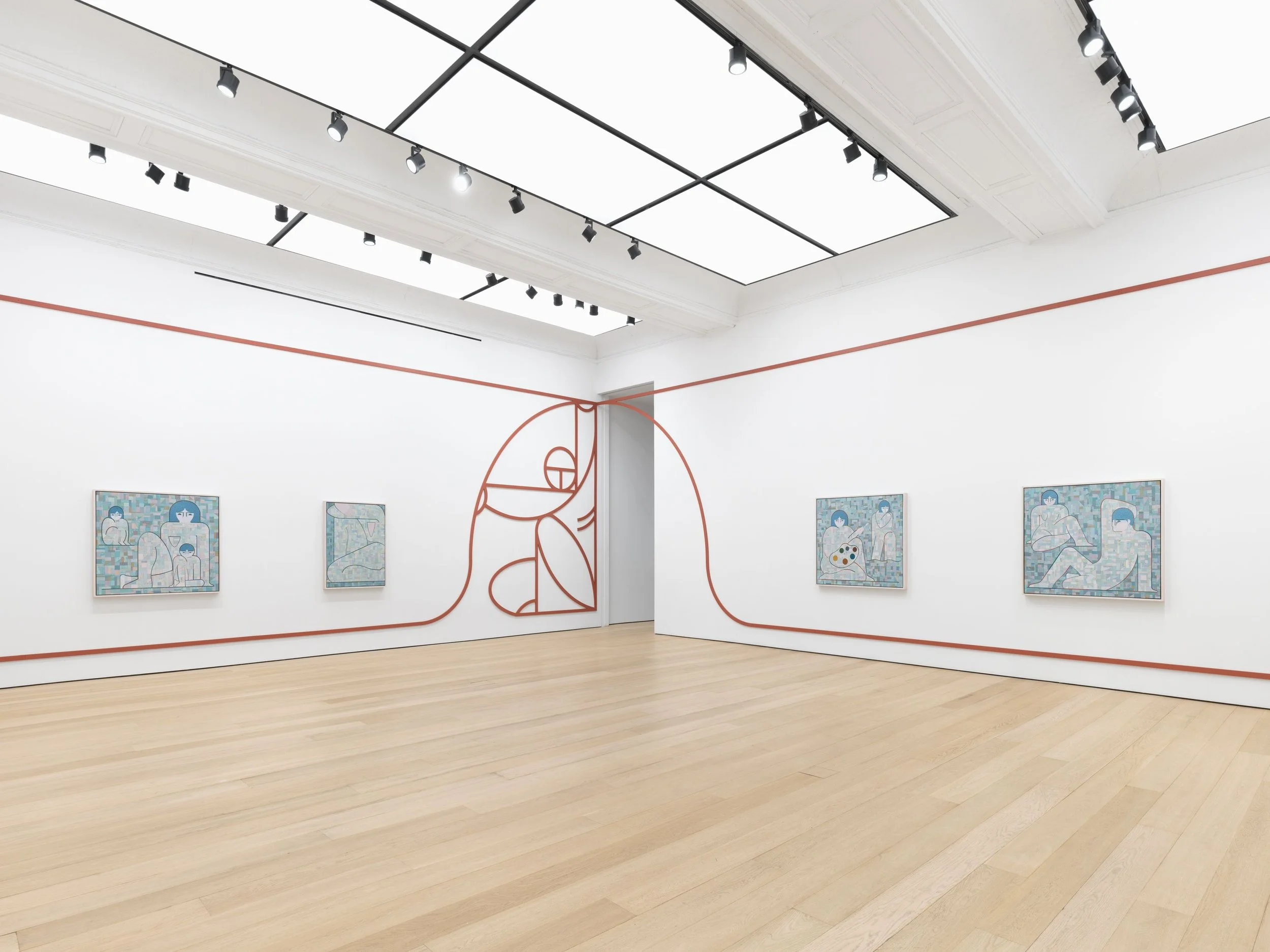
Installation view: Ruby Sky Stiler: Long Pose, Alexander Gray Associates, New York, 2025. Courtesy of Alexander Gray Associates.
For Ruby Sky Stiler, the nude is not just a subject, but a medium in itself. Long Pose, her first solo exhibition at Alexander Gray Associates, consists of collaged paintings of nude subjects structured around a panoramic, bas-relief mural traversing through the gallery walls, supported by three caryatid-like figures. The architectural framework is reminiscent of earlier exhibitions, in which Stiler’s work harmonized with its surrounding space to lend a multi-sensorial dimension to the work. Most crucially, it reframes each painting as one fragment of an overarching gesture—an embodied poem.
Stiler’s bodies live in hybridity. Evoking a wide range of visual traditions across the art historical canon, they are not specific individuals, but allegorical archetypes—the Venus, the Mother, or the bather. Their simplified form—monochromatic, geometrical, generalized, yet unmistakably gendered—evokes Ancient Greek representations of bodies. However, a closer look at their surface will reveal their mosaic-like assembly, with fragments of sketch drawings on canvas meticulously placed to conjure the illusion of pictorial space. While gesturing to Byzantine mosaics, Gothic stained-glass, and cubist painting, Stiler’s blue-toned tiles signal the vernacular, crafty undercurrent of her practice. As sketch mosaics, these works exist in endless construction. Their nature, much like their hybrid style, is intrinsically liminal, yet perpetually unfixed.
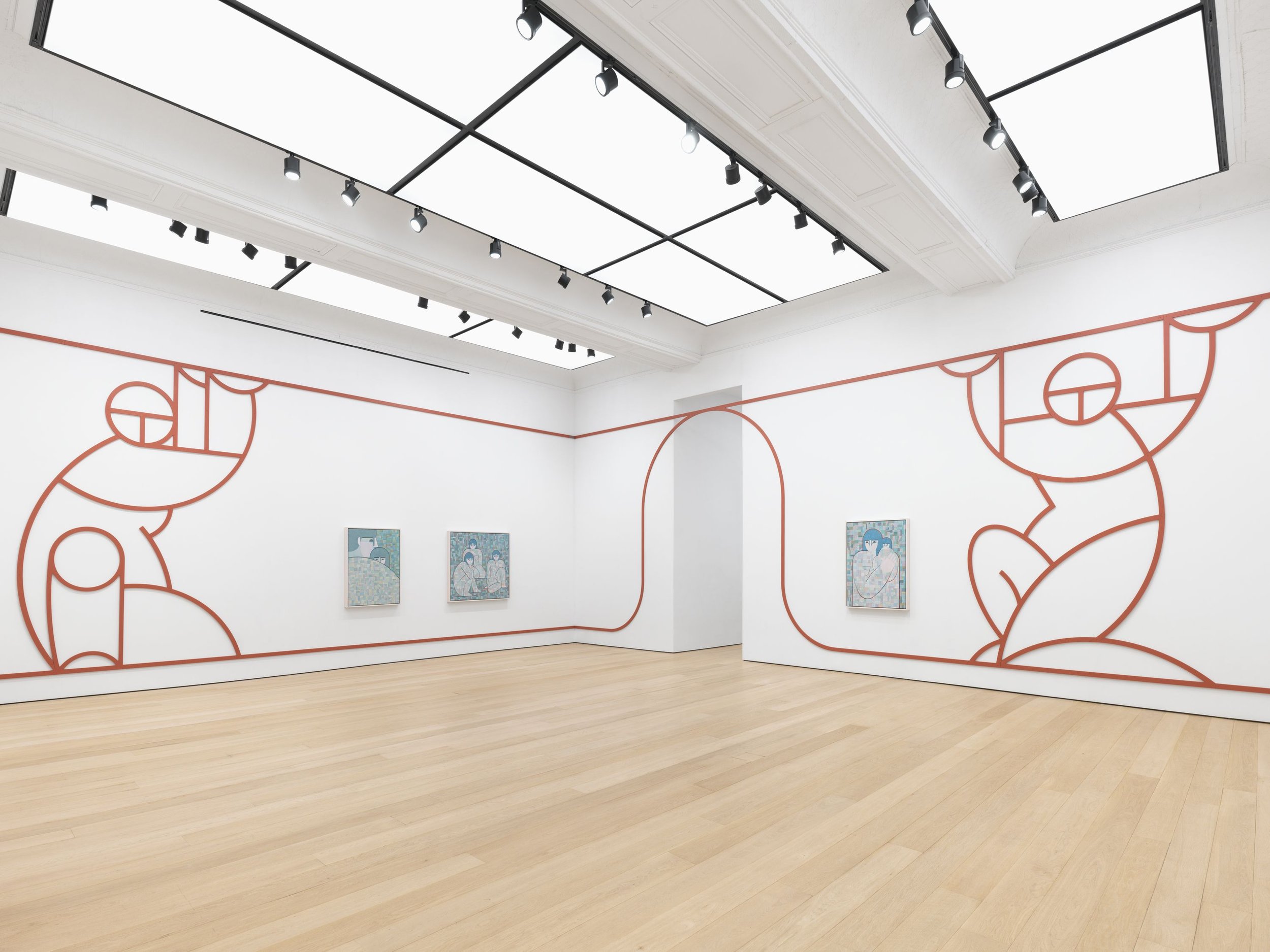
Installation view: Ruby Sky Stiler: Long Pose, Alexander Gray Associates, New York, 2025. Courtesy of Alexander Gray Associates.
Beyond this postmodern syncretism, Stiler’s primary concern is the elastic but powerful concept of womanhood—or more precisely, art’s historical role in shaping the aesthetic and ideological framework of patriarchal womanhood. Her feminist reimaginings recontextualize women archetypes as a means of undercutting a history of representational violence. They are nude but unbothered and unashamed, gazing back almost as if to invert the subject-object relationship: we are the observed objects here, intruders within their domain, guarded by the wooden caryatids. It would be remiss, though, to assume that Stiler’s revisionism is purely an act of negation. Evidently, she finds agency in reassembling misogynistic archetypes into her own icons. Gender inversions play a critical role: In Two Bathers (2025), the man rather than the woman lounges, whereas Father Holding Child (2025) extends Madonna iconography to an idealized image of fatherhood. Women also exist in generative community, such as in Three Blue Women (2025), or with family, such as in Mother Holding Child (2025) and Large Blue Mother (2025). Stiler’s feminist intervention is to reconsider oppressive gendered symbolism as universal markers of kinship and resilience.
There’s a tension between Stiler’s feminist concern for the politics of representation and her stylistic explorations. At once, Long Pose gestures to the lost murals of Pompeii, the cubist tradition, the monolithic sculptures of Richard Serra and Mark di Suvero, and the modernist designs of Anni Albers and Alexander Girard. Through that search, though, her women are relegated to extras rather than protagonists, literally blending within their monochromatic environments. As Stiler mentions in the press release, “they are almost falling apart into geometry—you take one thing away, and they would be just shapes.” In their lack of character and specificity, these women, like their classical and cubist counterparts, dissolve into abstract, universal symbols of womanhood.
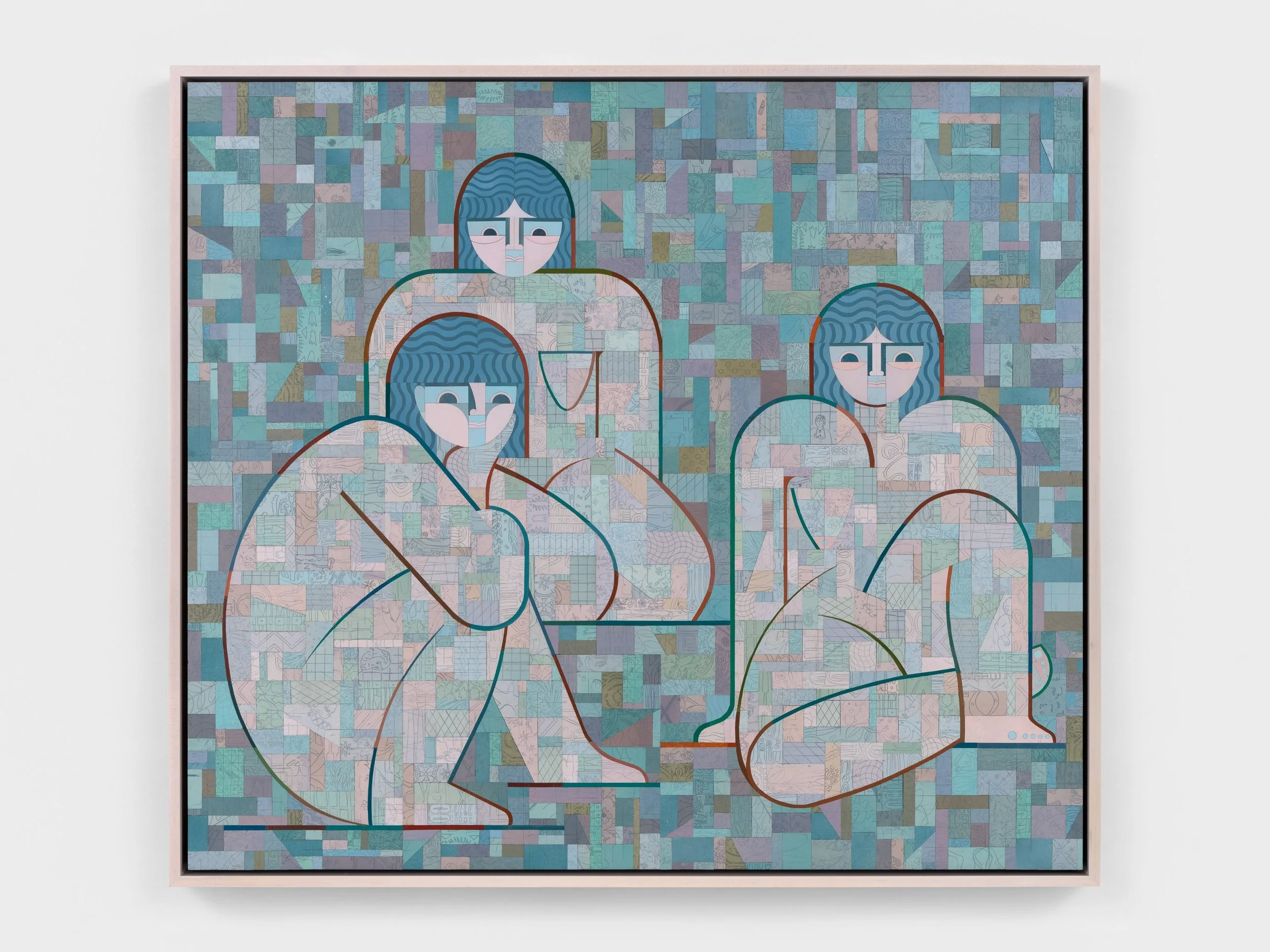
Ruby Sky Stiler, Three Blue Women, 2025. Canvas, acrylic, pencil, and jade adhesive on panel, 44 x 50 in (111.8 x 127 cm), 45 7/8 x 52 x 3 3/8 in framed (116.5 x 132.1 x 8.6 cm framed). Courtesy of Alexander Gray Associates.
This universalizing is intentional, but in representational terms, it inadvertently reduces these women to mere shapes, only characterized by their archetypal roles. In Large Blue Mother, Cropped Woman (2025), and Three Blue Women, mothers are identified by saggy breasts, corporeal manifestations of breastfeeding, rejecting conventionally idealized female nudes shaped by and for a male gaze. Apart from this, however, all the women share the same hair, skin tone, eyes, curves, and affect. Little distinguishes the three women in Three Blue Women, except for their body postures and the mother’s breast. There’s an air of kinship in the composition, but it’s so frail and vague that it dissolves within the image. This flattening of womanhood into symbolic abstraction arguably reifies the art historical essentialization of women as decorative ornaments, objects of procreation, or emblems of familial caretaking.
It’s important to note that Stiler has previously pushed her artistic experimentations to compelling results. In Seated Woman (2013), monumentality and fragmentation come to function as devices to hinder body objectification, whereas in Standing Artist (2023), sculptural figuration falls so close to geometric abstraction that it refuses to be read in representational terms. Long Pose doesn’t offer any such challenge: it presents beautiful but unaffective images of womanhood as a tapestry.
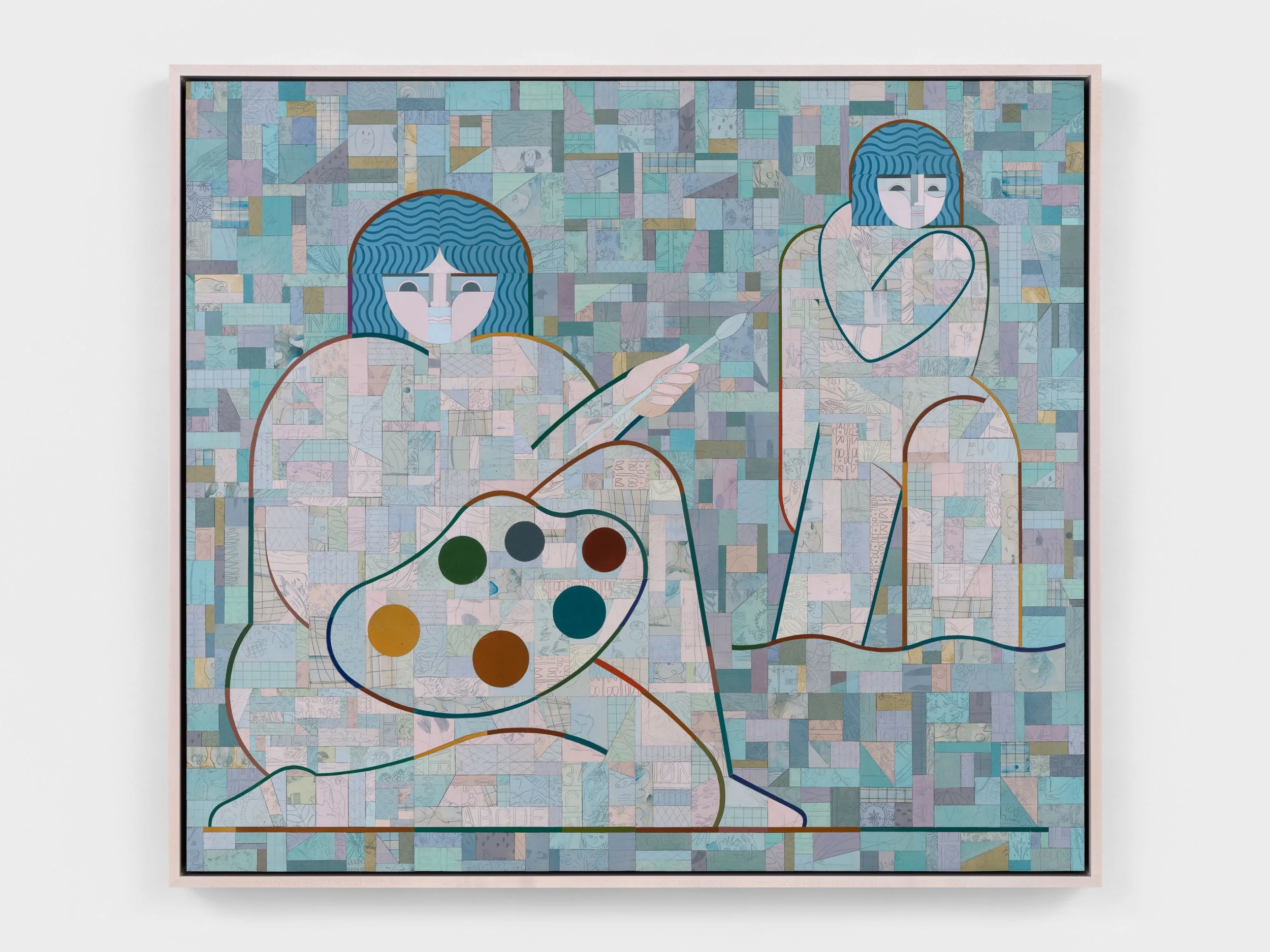
Ruby Sky Stiler, Artist with Bather, 2025. Canvas, acrylic, pencil, and Jade adhesive on panel, 44 x 50 in (111.8 x 127 cm), 45 7/8 x 52 x 3 3/8 in framed (116.5 x 132.1 x 8.6 cm framed). Courtesy of Alexander Gray Associates.
Ultimately, there are compelling challenges to archetypal conventions here. Artist With Bather (2025), the first painting you see upon entering the gallery, shows a woman holding a paintbrush and a paint palette containing the actual six colors used to contour the figures appearing across Long Pose. Ostensibly a self-portrait, Artist With Bather is also a declaration of Stiler’s feminist project, tearing down exclusionary borders between subject, artist, and mother. This also manifests in her process: the paintings’ tiles were cut from sketches made by herself and her children. Her everyday life as a mother is woven into the fabric of these mosaics, harmonizing artmaking and caretaking; hence, while Stiler’s pictorial representation of family, womanhood, and motherhood may be universal to the point of abstraction, her praxis emerges as a concrete one of love and care.
Ruby Sky Stiler: Long Pose is on view at Alexander Gray Associates from November 7 through December 20, 2025.