

.webp)

Marc Kokopeli: “M.Kokopeli CURSED/01” at Gladstone
Review
Bounty
Sargent’s Daughters | 370 Broadway, New York
January 28 – February 28, 2026
It’s inevitable at this stage of the art world that exhibitors increasingly claim to be engaged in social practice. Few, however, can actually elucidate this connection. In Bounty, the latest group exhibition at Sargent’s Daughters, the relationship between the art and its reality is uniquely direct.
Curated by Sadaf Padder, Bounty gathers an abundant group of artists who have created new works in response to the efforts of Grown in Haiti, a reforestation nonprofit based in the mountains of Jacmal. The correlation stems from Padder’s own volunteer work with the organization, which has helped plant over 20,000 trees that are native to the landscape. With acts of environmental restoration at its core, Bounty activates the themes of regeneration and cohabitation it unearths.
The exhibition is also anchored by a series of metallurgical pieces by historical Haitian sculptors stemming from gallery director Allegra LaViola’s family collection. In the 1940s, Georges Liautaud pioneered the metal-working practice of using scrap steel oil drums to create silhouetted scenes. His work, along with his protegés Janvier Louis-Juste and Damien Paul, grounds the callbacks to Haiti throughout the exhibition. Heritage is omnipresent in Bounty via this established inheritance from artist to artist, as well as from object to artwork. Moreover, these steel pieces highlight how generative creation sans resource deterioration has and always will be possible.
Besides materialistic regeneration, Bounty additionally showcases imaginative regeneration—that is, futuristic visions of a refurbished connection between humans and nature. The world-building series Wellspring I–III (2025) by Rithika Merchant, for instance, shows three stages of cultivating our connection to our habitual home: “Seedbed,” “Germination,” and “Oasis.” Founded in clear naturalistic and cosmological allusions, Merchant’s sequence abstracts our lived world to dream of subsequent iterations.
A highlight of the show is a wall-sized installation by Amanda Phingbodhipakkiya. Entitled Where sugar bleeds (2026), the work is a three-dimensional collage frozen in time. It precariously yet masterfully strings together sugarcane, coffee, grain sacks, silk, porcelain, and more reclaimed objects, resulting in a sort of shipwreck between the Pacific and Caribbean zones of the Columbian Exchange and its trickle-down effects. Phingbodhipakkiya’s construction enunciates the worldly element of Bounty. Though its roots are in the terrain of Haiti, the cross-cultural exchange that has faced the region and its repercussions are at play here, too.
Despite presenting static works, Bounty retains a very active feel not only because it teleports viewers to a different geography, but also because its works beckon close interaction. Nyugen E. Smith’s Head of State (2025), for instance, is a sculptural altarpiece seemingly ready to be enlivened. Bells adorning its base and forming the pupils of its subject await someone to sound them. The energy centrally harnessed by this work permeates throughout the exhibition, as all of the works featured are but snapshots of the artists’ contemplation of climate restoration efforts.
Rather than submit to a lackluster performance or mere declaration of social action, Bounty engages its artists in tandem with Grown in Haiti, allowing art and aid to coexist and engage on the same plane.
— Emma Huerta
Judy Chung: Cafeteria
RAINRAIN | 110 Lafayette St #201, New York
February 13 – March 14, 2026
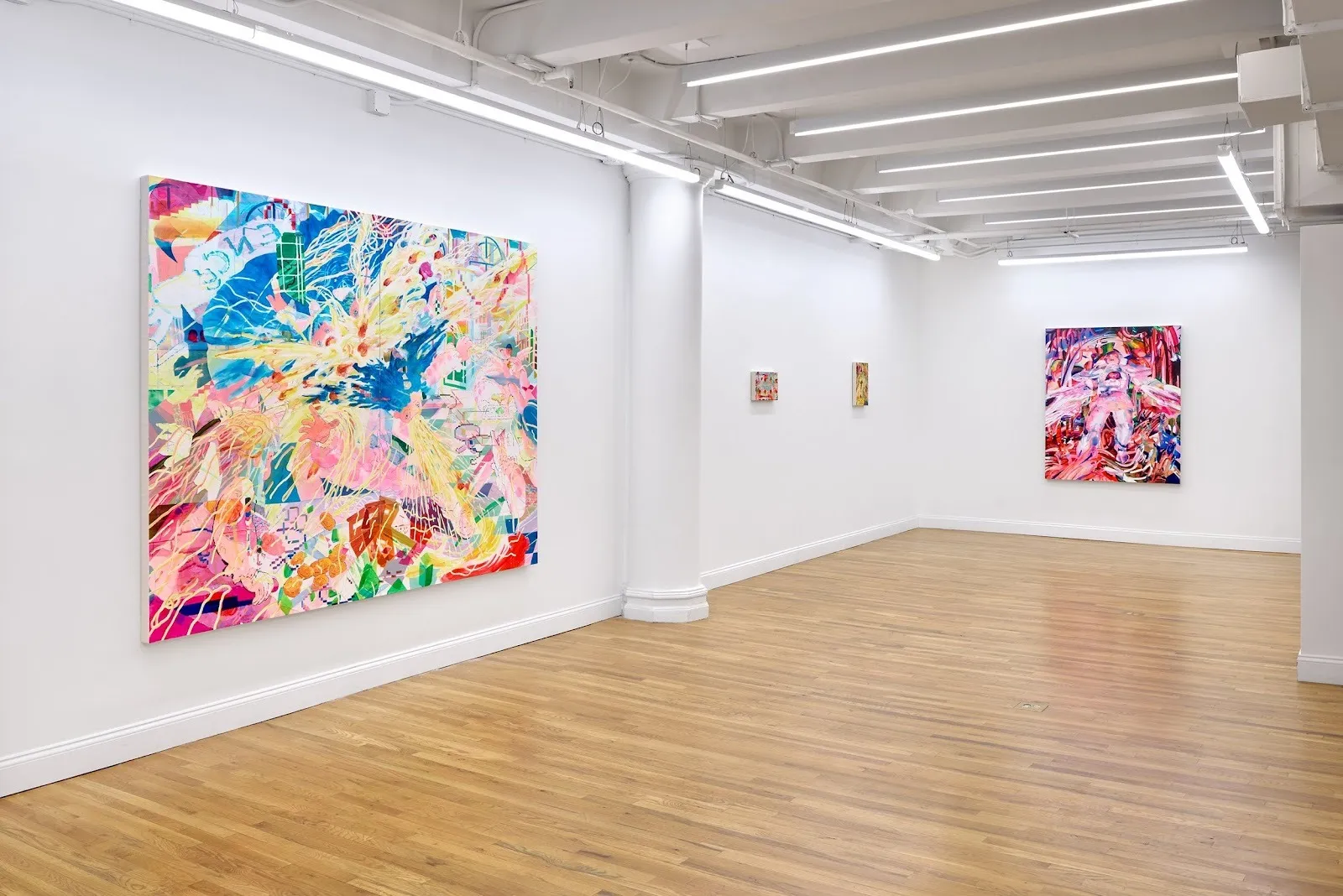
The moment you step into Cafeteria, Judy Chung’s first solo exhibition at RAINRAIN, you’re surrounded by disarmingly cute scenes of bright colors and anime-like characters. Chung doesn’t hold back: her illustrated aesthetic seduces you into a hyperreal world that feels oversaturated and overwhelming. At first it feels like an invitation, but the longer you look, it shifts into something more coercive.
The exhibition frames the school cafeteria as an enclosed social system where identity is developed, performed, and evaluated. But here, performance isn’t a choice—it’s a condition. Symbiosis (Cafeteria) (2025), the first painting that you see as you enter the space, immediately pulls you into that dynamic. There is no room to retreat, the compositions are crowded, and the figures look self-conscious under the pressure of being watched. The bright visual language holds our attention even as the space becomes suffocating.
Spaghetti Lariat (2025) takes this even further. The heroine is bound mid-air by spaghetti-like restraints, surrounded by two winged figures. The scene looks like it could've been directly taken from an RPG—the image of 2B from the game NieR: Automata flashes in my mind. But while the work nods to RPGs, games characterized by player choice, the heroine here is denied such agency. She’s trapped by the viewer watching her, in a role she didn’t choose.
Chung also references Manet’s The Dead Christ with Angels (1864), where Christ appears lifeless, held by angels. Yet here the restraints are created by our gaze. She is bound because we are watching her, and she performs heroism because she has no other choice; performance is inescapable.
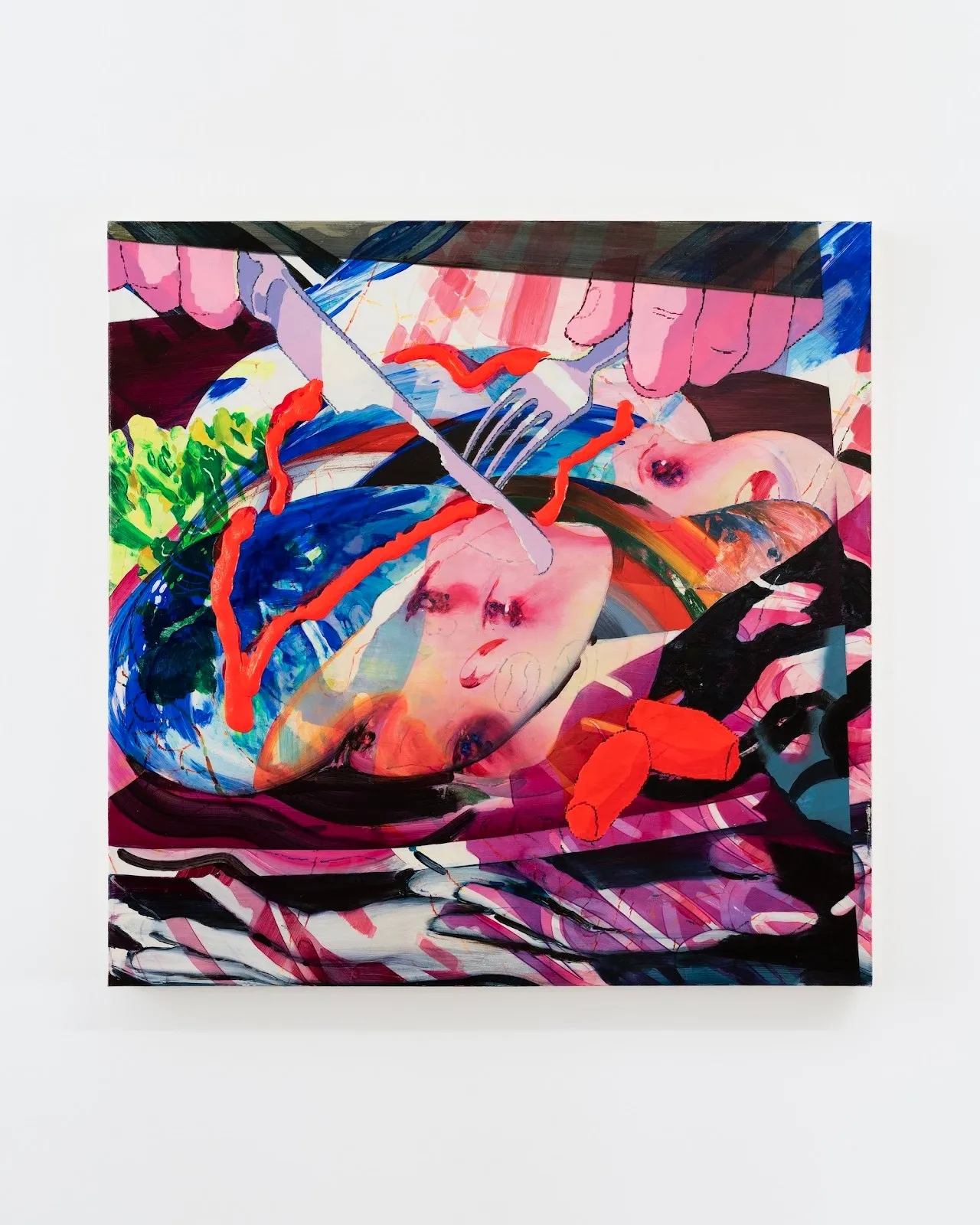
Our gaze evolves from looking to consuming in Communion (2025), where several heads are plated like delicacies—a reference to the biblical stories of Salome and Judith. The viewer already shapes how the characters exist in the show, but here intimacy becomes annihilation, consuming identity and erasing any possibility of self that exists outside judgment.
That pressure to perform is amplified by Chung’s experience of cultural displacement, moving between the US and South Korea while growing up. When you navigate two social (and governmental) systems, the pressure multiplies—you’re watching yourself through two different systems of judgment. Displacement intensifies scrutiny rather than allowing distance. Chung makes this literal with 3D-printed frames simulating phones for several of the smaller pieces. You watch others, others watch you, and phones watch everyone—a never-ending cycle.
Cafeteria offers no release from the pressures it creates, and what lingers instead is the sharp awareness of how early and often we learn to perform. Chung refuses to offer a resolution because the surveillance never really ends: we’re trapped in it, and we perpetuate it. The judgment your gaze enacts has never felt so unavoidable.
— Mer Mora
Ali Cherri: Last Watch Before Dawn
Almine Rech | 361 Broadway, New York
January 16 – February 28, 2026
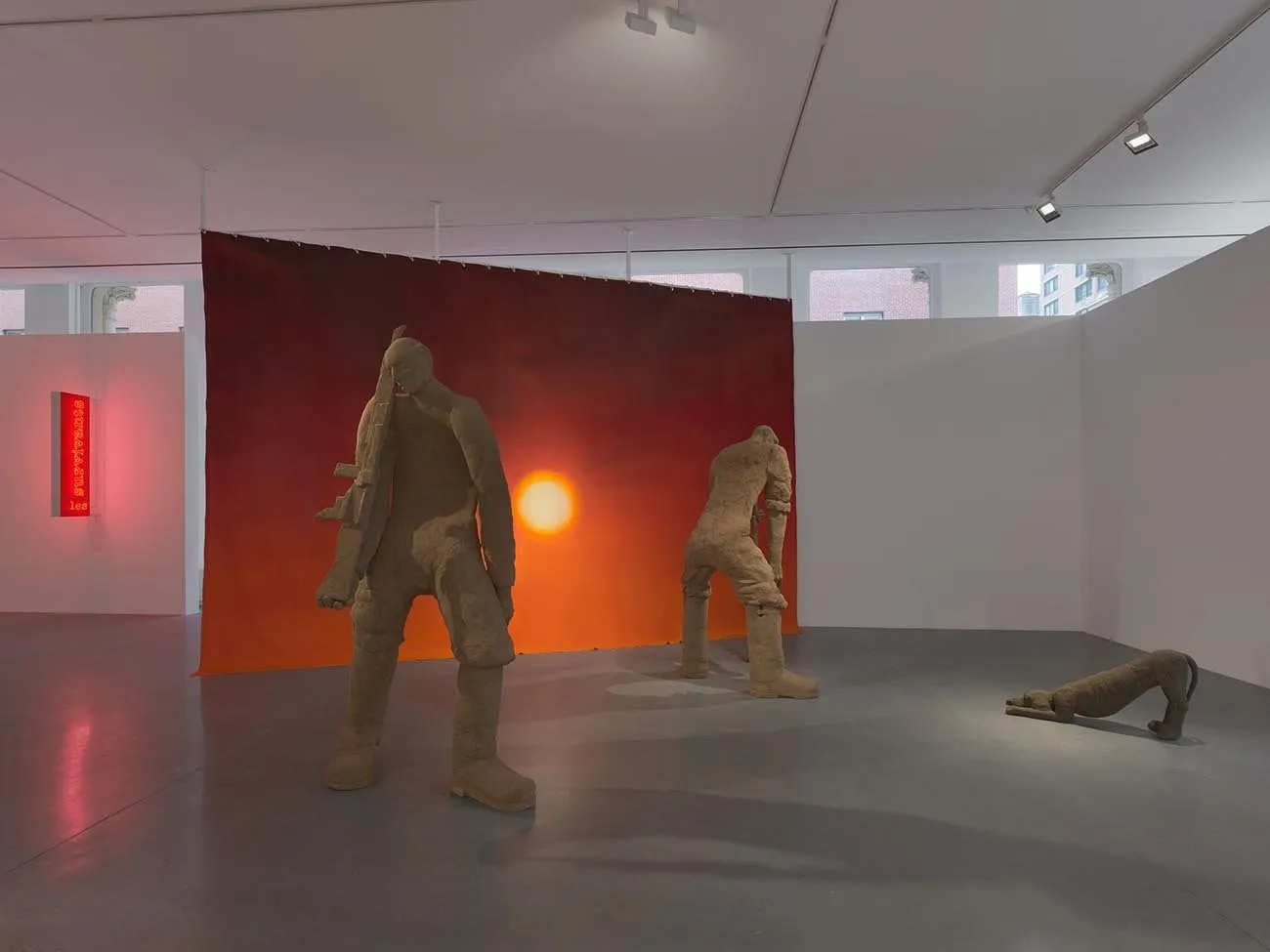
Lebanese artist Ali Cherri is fascinated by the figure of the soldier, falling and rising, dying and being reborn, as if the sun, waging battle not solely as an instrument of politics but within themselves. Last Watch Before Dawn at Almine Rech evokes the Arabic concept of jihad as an internal, or spiritual struggle towards moral clarity and the divine within oneself, but also its unfortunate and gross mischaracterization in ideologies of domination.
Cherri’s soldier figures are raw and elemental, constructed from the essences of life such as water and mud. The Nephilim fighters of Wake up Soldier, Open your Eyes (2026) emerge from the primordial earth, and his watercolor series To Save What Can Be Saved (2025) similarly depicts soldiers in relation to the ground and natural cycles. Their bodies mirror diurnal motion, as the mud soldiers’ torsos resemble hinges and the watercolor infantry lie down to rest. These figures are not at war with other nations, but in the process of reclining, falling, and going inward, descending into themselves. “My side” and “your side,” flags, regalia, and identifying markers are but happenstance for something far more vital.
The exhibition’s layout within Almine Rech’s space corresponds directly to Cherri’s vision of the sun in motion, particularly its sinking under the western horizon. This motion is prefigured by the viewer’s own descent into the gallery’s theatre downstairs, placed accordingly in the very back of the exhibition—stairs punctuated by scarlet lights encased in brazen and monstrous visages, Nocturnal Light I, II, and III (2025), signaling decline into the underworld. Completely dark save Cherri’s film The Sentinel (2026) (second to The Watchman [2024] in his soldier trilogy), the below-ground space and the images in circulation there become the dreams of the fixed soldiers in stance directly above the floorboard.
Be aware that one’s attendance is not solely for an art exhibition, but also for a film debut, in which you must pass the same film’s theatrical props before watching it. At 29 minutes long, The Sentinel is rich with symbolism and subtle commentary. In short, it follows a French soldier named Lafleur (translating to “the flower”) on the verge of taking his own life, and his descent into a Lynchian nightclub scene where he meets the singer Loula, only to resurface in his military barracks, renewed yet with an ambiguous conclusion.
Like the sculptures and drawings, it is generative to see the film’s structure as circuitous, or referencing the broader cycles of life. Staying in the gallery’s “underworld” for more than a single showing makes this palpable, as the film’s arc is bookended by moments of sleep and disappearance, leaving both the viewer and the principal character in a state of lucid, circular dreaming. As for the content, there are, of course, the given circumstances of a soldier’s lot, as one tasked with doing battle for the sake of political entities, and the consequent turmoil of such an existence. Yet Cherri points to more—even a horizon of queer futurity, as Lafleur’s rifle deep throating and his encounter with the trans singer Loula seem to indicate. Lafleur and his depressive trajectory are fundamentally altered by the meeting with Loula, suggesting a novel sunrise of expression and love, as opposed to internalized repression and unjust bloodshed.
— Jenan Marcela
Graciela Iturbide: Eyes to Fly With
C/O Berlin | Hardenbergstr. 22-24, Berlin
February 7 – June 10, 2026
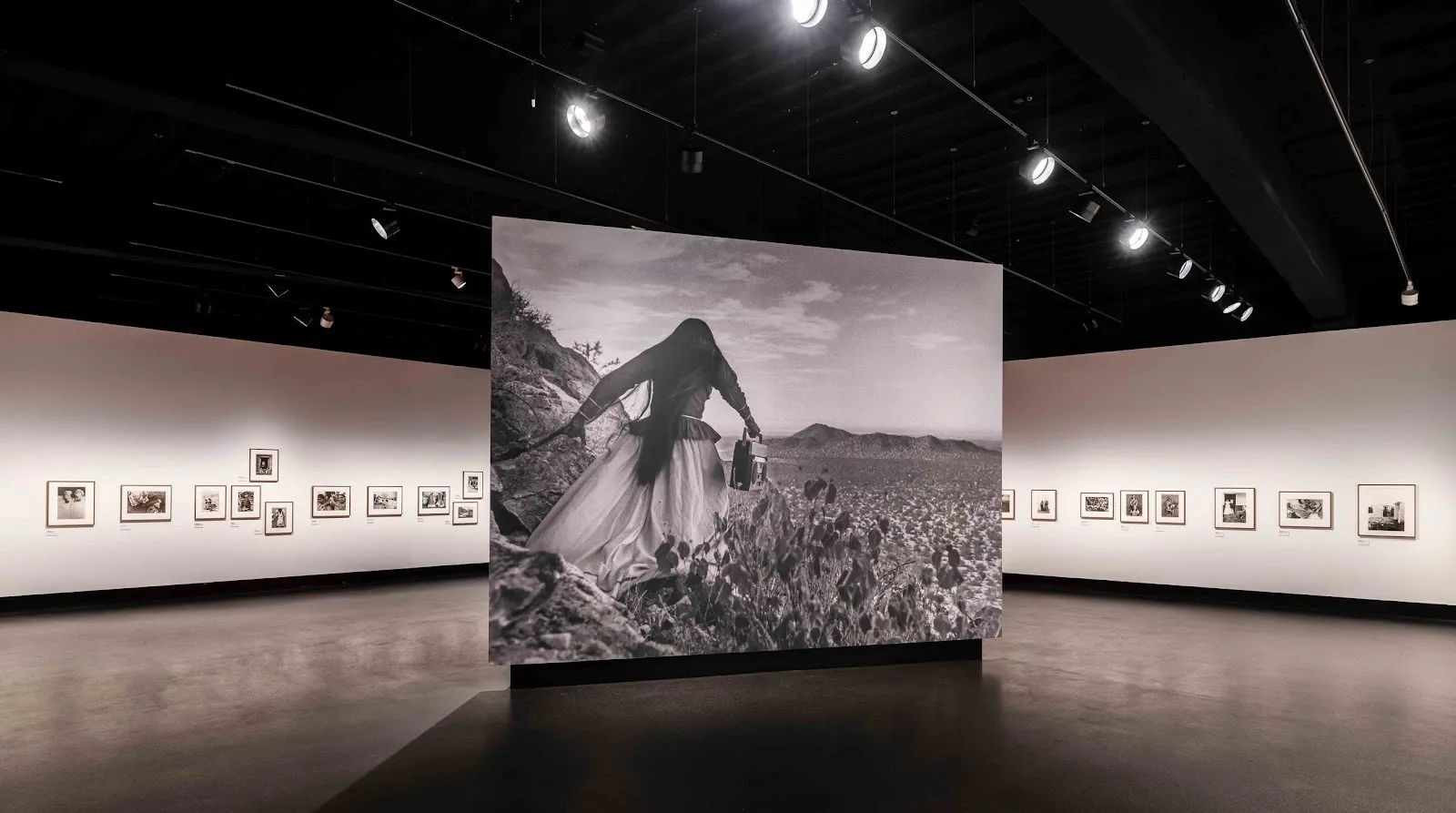
Art, like always, follows politics—or perhaps vice versa. In the 16 months since Claudia Sheinbaum became Mexico’s first woman president, two major retrospectives of Graciela Iturbide’s work have been mounted on both sides of the Atlantic: Serious Play at ICP in New York City, and Eyes to Fly With at C/O Berlin, marking her first major retrospective in both cities.
Iturbide is a giant of Mexican photography without qualification, but she is also undeniably the most influential woman photographer her country has ever produced. Her work is an essential counterweight to the wilder, decidedly masculine visions of contemporaries like Federico Gama and Francisco Mata Rosas. Without her, our photographic understanding of Mexico would be necessarily incomplete.
Iturbide harbors fewer journalistic ambitions than said contemporaries, quoted in wall texts as saying, “photography is not truth,” but the act of “[making] poetry out of reality.” The opening salvo is a self-portrait of her holding two birds—one alive, one dead—in front of her eyes, emblematic of her longtime obsession with birds in particular, animals in general, and an understanding of death and life rooted in Mexican folk tradition and iconography.
Included in the exhibition are compassionate depictions of indigenous people and marketplaces throughout Sonora and Oaxaca. There are photographic travelogues from Bangladesh, India, and the cholo gangland of ‘80s East LA. Images of ailing cacti being treated with IVs and wooden supports are supplemented by real Mexican fauna on loan from the Botanische Garten Berlin, which becomes an enriching context, given Iturbide’s avoidance of color.
Iturbide’s portraiture, arguably her greatest strength, is often beguilingly symbolic. Her subjects pose with alligators, bats, and fish. Animals appear as symbols, mediators, friends, and conduits; their deaths merit mournful consideration. Indeed, some of the exhibition’s most wrenching images are sourced from her series En el Nombre del Padre (1992), a bloody record of a goat-slaughtering festival held annually in La Mixteca.
Human tragedy provides a more elaborate emotional tapestry. A contact sheet depicting a baby’s funeral—an angelito in a tiny coffin, peaceful enough to mistake for a doll—includes the mourners’ encounter with a vulture-pecked corpse on the road to the cemetery. In the next image, she’s turned her lens to birds against a bright sky.
Although willing to depict unadorned death, Iturbide cannot seem to bring herself to linger on it. Eyes to Fly With is thus a fitting title, in that Iturbide looks without ogling. The witness she bears imbues her subjects with dignity, and then, just like the birds she photographs so consistently, she departs.
— Elle Carroll
The Endless Garment: Atlantic Basin
Pioneer Works | 159 Pioneer St, Brooklyn
January 24 – April 12, 2026
On a freezing Sunday evening in New York City, I attended Boarding Pass, a fashion performance by FeyFey Worldwide, a brand founded by China-born, New York- and London-based designer Feyfey Yufei Liu. Conceived around the condition of having “no fixed identity,” the performance stages fashion as both material and metaphor for diasporic identity—one shaped by movement, precarity, and continual redefinition. The venue is transformed into the interior of an airplane: seating is covered with airplane seat facades, aisles mimic narrow cabin walkways, and performers move through the space as if in perpetual motion. The refrain “always in transit,” uttered by the cast, functions less as narrative than as a shared condition.
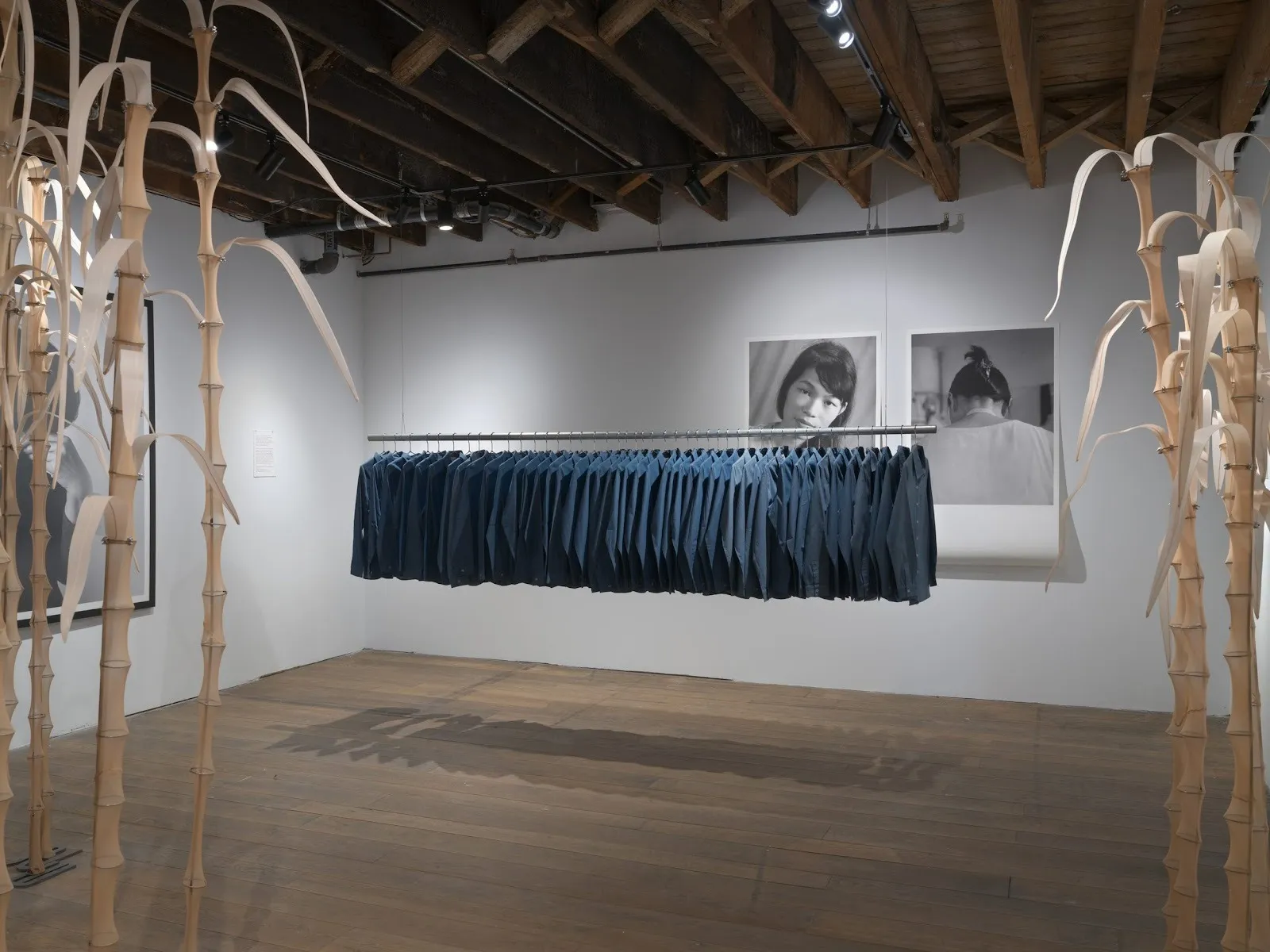
Works by Feyfey appear alongside those of other Asian diasporic designers, including United Bamboo, CFGNY, the late Benjamin Cho, and Amy Yao for JF & Son, in The Endless Garment: Atlantic Basin, curated by Jeppe Ugelvig at Pioneer Works. The site’s industrial history as a former hub for shipping and warehousing lends the exhibition a pointed material context, situating contemporary fashion practices within longer histories of labor and trade.
Spanning from the second floor to the third floor, the exhibition highlights questions of textile labor and its erasures. Particularly striking are Huang Po-Chih’s black-and-white photographs: three portraits in a gentle grey tone, rooted in the lived experience of the artist’s mother, a former textile worker in Taiwan. They convey intimacy and restraint, holding together tenderness and grief in the wake of the 1990s industrial shift from Taiwan to Shenzhen. In She said, “The back of my head instead of my face.” (2015), Huang presents a scaled-up medium close-up shot of a woman’s back, with a measuring tape draped around her neck—a quiet yet incisive behind-the-scenes portrayal of routinized labor in the textile industry. It is through these small, personal moments that the oftentimes invisible labor behind mass-produced garments becomes apparent.
The exhibition echoes with an ongoing shift in the global textile industry. Since the 2010s, rising labor costs and global trade tensions have led to a shift in textile production from mainland China to Southeast Asia. Within this macroeconomic narrative, Huang’s modest pencil notes on paper help surface individuals’ stories that are easily subsumed by economic abstraction. In Shenzhen, Shenzhen! (2021), the narrator jokingly proposes opening a factory inside a museum, a humorous gesture that offers hope in times of economic despair and unemployment while refusing pure cynicism.
Beyond gallery spaces, Shanzhai Lyric’s installation Incomplete Poem (2015–) extends into Pioneer Works’ hallways, where bootleg T-shirts are hung on lines, resembling their circulation in everyday urban space. The misspelled, nonsensical slogans on the T-shirts are composed into poetic “lyrics” by the collective, who transform linguistic error into a critical tool. Rather than correcting these phrases, the work lingers in their excess and ambiguity, proposing counterfeit fashion as a global archive of authorship, translation, labor, and desire. “Indulge your fantasies this season with sexy sithouettes and luxurionus lace,” they read. “Fandiou Fandiou . . . ”
— Amy Yuanchen Qian
SHIMA, part I
Aupuni Space | 729 Auahi Street, Honolulu
January 23 – February 21, 2026
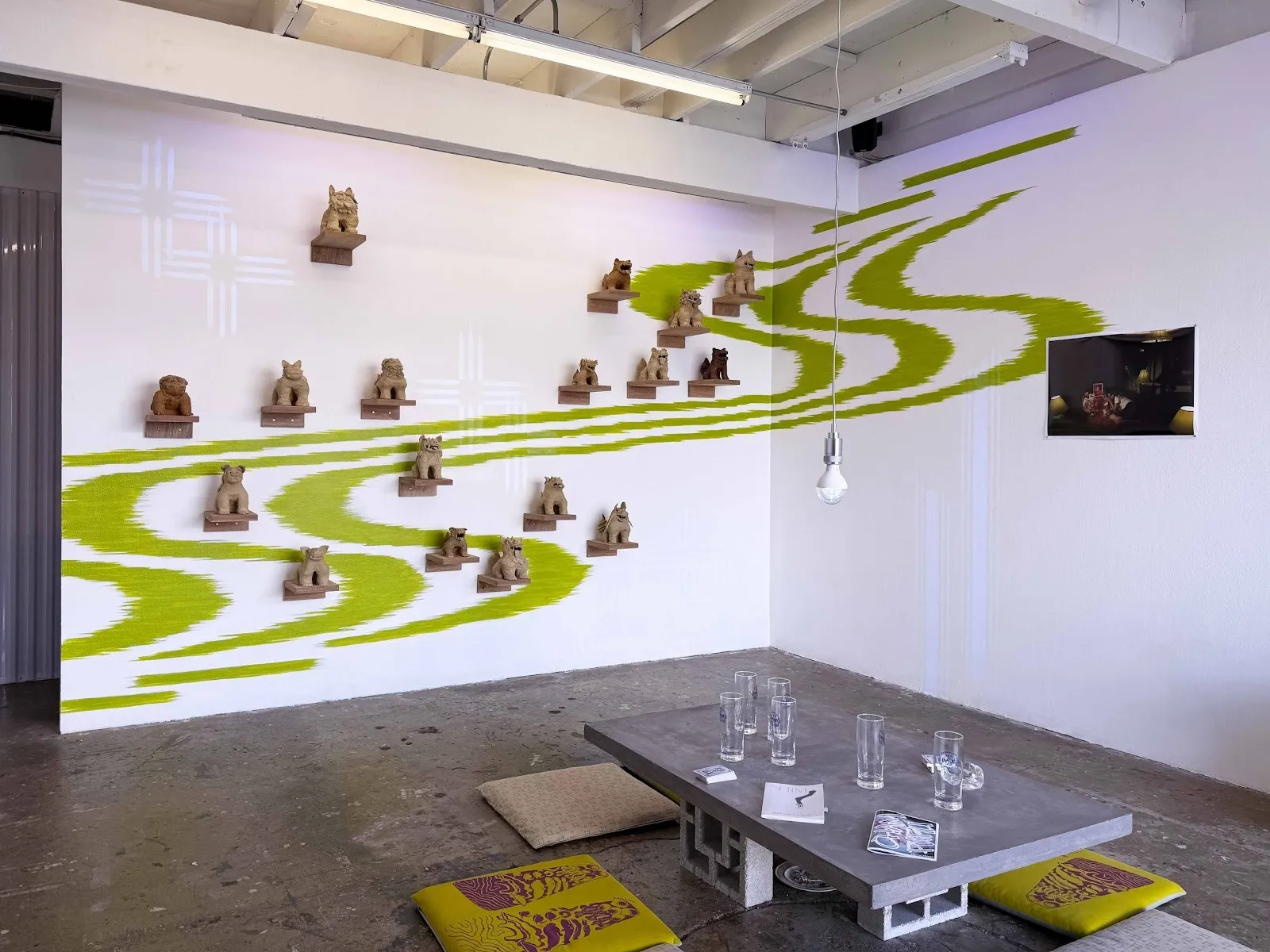
The first thing you encounter at Aupuni Space isn’t an object, but a frequency. Journey Home (2026) is a 5-channel surround soundscape by Shalev & Bambi: a tide of everyday field recordings of nature and friends talking story, sanshin melodies, and the domestic sounds of goya champuru sizzling in a pan. Woven through this atmosphere are the voices of native Uchināguchi speakers mined from archives, alongside interviews with a fellow artist and the exhibition’s curator on the fluid nature of Okinawan identity. At its center is the voice of shō yamagushiku reading from his collection shima, in which he writes of “poking the root ancestor”—a visceral refusal to let the Okinawan past remain a static, romanticized myth. This sentiment serves as the heartbeat of SHIMA, part 1, an exhibition curated by Josh Tengan that explores Okinawan identity as a “psychic condition” shifting between the archipelago and the diaspora.
yamagushiku’s poem “Henoko’s Concrete Dream” anchors the space’s political weight. Written while a storm approached Henoko, a site synonymous with the struggle against U.S. militarization, the poem’s very form mirrors the concrete blocks used to enclose the land. He holds a mirror up to the literary world, suggesting that a poet who merely “encloses words” is performing a sanitized version of history, mirroring political enclosure. He forces a confrontation with the physical cost of progress—the literal disappearance of a village’s forest. By tracing his own grandfather’s path from the Yambaru Rainforest to the coal mines of Mexico and then to the fields of California, he complicates the victim narrative by suggesting that Okinawan labor was often swept up as a gear in the very colonial and capitalist machinery that displaced them in the first place.
In the garage-style gallery, the weight of this connection becomes tangible through Erin Nagamine’s mural, Uchinā-Hawai‘i, Departures and Returns (2026), which travels the length of the room. The work features patterns of pig troughs and bamboo-green dye – a direct reference to the “Pigs from the Sea” history, where Hawai‘i’s Okinawan community raised funds to send 550 Chester White pigs to their starving homeland post-WWII. Here, heritage isn’t just inherited; it is sustained through radical acts of survival.
If yamagushiku’s poetry is the exhibition’s breath, the works of Dane Nakama and Emma Jane Chiyoko Oshiro are its bones—vessels for mabui, the Okinawan concept of spirit or essence in a person or object. Nakama, a UCLA MFA candidate, populates the back wall with a small army of shisa, mythical guardian lion-dogs, born from community workshops offered through the nearby Fishcake’s Fishschool, and reclaiming the “A-un” philosophy: the open-mouthed male to ward off evil and the close-mouthed female to retain good energy. Another piece, ヘビ (2024), was created for the Year of the Dragon, using sand and snakeskin to reference the erabu umi hebi (black-banded sea krait). A delicacy often smoked and simmered in irabu-jiru (sea snake soup), the snake echoes the spiral forms of the poetry, linking the body to rituals of preservation.
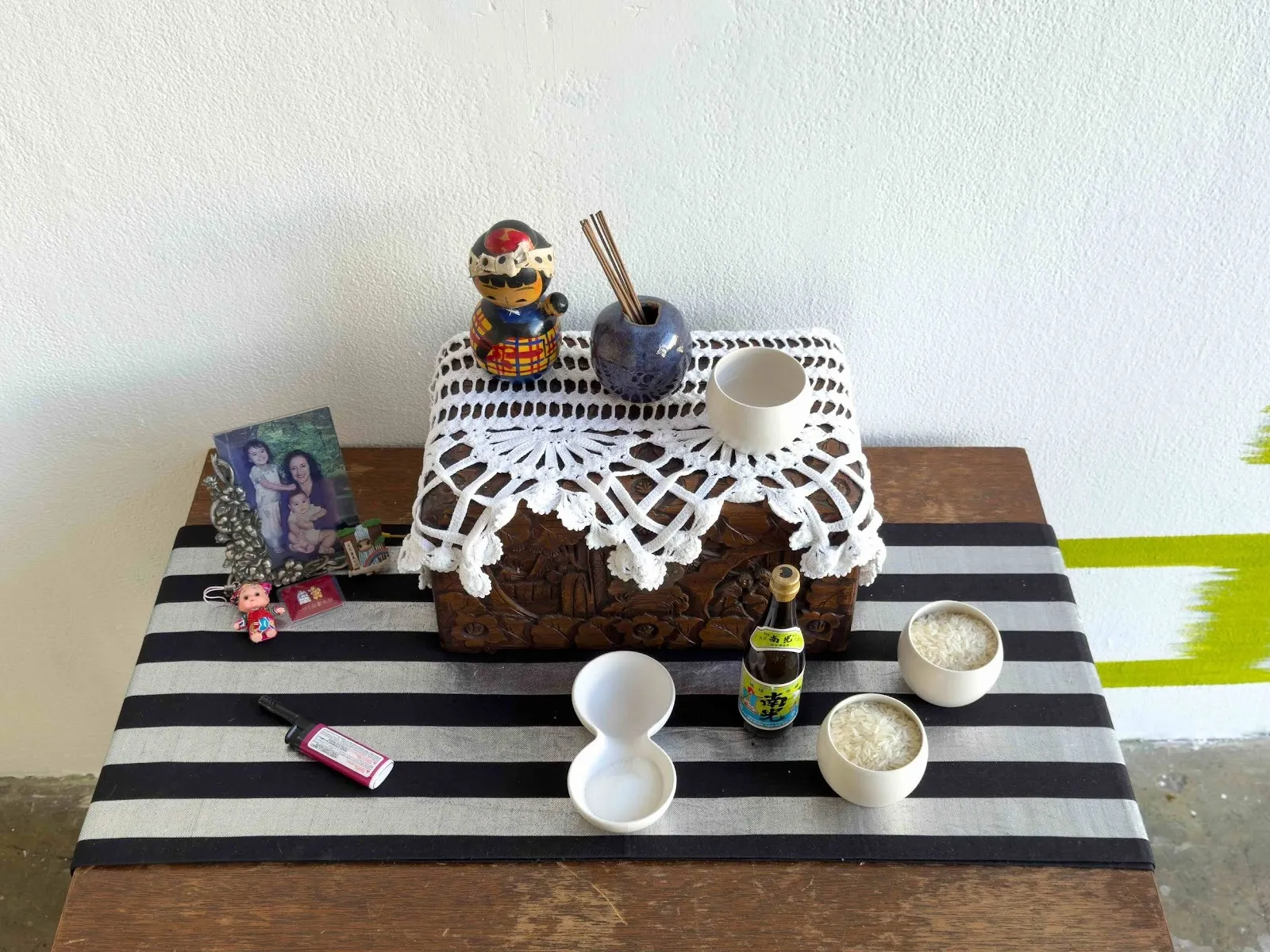
Oshiro’s intimate installation materialized from a handwritten book of instructions left by her late grandmother on how to construct a tangible family shrine. Dedicated to her grandmother, Tricksy, the work acts as a conduit for her relative’s mabui, bridging the gap between Okinawan tradition and the contemporary Hawai‘i home.
SHIMA, part 1 finds its physical anchor in its central gathering area, featuring a low concrete table balanced on cinderblocks, a design reflecting the resilient, typhoon-proof architecture of post-war Okinawa. By day, the space is a quiet tea house; by night, Orion lanterns and blacklight paint transform it into a neon-lit izakaya. As the soundscape loops back to the voices of aunties playing music, it becomes clear that the intergenerational trauma is being met with an equally powerful joy. For those raised in the celebrated “melting pot” of Hawai‘i, SHIMA provides a grounding weight. SHIMA proves that Okinawan identity in Hawai‘i is vibrant, evolving, and deeply rooted in the soil of the here and now.
— Maya Mathur