In Brackish Conditions: A Refusal of Refinement
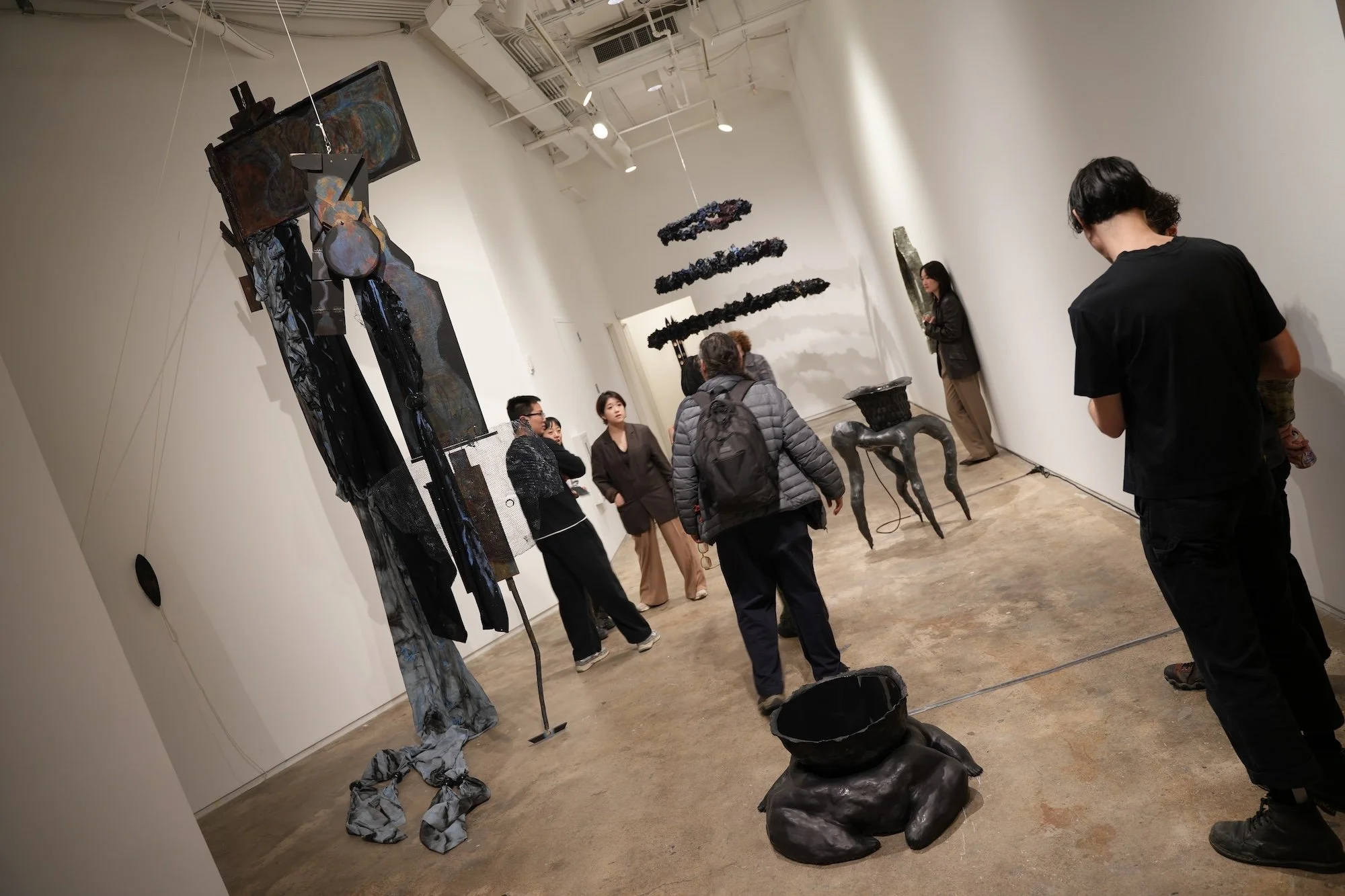
Brackish Water. Installation view of Coco Ma’s work, 205 Hudson Gallery, February 13–25, 2026. Courtesy of 205 Hudson Gallery.
A thesis exhibition is often framed as a culmination, but it is more accurately a public negotiation with process. It stages what has been lived with, revised, doubted, and ultimately chosen, exposing the scaffolding of creative form as much as the final product. Brackish Water, the first of Hunter College’s 2026 MFA thesis exhibitions at 205 Hudson Gallery, resists the rhetoric of arrival and instead situates itself within a state of suspension. The title names this condition of mixture, of forces pressing and receding without dissolving difference, and the works hold us within it.
Featuring Selena Cisneros, Clare Hu, Masie Love, Coco Ma, Dylan Musler, Vanessa Wallace-Gonzales, and Farangiz Yusupova, the exhibition favors adjacency over stylistic unity. Materials remain visibly worked. Surfaces are layered, pierced, and woven; evidence of revision is left intact. Transformation emerges less as a metaphor than as a critical procedure, enacted through repetition, pressure, and sustained material engagement.
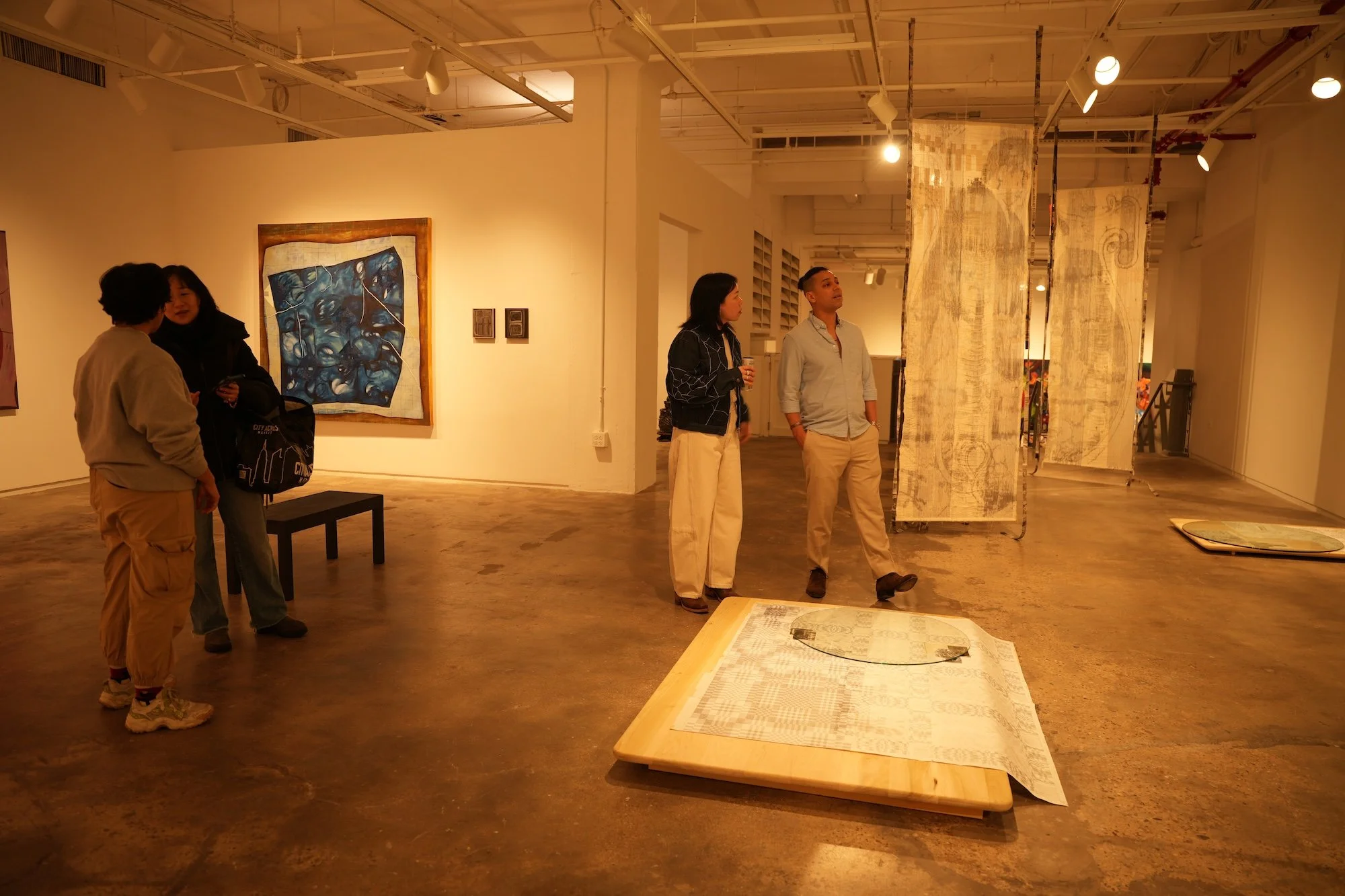
Brackish Water. Installation view of Masie Love and Clare Hu’s work, 205 Hudson Gallery, February 13–25, 2026. Courtesy of 205 Hudson Gallery.
Masie Love’s Bounding for Giles County (2026) literalizes this tension. Saturated colorfields of purple and red are interrupted by protruding threads that puncture the canvas, binding Black quilting traditions into a tensile articulation of lineage and authorship. In Selena Cisneros’s La Morada (2026), a family restaurant interior is anchored beneath the declarative “No Deportaciones / No Deportations,” transforming a site of warmth into a charged assertion. The painting is bound to a threshold where warmth, belonging, and displacement press against one another, coexisting without the necessary promise of restitution. In between, Clare Hu’s floor-to-ceiling 5010 var. 5 (2026) expands weaving into a form of cartographic inquiry, assembling fragments of mapping that trace what has been lost, displaced, or rendered illegible. The work punctuates the space, its suspended bands of fabric cutting through sightlines and subtly redirecting the viewer’s movement.
At ground level, Dylan Musler’s paintings and sculptural works refuse to sanitize experience, allowing discomfort, decay, and beauty to occupy a shared formal terrain. At several points, deep blues recall the exhibition’s brackish premise, where sediment and tide converge without settling. In Ruminator (2026), Musler stages a hybrid creature with mismatched feet carrying a lone figure across what appears to be a shallow, shifting river. The sculpture reads as a precarious crossing, a passage through unstable terrain where survival depends on uneasy interdependence. Nearby, Farangiz Yusupova’s large-scale canvases suspend migration and memory in compositional flux, their layered forms pressing against one another as if shaped by competing currents rather than fixed borders.
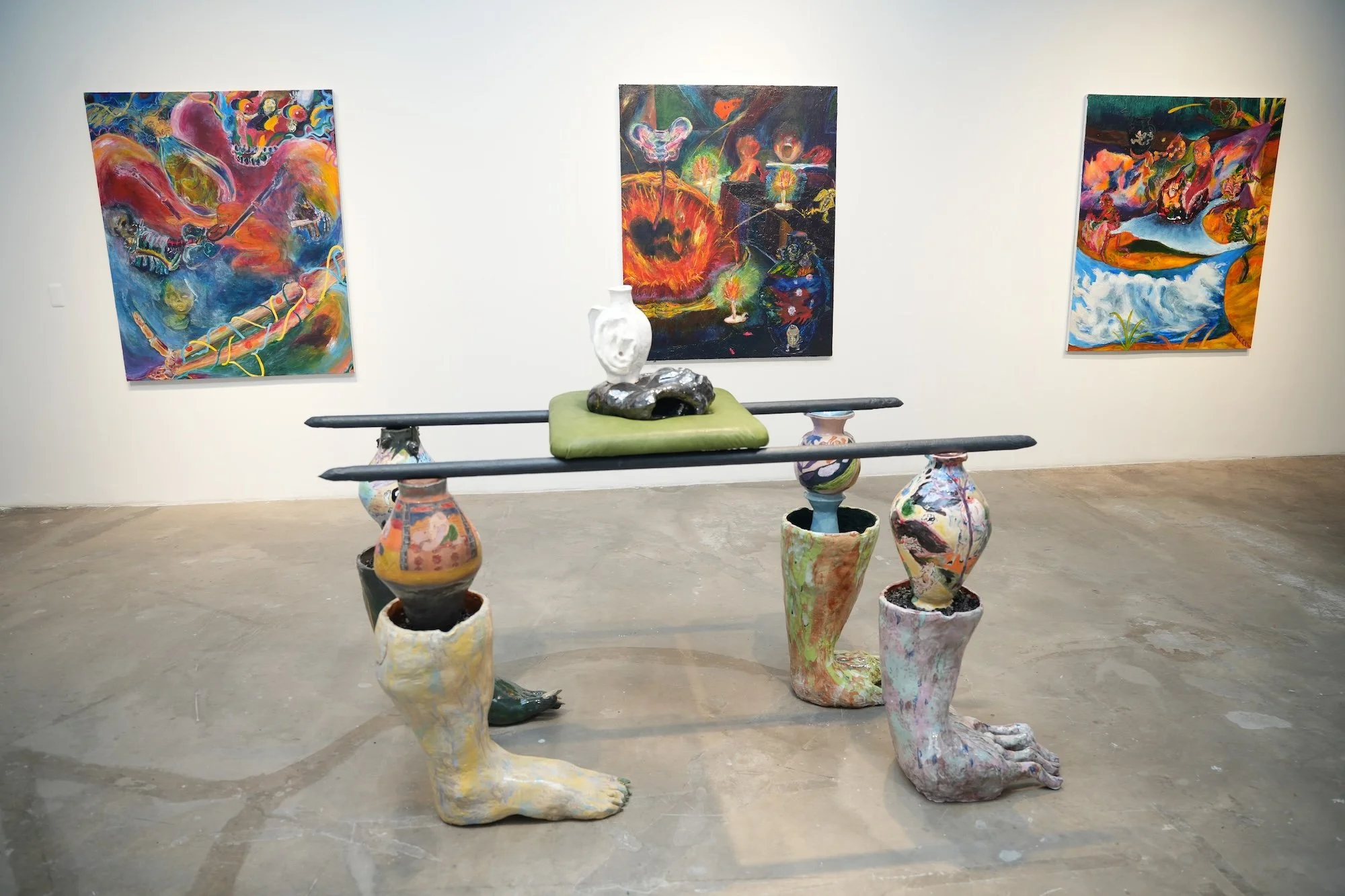
Brackish Water. Installation view of Dylan Musler’s work, 205 Hudson Gallery, February 13–25, 2026. Courtesy of 205 Hudson Gallery.
In a more secluded space, Vanessa Wallace-Gonzales’s installation, Where Does the Past Live? (2026), extends the exhibition into a sensorial register, incorporating sound, scent, and organic form to create a space that oscillates between unrest and reprieve. Coco Ma similarly mobilizes water and sound, constructing a labyrinthine installation in which black ink-infused water carries sonic patterns drawn from intergenerational histories. For both, the gallery operates as an intimate chamber and infrastructural system. Sound settles, sediment gathers, all while water archives.
What feels most resonant is the exhibition’s understated refusal of productivity as a primary metric of creative value. Difficulty, delay, and revision are treated as integral rather than incidental. And there is something deeply generous in this admission, one that positions viewers not as spectators of achievement but as participants in unfinishedness, and the gallery’s pointed lack of didactic text sharpens its quiet critique. The operative question shifts from “What does this art mean?” to “How long are you willing to remain with it?”
The exhibition reads less as a conclusion than as a rehearsal, opening onto future dialogue. If white cube galleries are often understood as refinement, Brackish Water proposes a more exacting model that preserves room for permeability. A level of sustained contact emerges that remains productively unresolved, affirming becoming as an ongoing practice and setting a measured, persuasive tone for the exhibitions that follow.
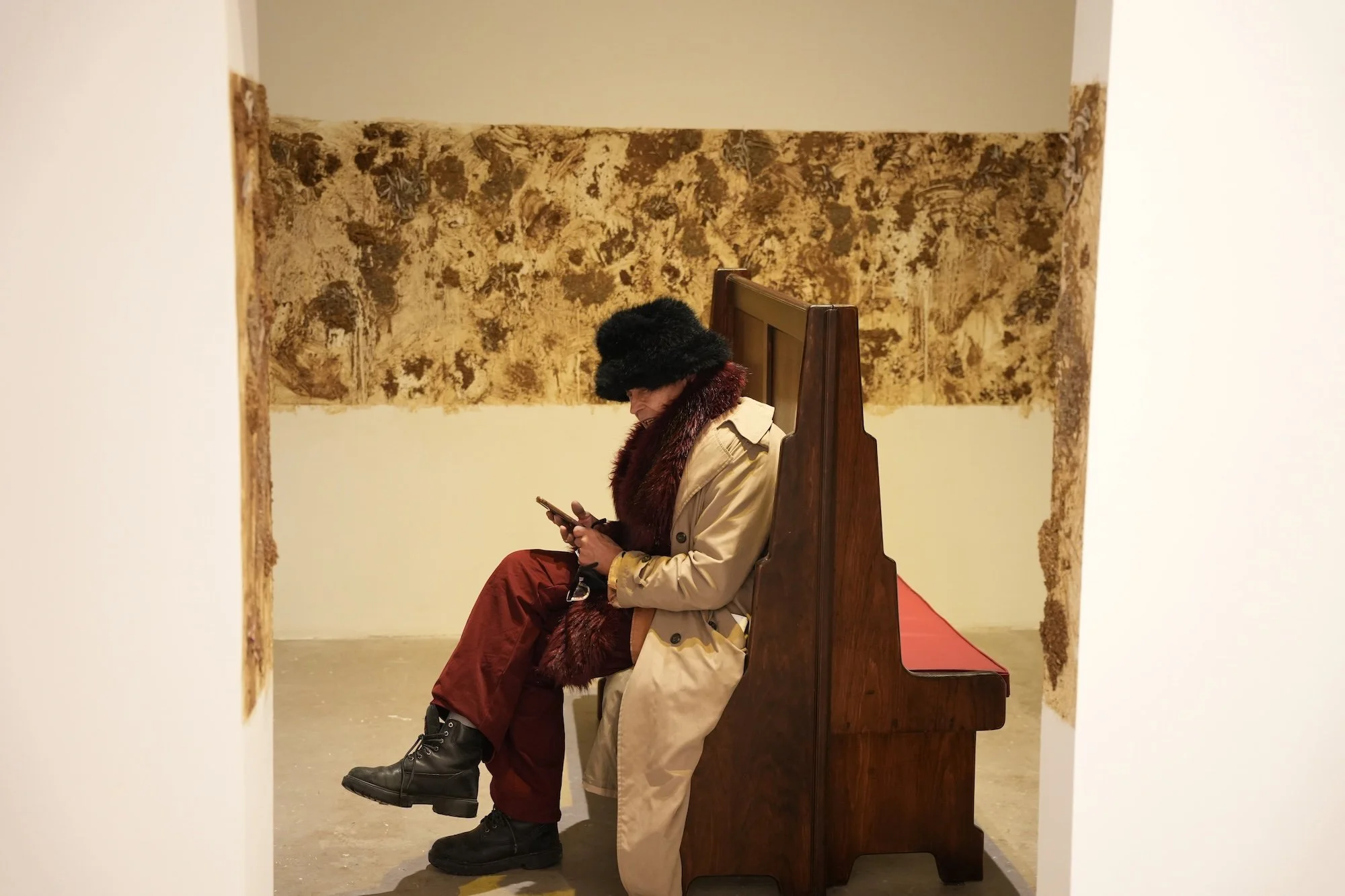
Vanessa Wallace-Gonzales, Where Does the Past Live? (2026), installation. Wood pews, leather cushions, white sage powder, yarrow flowers, liquid starch, and foraged white sage leaves. Courtesy of 205 Hudson Gallery.
Brackish Water is on view at 205 Hudson Gallery from February 13 to 25, 2026.