
.webp)

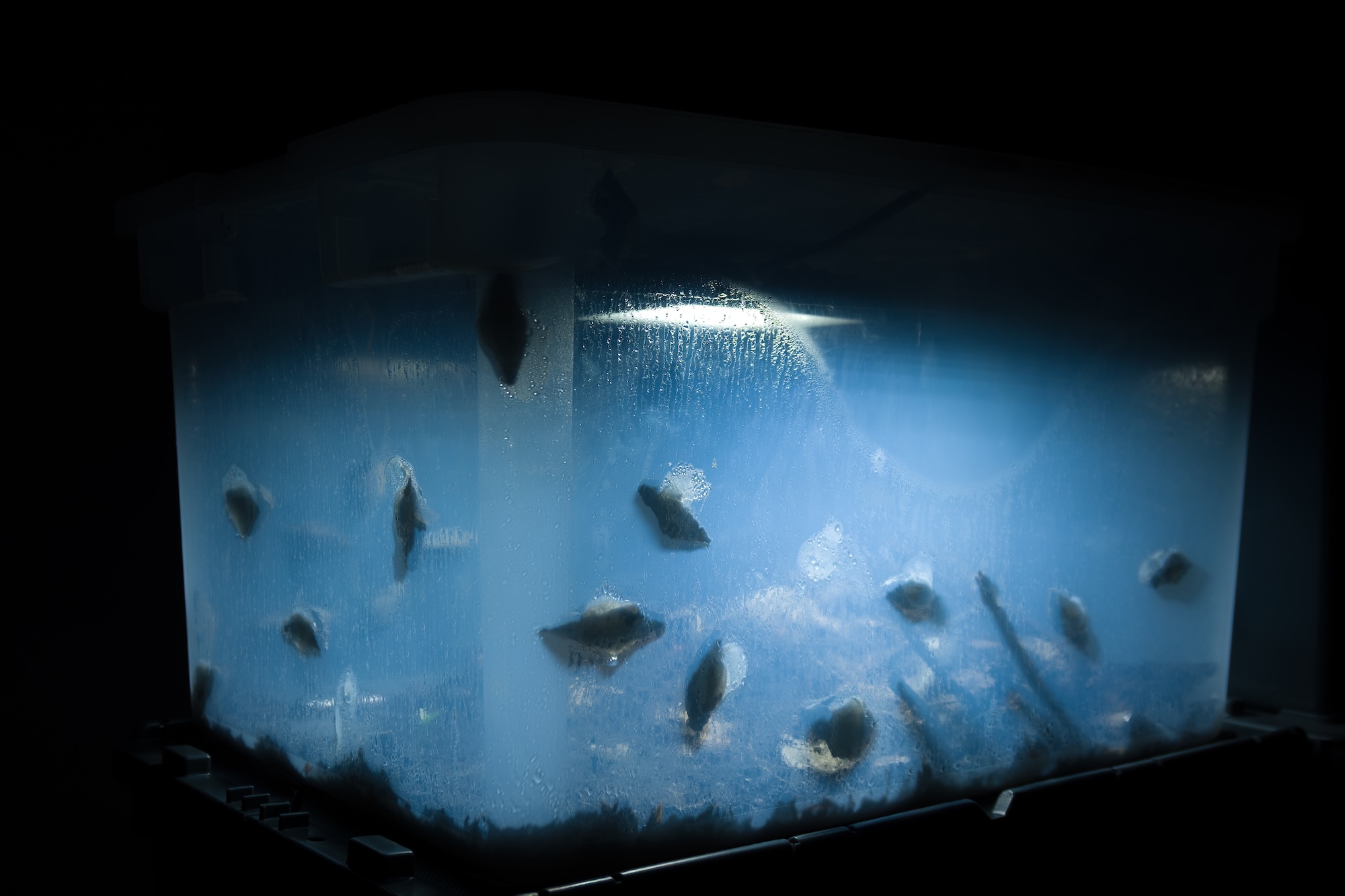
Santiago Gómez: “Cabalgando Entrañas / Riding Entrails” at Plaga
Review
Louise Bourgeois: Gathering Wool
Hauser & Wirth | 543 W 22 St, New York
November 6, 2025 – April 18, 2026
Just as language constitutes the psychoanalytic texture of verbal communication, materials constitute the psychoanalytic texture of visual art. This is especially true of sculpture, which, like writing or architecture, is a process of transformation through the assembly and refinement of parts. Sculpture represents a negotiated contrast between the loose theoretical substrate of the subconscious and the fixed characteristics of existing objects. It is perhaps the most dramatic translation between discrete substances.
Hauser and Wirth’s press text for Gathering Wool describes an exhibition populated by works that “probe the boundary and the slippage between container and contained.” Most of the writing on the wall is Louise Bourgeois’s own, allowing the artist to posthumously frame her own art. Words function as containers for meaning.
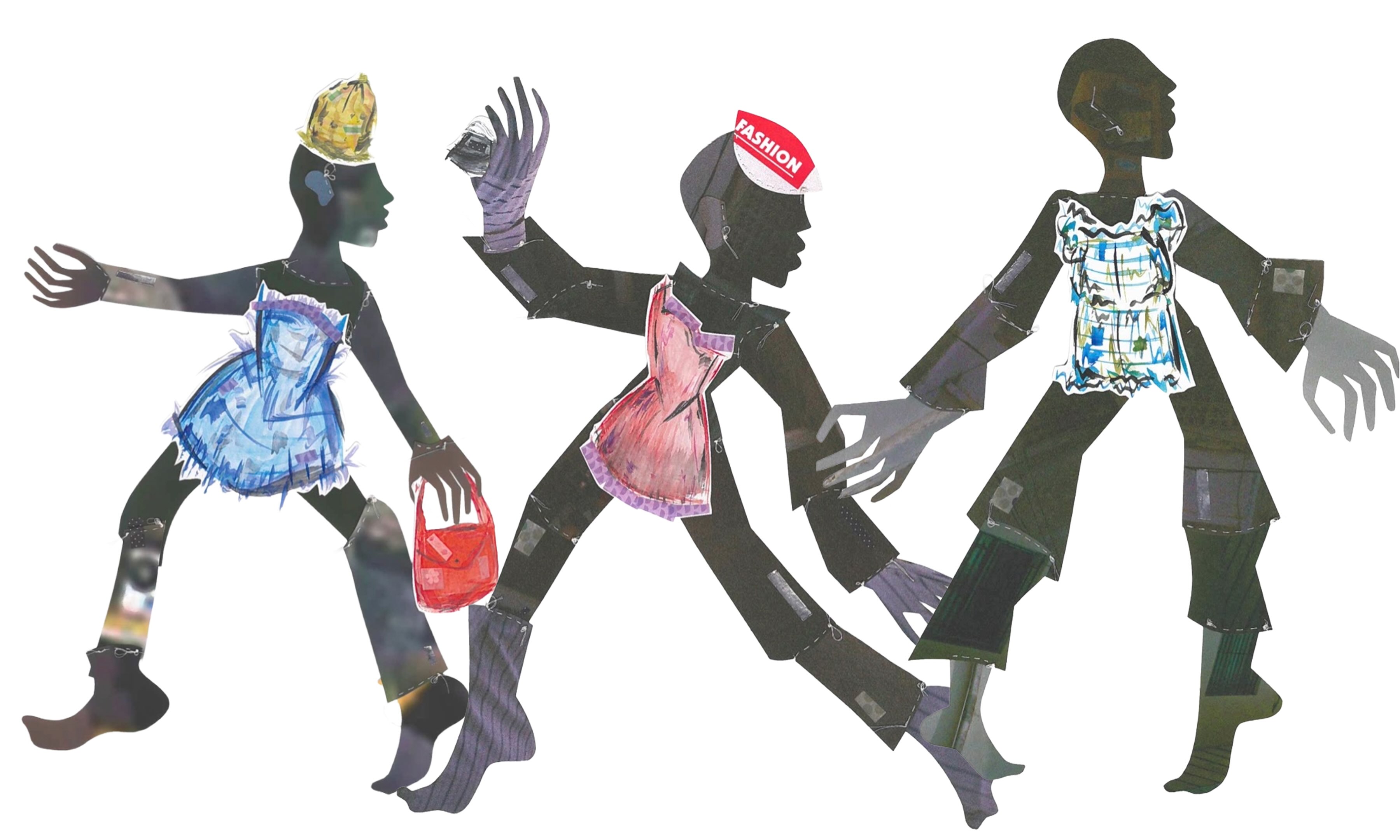
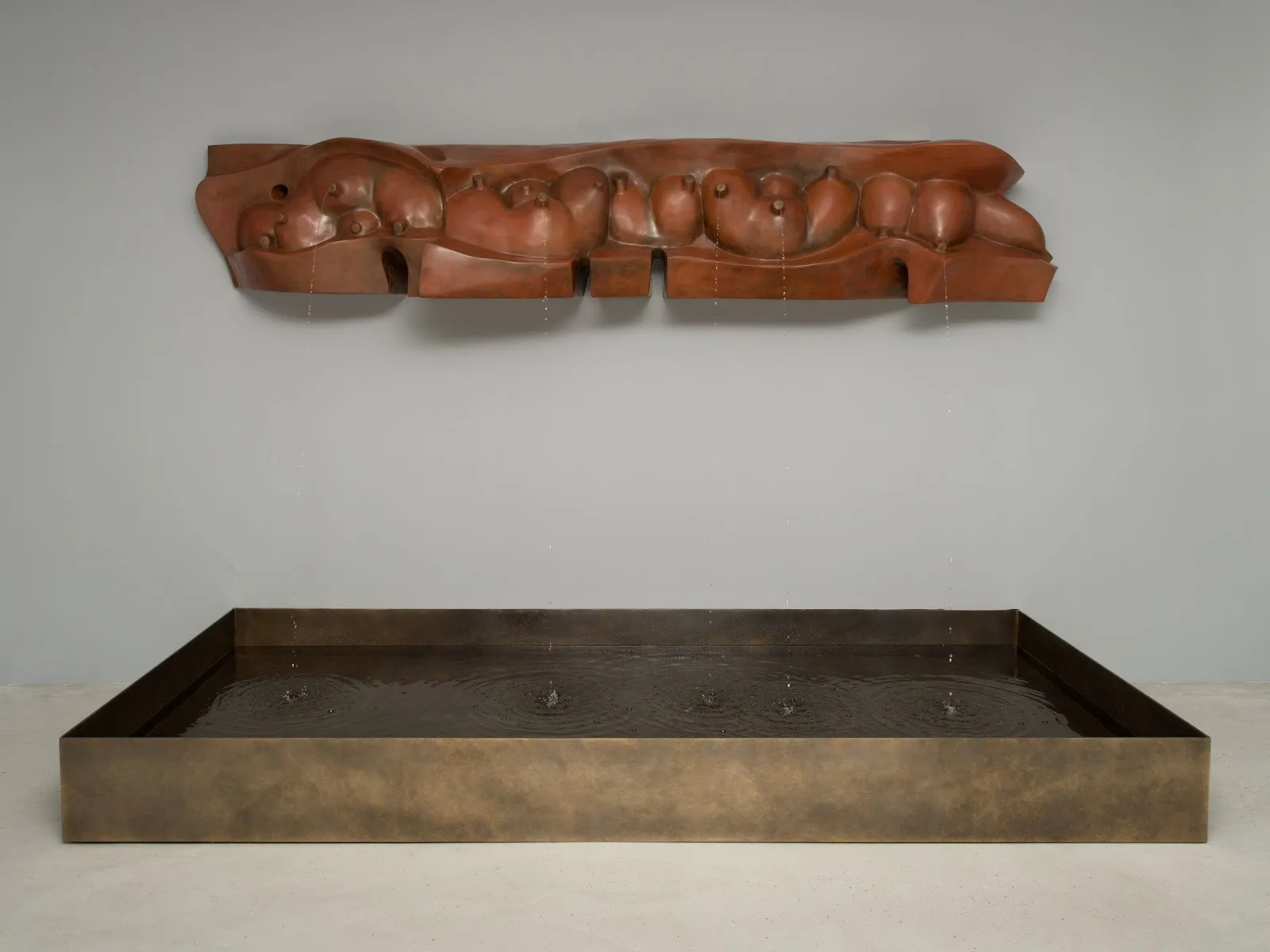
Of course, Bourgeois is primarily a poet of materials. Twosome (1991), a massive steel cylinder suggestive of a submarine entering and exiting its own shell along a truncated track, is an effective container for itself as much as it is a container for bright red light. The periodic whir of its motor joins—in the next room—the steady trickle of water traveling from one container of Mamelles (1991, cast 2005) to another, producing the backing track for a center-stage projection of Suzan Cooper singing “She Abandoned Me” in Bourgeois’s filmed performance A Banquet/A Fashion Show of Body Parts (1978). We are reminded that the gallery is not just a storefront for objects, but a container for optical and emotional experience.
The exhibition layout challenges false dichotomies between the logical and phenomenological; the latter linguistically contains the former, after all. Large, evocative, sensual forms ground the first floor in a primordial soup from which spindly mathematical abstractions emerge on the fifth (“gathering wool” is a necessary precursor to weaving, which is itself a precursor to computer programming). One floor stacks upon another in a conceptual progression that mirrors Bourgeois’s obsessive repetition—orbs rendered in marble and wood, rows of spherical glassware, columnar shelves and towers of textiles and metal, gridded drawings on paper that express both warp and weft, longitude and latitude. Tracks become ladders; the horizontal becomes vertical; subterranean impulse becomes material construction. There is fluid movement between the two—you can go back and forth and up and down all day.
Through her examinations of motherhood and womanhood—for a while, the mother operates as a literal container for the child—Bourgeois establishes the self as a kind of container for others: a responsive shell housing protrusions of the collective unconscious, a (horizontal) track or (vertical) ladder to facts and feelings beyond the strictly defined “individual.” Ray of Hope (2006), a series of red lines emanating from central egglike impressions, confronts you with twenty-four ambiguous cosmic orifices. Are they personal or universal? Is this navel-gazing? In utero, we are not quite the mother and not yet ourselves. You feel this truth in your body as you travel from the pulsing womb of the first floor to the light, quiet eyrie of the fifth. One is not so much unlike another.
— Matilda Lin Berke
The Body is the Body
Rice Hotel | 30 N Miami Ave, Miami
December 3, 2025 – January 4, 2026
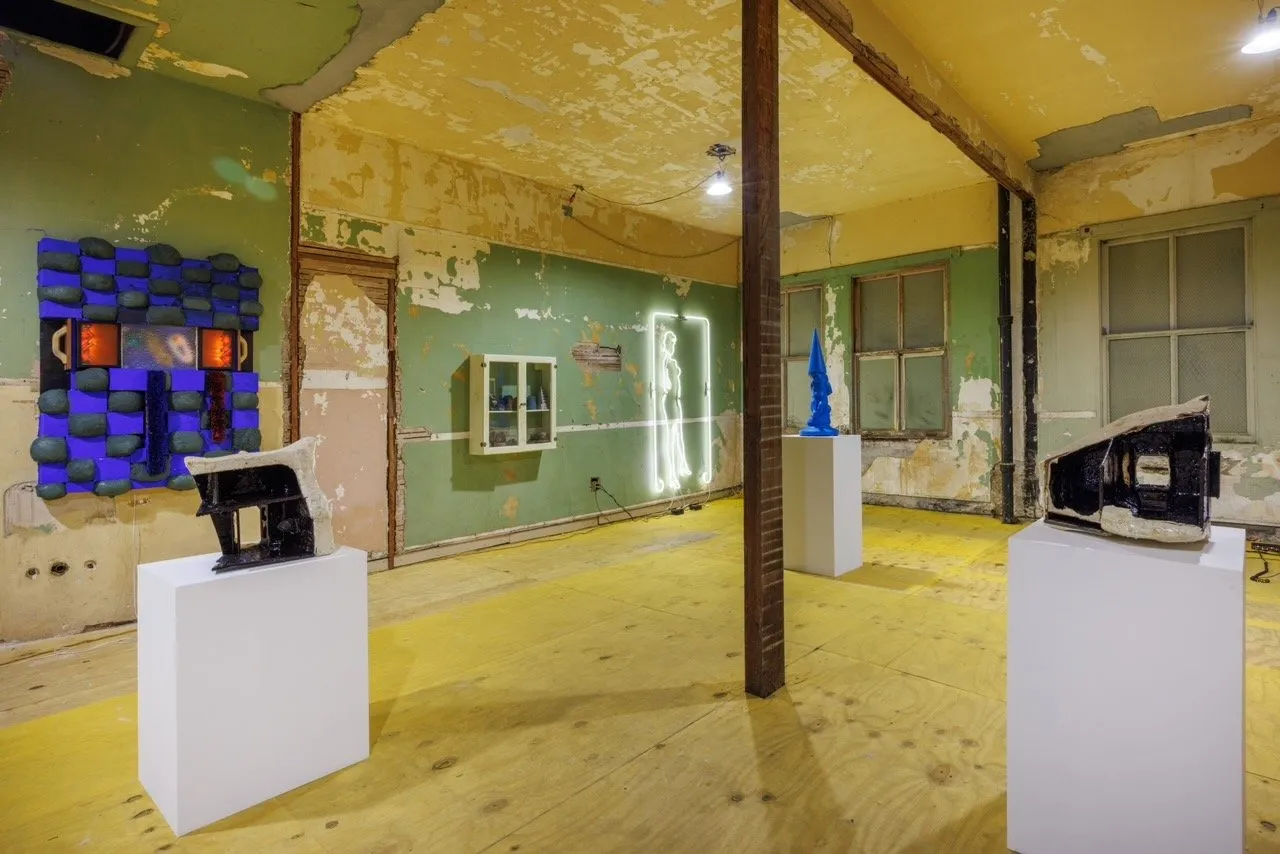
It’s hard to stand out—especially when you are competing with Art Basel Miami, Untitled Miami, blue-chip galleries like Gagosian, and new media spectacle (or trickery, depending on who you ask) such as Beeple’s Regular Animals (2025)—unless you offer something no one else does. Unless you manage to intervene and reconfigure the oversaturated territory called “art” during an event that claims to define its very frontier. It’s hard to stand out, unless you truly are offering something exceptional. And that thing could be found at the Rice Hotel’s exhibition, The Body Is The Body.
Setting forth a tautology as their opening curatorial gesture, Simon Brewer and Nathalie Martin lay bare the stakes of art. Unlike major art fairs, where the focus drifts to who wears what, who brings whom, or who buys what and for how much, The Body Is The Body offers no decorative backdrop. The Rice Hotel’s walls are stripped to their studs and pipes. It is this removal of superfluous decor that allows Brewer and Martin to properly engage the exhibition’s central inquiry: What is the Body?
Most reviews of this exhibition will likely fixate on canonical figures like Paul McCarthy, Lita Albuquerque, or Jordan Wolfson. Yet, within the dilapidated interiors of the Rice Hotel, I encountered two emerging artists who engaged the Body through its extremes. On one end of the spectrum, Ethan Shaw takes the path of via negativa—of absence—while Mila Rowyszyn hyper-realizes the body, transubstantiating it into artificiality.
Ethan Shaw’s If the door has a human dimension it is because people walk through it (2025) is a rustic, wall-mounted wooden cabinet with glass doors. Distressed paint in a creamy hue reveals the wood’s wear, chips, and grain. Inside rests an assortment of handmade ceramic objects and tools that appear worn from use. These objects wither in their inaction, dead without the physique that animates them. Here, Shaw posits the Body as the “tool of tools”—the substance immanent in, and necessary to, all other human-made objects.
Mila Rowyszyn takes the opposite path. In Olivia at the Rice Hotel (2025), Rowyszyn reconstructs the Rice Hotel in 3D, injecting a personal palette of faded pinks and yellows. Under her hand, the hotel ceases to be a spatial backdrop and transforms into a meretricious labyrinth; glossy walls, neon lights, and claustrophobic corridors trap the protagonist, Olivia. Scantily clad and occasionally nude, Olivia serves as the foil to this artificial architecture. Though she is an avatar herself—sculpted in code and modeled after the artist's best friend—she represents embodied artificiality. Through her, Rowyszyn posits that the hyper-realized body occupies a position in reality just as irreducible as its organic counterpart. The Body Is The Body is an essential addition to the Miami Art Week. If you can, don’t miss it.
— Yonatan Eshban-Laderman
PINCH
3AM Theatre | 9-20 35th Ave #3N, Astoria
December 12 – 13, 2025
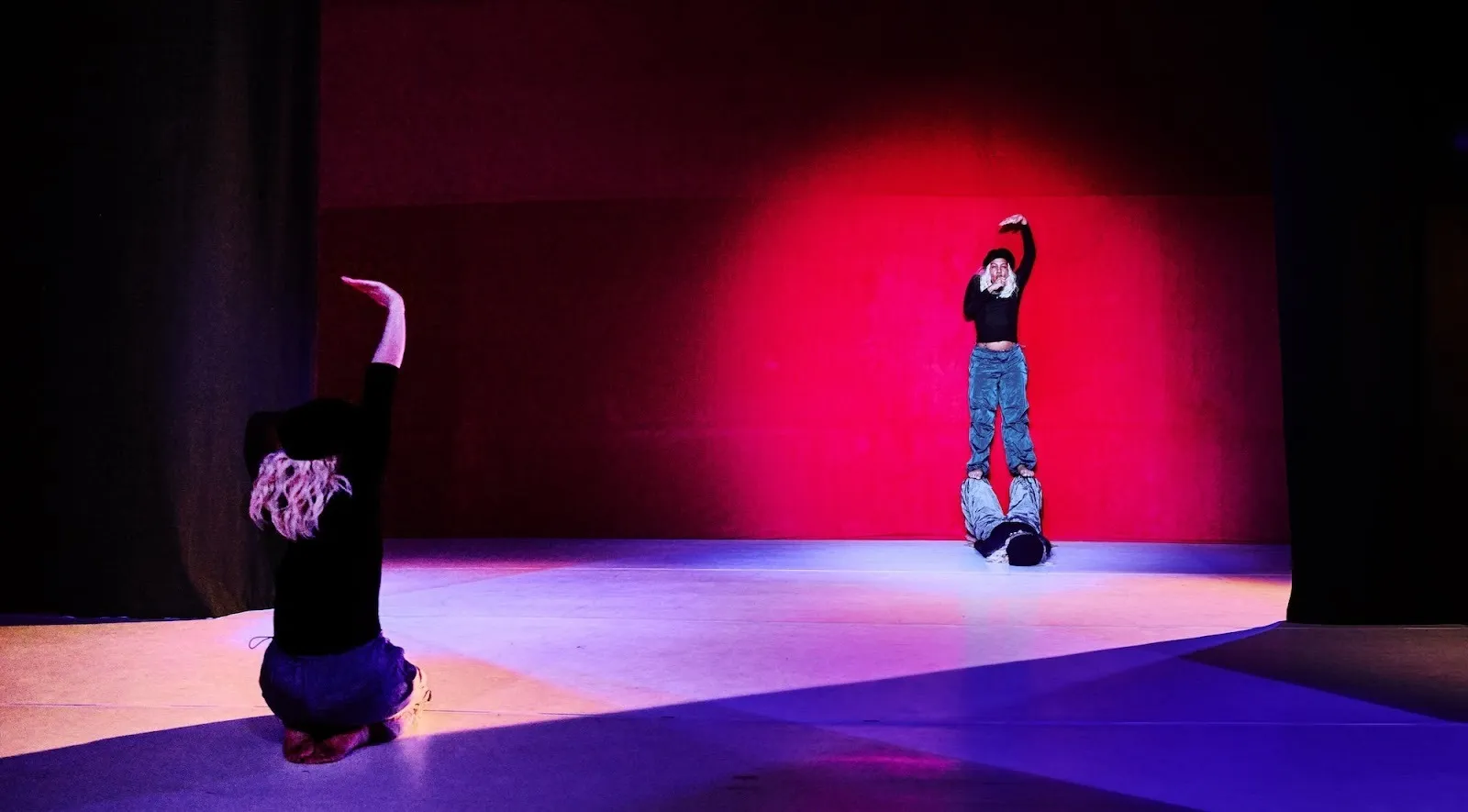
Neva Guido (left), Sophia Halimah Parker (right top), and Sacha Vega (right bottom) in a safety demonstration sequence PINCH. Photograph by Max Branigan
The New York premiere of PINCH, Sacha Vega’s newest trio, takes the audience on a wild ride through the absurd rituals of preparedness. The work is unapologetically eclectic and rapid-fire, as Vega cycles through dance, video, sketch comedy, puppet show, and poetry reading to deliver an electrifying study of the psychic and social cost of the co-entangled mechanisms of security and control. Building on a previous iteration of the work presented at the Cannonball festival in Philadelphia last year, Vega devised this version in conversation with performers Neva Guido and Sophia Halimah Parker.
With a composition that ups the ante with every new act, PINCH feels like spiraling out, embodying the accelerated rhythm when one’s sense of groundedness slips away. The point of departure for this spiral is an archetypal office where time, movement, and thoughts are subject to strict organization and policing. What begins as a quirky watercooler chitcha soon devolves into a tangled web of tensions—internal, interpersonal, and social—that shatter the facade of shared values, voluntary involvement, and the promise of stability upheld by capitalist work dogma. Through frenzied, labor-derived movements, Vega pokes fun at the performativity of labor, but soon she digs deeper into paradoxical dynamics of security and risk at play in workplaces. The choreography draws from various contexts of collective learning—pre-flight safety demonstration, PE classes, traffic direction, and even swimming lessons—to underscore communication and bodily training as the primary components through which security is constructed, maintained, and negotiated. In continuous cycles of seemingly meaningless training, the body and mind are molded, broken in, as Henri Lefebvre argued in his Rhythmanalysis.
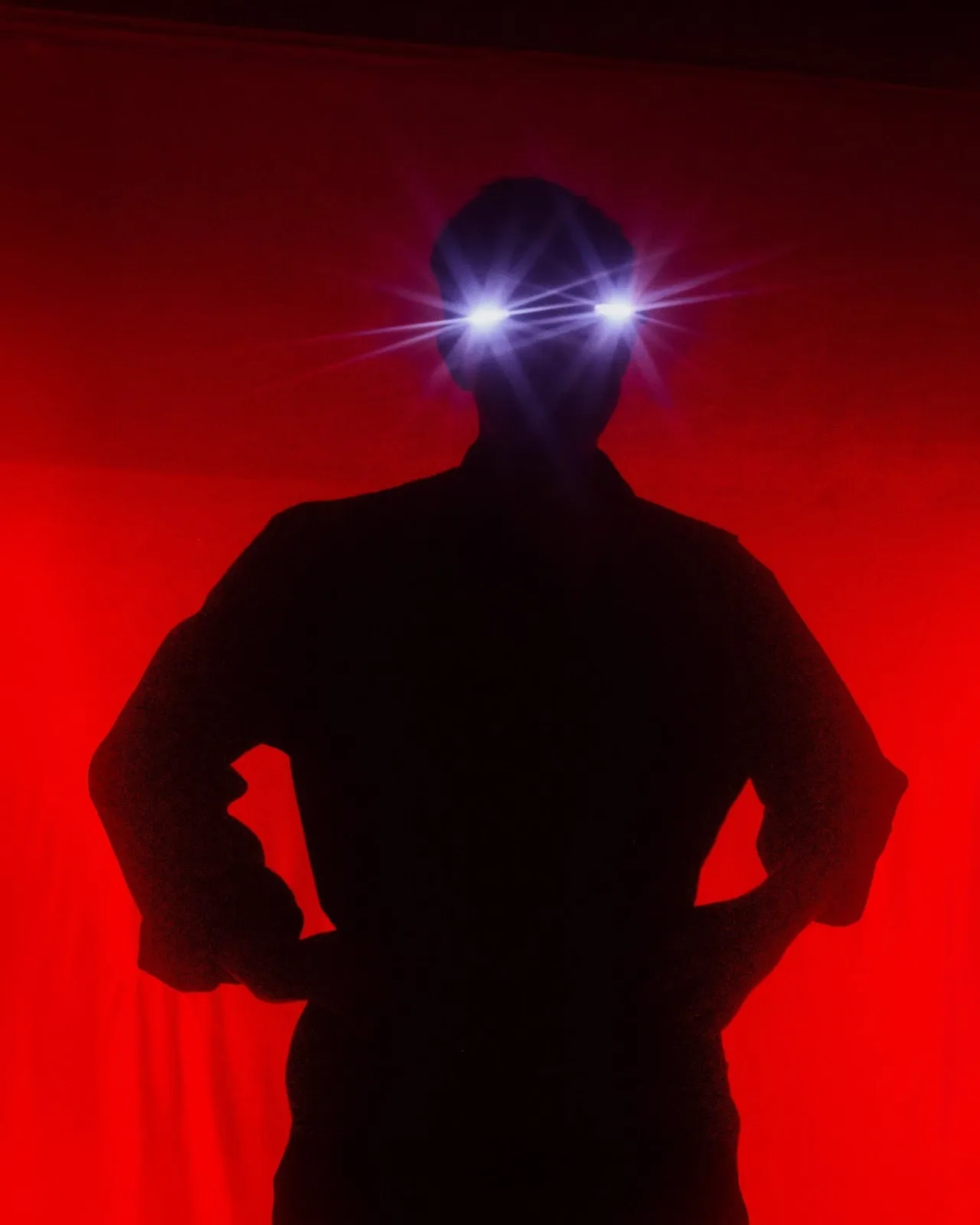
The strength of Vega’s work owes much to the depth of her inquiry into what produces safety under capitalism. As much as her choreographic take on preparedness drills is both hilarious and uncanny, the piece offers a meditation on the violence generated by organized efforts to tighten security, which manufactures threat in the name of eradicating it. Within the trio, the fallouts and makingups between the performers dramatize the unresolvable risk of being rendered a threat by the economy of fear. In PINCH, anyone can be a snitch and visibility is paramount. The gas-lighting tactics of preparedness are mercilessly (and hysterically) smashed to smithereens in a series of video vignettes. But in the absence of that proxy of safety, what’s left is a gaping hole, filled with yearning for unity and stability in the wake of the divisive insularity and the extreme in-group/out-group logic of security and workplace parlance.
The performers’ deranged face expressions make it seem like each of them is constantly held at gunpoint. Along the way, PINCH reveals this invisible weapon to be the very power their characters serve, from a cruel company owner in the puppet skit, to a mirage of success painfully crushed in another segment dedicated to a dancer. The outsourcing of the actual care and safety to twinges of empathy, ever scarcer in an atomized social field, is summed up with a comical puppeteer crowdwork solo of the choreographer herself.
When Vega shifts her focus to the psychic damage resulting from that erosion of confidence, the work’s rhythm mellows out, turning nearly elegiac. The performers huddle, sway, pull, and push in a poetic sequence thematizing support, dependence, and bonds. The final duo reached an intensity of a catastrophe: I simply could not take my eyes off the spellbinding mixture of make-believe violence and trust that unfolded on stage.
PINCH is devised and performed by Neva Guido, Sophia Halimah Parker, and Sacha Vega with appearances by Tina Bararian. Choreography and writing by Sacha Vega. Original audio composition by James Gentile and Zack Kelley-Onett. Live sound by James Gentile. Lighting design by Kyle Driggs. Produced by Cole Stapleton. Additional production support by Logan Kerr.
— Dominika Tylcz
Liz Collins: Motherlode
RISD Museum | 20 N Main Street, Providence
July 19, 2025 – January 11, 2026
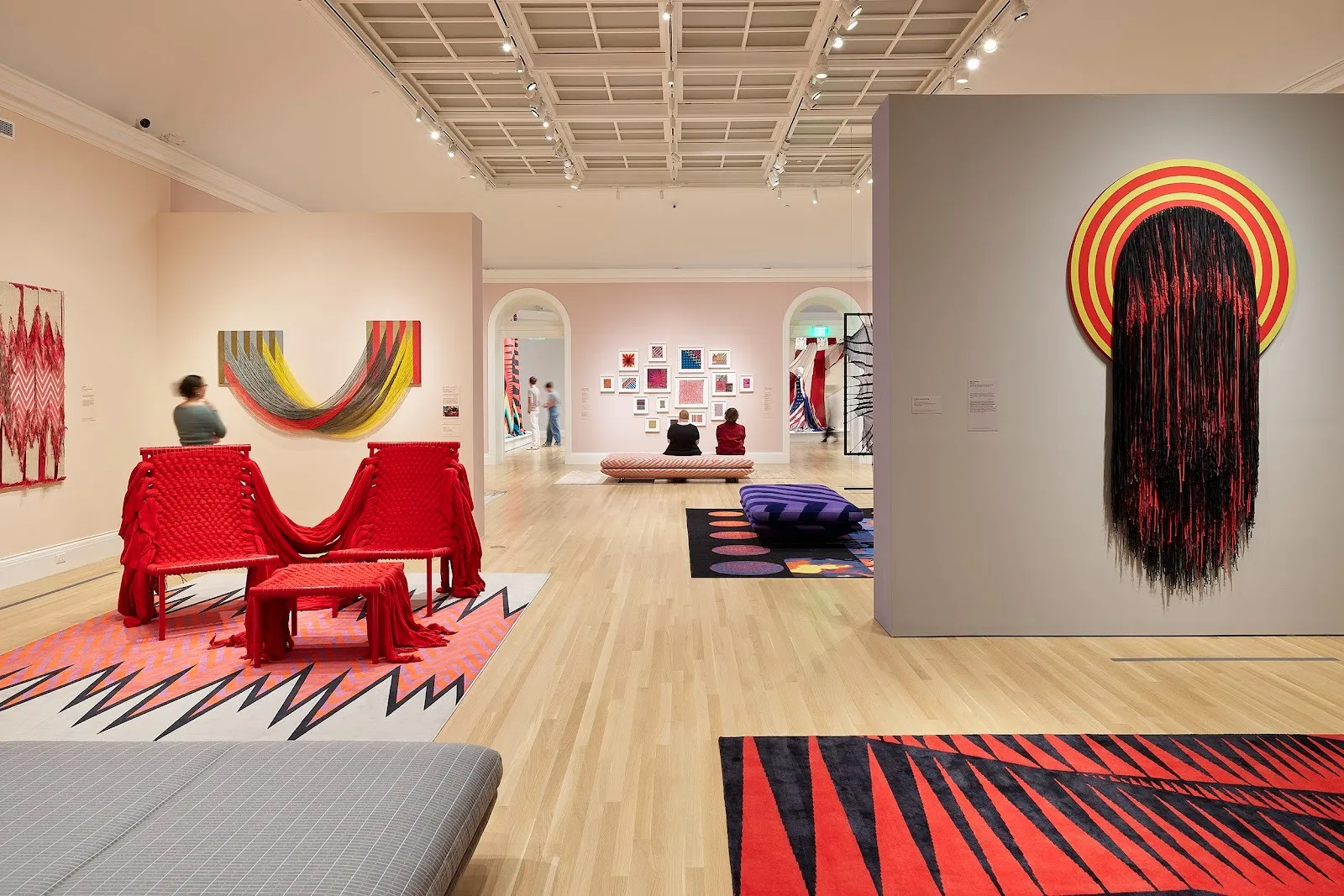
The threads holding, tying, and protruding from Liz Collins’s fiber-worlds are all rooted in one proposition: queerness is not a fixed object, but an abundant lifeforce. Motherlode, curated by Kate Irvin, is her first US solo survey. It’s also a homecoming, given the artist’s ties to the Rhode Island School of Design (RISD) as an alum, and later, as faculty. Joining painting, drawing, fiber, design, fashion, performance, video, and installation made from the 1980s onward, Motherlode is a panoramic display of an artist endlessly experimenting to craft every part of her visual universe.
Collins’s trademark patterns already appear in a grid of woven fabrics she made for her 1991 BFA thesis show at RISD: sun-shaped portals, jagged diagonals, swirling orbs, and those harsh zigzags—overstimulated vital signs incessantly thundering and reflecting inward like lightning in a bottle, contained yet perpetually on the verge of explosion. They anticipate later tapestries punctured with rips and tears—openings from which the interior flows outward in anatomical transgression, such as in Power Portal (2022–2024) or Euphoria II (2016). Beneath the rainbow colors, this precarious excess is what makes her practice so queer: this rapturous collapse of the erotic and abject, pain and exhilaration, tension and tenderness, or grief and renewal.
Motherlode finds Collins constantly pushing toward the monumental, with later works like Rainbow Mountains Weather (2024) nearing immersive art. Yet overall, symbols and gestures are so recursive throughout her career that Irvin’s non-chronological structure becomes necessary. The work instead folds into itself. Veins-Darkness is a case in point: first made in 2005, but reworked in 2011 and 2025 to reflect the present. Such revision signals that every work here exists as part of an ever-shifting, non-linear journey.
In an interview for the exhibition catalogue, Julia Bryan-Wilson brings up Sara Ahmed’s concept of queer orientations before asking Collins: “Do you think of space queerly?” She responds: “I do. [ . . . ] I also have an orientation related to spiritual practices, which could be called queer, but is also an idea based in witchcraft about grounding a space first before doing any other magic.”[1] Her all-consuming maximalism—the carpets, chairs, and drapes tying the galleries—is not mere aesthetics. It’s an aural enchantment meant to catalyze a queer affect: functionally relational and thus political.
Motherlode also devotes a gallery to Collins’s work in Knitting Nation (2005–2016), which opens a path to address her deep engagement with queer, feminist, and HIV/AIDS activism, with several object labels alluding to past activations in protests and specific sites. Indeed, collaboration and community aren’t buzzwords for her. They’re tenets. Nothing exemplifies this better than Homecoming, an accompanying group show of queer RISD artists curated by queer RISD grad students mounted in the museum’s Skylight Gallery. Together, the exhibitions act as a promise that anything can be reimagined queerly. What better act of devotion than to teach a new generation of queer artists how to resist, care, and hope—and to graft their creations to your own? As Motherlode and Homecoming suggest, queer world-making is a communal tapestry.
— Nicolas Poblete
Naima Green: Instead, I spin fantasies
International Center of Photography | 84 Ludlow, New York
October 16, 2025 – January 12, 2026
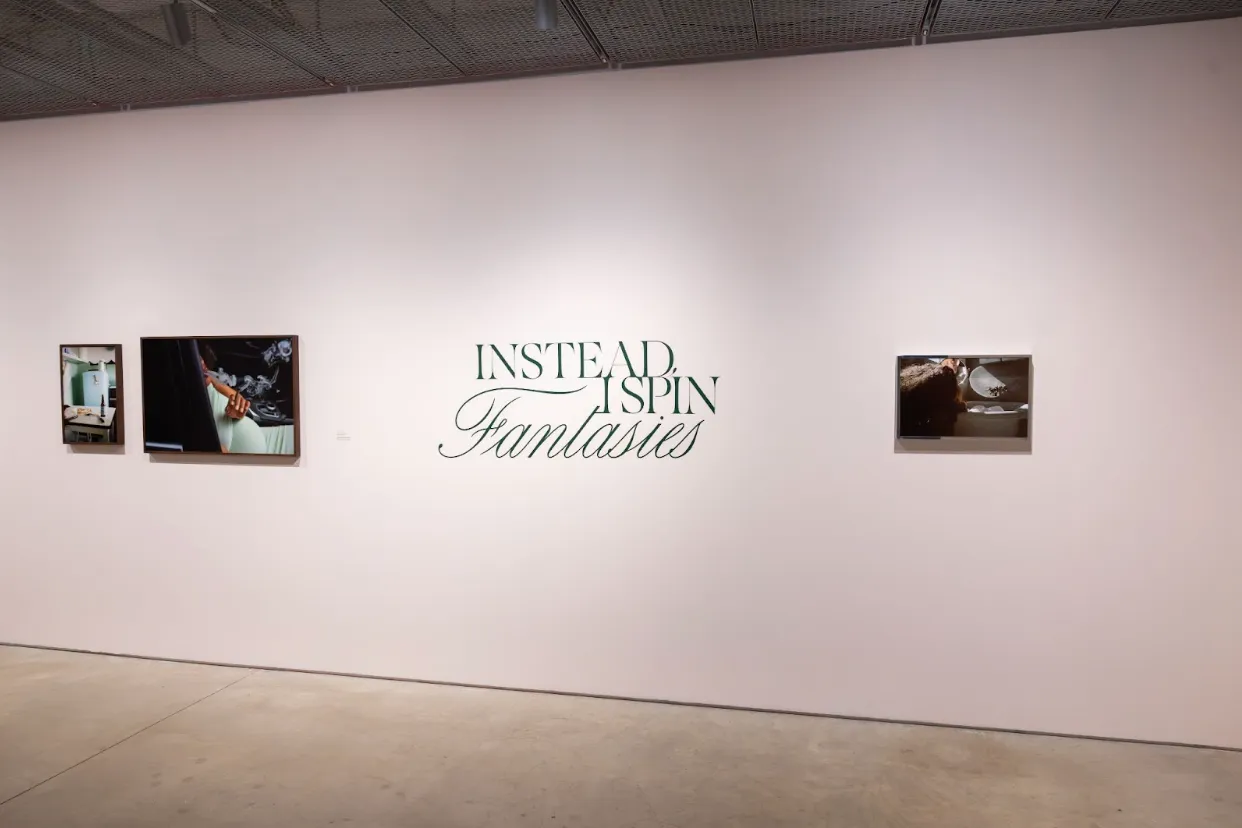
Instead, I spin fantasies, Naima Green’s solo show at the International Center of Photography, greets viewers with an image both contradictory and captivating: a faceless figure hotboxing a car with rings of smoke surrounding their baby bump. Featuring a selection of recent landscapes, self-portraits, and still lifes, the exhibit examines the complexities of pregnancy through a mix of modern and historical printing techniques, including albumen and lumen, as well as a site-specific vinyl installation.
Never stereotyping her subjects or scrutinizing their circumstances, Green’s vision of parenthood is multidimensional, encompassing everything from biological to blended and chosen families. Each picture captures a fragment of a feeling, a memory, a relationship, ambiguous to the viewer yet compelling nonetheless. Casual shots show gay couples and expectant parents, Wednesday breakfasts or Saturday lunches, the cleanup after a baby shower, and several examples of the emotional and physical labor necessary to build a home. Alluding to the clinical nature of assisted reproductive technologies, one vague image of someone holding a vial of blood demonstrates the disparity between queer people and parents privileged enough to circumvent medical intervention.
For many, like Green, family can extend beyond the formulaic nuclear structure. Taken during the artist’s first visit to her Aunt Dot’s house since her death in 2023, a bittersweet photo memorializes Dot’s favorite keepsakes: a baseball bat beside a framed picture of MLK Jr. In other pieces, being pregnant becomes a performance—fabrications that Green calls “prosthetic lives”—and a medium to explore her unaddressed anxieties about motherhood following her aunt’s passing. A few self-portraits depict the photographer wearing a silicone stomach, either in her bedroom, beside a fictitious baby daddy, or in front of the mirror with her Rolleiflex, the latter’s title underscoring an internal conflict: the trouble with motherhood, is not the work itself but the conditions under which it is done (2024).
By portraying a vast range of experiences, Instead, I spin fantasies deconstructs the expectations society places on anyone carrying a child, and questions, whether implicitly or ironically, the institutional obstacles that shape our existence. A lack of chronology leaves room for our personal interpretations of the material, prompting me to reflect on my own upbringing by a single mother, made possible only through in vitro fertilization. Families don’t need to fit some heteronormative mold, Green’s photographs seem to suggest, even in those more imagined than real.
— Christina Elia
Megumi Shauna Arai: Sinew
KOKI Arts | Rose Bldg 1F, 1-15-2 Higashi-Kanda, Chiyoda-ku, Tokyo
November 11 – December 27, 2025
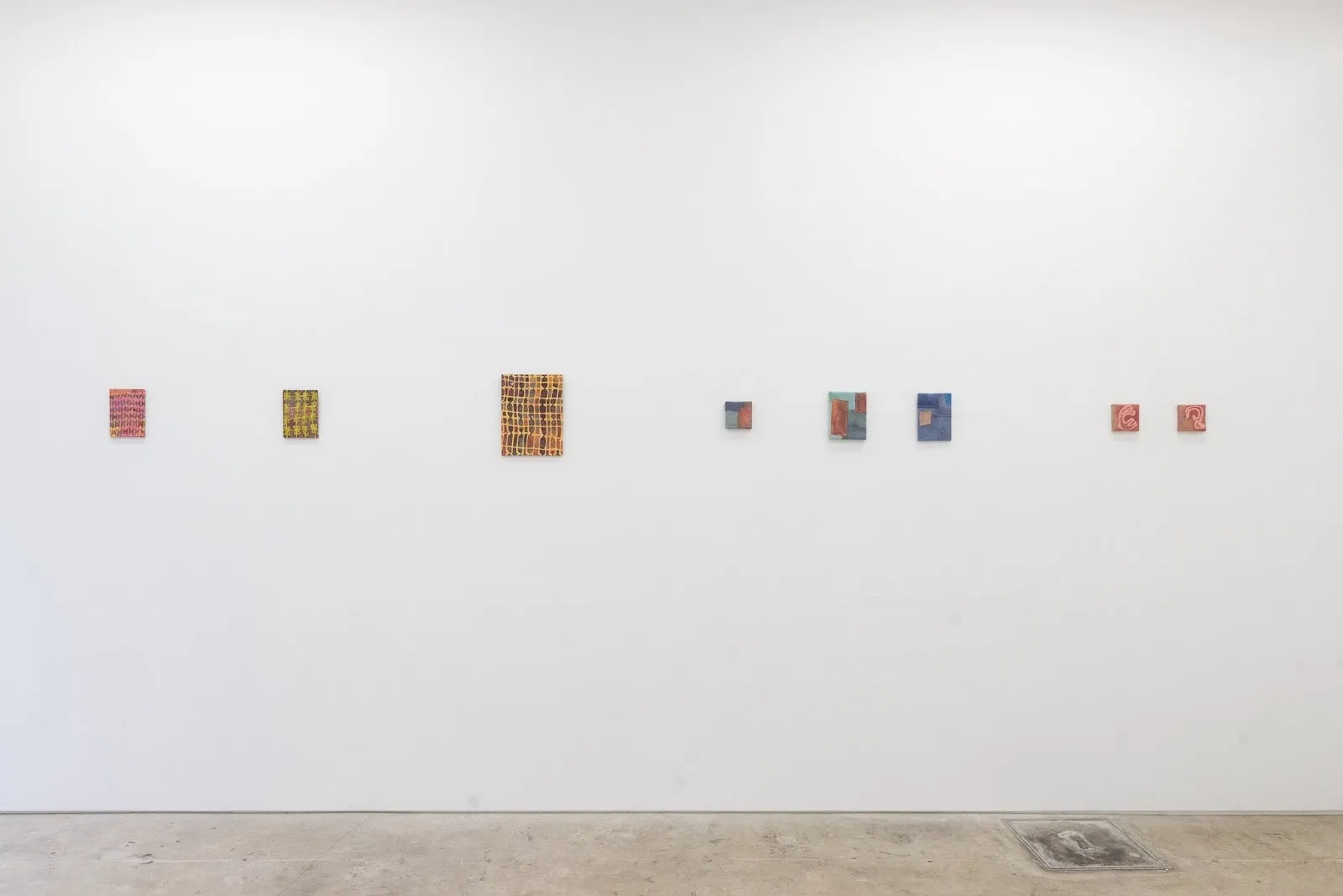
Sinew, Megumi Shauna Arai’s first solo exhibition in Japan at KOKI ARTS, is exemplary of “painting beyond itself.”[2] Fourteen miniatures legibly persisting as paintings are, in fact, textile-based works made by stretching silk onto a canvas, drawing on lines with relief glue, painting the silk, washing it, and finally, dappling over the glue’s negatives with oil paint. This exacting process underscores the invisible labor historically linking textile with women and indigenous traditions. The zone of indecision involved in integrating nuanced histories of labor in the form of painting is one way in which Arai pursues a line of flight, recalling an ethos conceived by American philosopher and Gilles Deleuze student John Rajchman—an ethos “which consists in our multiple manners of being and ways they are woven together… in such manners there always lies the possibility of light movement in formless space, prior to both the material assignation of place and time and the immaterial mastery of space and form. The function of lightness thus is to be found in a certain ease of freedom in movement.”[3]
In this new body of work produced in New York, Paris, London, and Japan, a few common points of intrigue emerge: the tactile creases of the silk, bleeding colors and borders, and most fascinating—wandering lines that push and pull within form and formlessness. In the Auxesia (2025) series, dense patterning which evokes the sartorial borrows the rhythm of auxetic geometries—highly energy-absorbent structures that follow the logic of negative Poisson’s ratio—behaving in our body’s tendons and used for protective garments (body armor, prosthetics, smart fabrics). Fatter when stretched and thinner when compressed, tendons’ mechanical redistribution of energy map generatively onto the relational practice of qigong. Meridian (1–5) (2025) works reference and loosely figure qi’s tendon-meridian flows such that it turns the gestural lines of abstract expressionism on its head, and towards durational somatic recordings informed by Chinese philosophies.
Arai’s provisional marking of space informed by repertoires of bodily movement is further explored in Sinew (1–3) (2025), for which earth-toned patches of silk handled like scraps of cloth are placed, folded over the canvas’ usually dormant edges, and stitched onto one another. The stitches, gleefully crooked and disjointed, diagram space with the spontaneity of a child placing a foot before another in a wilderness’s expanse. Unmapped, improvisatory, and lost in one’s drift, these wandering lines, like qi’s expressive paths, contain reserves. They recall Fernand Deligny’s lignes d’erre; like the French cartographer, Arai seems to be in search of another, lighter mode of existence. She seems as uninterested in the burdensome weight of intergenerational ties or geographically fixed philosophies for the migrant’s search for self as she is in rigid symbolic coding and coherent interpretive systems. The ease of movement in her practice, her freedom, starts with tracing the vital depth of movements circulating within one’s own body.
— Lily Kwak
[1] Julia Bryan-Wilson, “The Magic of Dialogue: An Interview with Liz Collins,” in Motherlode (Hirmer, 2025), 75.
[2] Isabelle Graw, Painting Beyond Itself: The Medium in the Post-Medium Condition (Sternberg Press, 2016).
[3] John Rajchman, “Lightness: A Concept in Architecture,” ANY: Architecture New York 2, no. 5 (March/April 1994): 5–7.