.jpg)

.webp)
“Thucydides Fever Dream” at Hill Art Foundation
Review
Postmodernism has been on my mind, and one of the questions I have been debating with myself over is whether it still holds sway in contemporary art of the 2020s. A recent visit to Freight + Volume Gallery gave me an answer in the affirmative through a remarkably conceptual series of paintings by the Manhattan-born, currently Buffalo-based artist Becky Brown. Some conceptualists make use of the visual semiotics of our screen culture as critical commentaries of life in the digital age, but then an artist like Brown comes along and goes even further by appropriating and dismantling the strictures of language through the power of paint. Brown’s Pleasure Reading is a humorously cogent and cleverly observant reflection of text’s almost unbearably encroaching presence in our lives. Like a classic postmodernist, her paintings consider these ideas through a collapsing of visual conventions undergirded by appropriation and wit.
Brown’s work is heavily influenced by the art critic Jonathan Crary’s “Internet Complex” theory from his 2022 book, Scorched Earth, in which he argues that the filtration of the Internet into practically every facet of our day-to-day existence carries deleterious repercussions, from fomenting chronic screen addiction to increasing surveillance in the private sphere. Her recent painting Brain Fog (2025) appears to be a natural outgrowth of the cognitive and psychological effects that the internet exerts on its users. All-capitalized pink text overwhelms the composition with their cramped groupings, the top half spelling out “BRAIN FOG” and the lower half being more overtly expressive of the term, which has become ubiquitous in the contemporary digital vernacular as connotative of valueless content that can only dull, stupefy, or weaken our brain capacity.
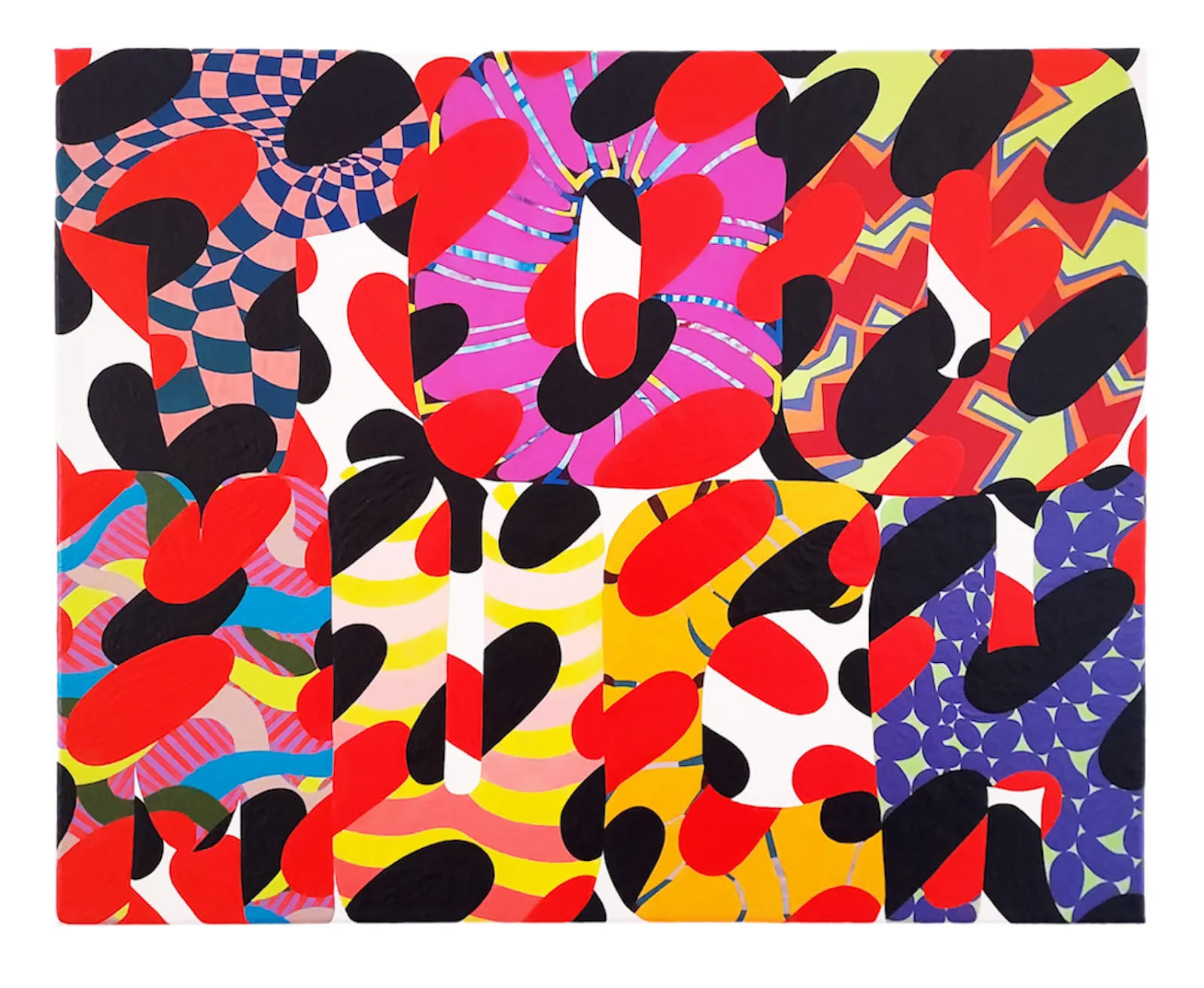
Elsewhere, the predominantly abstract Too Much (2024), in which the titular message is camouflaged within a dizzying morass of colors and patterns, becomes a visualization of information overload. In a similar vein, Creator (2025) features the aforementioned word layered multiple times over itself as white text marked with multi-spectral globs of color floating in an illegible sea of stylized abstraction. The term “creator” is frequently tossed around on the internet and is expressed or monetized in ways that have little to do with conventional forms of creativity (think of the vague, oftentimes hollow usage of the word “content creator”). Brown’s painterly reenactment of the word’s overuse has amounted to its distention beyond its original meaning.
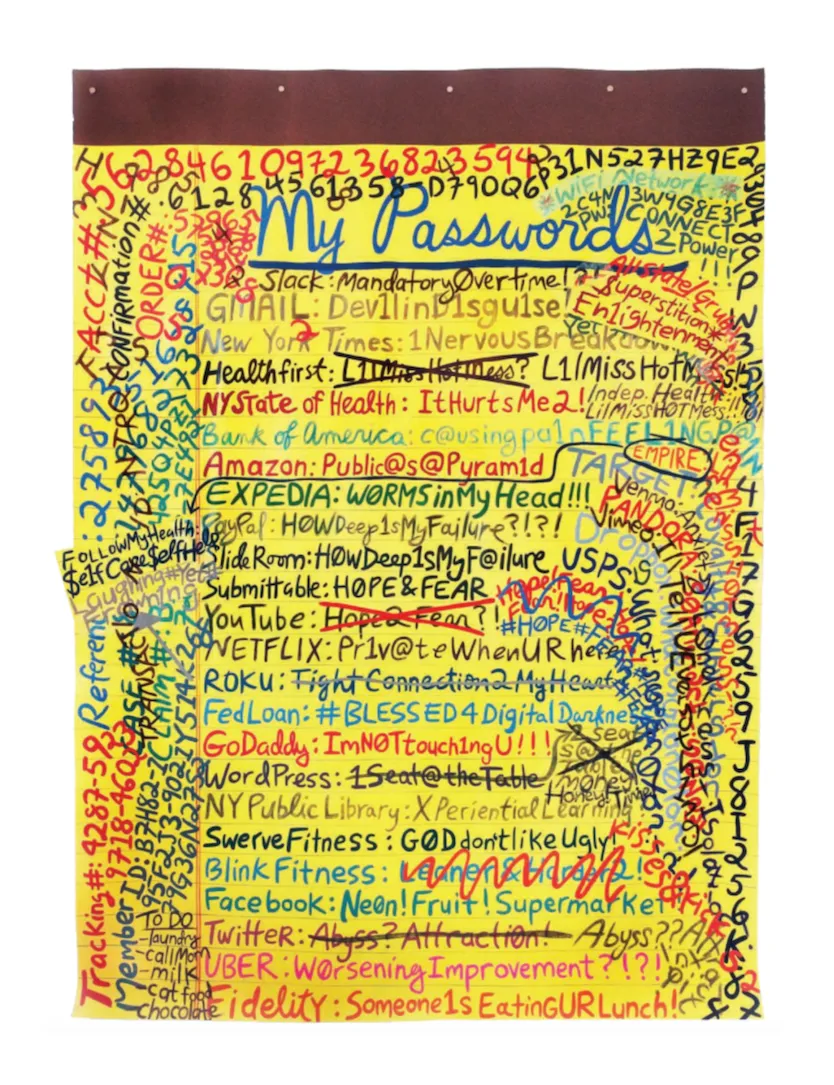
These smaller paintings already contain much material to process and digest, yet Brown’s larger compositions from this exhibition invite an even more engrossed visual engagement. My Passwords (2020) is guaranteed to hit close to home for many viewers, as this is Brown’s blown-up depiction of a yellow-pad password book inundated with text across every square inch of its surface. Consider this work on paper an encapsulation of life in the 2020s, inflected with a touch of anxious millennial humor—she has the verism down to a T with the multi-colored inks and pencil markings she applied for text. Tongue-in-cheek and ironic statements abound, often determined by the pairing of passwords with their intended label: “ItHurtsMe2!” for NY State of Health, “G0DdontlikeUgly” for SwerveFitness, and so forth. Within the mess of passwords (both in-use and crossed-out), numbers abound in every direction. Their unmissable presence bellows out that we are living within a matrix, or perhaps even more critically, serves as a reminder of the unceasing numbers game of living in a late-stage capitalist society.
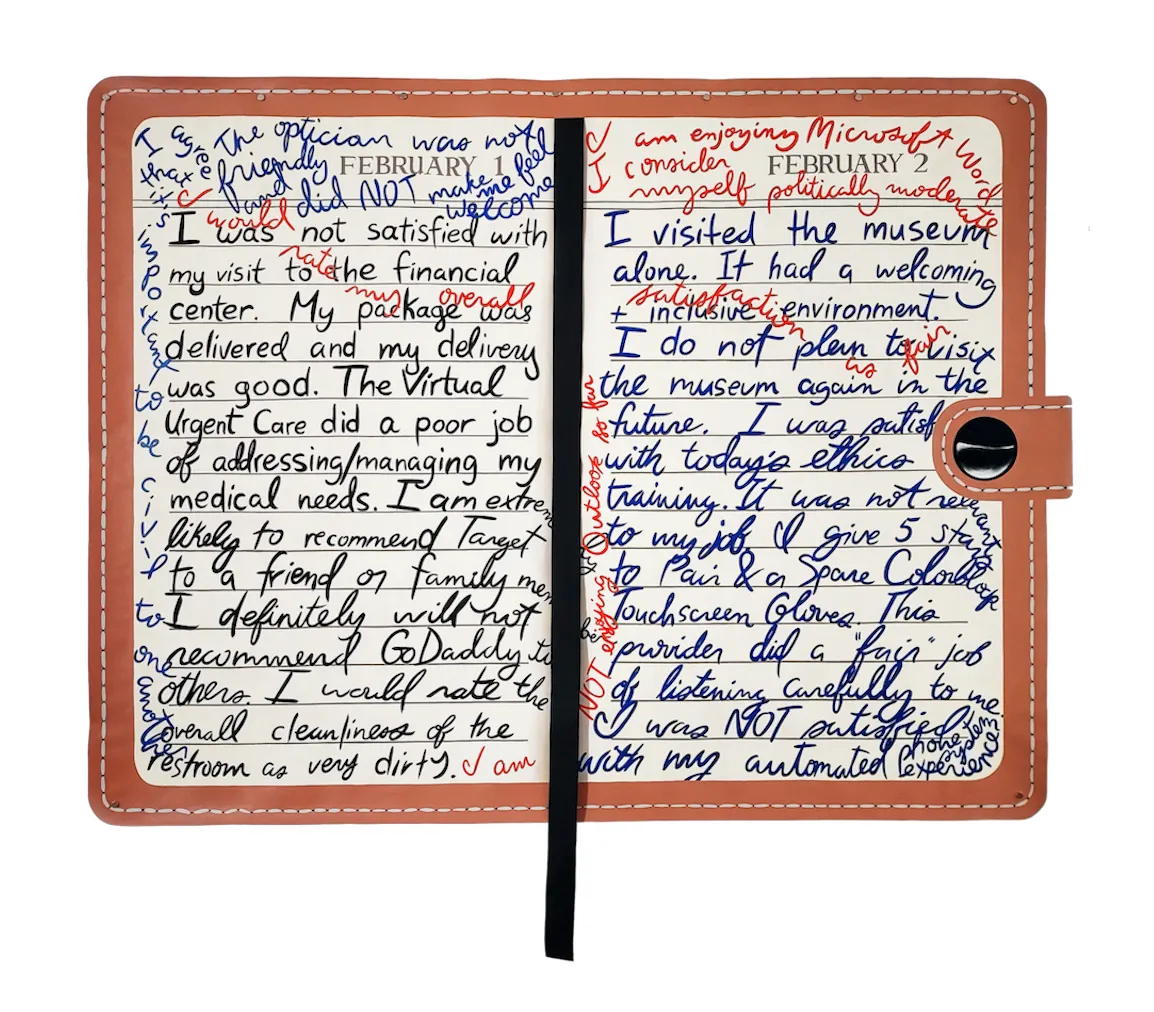
My Overall Satisfaction (2025) accomplishes similar insights as My Passwords, but this time in Brown’s aggrandized depiction of a two-page diary entry filled to the brim with messages that sometimes contradict or inform one another. Statements like “I was not satisfied with my visit to the financial center” and “The Virtual Urgent Care did a poor job of addressing/managing my medical needs” are acutely familiar and, tragically, universal problems that have been neck-and-neck in the midst of our fraught socio-political climate. For this to be a diary entry that is elevated to the physical magnitude of a grand painting at roughly 53.5 x 69 inches is a bold approach by Brown to bring these issues out into the open—and by open, the physical and public realm as opposed to the small-scale, portable screens of the Internet.
Pleasure Reading is a prescriptive solution and an attempt to escape the overwhelming influence of the “Internet Complex.” A major reason for the success of this exhibition is that this is coming from a painter who is translating digital and otherwise formless content into physical matter via oil, acrylic, ink, and other materials. One need only spend some time with Brown’s paintings to fully feel themselves disconnect from the internet and truly get back in touch with reality.
Becky Brown: Pleasure Reading is on view at Freight + Volume Gallery from January 10 to March 7, 2026. There will be an artist walkthrough of the show, along with a closing reception and catalogue launch from 5 pm to 8 pm on March 7.