
.webp)

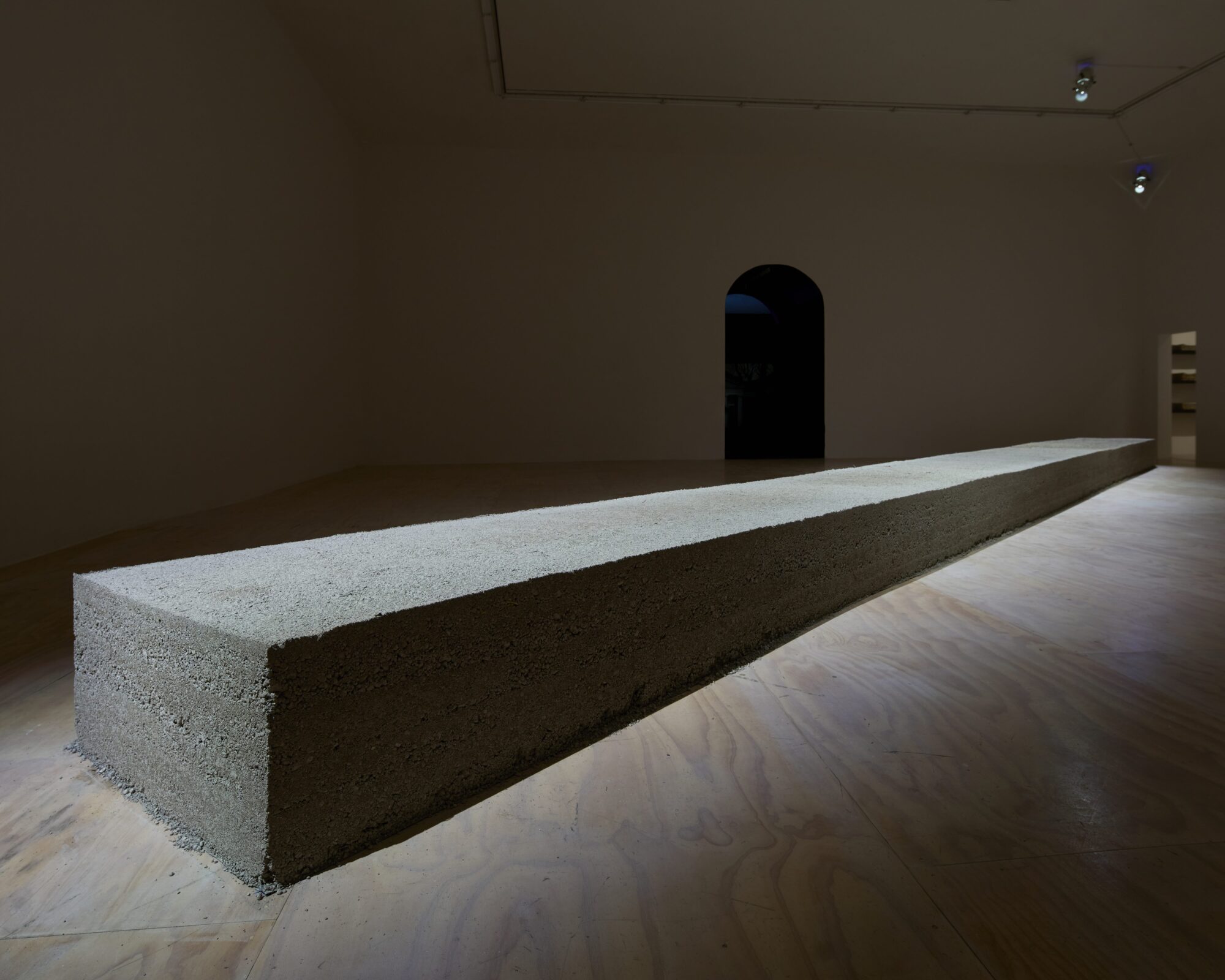
Teresa Margolles: "En el lugar de los hechos (At the Scene)"
Review
When we think of generational artistic influence, we might picture three painters in a studio, such as Frenhofer, Porbus, and Nicolas Poussin in Honoré de Balzac’s short story The Unknown Masterpiece, making incremental changes to achieve greater verisimilitude in portraiture. In these mental sketches, artistic inheritance often feels linear, yet in reality, it unfolds in unexpected echoes and resonances. In Celebration of Shadows at Grimm Gallery reconsiders this notion through a distinctive curatorial framework: nine artists were invited; each selected one student and one teacher to participate, with one artwork contributed per artist. Each resulting trio serves as a case study of how influence manifests.
As a participating artist and a painting educator with over 25 years of experience, most notably as the Head of Painting at Manchester School of Art, Ian Hartshorne brings his unique perspective on pedagogy to In Celebration of Shadows. Instead of tracing influence merely in painting’s formal elements, Hartshorne expands artistic inheritance to encompass the intangible, psychological, and relational. To do so, the exhibition invokes Jun’ichirō Tanizaki’s seminal 1933 essay on Japanese aesthetics, In Praise of Shadows, which positions shadows as central to the aesthetic experience. While In Celebration of Shadows offers productive moments of comparison, where unfamiliar affinities and practices emerge, the deliberately loose framing leaves some groupings confusing.
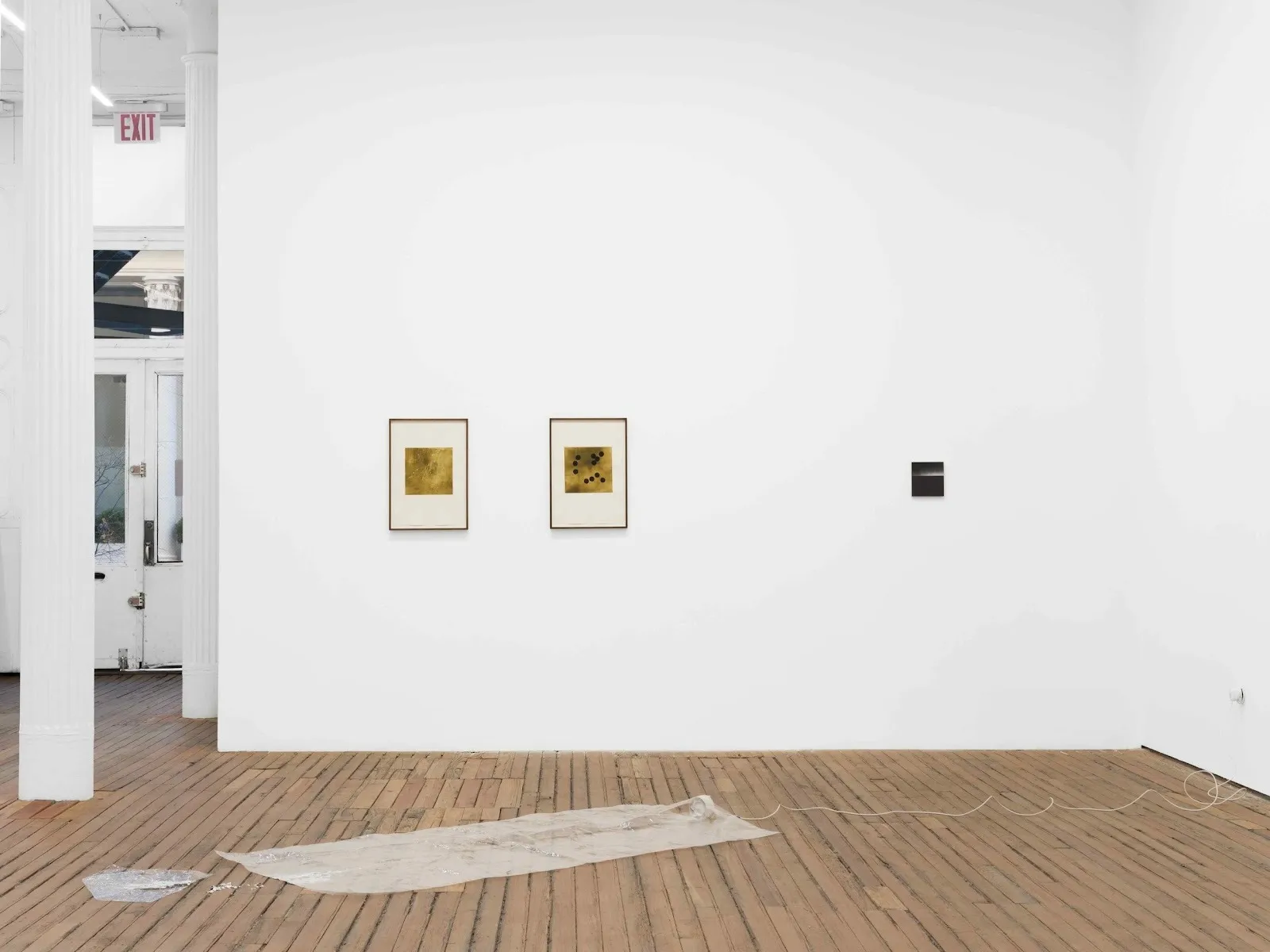
In moments when coherence arises, groupings often share strategies and material awareness, such as among Jo McGonigal, Ian Kiaer, and Jack Ginno. For instance, McGonigal’s Thoughts I (2025) and Thoughts III (2025) are gold leaf squares on paper with dots painted on the gilt. While the smaller blue dots float to the surface of Thoughts I, Thoughts III’s black dots register as black holes burned into the surface. On the other hand, by assembling found objects to create an incidental ocean landscape, Ginno’s UNT2510-DPB (2025) extends McGonigal’s minimalist logic. Similarly, Kiaer’s health house, breath (small) (2025) presents a cellophane bag that slowly inflates until a central slit arrests the expansion. In total, each artist employs minimalist logic and the readymade to different ends—McGonigal toward transformation, Ginno toward continuity, and Kiaer toward rupture.
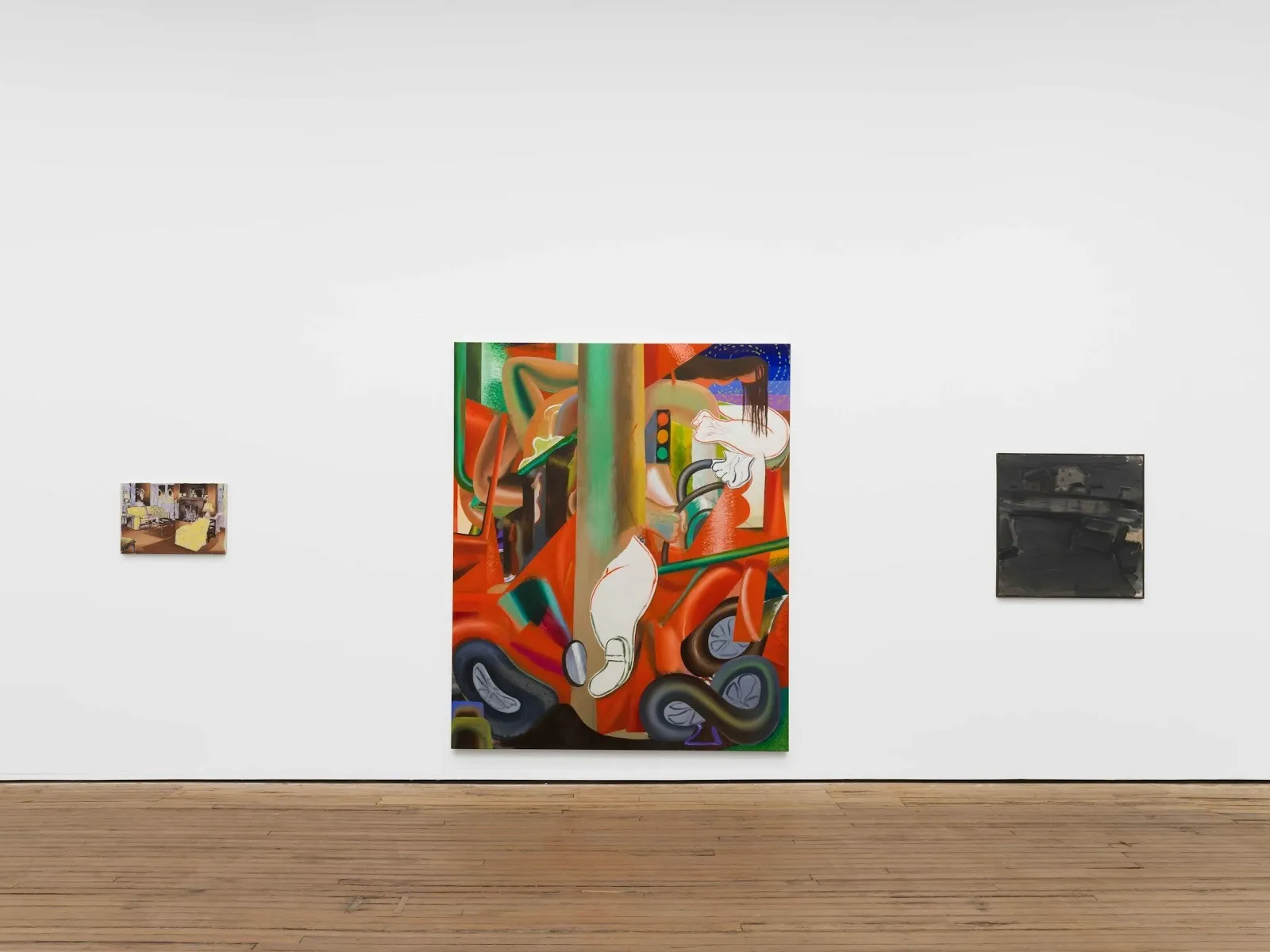
In a similar vein, the works of Matthias Weischer, Wolfram Ebersbach, and Kristina Schuldt reveal an evolving technical dialogue through their depiction of architectural space. Wiescher’s Salon ’25 (2025) portrays a living room rendered in yellow and purple pastels over ochre tones, refracting architectural elements and inverting colors to produce a liminal, disembodied space. Schuldt’s Kaputt (2024) expands Weischer’s limited palette into a serpentine image of a car crash, in which metal folds inward, and wheels melt and loop. Like Weischer, Kaputt uses color to displace a white-painted human figure amidst the larger, colorful crash. By contrast, Ebersbach’s Mauer Berlin 1 (1989) represents a parking lot in blurred blacks, deepening the focus on shadows. Its visible brushstrokes lend the painting the quality of an underdeveloped photograph. Together, the trio subverts legible, linear representation of architectural space through divergent painterly approaches—from Schuldt’s rounded forms to Ebersbach’s gestural, blocky marks.
Where these earlier trios articulate lineage with relative clarity in their shared material approaches and subject matters, the grouping of Ian Hartshorne, Louise Giovanelli, and Isobel Shore locates influence more obliquely in the sensuous accumulation of surface, pattern, and technique. Hartshorne’s Woman With a Book (2025) uses a muted palette to show a woman in a frock with a book, generating a surface interest through the patterned background and clothing. Conversely, Giovanelli’s portrait Manifold (2025) blurs and refracts stills of the heroine from Buffalo ‘66, using pink and purple-toned highlights to lend the image a voluptuous, tactile density. Akin to Manifold, Shore’s Fract (2025) doubles an X-ray image of a hip, filling the negative space with red and adding pink and white highlights to produce a plastic-like sheen over the hip’s silhouettes. Although each artist presents vastly different scenes, their practices converge in their focus on color and pattern to generate surface texture.
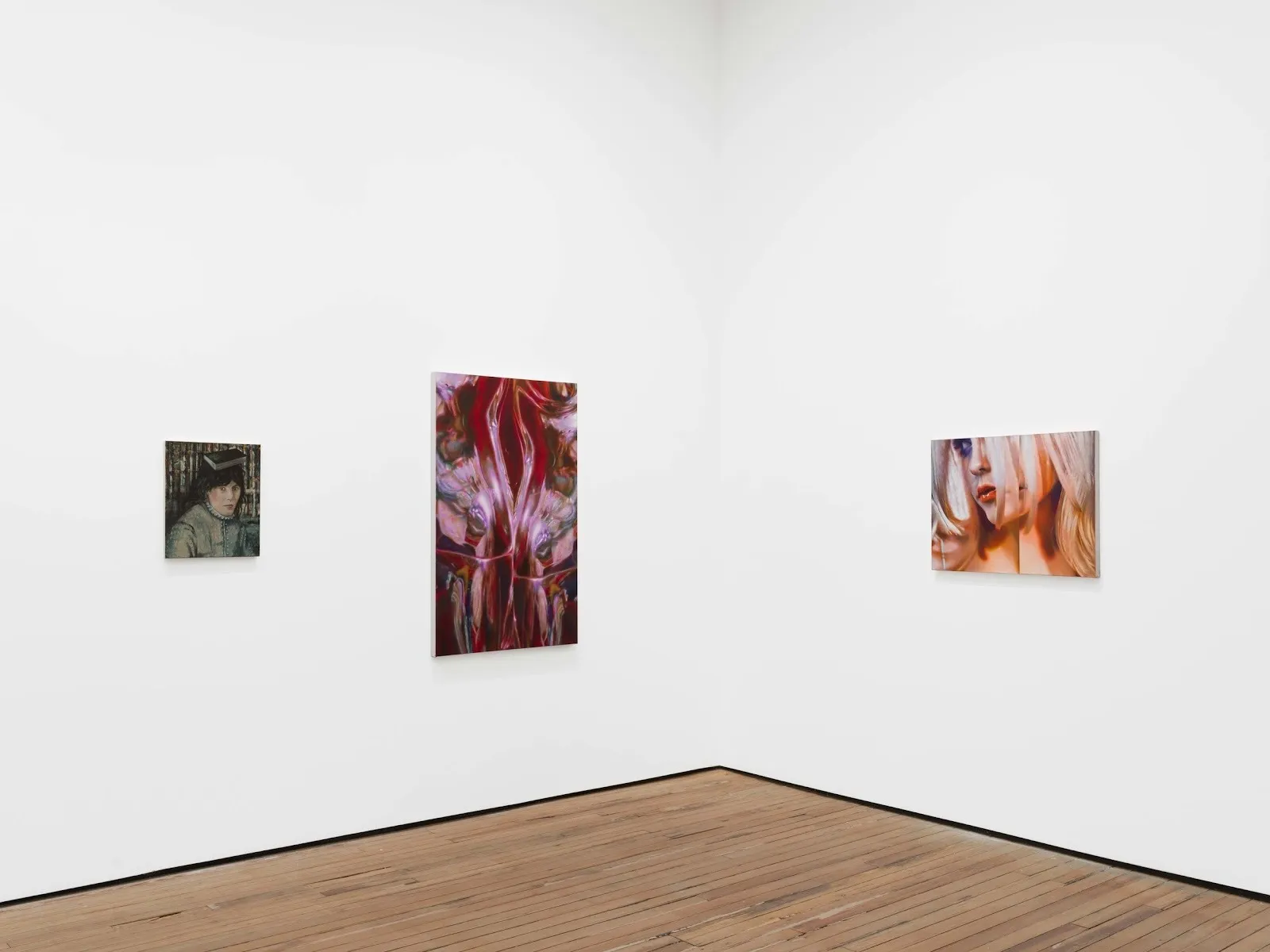
Despite its most compelling moments, In Celebration of Shadows is less persuasive when technique alone conveys generational transmission, and formal commonalities between works are obscure. This difficulty is apparent in the grouping of Anthony Cudahy, EJ Hauser, and Jennifer Leigh Blaine. While Blaine’s Skating the lake (blue hue) (2024) and Cudahy’s Temporal Range (2025) display figurative scenes with selective color palettes and thickset brushstrokes, Hauser’s Mount Etna (2025) abandons figuration entirely, presenting an abstract field of red punctuated by grey blocky brushstrokes. The leap from figuration to abstraction without a conceptual through line reduces the comparison to shared stylistic traits—color and brushwork—thereby narrowing the scope of analysis for Hauser’s work in particular. This forces viewers to impose legibility where it is not evident, flattening the distinct stakes of each work in favor of a tenuous formal alignment.
Ultimately, In Celebration of Shadows proposes a risky curatorial model whose ambitions do not always exceed its execution. By distilling intergenerational influence into one work per artist, the exhibition makes it difficult to find nuance through visual juxtaposition alone. When the formal and conceptual distances within a trio grow too wide, the framework falters, and viewers must create order at the expense of each work's individuality. Still, the exhibition achieves moments of clarity, where lineages emerge as shared modes of attention, revealing a compelling reassessment of how artistic knowledge is transmitted across generations.
In Celebration of Shadows is on view at Grimm Gallery from January 23 through March 7, 2026.