Staring at What Is
Installation view of Paz Sher: Justice [laughter] Justice. Courtesy of the artist and D.D.D.D.
Art probably cannot change the world. In recent years, we have been starkly reminded that billionaire oligarchs dictate the terms of our reality, operating with utter impunity. We merely follow suit. Why, then, should we try to change a world deliberately kept at arm's length? Must we continue to play pretend, to cosplay democracy? What happens if we refuse the comforting myths we’ve been fed—the ones we almost cannot help but believe? A new mythology only rehashes the old, once again obscuring the bare, material reality around us: hair, chains, skulls, wood, animals, concrete, screens, furniture, ceiling, floor.
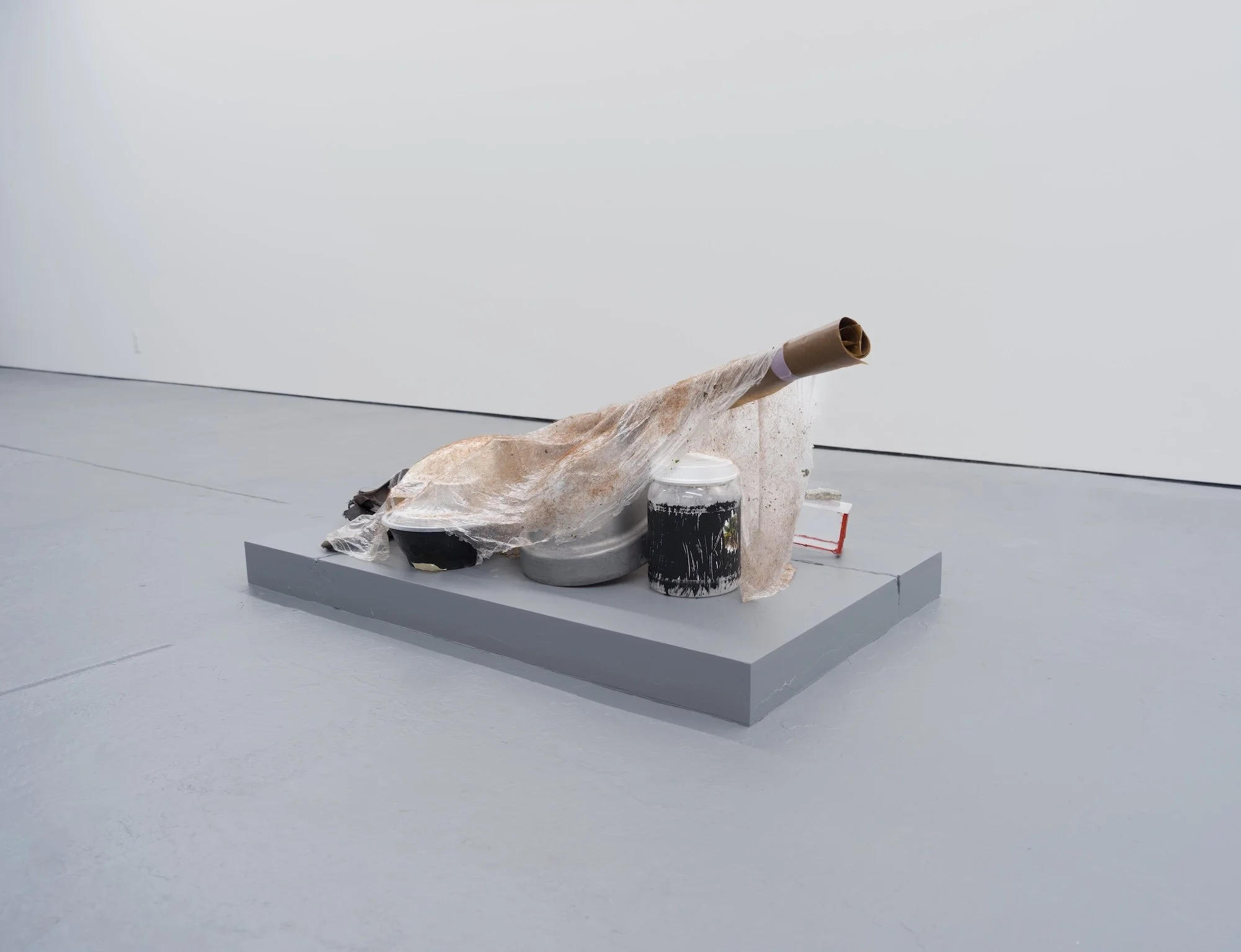
What happens when we stare at what is, without the impulse to transform it into something it is not? Enter Paz Sher’s Justice [laughter] Justice, currently on view at D.D.D.D. The title alone gestures toward an impossible possibility, laughing with, at, or between this floating signifier—an undefinable ideal we can never truly reach, yet for which we aspire to live (and die). Sher’s approximation of justice-as-laughter is a sprawling, realist sculptural installation teeming with medial and material assemblages.
Installation view of Paz Sher: Justice [laughter] Justice. Courtesy of the artist and D.D.D.D.
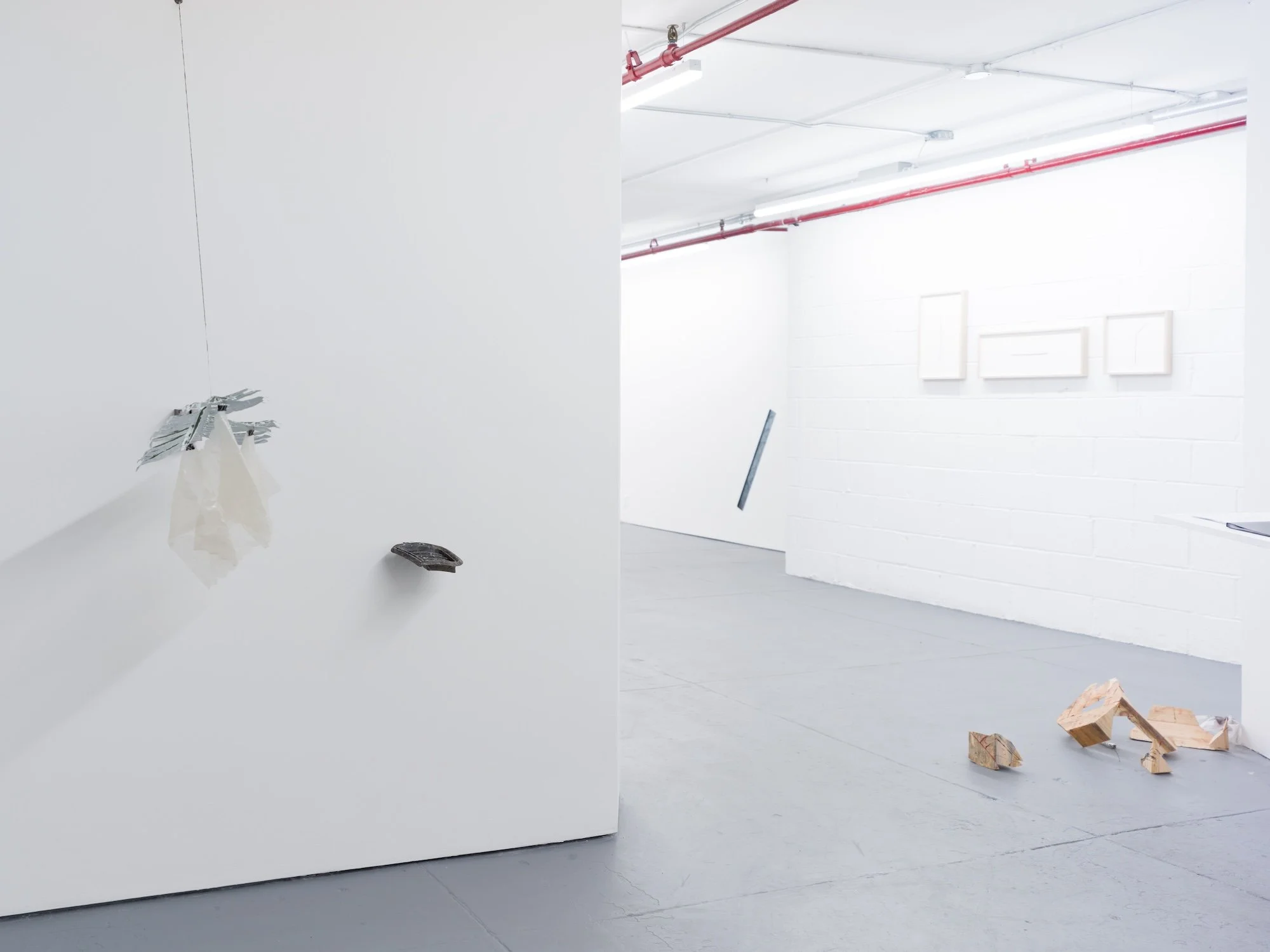
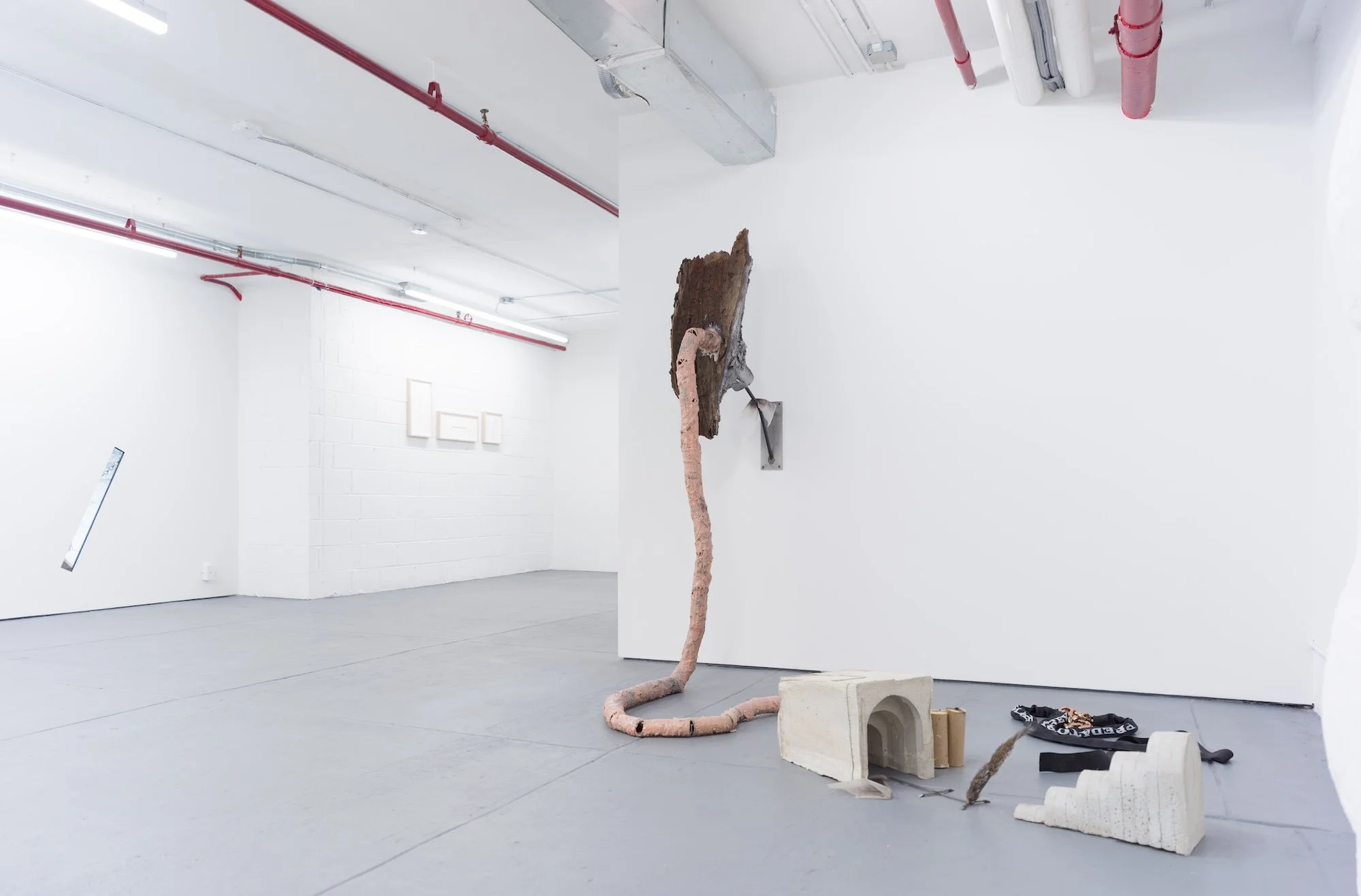
Entering the space, one is immediately confronted by the mechanical and the absurd: a plastic leaf, painted white, tethered to a kinetic mechanism driven by a black wick that raises and lowers it at calculated intervals. Nearby lies a wooden plaque bearing the screen-printed shape of the leaf, pinning down a five-dollar bill. Further in, the visitor navigates clusters of jarring material collisions. Wooden spikes are injected into the gallery walls. Assorted containers, plexiglass, concrete, and rocks are semi-concealed beneath a fleshy skin of thin silicone. From a slab of tree bark spills a grotesque, elongated tail composed of cardboard layered in silicone, rubber, and black pigment. A wooden skull hangs suspended by a metal chain, while nearby, molds of a tunnel-like structure feature a squirrel tail affixed to a steel structure replacing its body, alongside a chain bearing the UV-printed decree: “predatory prey selfish liar.”
Installation view of Paz Sher: Justice [laughter] Justice. Courtesy of the artist and D.D.D.D.
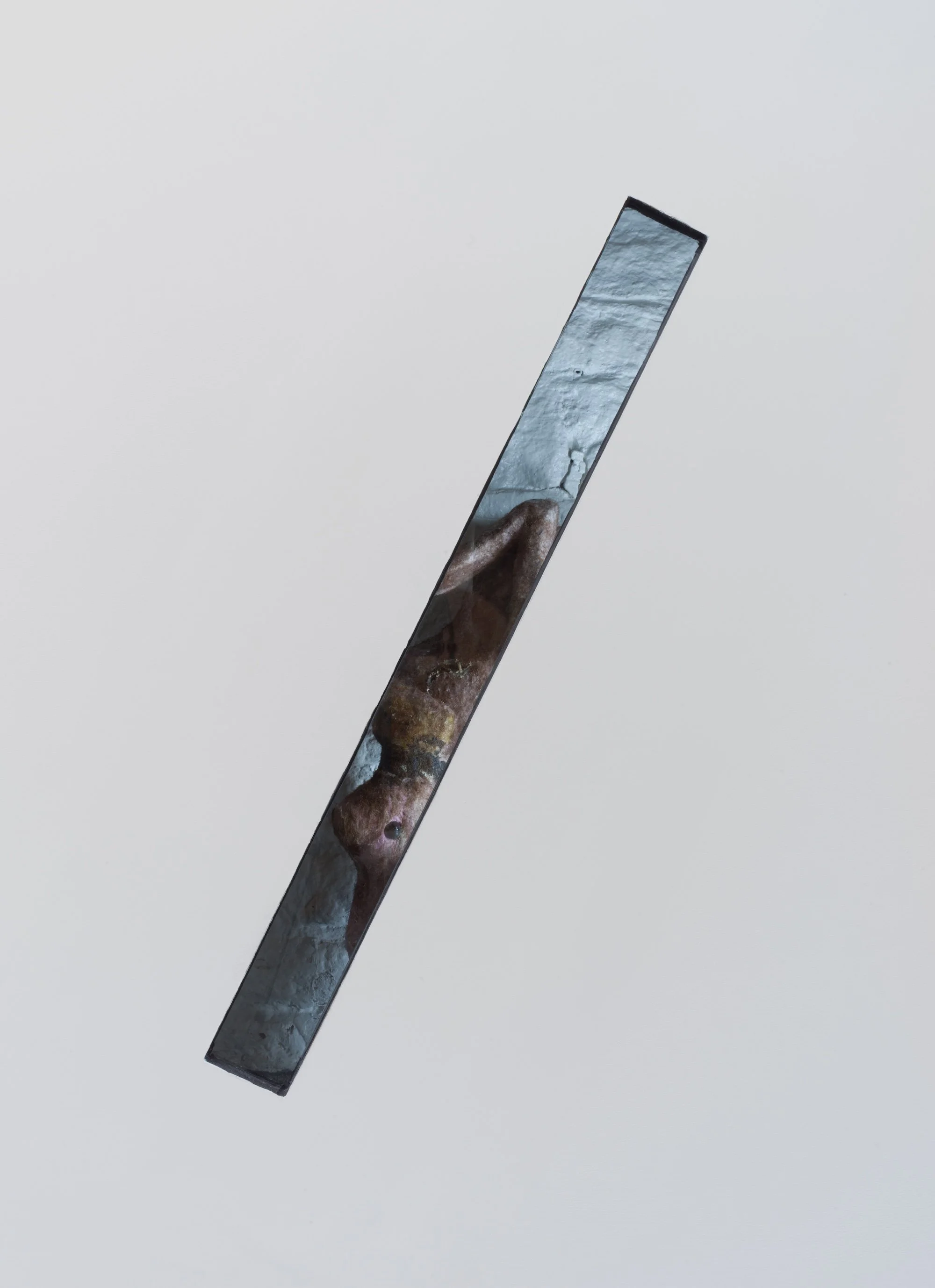
Sher refuses to be contained by the traditional gallery format, executing two aggressive spatial interventions that breach the room's architecture. First, he dismantled a section of the gallery walls to entomb a rabbit sculpture outside the conventional viewing space, offering only a small, voyeuristic window into the contraption. Second, he entirely transformed a smaller adjoining room into a warmly intimate, yet intensely claustrophobic shed. The walls and ceiling are reconfigured with plaster-covered wooden panels that jut asymmetrically into the viewer’s space. Inside this structure, an ink fountain sits below two optical burrows fashioned from thin wooden beams. These viewfinders direct the gaze toward screens displaying a video in which Sher activates the very objects scattered outside: handmade smoke grenades, the carved skull, and the wooden spikes—implicating them in an active cycle of use.
Sher constantly flirts with magical realism yet never fully abandons the realm of bare representation. What feels magical is, in fact, an implosive hyper-realism that uncovers the relational qualities of our world—qualities that are alienated as “magic” but remain foundational to survival. We see this human-animal entanglement in a hare whose fur incorporates the artist’s own facial hair, in an organically decaying skull hand-carved from the wooden beams serving Brooklyn’s infrastructure pits, and in the mechanized life of a leaf bound to a motor.
Installation view of Paz Sher: Justice [laughter] Justice. Courtesy of the artist and D.D.D.D.
Ultimately, Sher’s installation deconstructs nature, stripping away colonial fantasies of a virginal landscape to reveal the environment we have actually forged through violent human intervention. This is morbid naturalism. It is a sado-masochistic ecosystem defined by chains, predator-prey binaries, and Frankenstein organisms—animal taxidermy fused with human remains. And perhaps this is the answer to the political disenchantment that plagues us. Sher’s work does not pretend art can stop the wars or overthrow the billionaires. Instead, it refuses the mythology altogether, forcing us into the claustrophobic shed of our own making to confront the mechanical, brutal, and absurd reality of exactly what is.
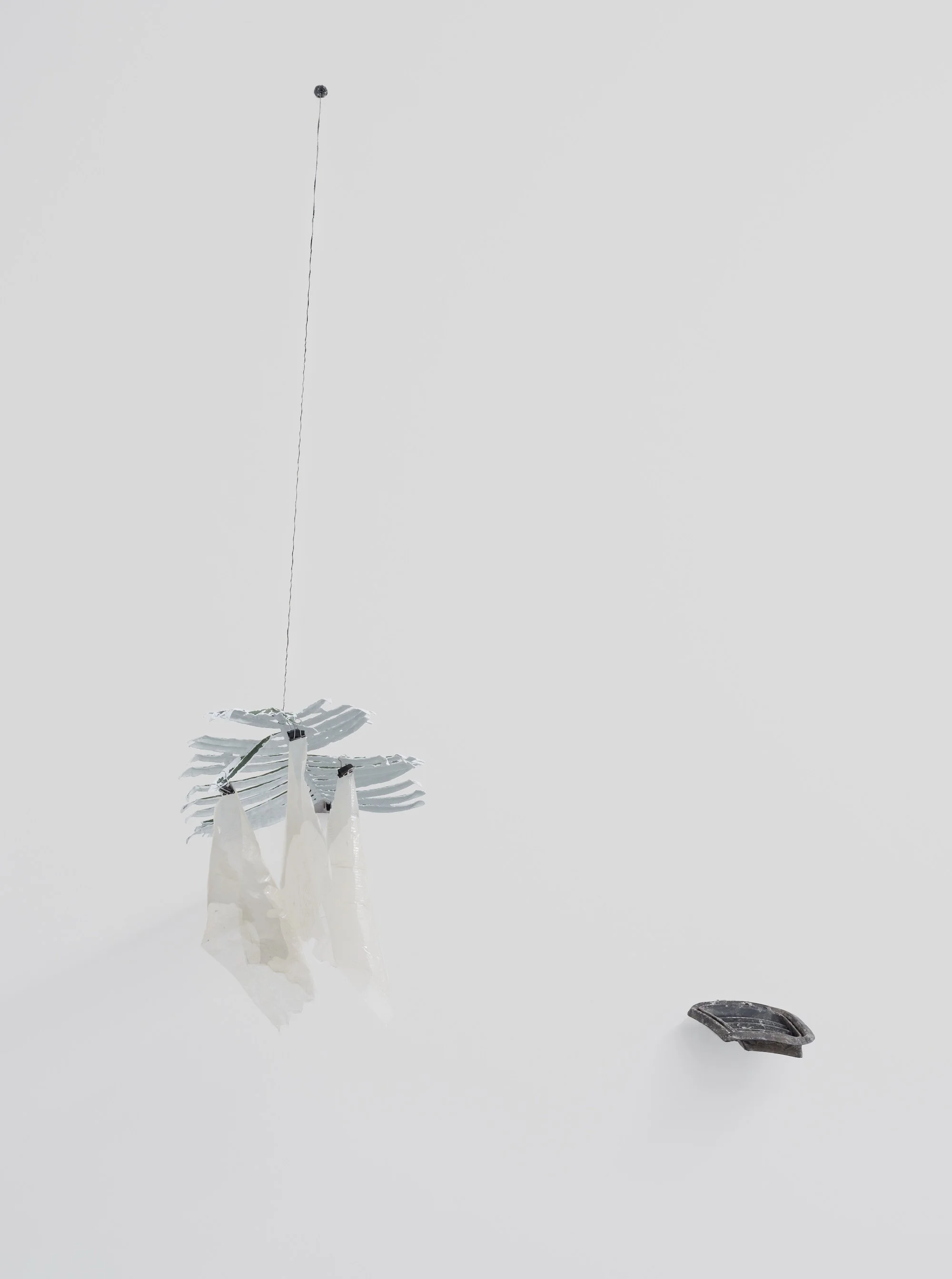
Installation view of Paz Sher: Justice [laughter] Justice. Courtesy of the artist and D.D.D.D.
Paz Sher: Justice [laughter] Justice is on view at D.D.D.D. from February 27 to March 27, 2026.