Melissa Peritore Documents the Living Who Find Refuge in Manila’s Cemeteries
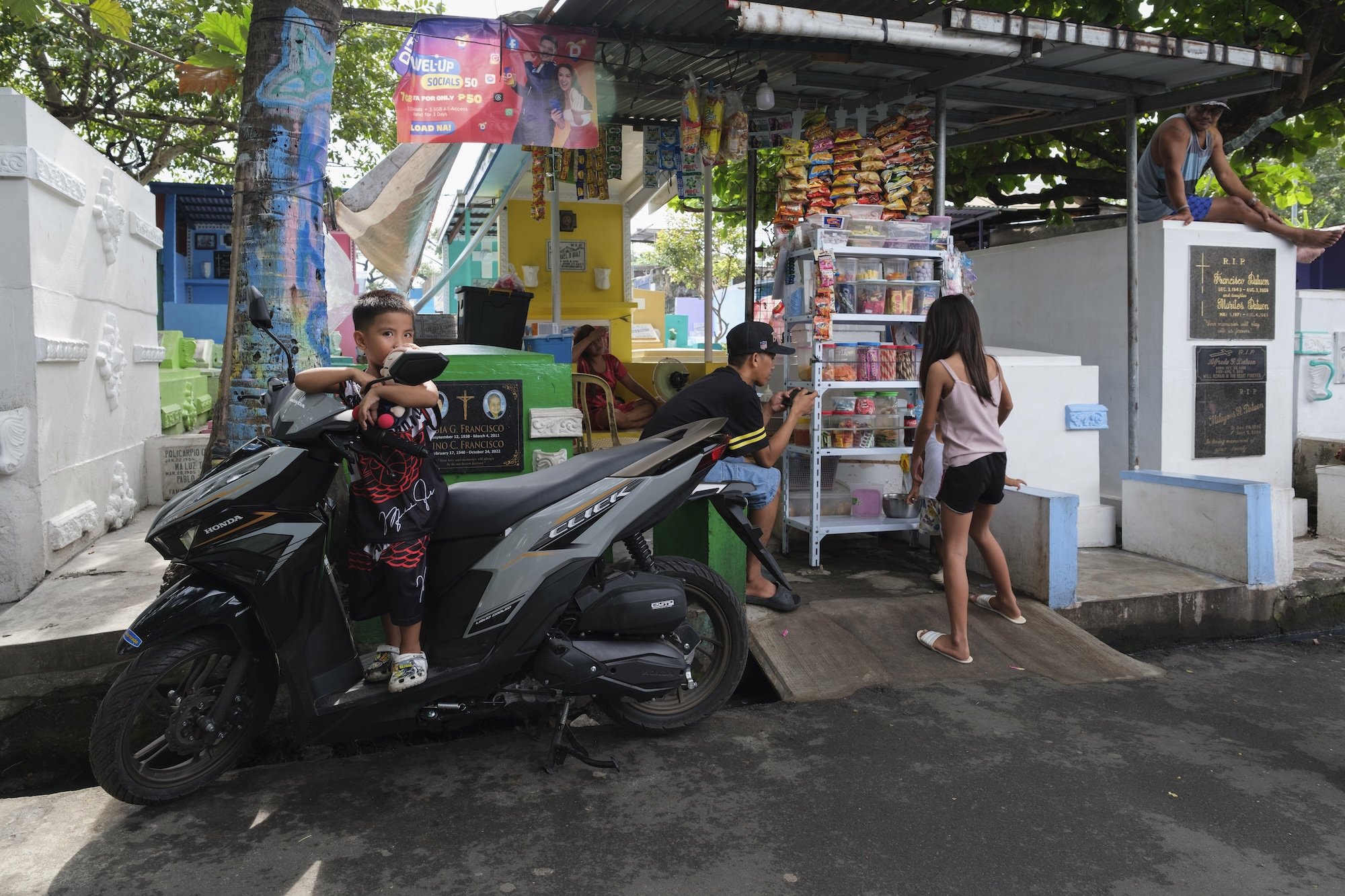
Melissa Peritore, from Sementeryo, 2024. Courtesy of Forum Austriaco di Cultura Roma.
Cemeteries may be the final sanctuary for the dead, but in Manila, the bustling capital of the Philippines, they also serve as a refuge for thousands of people who would otherwise live in the streets. In her solo show Sementeryo, Vienna-based Italo-Filipino photographer Melissa Peritore immerses the visitor in these parallel cities: sites where people sleep on graves, and candy shops and karaoke bars are built on top of tombs and in between shrines.
From the second half of the 20th century to recent years, the metropolis’s two major cemeteries, the Northern and the Southern ones, have turned into an alternative to the chaos of favela housing. Supporting Peritore’s journey into these communities were the Fotografia Calabria Festival in Southern Italy and the Forum Austriaco di Cultura (Austrian Cultural Forum) in Rome, the latter hosting the photographer’s exhibition until March 13.
Peritore’s photographs retell moments of life through traditional photo-reportage, continuing her previous work that captures intimacy and precarity in communities in the Global South. It would be a mistake to confuse Peritore’s work for “poverty tourism,” as she tells IMPULSE on the phone: “It’s just their reality, and I wanted to give it dignity with my portraits. The people in my photos show some sort of fierceness.” She points out she always asked for permission: “Even when I instinctively took a shot, I would go to the guy and show the picture.”
Peritore’s lenses focus on the dwellers rather than their surroundings, zooming in on the details of their daily life: a girl looks directly into the camera; some clothes dry on the fence of a shrine. “Most of the time you don’t even immediately recognize that you are in a cemetery,” Peritore notes. In fact, the most familiar elements of the scenes are the first to capture the eye: snacks crowding a display counter, the shoulders of a woman washing clothes in a plastic basin. Then you realize that the walls surrounding them are tombs, and you can even read the names on the plaques. The asphalt is not that of a normal road, but it is the alley of a tree-lined graveyard.
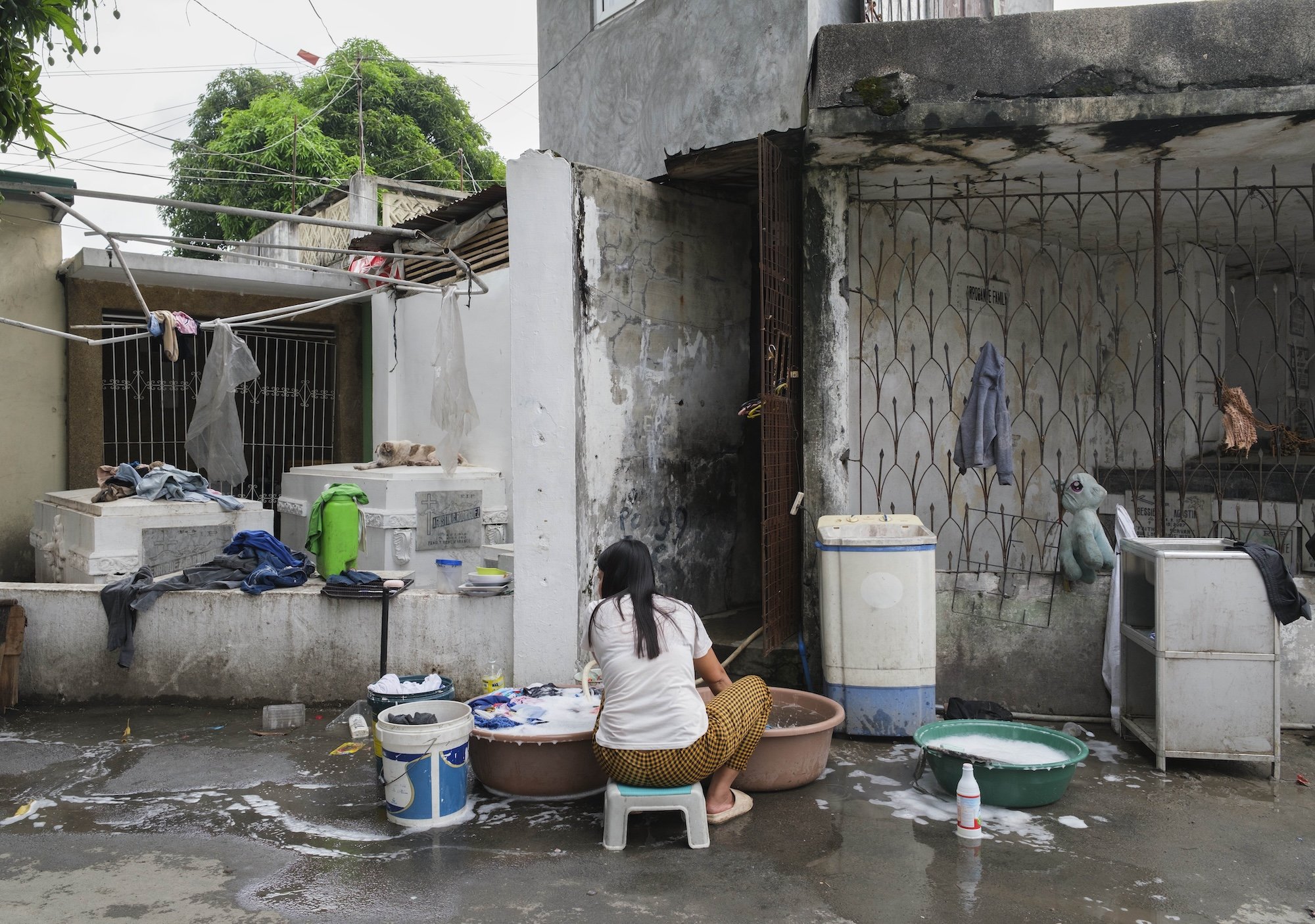
Melissa Peritore, from Sementeryo, 2024. Courtesy of Forum Austriaco di Cultura Roma.
The project started in 2018, but it was only in 2024 that Peritore managed to come back to the Philippines to complete the reportage. During her first trip, she recalls, she only wanted to visit Manila’s Northern Cemetery on All Saints Day, the first of November, in order to document the celebrations and festivities. Parents spend the day visiting their families’ tombs, bringing food, playing, and praying. “When I got there, I found out there were people living amongst the graves. There were tiny shops, a micro-economy. I decided to come back one day and document this parallel reality,” Peritore says.
With more than 24 million people in its metropolitan area, Manila is one of the world’s most densely populated metropolises. Even its cemeteries are crowded, both with the living and the dead. There are roughly 6,000 breathing inhabitants in the Northern Cemetery. Some have built their homes on top of the mausoleums, Peritore explains, while others have agreements with the families to care for their beloved’s tomb in exchange for taking shelter nearby. Many sleep on mats put directly on the coffins. Their micro-economy mostly involves the residents’ cleaning the shrines, offering guidance and food to the visitors, and selling goods or providing services to the other inhabitants of the cemetery. “I wanted to show how a space that we deem as sites of grief could coexist with life,” Peritore says. “There is a photo of a woman carrying a baby while sitting on a coffin, and that contrast has prompted me to work on this project.”
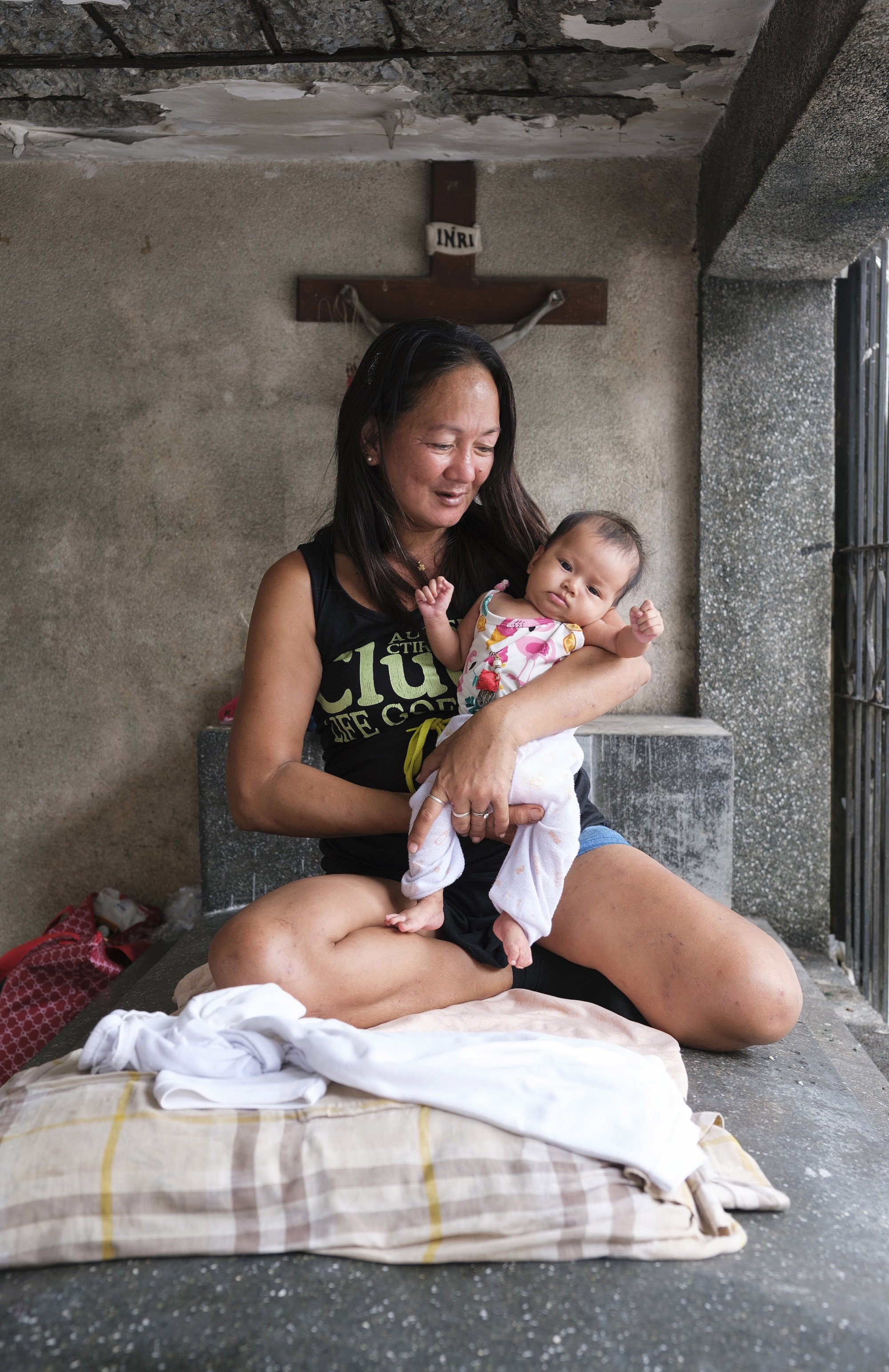
Melissa Peritore, from Sementeryo, 2024. Courtesy of Forum Austriaco di Cultura Roma.
The intimate show offers insight into the lives of dwellers who face a real lack of public housing. During her visits, Peritore identified the shops and businesses for the living and marked them on the cemetery map, which hangs at the center of her exhibition at the Forum Austriaco di Cultura. “It is common to see people living on the street, including newborns, staying in the chaos and smog,” Peritore says. “Entering the cemetery is like finding yourself in a village, but it’s way more peaceful.”
Melissa Peritore’s photos are on view at the Forum Austriaco di Cultura in Rome until March 13, 2026.