
.jpg)
.webp)

Tim Kent: “Sojourn” at Hollis Taggart
Review
Horror at Sprüth Magers builds on Mike Kelley’s seminal project The Uncanny, which Kelley described as “somewhat a joke on the idea of site-specificity as a gesture of ‘resistance’.”[1] Despite Kelley’s history of site-bound work, The Uncanny adopted a more museological approach, presenting a collection of discrete objects. Horror grapples with this inherited bind through artworks that largely contain built-in implicatures of their display—support structures that are inseparable from the work or engage the gallery’s architecture—privileging works that are simultaneously potent, contained within, and, like all good horror films, bleed into the viewing apparatus itself.
Curated by artist Jill Mulleady, Horror pulls the cinematic genre into representations of lived terror while asking how art, and the devices that make it legible, translate fear into something consumable. Its range of sublimated states deliberately lingers between staged fright and historic atrocity—unnervingly without resolution—as a condition that moves through images, objects, and the institution, producing a dread that lives among us. For example, Kelley’s Odalisque (2010) lies stiffly atop a chaise lounge on a support seemingly ready to roll away. Beneath Bumper Car and Hobby Horse (2011), exposed plywood plinths underscore terror as inseparable from its aesthetic condition. Paul Thek’s Meat Cable (1969), suspended in a corner, literalizes flesh as conduit. By contrast, entirely void of stabilizing forms, Karen Kilimnik’s Lunatic Asylum (1992) scatters a black candle, a bedsheet, symbols unmoored from playing cards, and straw littered along a low windowsill.
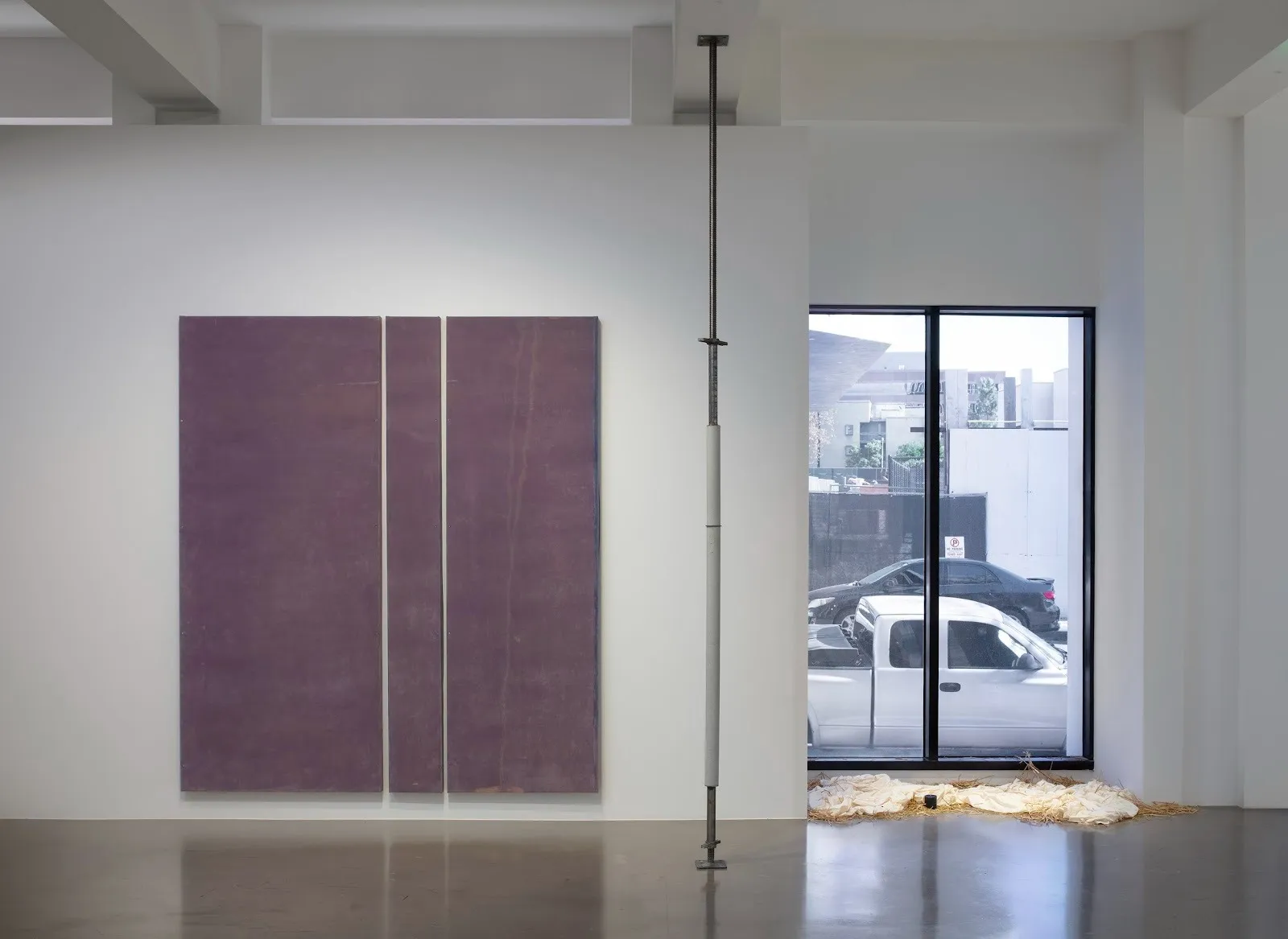
Horror permeates the gallery’s architecture. Mire Lee’s floor-to-ceiling Poles (2025), remaining from the previous exhibition, punctuate the lower level where, horror of horrors, the call is coming from inside the house. Jordan Wolfson’s modular points in Spike Panel (2025) impale the wall they rest on and thrust outward toward the viewer, slipping between weapon and artwork. Seeping into the installation’s infrastructure, works can be found in an upstairs office, while Mati Diop’s foreboding track Yelwa (2019) plays in the stairway. The gallery itself becomes a carrier of dread.
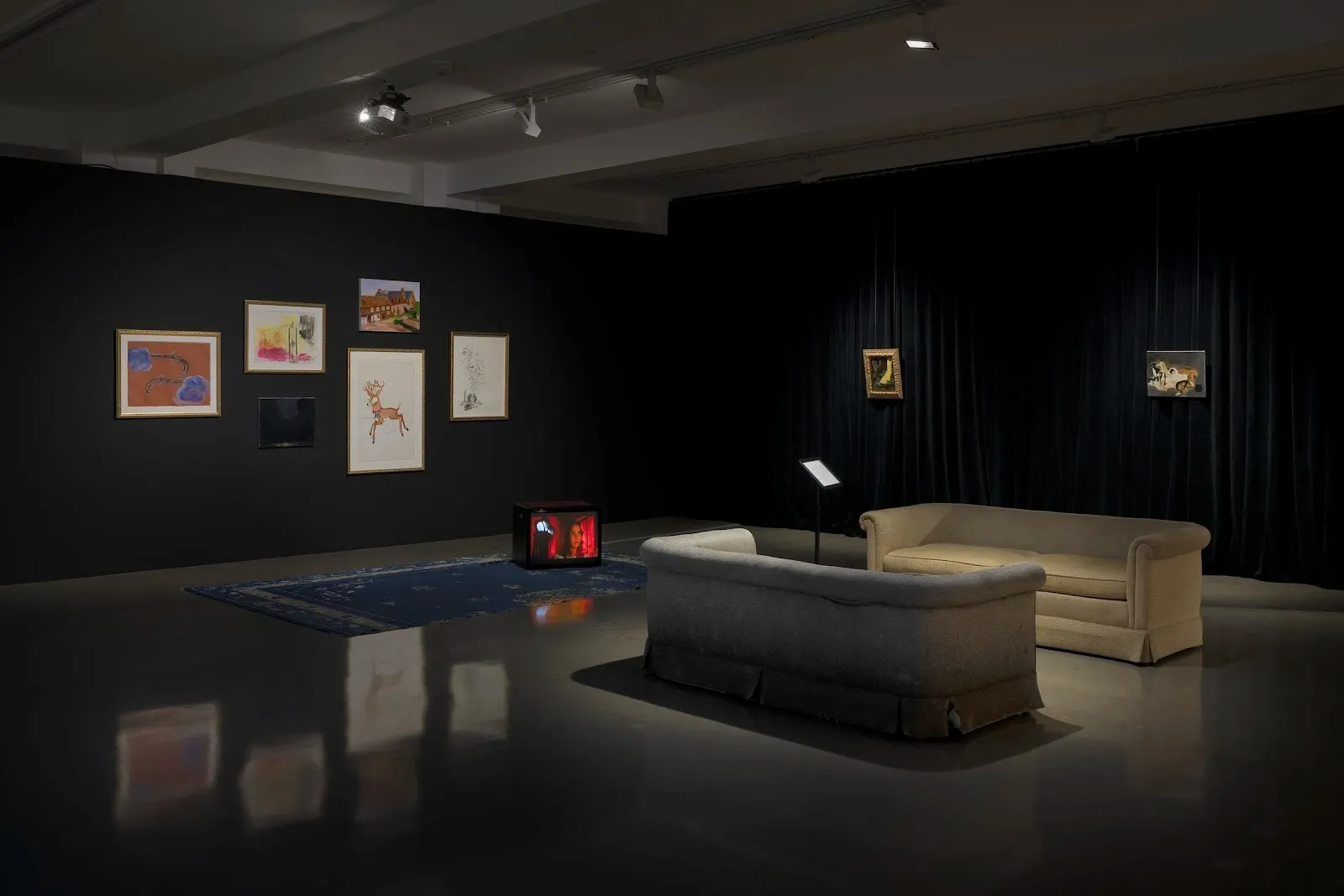
Throughout Horror, the film industry serves as both backdrop and generator of fright. Costumed and theatrical, Jonathan Glazer’s rejected pitch for a Cadbury Flake commercial (2010) appears in proximity to the dark humor of Harmony Korine’s canned acting in Curb Dance (2011). Cinema surfaces again in Henry Taylor’s figure slumped at a desk (2025), conjuring the diabolical mantra of all work and no play, while the original 1977 film Suspiria plays in full on a severed domestic rug, its remaining half casually rolled behind a partitioned wall.
At several points, cinematic stylization reaches its limit in the presence of lived violence. Reflected in the omnipresent voids on a monitor playing Mike Kelley’s Bridge Visitor (Legend-Trip) (2004), Arthur Jafa’s charred afterimage of a brutalized silhouette in Ex-Slave Gordon (2017) bears the weight of historical violence, leaving discomfort intact. Duration may sharpen fear, but only when threat remains imaginable, deferred between anticipation and recognition. When violence is fully realized or historically fixed, time no longer heightens fear but instead lays bare the limits of prosthetic suspense.
Throughout, bodies are reduced to parts, interiors exposed, fact and fiction blurred, as abjection prods the porous skin between life and death. At this seam, the exhibition locates the true site of fear in its residues of decomposition and after-shock recoil. Tyler Mitchell’s two photographs (2022) capture figures succumbing to the sludge of the earth, while Sondra Perry’s lenticular Flesh on Flesh (2021) collapses surface and signal. Cyprien Gaillard’s wall-mounted panels in Life in the cracks (2025) read as deconstructed coffins lined with stained velvet, where small embroidered skeletons carry out the labor of death along their edges. Bruce Conner’s SHRINE (1961) is an altar-like assemblage of a real human skull and jaw, candle, and wooden shadow box. Scenes of disfiguration, decomposition, and thanatological ritual abound.
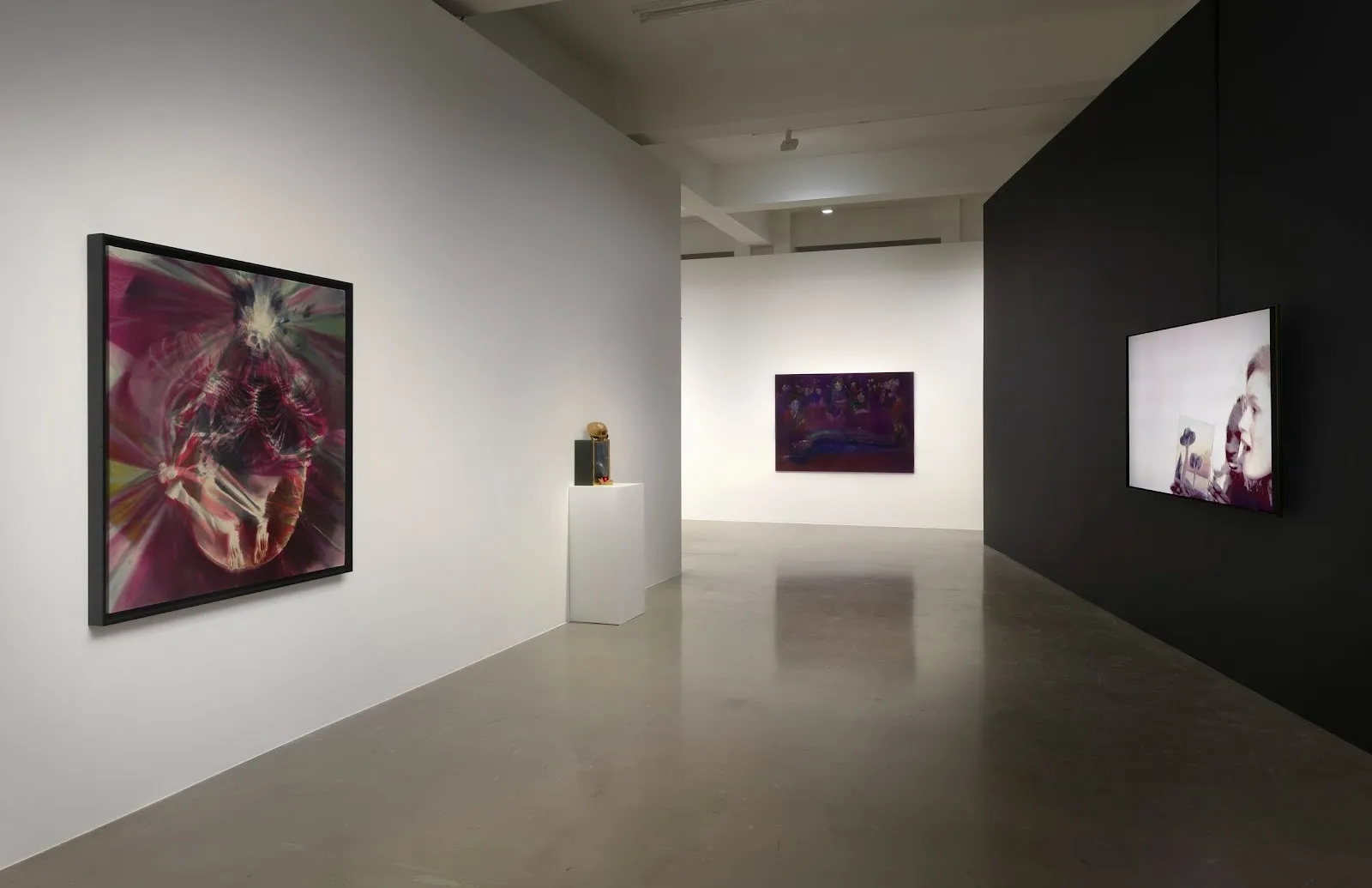
In a radio séance recorded shortly before his death, Antonin Artaud’s To Have Done With the Judgement of God (1968) muses on the organless body. Elsewhere, the supernatural surfaces vividly, where explanation curdles, such as Andra Ursuța’s Old Maid (2023), a prismatic shaman-skeleton in a cradle, or Kilimnik’s bewitched cluster of drawings and paintings where enchantment and menace remain inseparable.
Like an unwaking nightmare, the instinct to escape only leads to more horror, forcing the viewer to ripen their capacity to stay with—the only way out being through. Anne Imhof’s motion-blurred deer, Untitled (Bambi) (2002–18), runs endlessly on a loop from an unseen predator. Animals recur, claws and hooves slipping between innocence and threat.
Diego Marcon’s TINPO (2006) offers an intimation of familicide, its cuts and stalls mimicking the disorientation of traumatic memory. Fear continues to breach the domestic in Ottessa Moshfegh’s paired couches of Untitled (2025). Here, an accompanying text recounts their origin in a Pasadena home where one was abandoned outdoors to endure wildfire and flooding, and its twin was left inside. Though the indoor sofa appears intact, material testing detected toxic residue within the home.
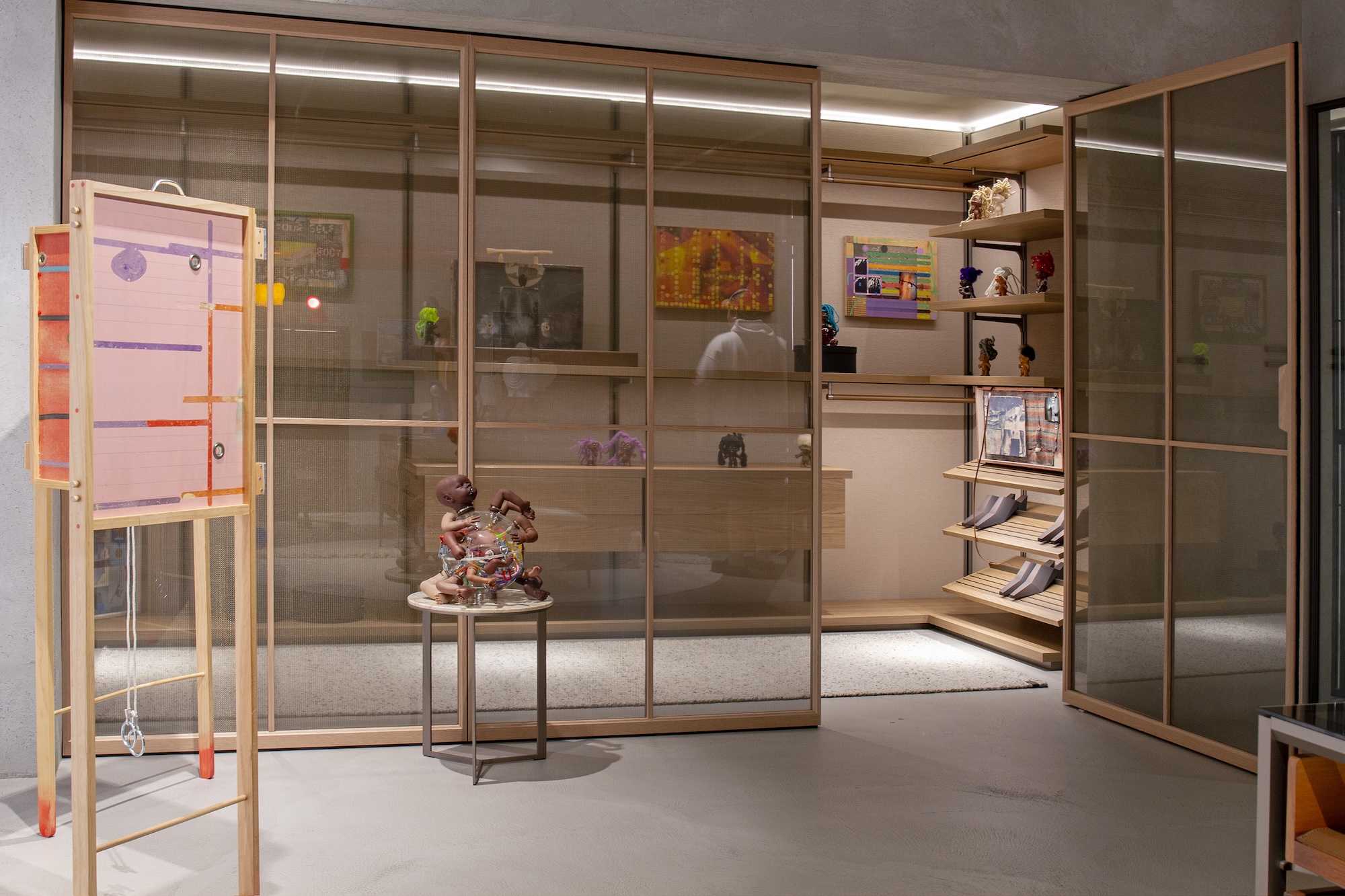
Childhood proves a ready scene for horror’s first encounter. Precious Okoyomon’s Hold me in my inner room (2025) embeds a doll’s face within the body of a worn plush rabbit, recalling the psychoanalytic notion of transitional objects that move from adored and abused to diffused “across the cultural field.”[2] Somewhere between a birthday party and a baby shower, Rosemarie Trockel’s Manus Spleen 3 (2001) records the manic delight of a sudden birth in reverse through repetition and hypnotic thrum.
Mulleady’s own paintings mark the artist’s curatorial authorship, reflecting themes and figures from neighboring works. Taken together, the exhibition edges toward a socio-political condition in which violence is packaged as spectacle and rendered consumable for control and profit. When the show’s text positions empathy as its ethical horizon, however, it risks bypassing the bent pleasure and extractive economies of mediated terror. Here, critique itself circulates as institutional currency, moving without friction once legible and for sale.
I bought the merch on the way out.
Horror is on view at Sprüth Magers from November 21, 2025 through February 14, 2026.
* Mike Kelley, From My Institution to Yours (MIT Press, 1999).
[1] Mike Kelley, “A New Introduction to The Uncanny,” in The Uncanny, ed. Christoph Grunenberg (Buchhandlung Walther König, 2004), 9–12.
[2] D.W. Winnicott, “Transitional Objects and Transitional Phenomena,” in Through Paediatrics to Psycho-Analysis (Basic Books, 1958), 233; cited in Mike Kelley, ed., The Uncanny (Buchhandlung Walther König, 2004), 18.






%20.jpeg)