Spectacle and Intimacy: Claudia Bitrán’s Remake of “Titanic”
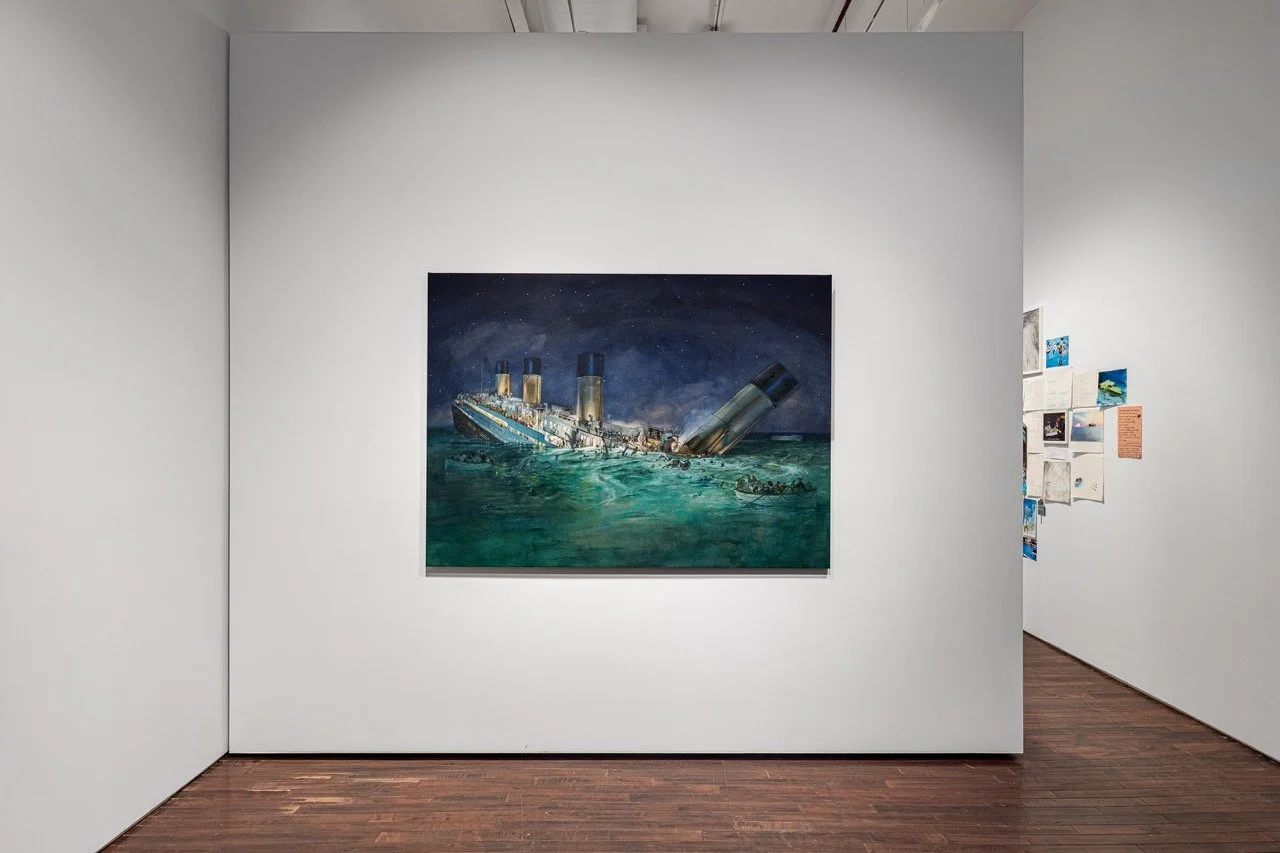
Installation view of Claudia Bitrán, Sometime Between 2:15 and 2:17, 2026. Oil on linen, 55 x 74 inches. Photograph by Mikhail Mishin. Courtesy of the artist and Cristin Tierney Gallery, New York.
Nearly thirty years after its release, James Cameron’s Titanic (1997) remains a source of inspiration and critical examination. A Titanic enthusiast, artist Claudia Bitrán (b. 1986) has recreated the film scene by scene with both love and scrutiny. Developed over twelve years, the resulting work, Titanic, A Deep Emotion, marks its New York premiere at Cristin Tierney Gallery.
In the opening painting, Sometime Between 2:15 and 2:17 (2026), the enormous ship is half-submerged. The beautiful turquoise of the ocean and the glitter against the dark expanse lend the scene an eerily romantic tint. But upon closer scrutiny, one can see a swarm of human figures struggling to get out of the sinking ship in desperate gestures. Installed on a wall that blocks the rest of the exhibition from view, the painting suspends the viewer in a state of unease between a tension-filled moment and the tragedy it embodies.

Claudia Bitrán, Titanic, A Deep Emotion Production Wall, 2013–25. Mixed media, dimensions variable. Courtesy of the artist and Cristin Tierney Gallery, New York.
With Titanic, A Deep Emotion Production Wall, Bitrán further stirs up a sense of awe, though in a completely different manner. In contrast to the opening painting’s grand, historical scope, the production wall insists on the minutiae. Hand-drawn storyboards, production notes, and miniature models spread across the wall, forming the silhouette of the giant vessel. By materializing the labor behind the project and displaying it at full scale, Bitrán emphasizes that it is the accumulation of human time and effort that makes something as grandiose as a ship of dreams possible.
Right across from the production wall stands the centerpiece of the exhibition: a three-channel video installation of Bitrán’s shot-by-shot remake. A visual collage of live action, stop-motion animation, and backstage footage, Titanic, A Deep Emotion is punctuated by traces of artifice and improvisation. Unlike Cameron, who was operating with a production budget of around $200 million, Bitrán relies on grants, artist residencies, exchanges of favors, and her own money to realize her vision. Because of and in spite of financial and technical constraints, Bitrán experiments with many different forms and approaches. She uses recycled materials to create props and sets, and films scenes that remind her of Titanic on city streets. Hence, we see a ship made of McDonald’s boxes and egg cartons grazing a pile of crumpled paper, while a cloud of steam rising from the orange-and-white pipes in New York City stands in for the smoke of the Titanic’s funnels.
Lo-fi materials and DIY approaches might make a film seem unserious or cheesy, but Bitrán pushes this playfulness to an extreme. By exposing her film’s imperfections, she renders its construction hypervisible, hinting at the often-overlooked fact that while Cameron’s Titanic may appear more authentic and convincing due to artistic and technical polish, it is built on spectacles and fantasies no less constructed.
High-production movies are good at alluring viewers into formulaic narratives that can be easily consumed and romanticized. The story of Rose and Jack, originally played by Kate Winslet and Leonardo DiCaprio, is one prime example. Stripped of lavish production design and its star-studded cast, Rose and Jack’s relationship is an archetypal love affair between a troubled white woman and a heroic white man at its core. But Bitrán trenchantly rejects such simplified narratives. In her remake, Jack is played by actors of different ages, genders, and ethnicities. While Rose is consistently played by the artist as an anchor, the story of love no longer belongs to a stable pair. Fixed gender roles and heteronormative expectations give way to queer desire and alternative modes of intimacy and connection.

Still of Claudia Bitrán, Titanic, A Deep Emotion, 2013–24. Three-channel video installation, dimensions variable. Courtesy of the artist and Cristin Tierney Gallery, New York.
Bitrán’s open display of the film’s construction turns the viewer’s attention to the people behind the scenes and their labor. One can find Bitrán’s ten-year-old cousin, Jack, re-enacting the “Spit Like A Man” scene in Spanish, and swimmers in handmade costumes performing a unified choreography drawn from both their own routines and the original film. Ranging from the artist’s family and friends to those recruited from the public space, over 1,400 people have participated in the project. In Bitrán’s Titanic, creative collaboration takes precedence over single authorship.
The behind-the-scenes show one actress calling the script of Titanic “a complete horror show” and admitting that she cannot stand delivering the lines straight. Accidents take place, both unhappy—a camera operator accidentally falls into the pool—and happy ones—an actress playing the elderly Rose repeatedly replaces the word “ocean” with “emotion” in the line: “A woman’s heart is a deep ocean of secrets,” which inspires the work’s title. These moments bring more truthful voices and feelings into Bitrán’s work. In Bitrán’s hands, Titanic is no longer a mere spectacle for audiences to consume at a safe distance. Through open-ended experimentation and collective collaboration, she rips open Cameron’s original with a heightened sense of intimacy and rawness.
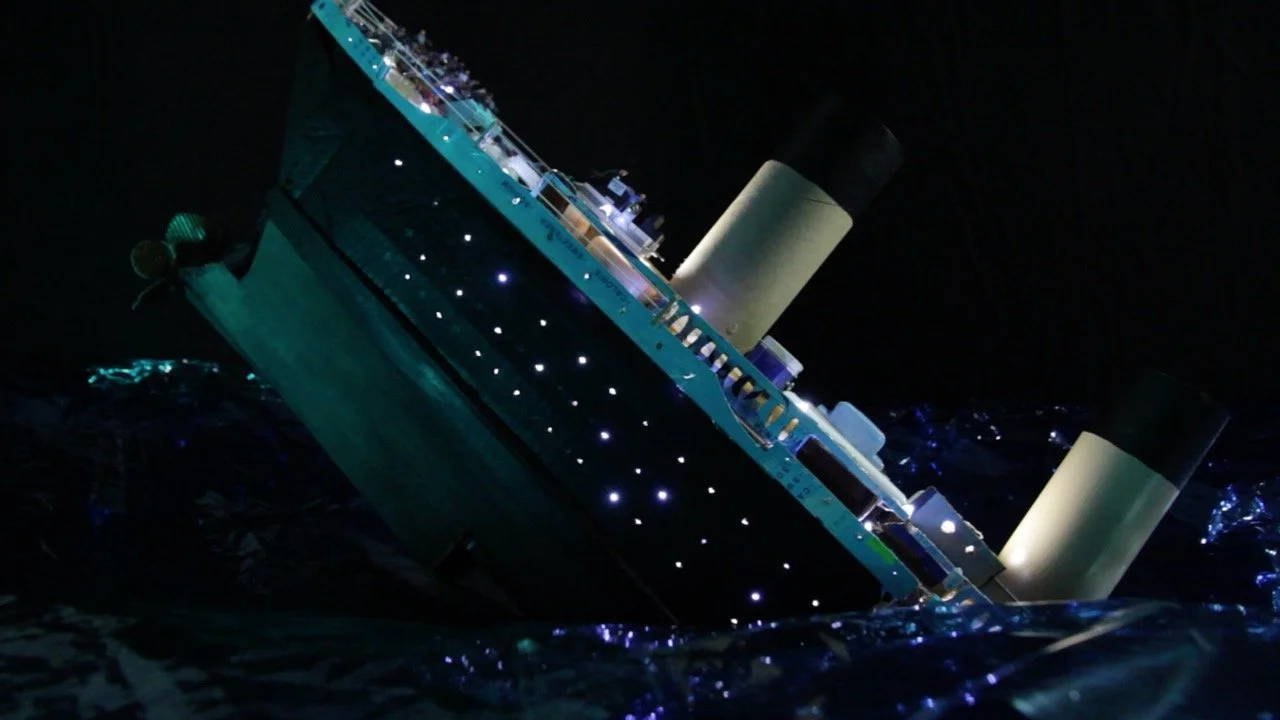
Claudia Bitrán, Cardboard Titanic Model, 2023. Archival print, 9 x 13 inches. Courtesy of the artist and Cristin Tierney Gallery, New York.
Titanic, A Deep Emotion is on view at Cristin Tierney Gallery, New York, from February 20 to March 28, 2026.