
Looking Past Revulsion
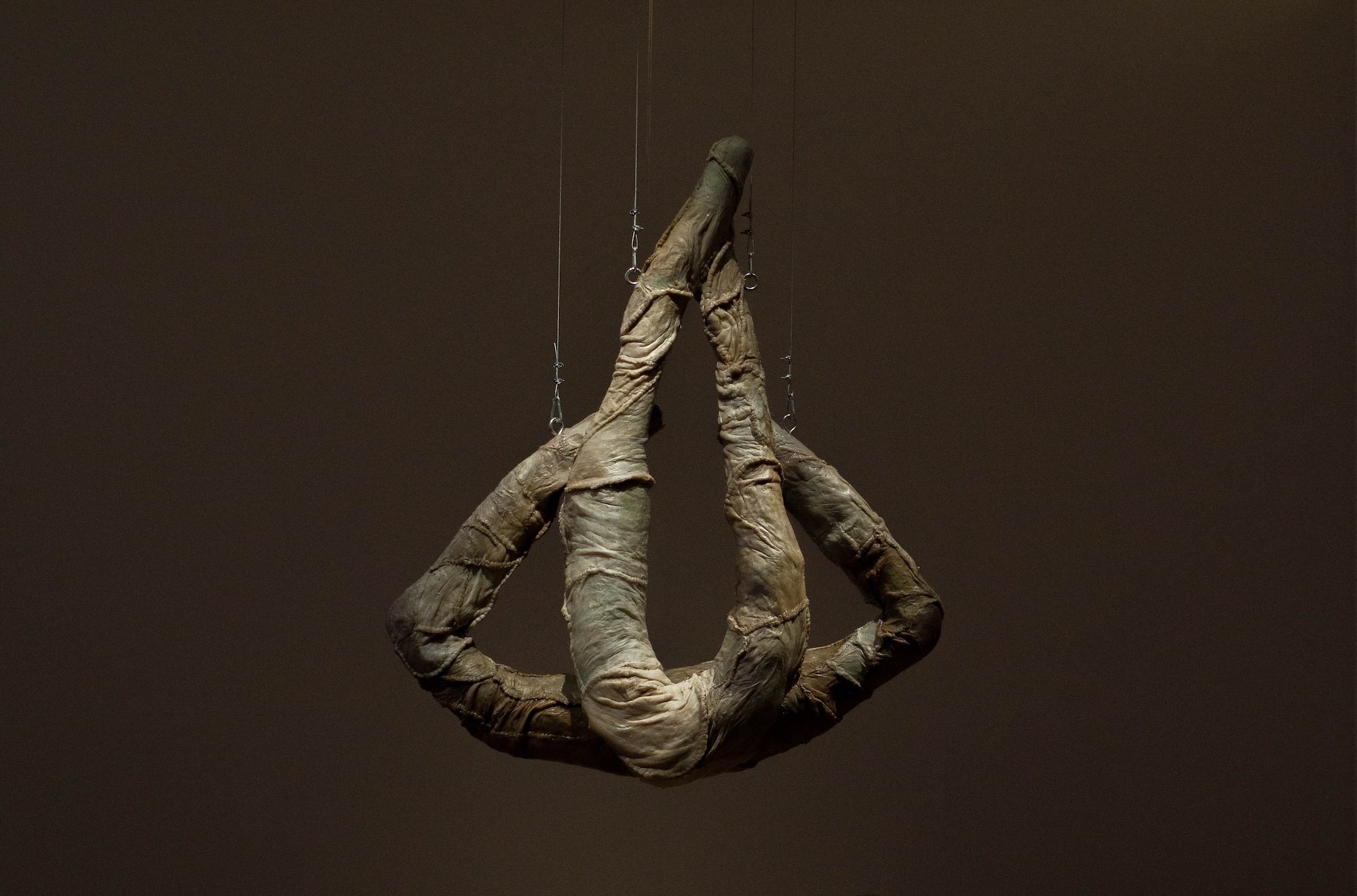
Anna Ting Möller, In Tandem (2025). Photo: Kaelan Burkett. Courtesy of the artist and MASS MoCA.
I saw Anna Ting Möller’s In Tandem (2025) in the show Dirty & Disorderly: Contemporary Artists on Disgust at MASS MoCA last year. Möller’s installation and artworks by New Red Order and Nguyễn Duy Mạnh triangulate each other across a small, blacked-out gallery. The artworks on display appear to float in the dark space, inviting the viewer to get closer and examine what curator Riley Yuen articulated as “[artists’] use of the aesthetics of disgust to understand the social construction of putrid and squalid things.” In Tandem hangs from the ceiling. It’s a “body” but not quite. A closer look reveals that it is actually two forms situated very close to one another, overlapping and seemingly merging. Its two parts are structurally unattached to each other, yet their weird proximity initiates a silent inquiry into the nature of wholeness.
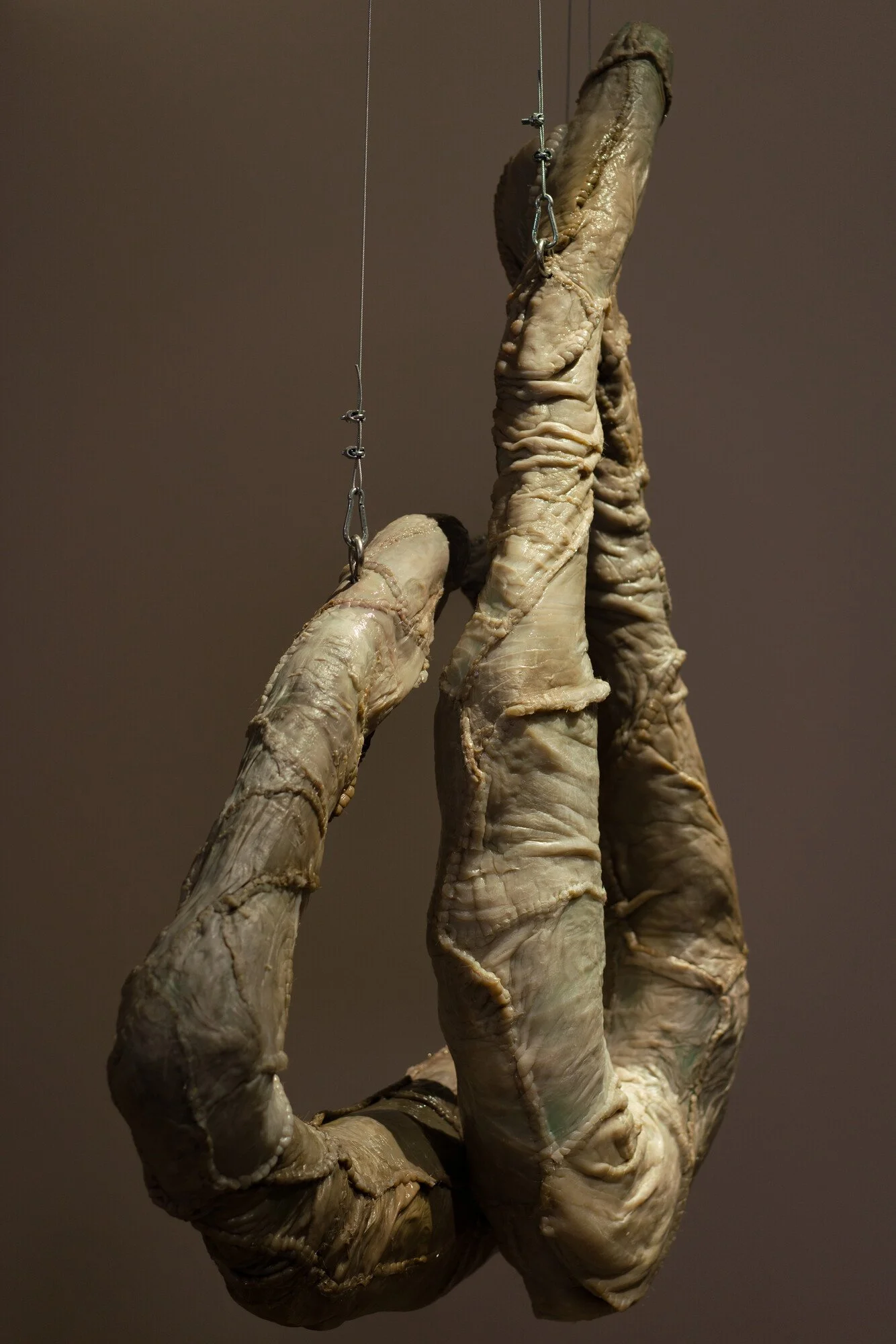
Anna Ting Möller, In Tandem (2025). Photo: Kaelan Burkett. Courtesy of the artist and MASS MoCA.
The putrid, the squalid, the abject, the uncanny, the repulsive, the gory, and the grotesque form a bouquet of physical sensations that have been picked and probed since the dawn of civilization. In recent memory, they were used as a device for critique by feminist artists of the seventies, and then they went on to be activated by a variety of practitioners in the humanistic fields throughout the explosion of queer theory in the nineties and beyond. Disgust-ing became fashion and established a discourse while its referent bore the expectation to stand still and repulse. In her curatorial text, Yuen argues that disgust is an immediate and powerful emotion that political and cultural institutions often exploit. In this exhibition, however, the making of disgust as such goes unchallenged.
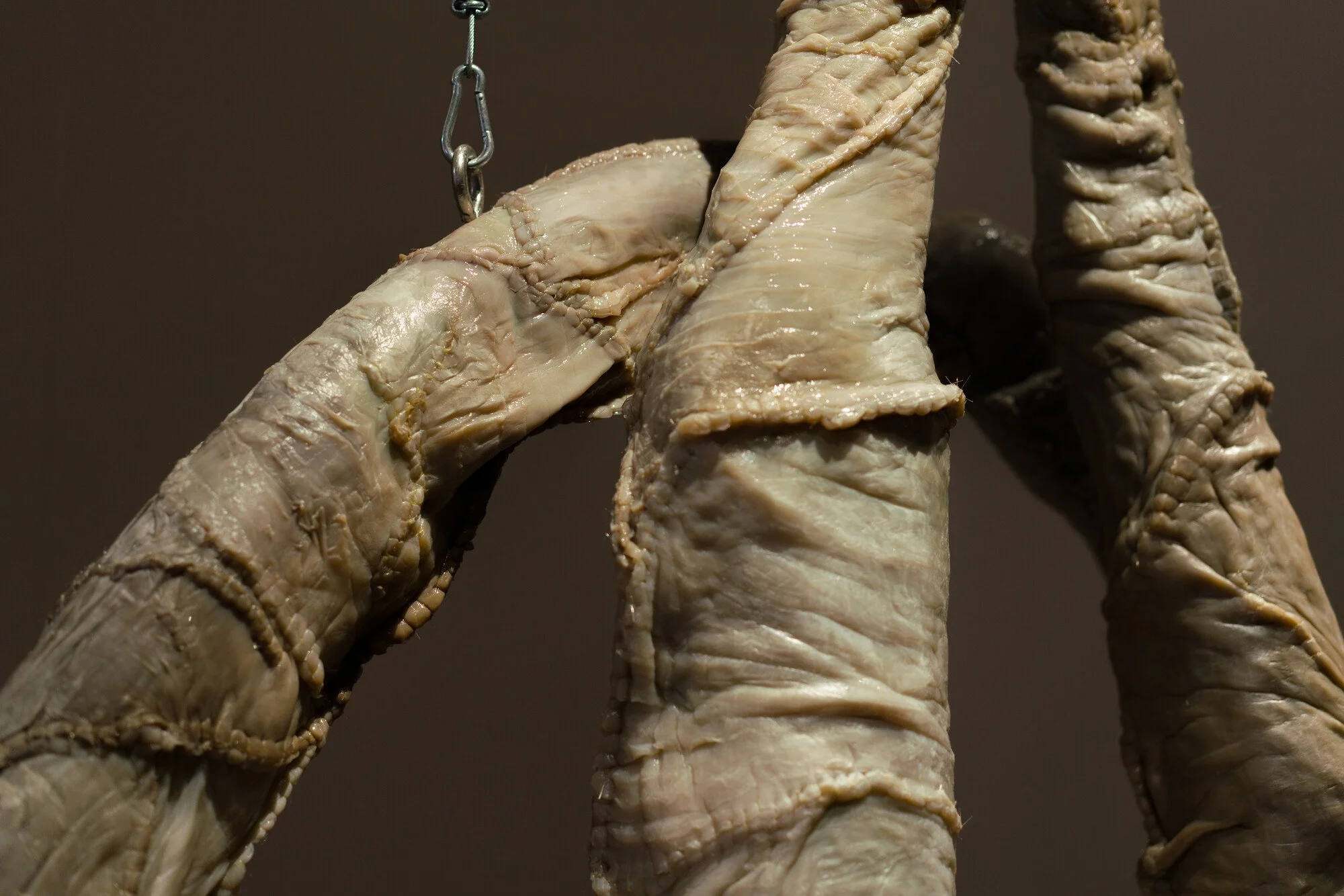
Anna Ting Möller, In Tandem (2025). Photo: Kaelan Burkett. Courtesy of the artist and MASS MoCA.
Spending time with In Tandem disrupts the idea that the work provokes disgust. The longer I look at it, the harder it is to remember feeling any aversion to the hanging, motionless mass. Its monumental shapes are made of long, cylindrical forms that are bent: one bends in a narrow, vertical curve, forming a tear shape, while the other bends toward the horizon in an almond shape. What makes me want to call these shapes “bodies” is that they appear to be covered with skin, a displaced quilt of fleshy-looking material composed of patches joined with nylon string in a blanket stitch. This is no blanket; the flesh material is pulled into itself, and it sags, which makes it look even more like skin—boiled, oily, tanned, or wrinkled. It is drenched. The entire body is dripping—is it sweat? Is it formaldehyde? Is this body kept dead or alive? Möller’s provocation in In Tandem and throughout her practice (she spends years maintaining a SCOBY, out of which she produces sculptural objects) is not to turn away in revulsion but to inquire about the care that goes into this thing that exhibits traces of life in its most endangered and dependent state.
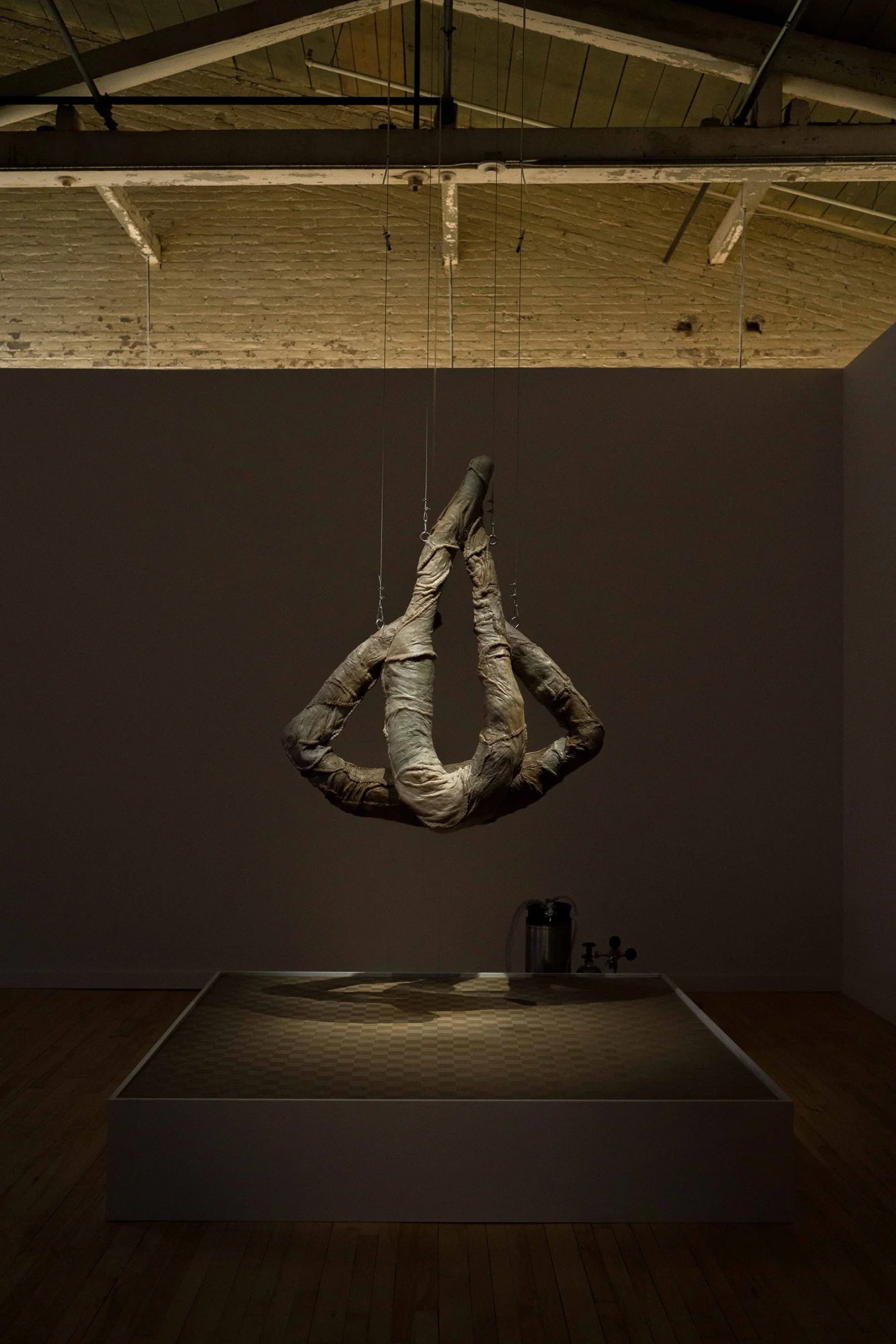
Anna Ting Möller, In Tandem (2025). Photo: Kaelan Burkett. Courtesy of the artist and MASS MoCA.
In spoken English, “in tandem” describes things happening together or in conjunction. The Latin tandem, however, referred to time rather than space, meaning “at last” or “eventually.” English usage playfully reworked the term, applying it to horses hitched one behind the other in a carriage—lengthwise, in sequence. From this spatial image, the phrase “in tandem” emerged. Möller’s use of the phrase to name her installation here indicates a consideration of space and time, and in earnest. The two bodies are certainly not conjoined, yet the way they relate to each other in space is strange. The work seems to pursue the elusive value that makes the whole greater than the sum of its parts. Their spatial relation introduces a sense of depth that also recalls diachronic time: one body after another. One must precede the other; one becomes the result of the other. Together they form a single, paradoxical body-in-tandem. This whole body is an aggregate of limbs; there’s no torso, just gigantic limbs that are permanently frozen, crawling up into the air. At times, however, the form appears strangely flat. In those moments, I no longer see a body but an image: a monumental and mysterious sign that communicates indeterminate meaning with its opaque outline.
Dirty & Disorderly: Contemporary Artists on Disgust was on view at MASS MoCA from February 1, 2025 to January 4, 2026.
