Leah Dixon: “Sky on the Floor”
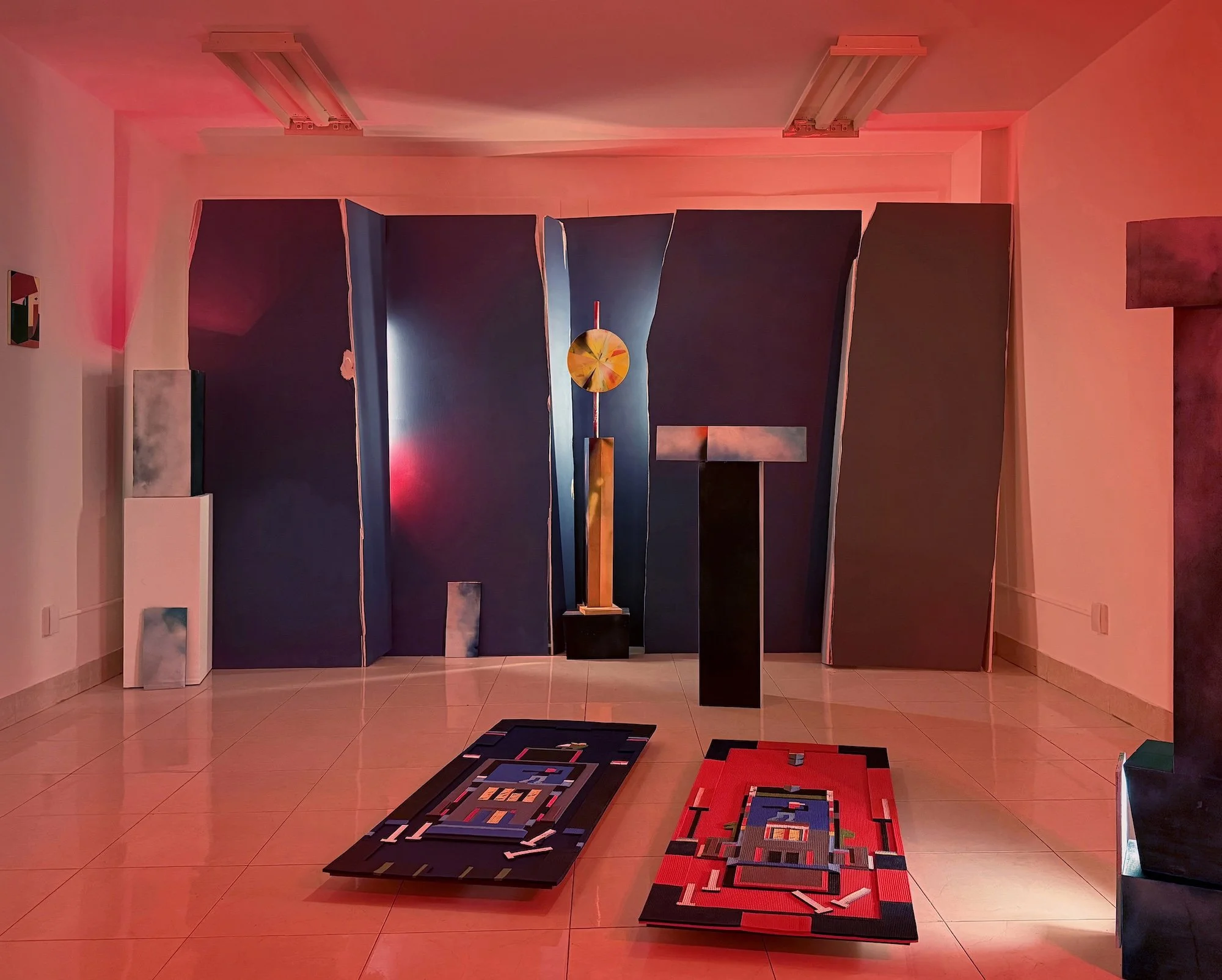
Installation view of Leah Dixon: Sky on the Floor. Courtesy of the artist and Underdonk
Leah Dixon’s solo exhibition Sky on the Floor at Underdonk questions society’s fixation on permanent monumentality and how architectural symbols make meaning in cultural contexts, not just spatial ones. Inspired by Afghan war rugs, which turn militant imagery such as planes, guns, and even tanks into decorative and narrative motifs on utilitarian textiles, Dixon has been creating what she calls “American war rugs” out of yoga mats for over ten years. The two American war rugs in the show are predominantly black and red, geometrically rendered as two buildings poised for imminent collapse. The bottom half of the rugs communicates precarity with falling columns. And on the upper mezzanine of each building appears a figure—one that, according to Dixon, falls into a limbo of interpretive possibilities in today’s political climate and general atmosphere of civil mistrust. It could evoke Thomas Crooks, counter-snipers, or even stand in as a personification of all that is on the verge of falling. Details such as the Ukrainian national flag’s color scheme, a helicopter, and a cartouche that resembles a war emblem relate these two pieces to a world stage in which civilian life is inextricably entangled with global tension. With these symbol-laden visual cues juxtaposed against the yoga mat material, which serves as a constant reminder of a kind of wellness culture uniquely powered by capitalism, the slippage of meaning results in a slippage of a sense of safety.
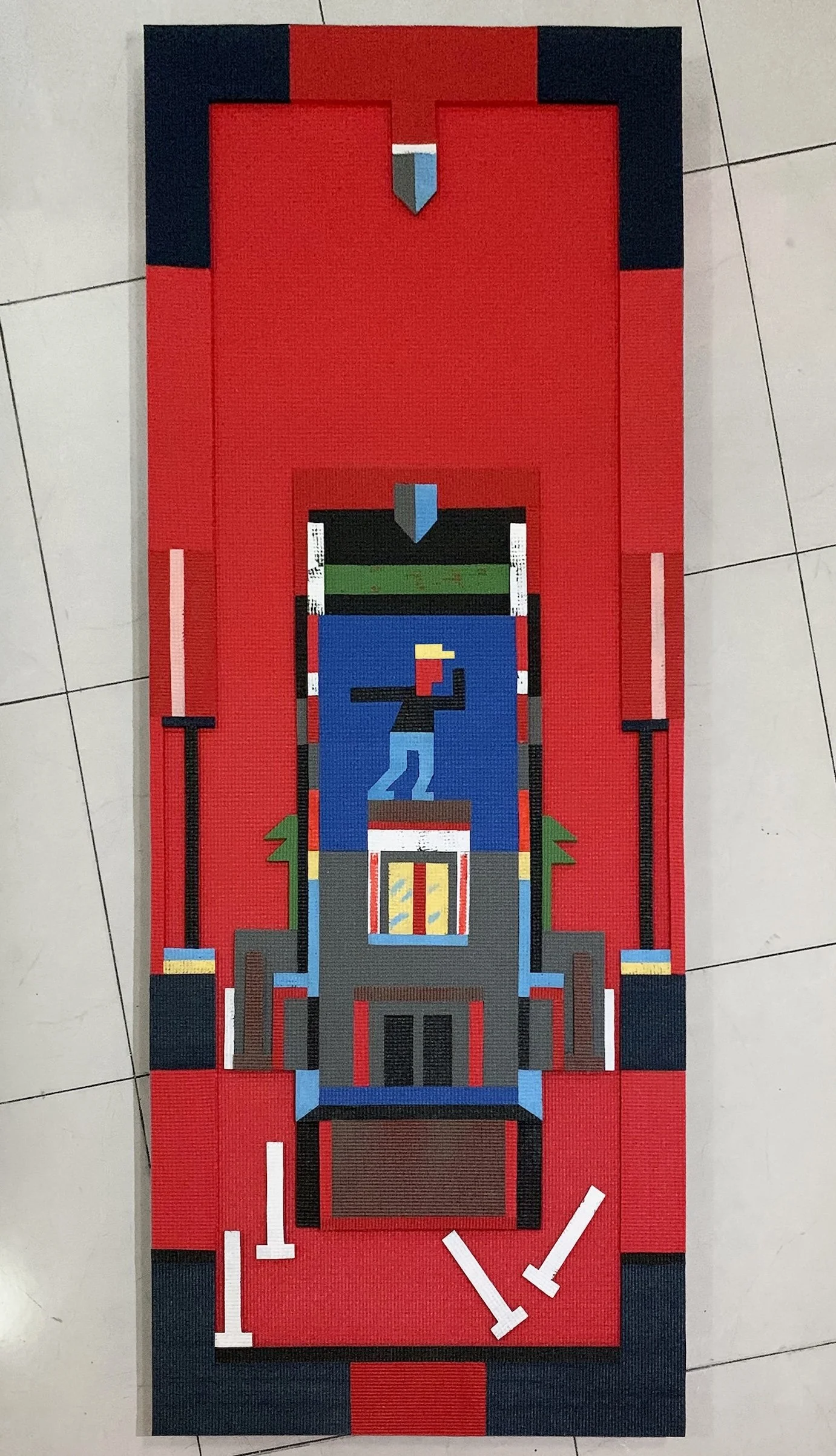
Leah Dixon, America War Rug (2025). Courtesy of the artist and Underdonk
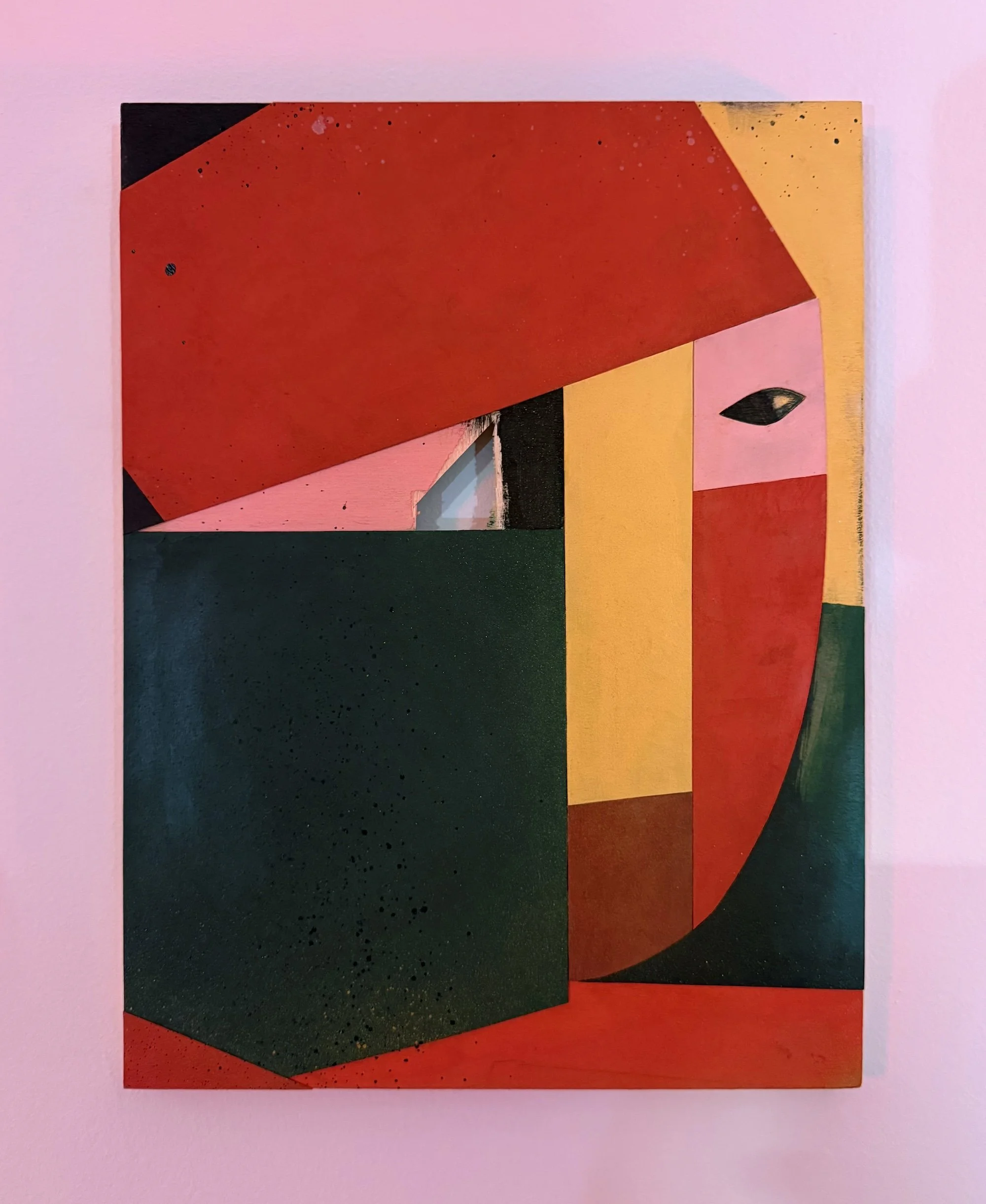
Dixon’s sculptures, on the other hand, bear a sense of formal simplicity and verticality. Their surfaces are finished with pigment and colored LED lights. Their edges are oftentimes left raw, and their anatomies are simple and column-like. Notably, many woodboards used in these sculptures had been repurposed from Dixon’s earlier sculptures, both for pragmatic concerns about storage space and as a parallel to how buildings and monuments (think: the city of Babylon, the Twin Towers, the Parthenon, etc.) constantly undergo transformation in their structure and relationship to the public. In a way, Dixon’s three-dimensional works are characterized by material permanence and formal impermanence. The act of assembling, then, becomes a durational performance, folding destruction, lapsed time, revisions, and an aesthetic of incompletion into the configuration of space.
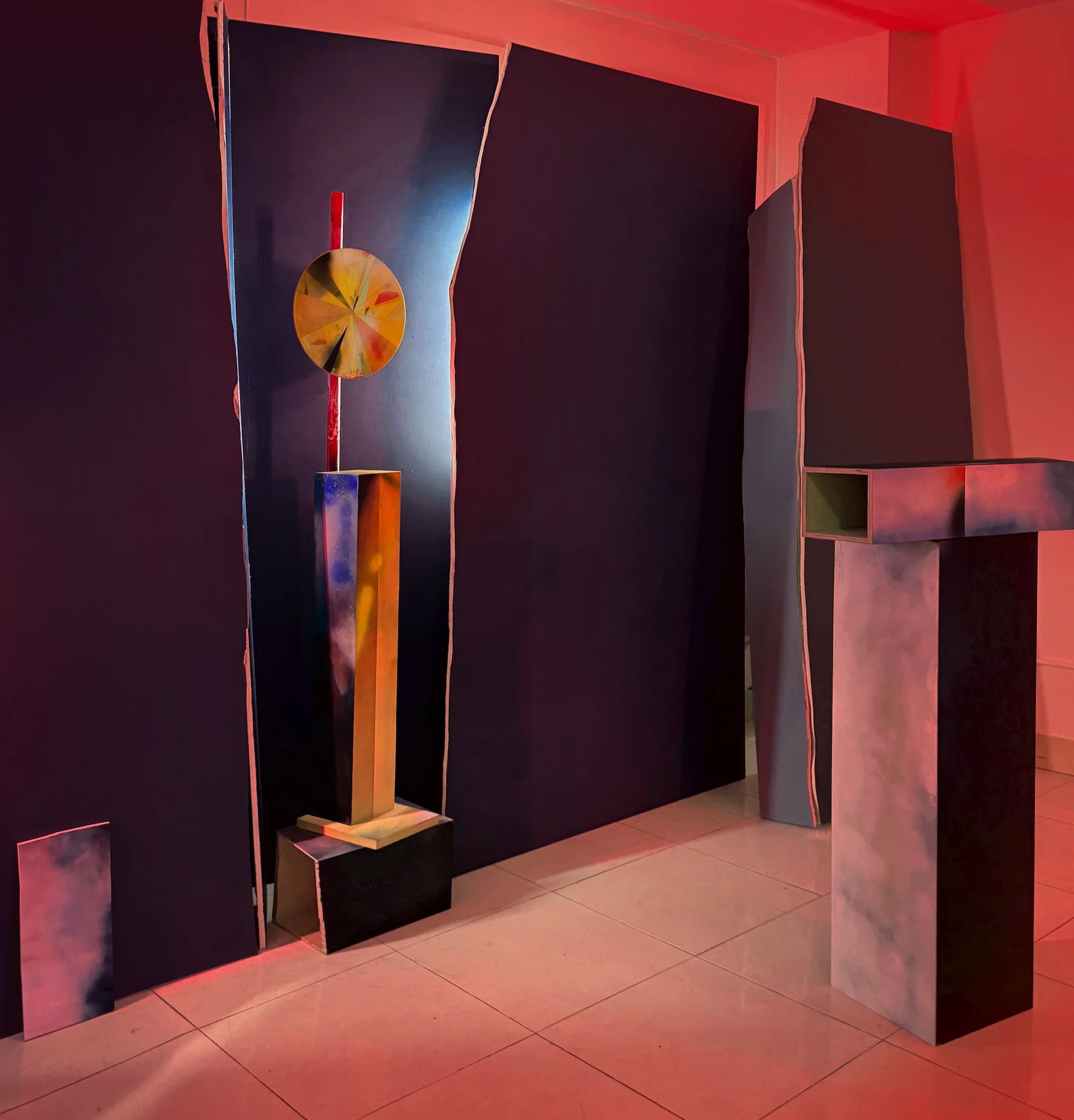
Installation view of Leah Dixon: Sky on the Floor. Courtesy of the artist and Underdonk
To relinquish the fixation on finalized forms is also to redirect attention to labor itself. Dixon, who is the founder of BEVERLY’S, a LES-based exhibition space/bar for the art community, draws on nightlife and spacebuilding to create a movement-oriented layout that encourages an embodied way of experiencing the show. She mentions feeling reluctant about displaying works only on the wall, as it creates a linear relationship between the viewer and the works. Instead, the rugs are displayed at an angle to the floor tiles, human-sized sculptures triangulate the space, and colored light sources pointing towards various directions overlap in a manner that fundamentally defies the white cube format. Taken together, Dixon’s system of installation resists art’s self-preservationist logic and volunteers into an inevitable outcome of impermanence that is perhaps emblematic of all architectural formations, physical and ideological alike. Scaffolding is neither a failure state nor an exercise of patience. It is the natural condition of structures overwhelmed with meaning.
Courtesy of Leah Dixon and Underdonk
Leah Dixon: Sky on the Floor was curated by Alex Hammond and was on view at Underdonk, New York, from January 9th to February 1st, 2026.