Carole Harris’s “Threads of Time”
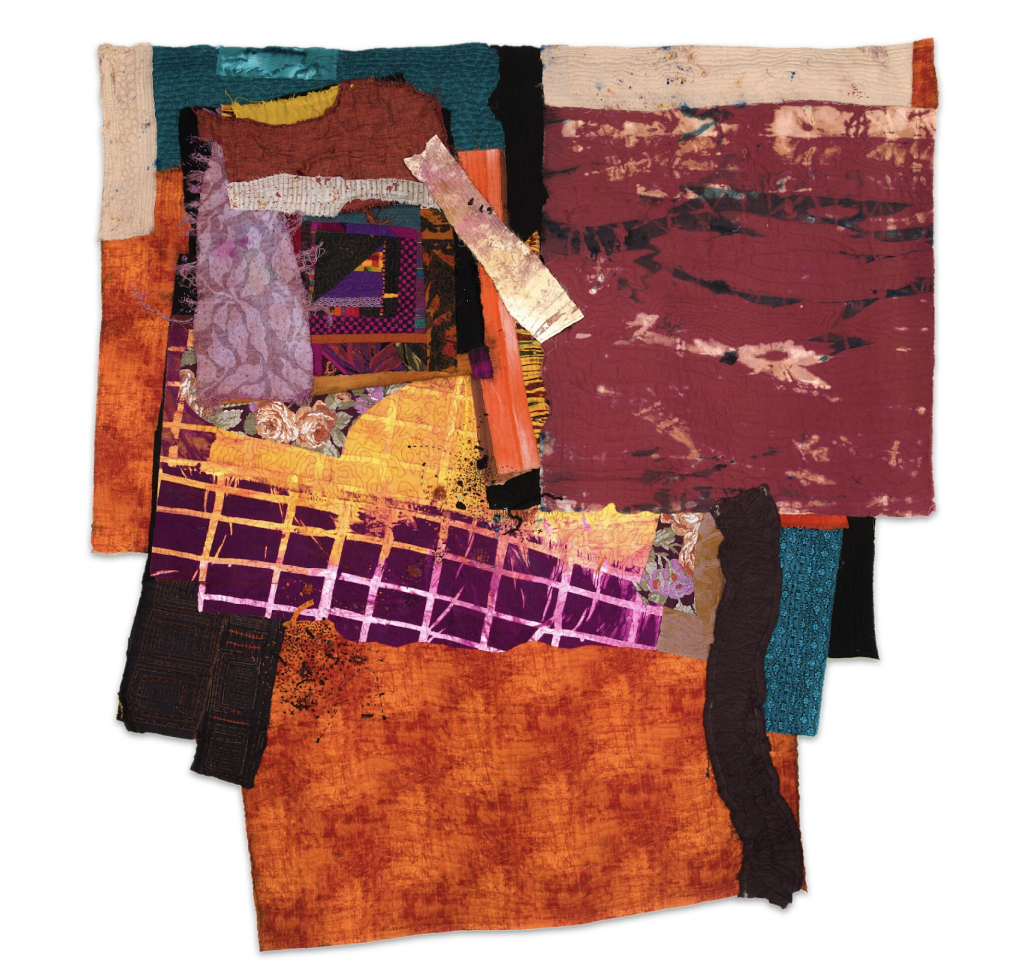
Carole Harris, The Time When, 2022. Fiber, 48 x 45 in. Courtesy of the artist. Photo credit: Eric Law.
Carole Harris’s Threads of Time is a survey of seventeen quilts by the Detroit-based artist, one of several exhibitions this season featuring Harris in her home state of Michigan. Harris’s solo exhibition, This Side of the River, will open at the Museum of Contemporary Art Detroit in the spring of 2026, and the artist opened a two-person exhibition at Matéria Gallery Detroit alongside Jova Lynne. Her robust Midwest exhibition history echoes the strong conceptual grounding intrinsic to each art object, with her largest influences being local artists. The exhibition title aptly gestures towards the essential time-based dimension of Harris’s practice, while many of her quilts formally reference a spatial dimension: the architecture of Detroit.
The cumulative process of quiltmaking is both time-consuming and labor-intensive. Each object’s rigorous creation is thus a passage of time in and of itself. The signs of age in Harris’s fast archive of fabrics are highlighted rather than obscured; aged textiles with frayed edges and sun-bleached pigment are used alongside graphic patterns. Harris occasionally exaggerates these aged qualities through a process of burning, tearing, and dying. The Time When (2022) showcases this process: oriented around a small square in the top left corner, traces of floral prints peak through asymmetrical cuts. Hand-dyed and assembled through sinuous, undulating boundaries, the time-worn features of each element become intrinsic to the work. The artist frequently applies dye through a handmade rust-based pigment, a nod to the passage of time in iron oxidation evoked by imagery of aging metal structures. The aforementioned dyes are created from found objects discovered on walks through her neighborhood. The work is focused not only on the temporal but also the physical space—a Detroit native, Harris’s work emulates the distinct architecture of her city with an ardent admiration.

Carole Harris, View From the Kitchen on Preston Street, 1999. Fiber, 36 x 63 1/2 in. Courtesy of the artist. Photo credit: Eric Law.
Post-industrial Detroit wears its history plainly in its Art Deco skyscrapers, residential duplexes, and overgrown lots, and works from Harris’s Cityscapes series make reference to the city’s environment through direct reference and memory. View From the Kitchen on Preston Street (1999), one of the first objects encountered in the exhibition, was given its title after the finished quilt inspired a memory of her childhood in the McDougall-Hunt neighborhood. In a 2024 oral history with BOMB Magazine, Harris called View from the Kitchen her first cityscape, revealing her conceptual emphasis on time and place via memory and home: “The shredded strips of fabric evoke the overgrown lots I used to play in as a girl—catching grasshoppers and picking wildflowers.” She has publicly expressed distaste for the “ruin porn” recklessly and gratuitously wielded in depictions of the Midwest city, instead applying the same appreciation for the life of her textiles to the life of her city: visible aging speaks to their extant vibrancy.
The works’ grounding in time and place is reflective of the associated traditions surrounding Black American quiltmaking. A craft passed down generationally within families and larger regional communities, quilts historically told stories of lineage and migration. The distinct style of quilting developed in the geographically isolated Gee’s Bend (Boykin, Alabama) illustrates the often vernacular and generationally determined nature of quilting: the larger community developed a unique visual language when a modernist sensibility was applied to historic quiltmaking traditions. Passed down within extended family units, quiltmaking relays history through technical tradition and aesthetic conventions.
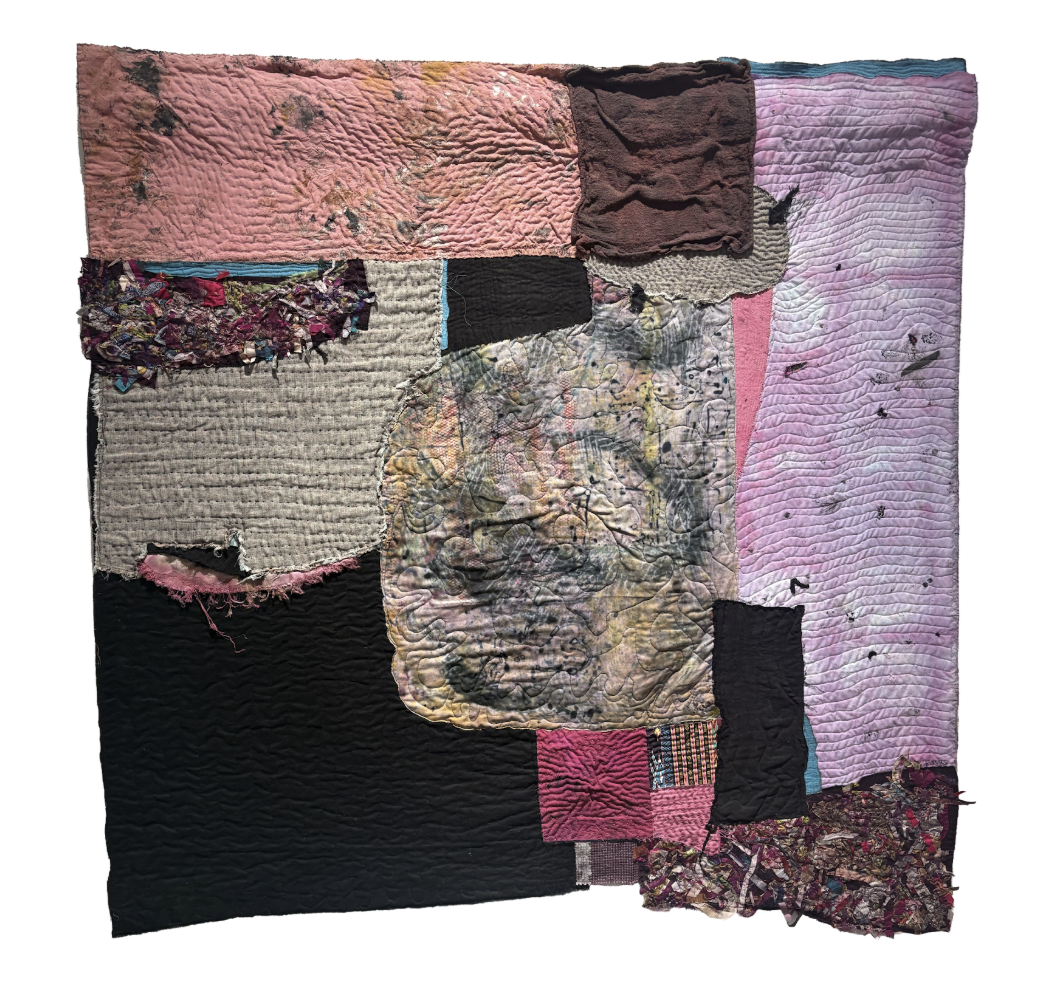
Carole Harris, Days, Journey into Night, 2024. Machine and hand quilted recycled cotton, linen, silk, tulle, and hand dyed cotton, 51 x 55 in. Gretchen Gonzales Davidson Collection. Photo credit: Eric Law.
While quiltmaking is foundational to her practice, Harris deviates from its traditional methodology on several key components. She does not adhere to a grid or symmetry: the forms within each quilt are organic and often sculptural, and protrusions off the surface are frequent. Days, Journey into Night (2024) features frayed edges dangled over the surface, accumulations of small scraps of fabric subtly protruding, and a quilted element that is intentionally ajar to its backing. Though her mother taught her how to sew, Harris developed her own quiltmaking practice as an adult, developing an idiosyncratic technique that is reflective of a broad interest in global anthropologies: Yoruba Egungun garments in color and composition, Japanese boro and sashiko techniques in layering and stitchwork, Korean joomchi in felting.
Flint Institute of Art’s survey provides a concise glimpse into Harris’s oeuvre. The seventeen quilts are organized semi-chronologically, with associated works grouped, illustrating a clear shift from chevron to boro. A focus on memory and commitment to quiltmaking remain steadfast through noticeable technical shifts, and Threads of Time manifests as a reflection on what changes and what remains through the progression of time.
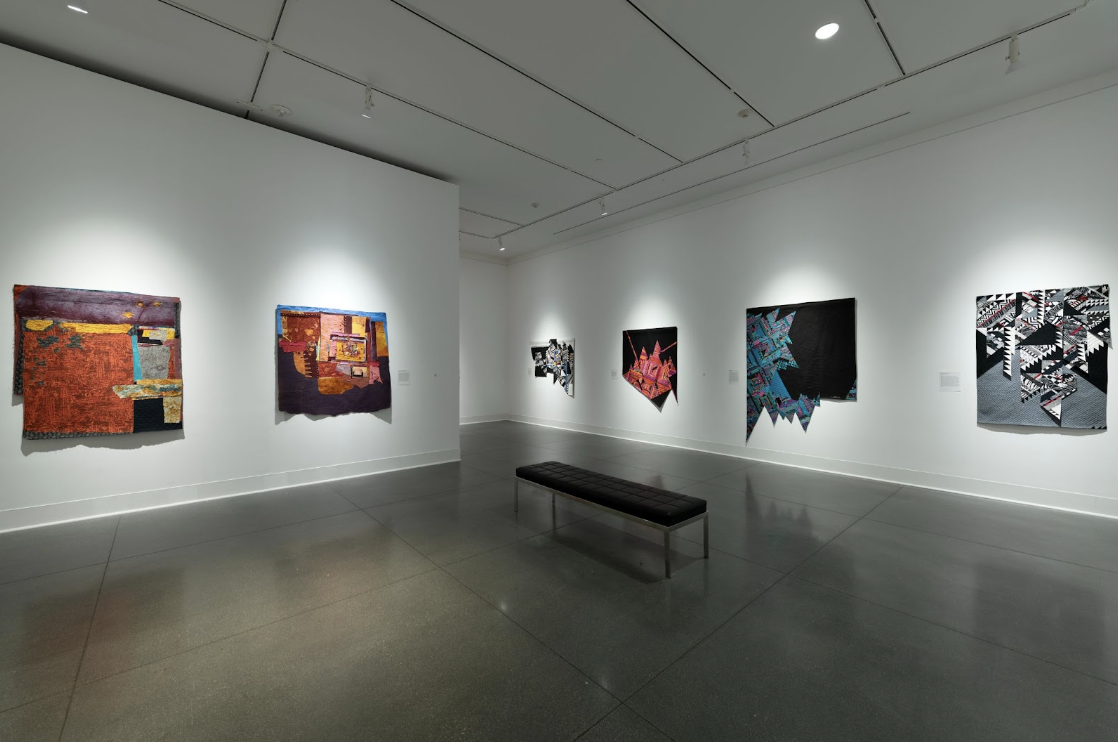
Installation view of Carole Harris,Threads of Time, 2025–26. Courtesy Flint Institute of Arts Museum + Art School.
Carole Harris: Threads of Time is on view at the Flint Institute of Art’s Harris-Burger Gallery through April 12, 2026.