Feathers and Bones
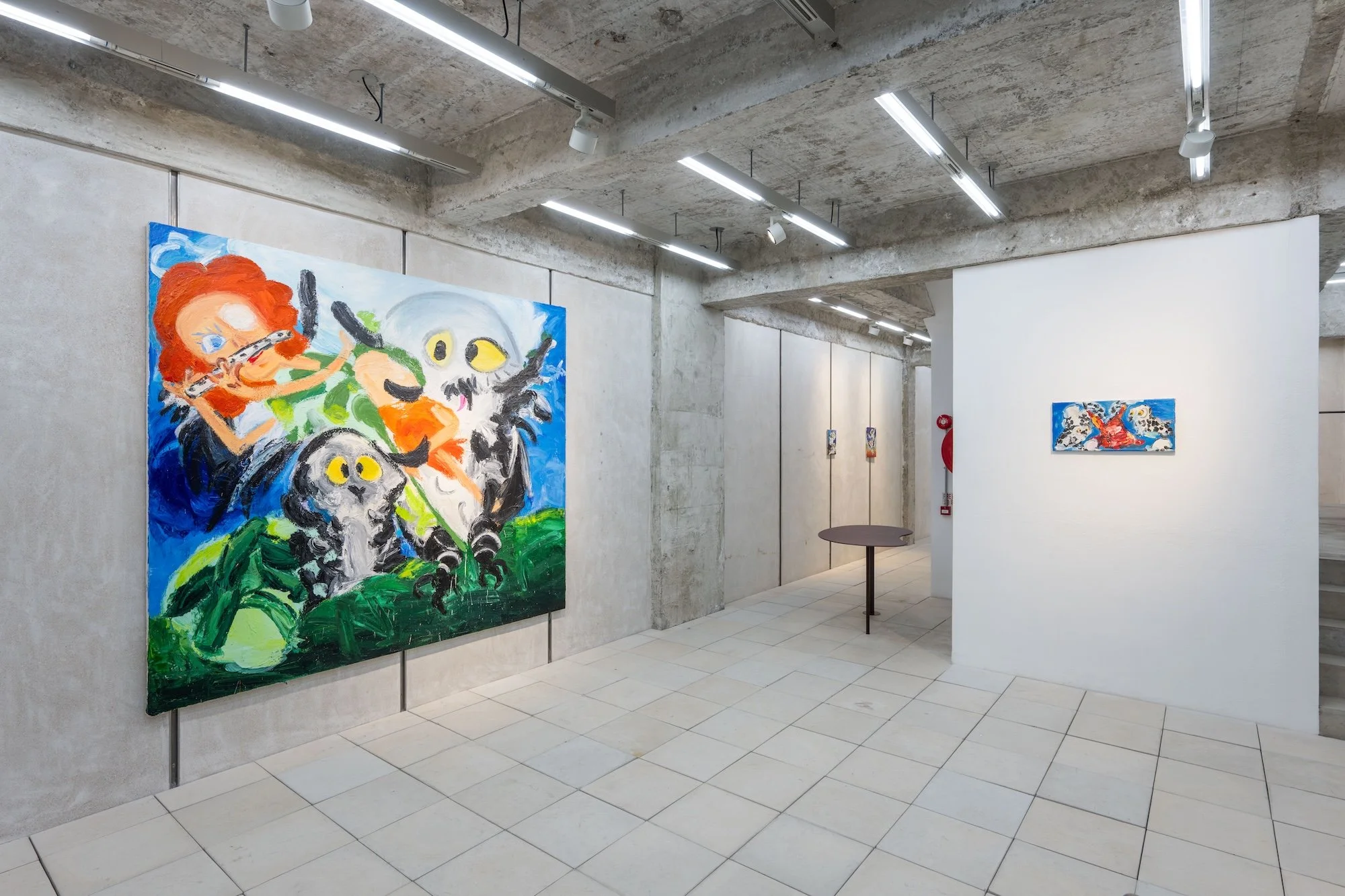
Installation view of Yirui Jia: Play Gravity. Courtesy of the artist and Kiang Malingue. Photo by Samson Wong.
Yirui Jia’s Play Gravity at Kiang Malingue’s Hong Kong space shows some of the messiest paintings seen today. In a 2024 interview with Jia in BOMB Magazine, Alex Leav writes, “Yirui Jia’s Brooklyn studio is an artist’s playground of opened paint cans, dirty paintbrushes, inflatable palm trees, satellite dishes, toy trumpets, and tubs of glitter. The act of painting is everywhere, splattered and hardened on all surfaces. A large tarp on which overlapping pools of acrylic have dried does its best to protect the hardwood flooring. Similarly, Jia’s ‘studio pants’ are sealed in a thick layer of paint and stiff as cardboard.” Considering the artist’s fixation on the notion of play and her idea of defying gravity through the image of an avian creature, how thick, hard, runny, or soft are the surfaces is an intriguing question that entices a viewer to touch and caress the feathers of the depicted owls.
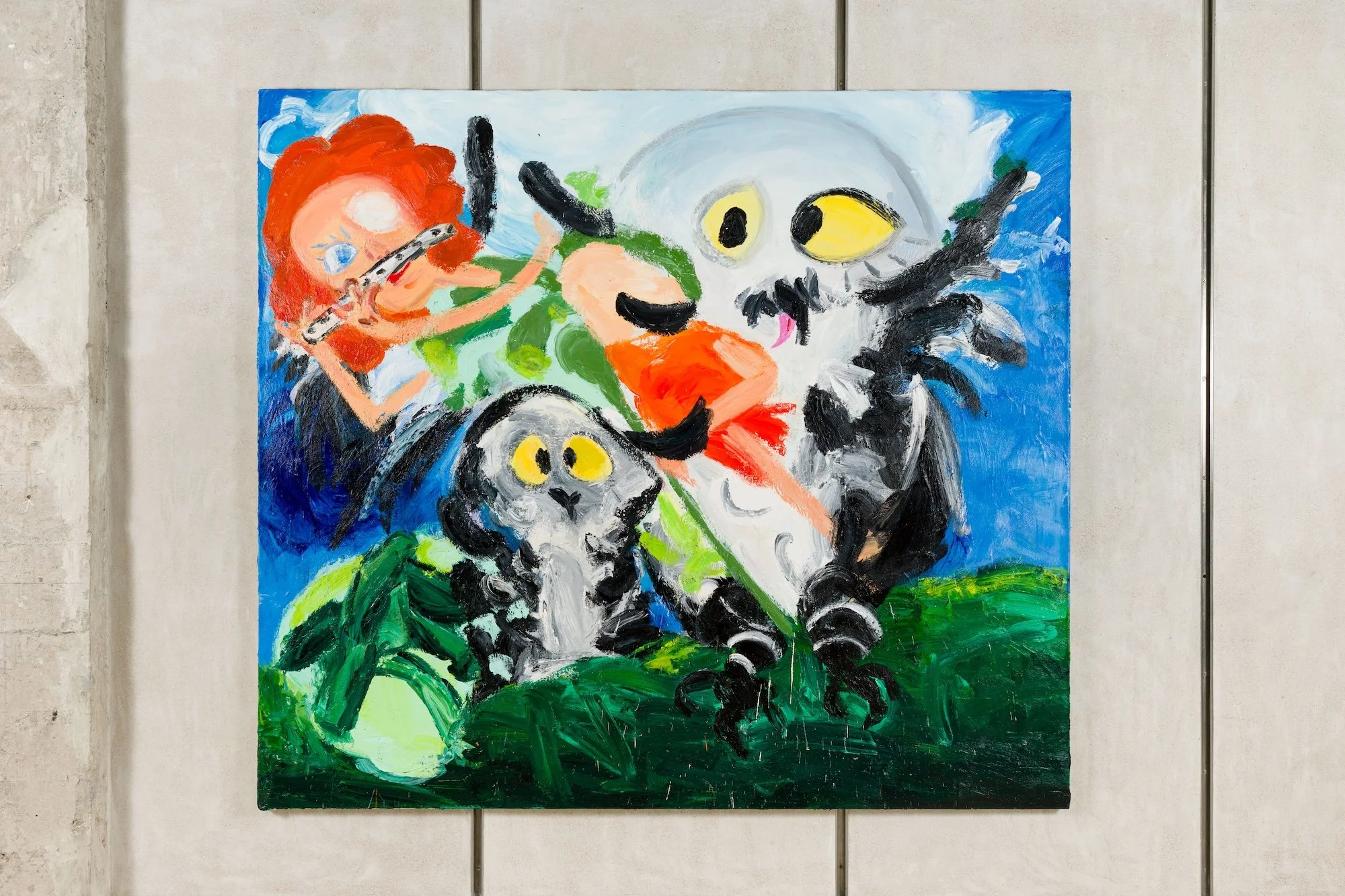
Yirui Jia, Picnic, 2025. Acrylic on canvas, 216 x 244 cm; 85 x 96 in. Courtesy of the artist and Kiang Malingue. Photo by Samson Wong.
One can, however, soon understand that the feathers are not necessarily the owl’s. They overflow too much, effectively outgrowing and outnumbering the owls, adhering to these nocturnal creatures almost like toupees. Jia is known for crafting paintings and sculptures that focus almost exclusively on a one-eyed heroine and a skeletal figure. Remarkably loose and free, her work levitates grimy parts of a composition with multiple layers of scruffier marks, turning the whole surface into a wonderful show of gestural excess. Introducing owls into her painting practice for the first time, what Jia is effectively rummaging here, one is tempted to imagine, are collections and displays of her own feathers. The artist is molting; the splashed, overspilled paint is her plumage. Her skin and hair give shape to the owls that could not look like anything else but owls, however deformed and abstract they are: googly-eyed, stooping and stretching their wings, albeit asymmetrically in most cases. The first and biggest painting in the show, Picnic (2025), shows just how haphazard Jia’s owl pieces are: a flute-player is abruptly inserted between a small and a giant owl, resting on a lush lump of undefined green. The owls look clumsy and silly in a wise way. One may recall that before the kawaii culture turned birds of prey and other predators into cute, fluffy, cuddly entities, owls played a part in Aristotle’s realm of Metaphysics as the wisdom-giver that grants human intellect. It is apparent that Jia’s owls are neither cute nor wise. They are, unlike Sun Yitian’s impeccably tidy, fantastic, plumply inflatable owls of Minerva shown in Shanghai in 2021, just owls.
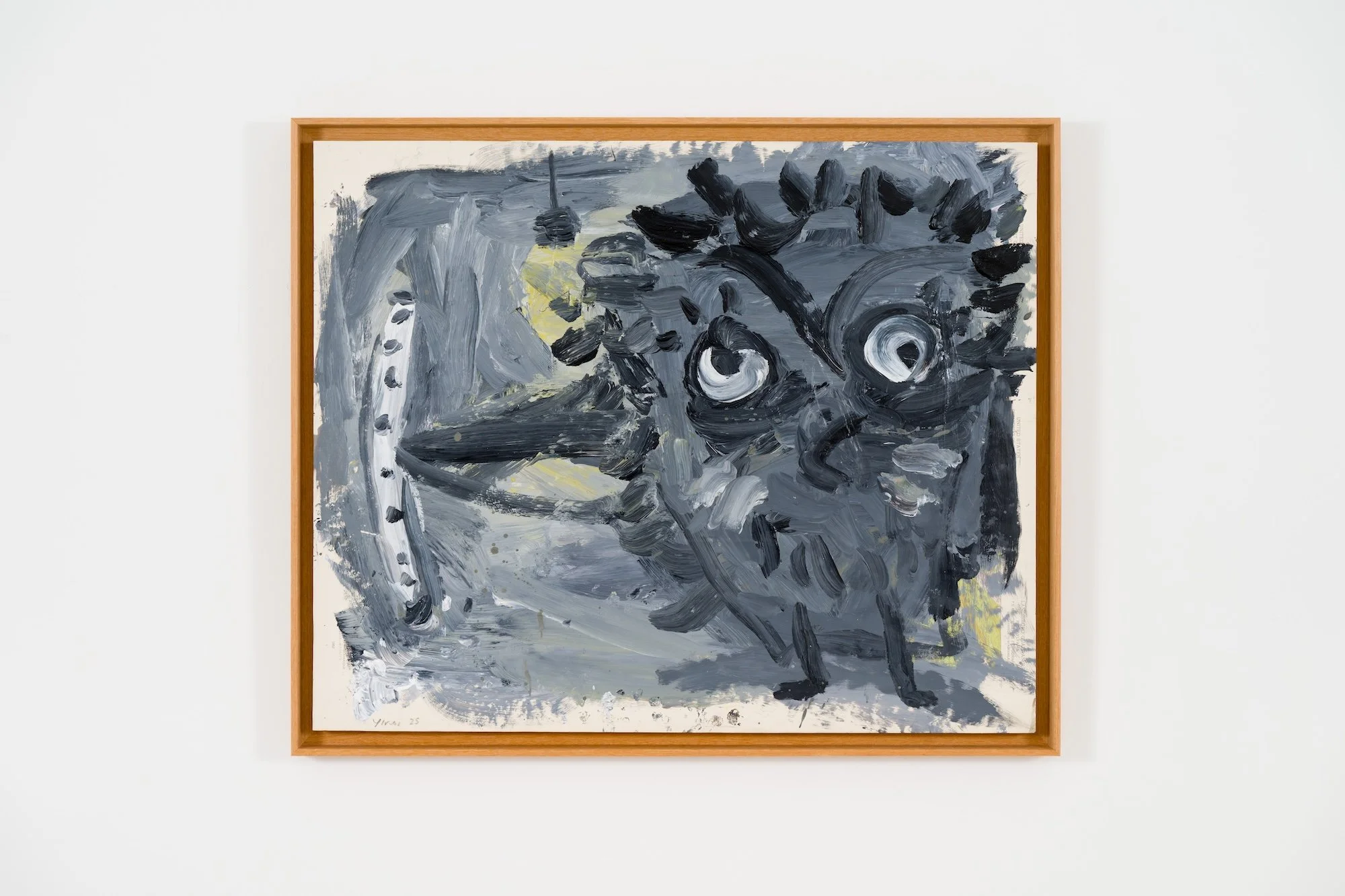
Yirui Jia, Atlas 3, 2025. Acrylic on paper, 60.5 x 72.8 cm; 23 ⅞ x 28 ⅝ in (framed). Courtesy of the artist and Kiang Malingue. Photo by Samson Wong.
Liu Wei, another Chinese artist known for his large-scale installations, once talked about his early diamond paintings: diamonds are easy to paint; they become what they are as long as you paint them super white. Jia says the same thing about her owls: owls are easy to paint, since you don’t have to worry about anatomy; colours alone will do it right. But one also sees in the exhibition some intricate pieces: Atlas 3 (2025), monikered for the fact that it is a painting on a subtly textured vintage map, portrays a particularly ill-groomed owl, almost only in dark grey and black. This largely monochrome figure is seen raising one of its sticky wings as if giving directions—or is it a flute in its hand, away from its beak? (How does musicality play a part in Jia’s art? She admitted once that she’d listen to old-school Chinese rock n’ roll music when at work.) The tiny painting is marked by an uncanny, bone-like quality, carried through in its dry, brittle brushstrokes. One begins to read the image less as a coherent body than as an assemblage: the flute, the exposed wing, the darkened mass of the owl all register as skeletal fragments. In this sense, the feathers no longer belong to the body they describe. They feel applied, almost improvised, as if borrowed from elsewhere and affixed onto a structure that remains fundamentally bare.
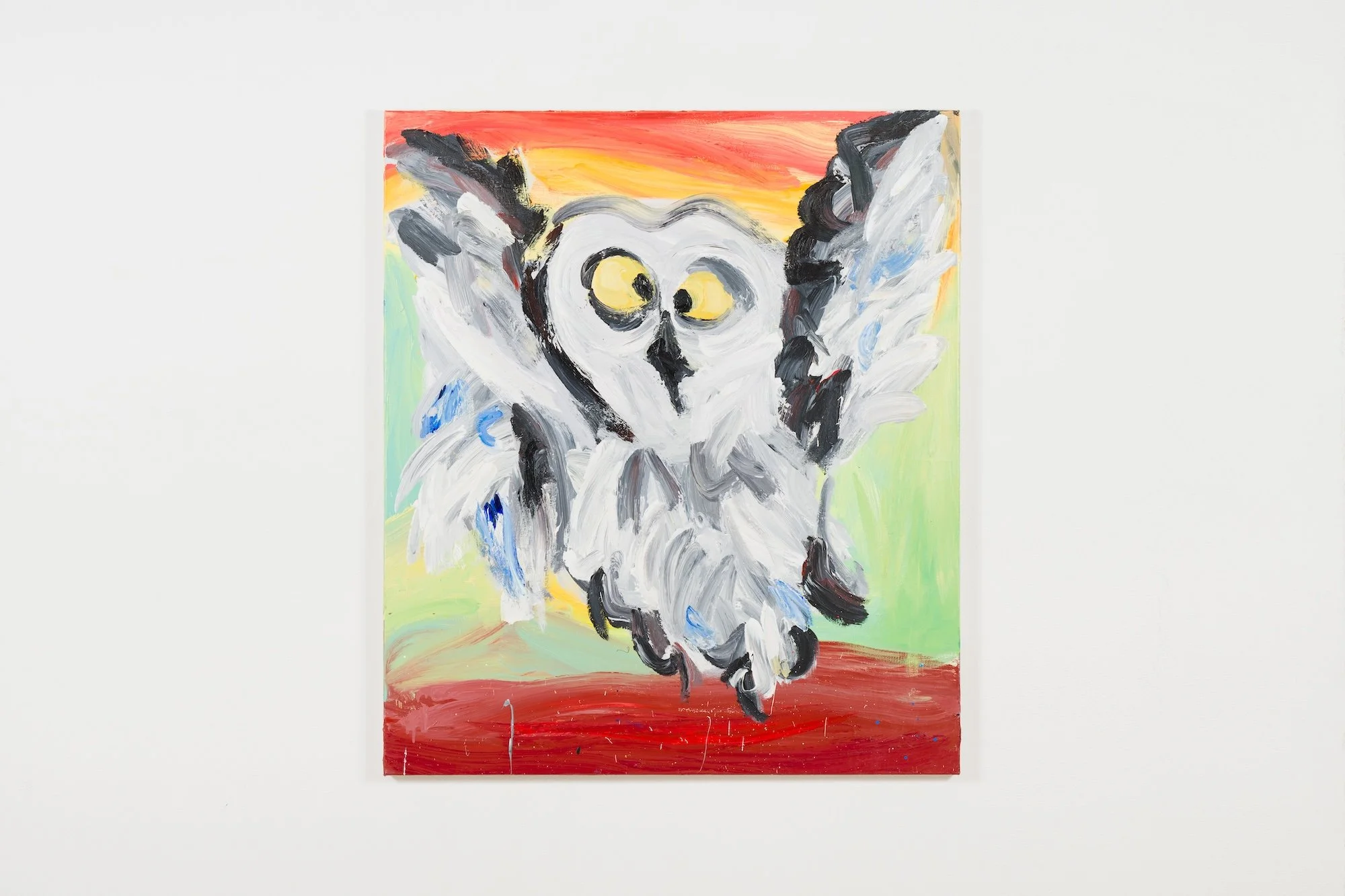
Yirui Jia, Owl’s Stare, 2025. Acrylic on canvas, 135 x 117 cm; 53⅛ x 46 in. Courtesy of the artist and Kiang Malingue. Photo by Samson Wong.
One of the exhibition’s more mystifying gestures lies in its Chinese title: Lu Xun’s transliteration of “play” as pōlài—a term that can connote rascality or hooliganism. And yet, the owls themselves are anything but fleeting. They do not hide themselves in a fashion proper to nocturnal animals. They rest or flap from one painting to another, so much so that one sees their phantoms even in the exhibits where they are absent. One reads into Front and Back (2025) a couple of owls breaking the reclining flute player into several parts, before realising that the typically goofy, white, rounded thing is a winged or caped skeleton; one sees in a classic Yirui Jia depiction of femme fatale, La Rose Noire 2 (2025), a woman in black striking a pose that is paradoxically triumphant and submissive, only to be reminded that this is not at all a paradox, a bad gestural ideology, for an owl—Owl’s Stare (2025) shows a goofy cross-eyed bird in exactly this pose. One of the most recent paintings in the show is To Be or Not To Be (2025), which is not only titled after Shakespeare’s play, but also Ernst Lubitsch’s eponymous film. This white skeletal figure on a tainted black surface (partially revealed is in fact another map in the back), along with the smaller version of it, Maybe or Maybe not (2025), could be where the artist was most economical with her own feathers, thereby envisioning a kind of play for which one does not have to know how to fly.
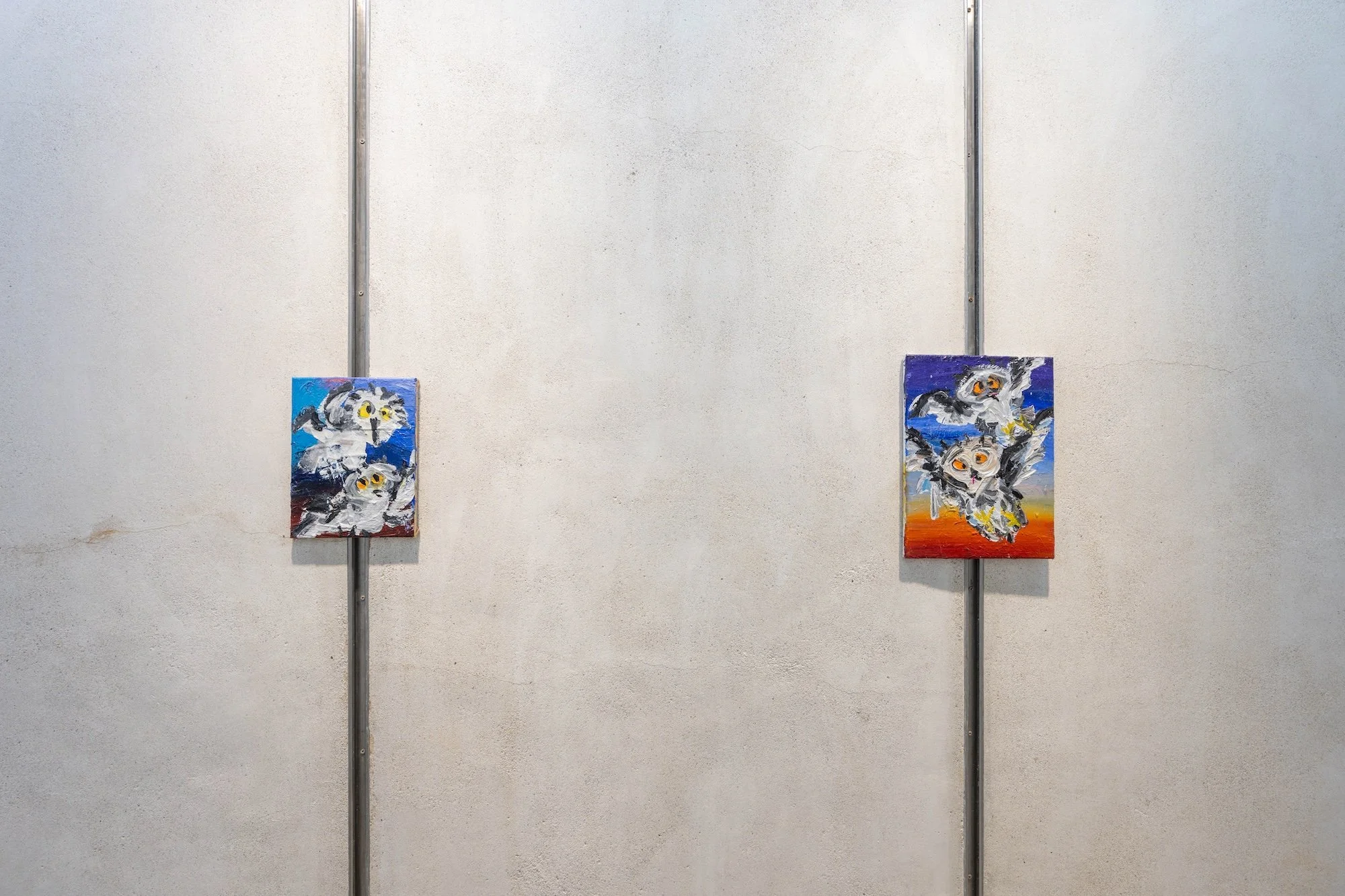
Installation view of Yirui Jia: Play Gravity. Courtesy of the artist and Kiang Malingue. Photo by Samson Wong.
Play Gravity was on view at Kiang Malingue, Hong Kong, from Jan 16 to March 14, 2026.