Sinister is the Night in Amanita’s “Swallow the Moon”
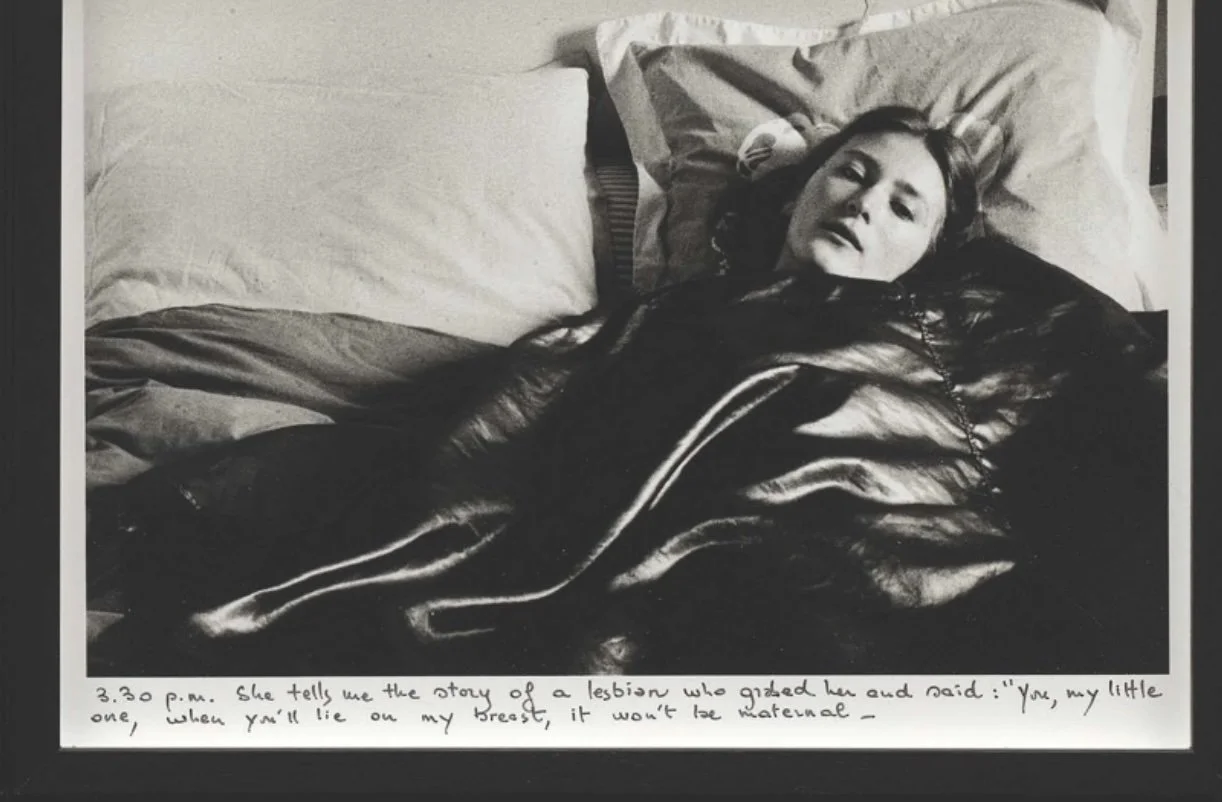
Sophie Calle, detail of The Sleepers (X., baby sitter, fourteenth sleeper, 1980. 6 black and white photographs, 1 text Edition 2 of 3. 16.5 x 21.2 cm (6 1/2 x 8 3/8 in). Photo courtesy of Amanita.
Amidst the doom and gloom of our current world, one might think that a few bottles of wine and a good night out with some good friends are the antidote to our anti-party-anti-social generation. But this simply isn’t the case—since the calamitous arrival of Covid-19, social isolation and anti-dating culture, not to mention the unprecedented decline in alcohol consumption, have somehow put our complex romance with the night into a disarming but necessary triage. In Amanita’s recent show, Swallow the Moon, curated by Reilly Davidson, there seems to be a real attempt to rekindle this love of the night and make us question our carnal lust and unreconciled nocturnal proclivities.
Comprising fifteen established artists, Davidson’s visions seem to aim less towards awing the titular moon than sitting and contemplating its spectral possibilities across different media. Essentially, it’s Goodnight Moon but for adults who love to stay up past their bedtime, and possibly to their own regretful chagrin in the morn. It is an earnest and humorous attempt to think through the wondrous night where the twists and turns offer both delight and whimsy. In pop analogy, the exhibition is comparable to a Gemini and an Aries Moon battling to claim a muted chaos of which even SZA would be envious.
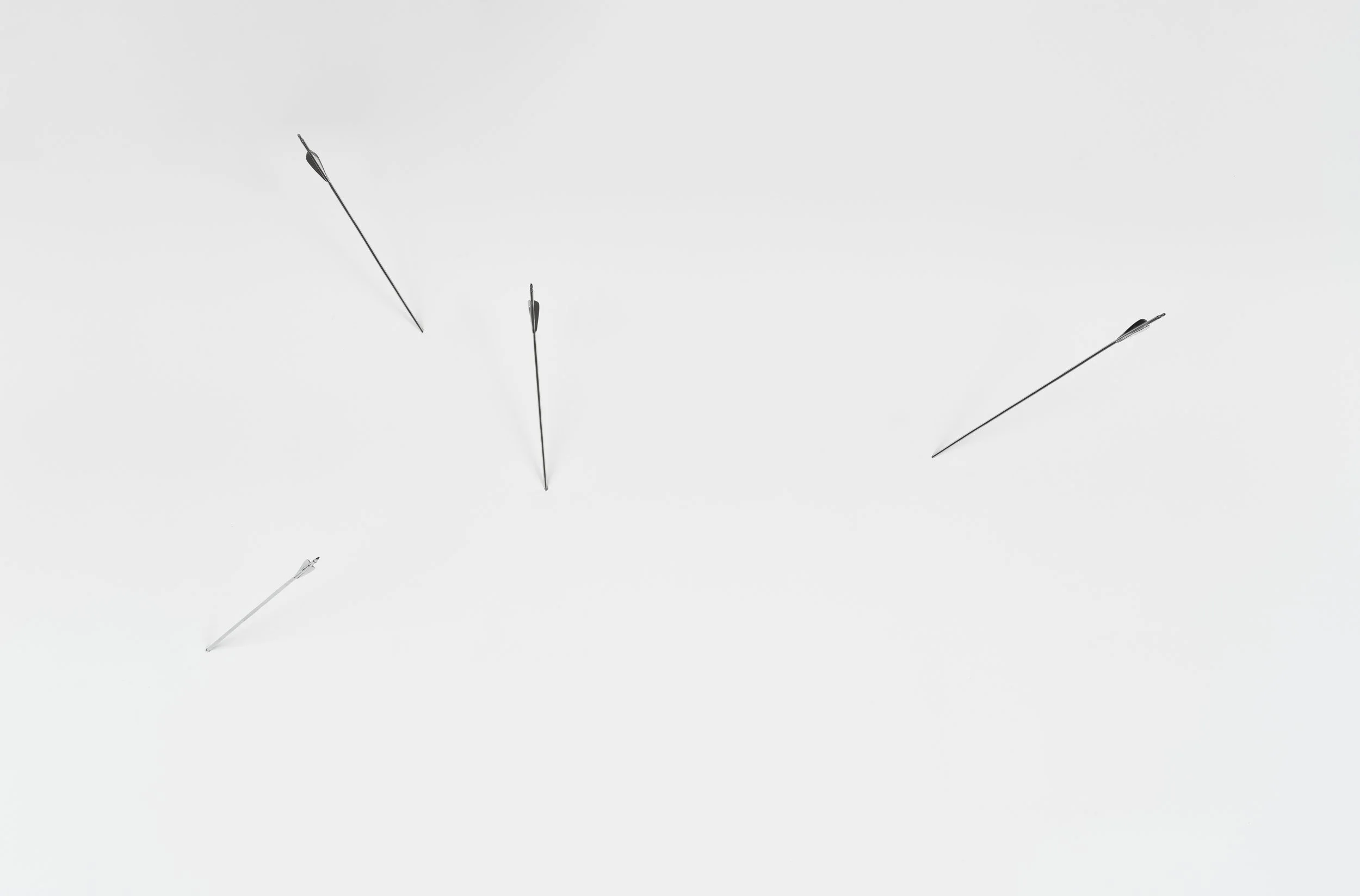
Olivia Erlanger, Eros, 2024. Four polished aluminum arrows, Dimensions variable. Courtesy of the artist and Amanita.
Starting with Sophie Calle’s The Sleepers (X., baby sitter, fourteenth sleeper) (1980), the suggestion of night already comes preloaded with sexual tension. The languid posing with handscript beneath hark to memoir confessions, where the camera frame both omits and incites. This erotic energy continues in Olivia Erlanger’s Eros (2024), a constellation of polished arrows formulating bold shots as one descends into the night. Planted high on the gallery walls, they act as fixtures reminding viewers to keep their eyesight toward the sky.
At eye-level, Cynthia Hawkins’s Clusters: Cephus, Cephus, Cephi (2004) and Thomas Nozkowski’s Untitled (4-14) (1983) combine abstracted planetary bodies in chromatic contrast. Falling or melting, the shapes do not lend themselves to stability, but rather read as iterations of a shared figure, culminating in cosmic tension alongside Turiya Adkins’s latest painting, Big Fish (2026).
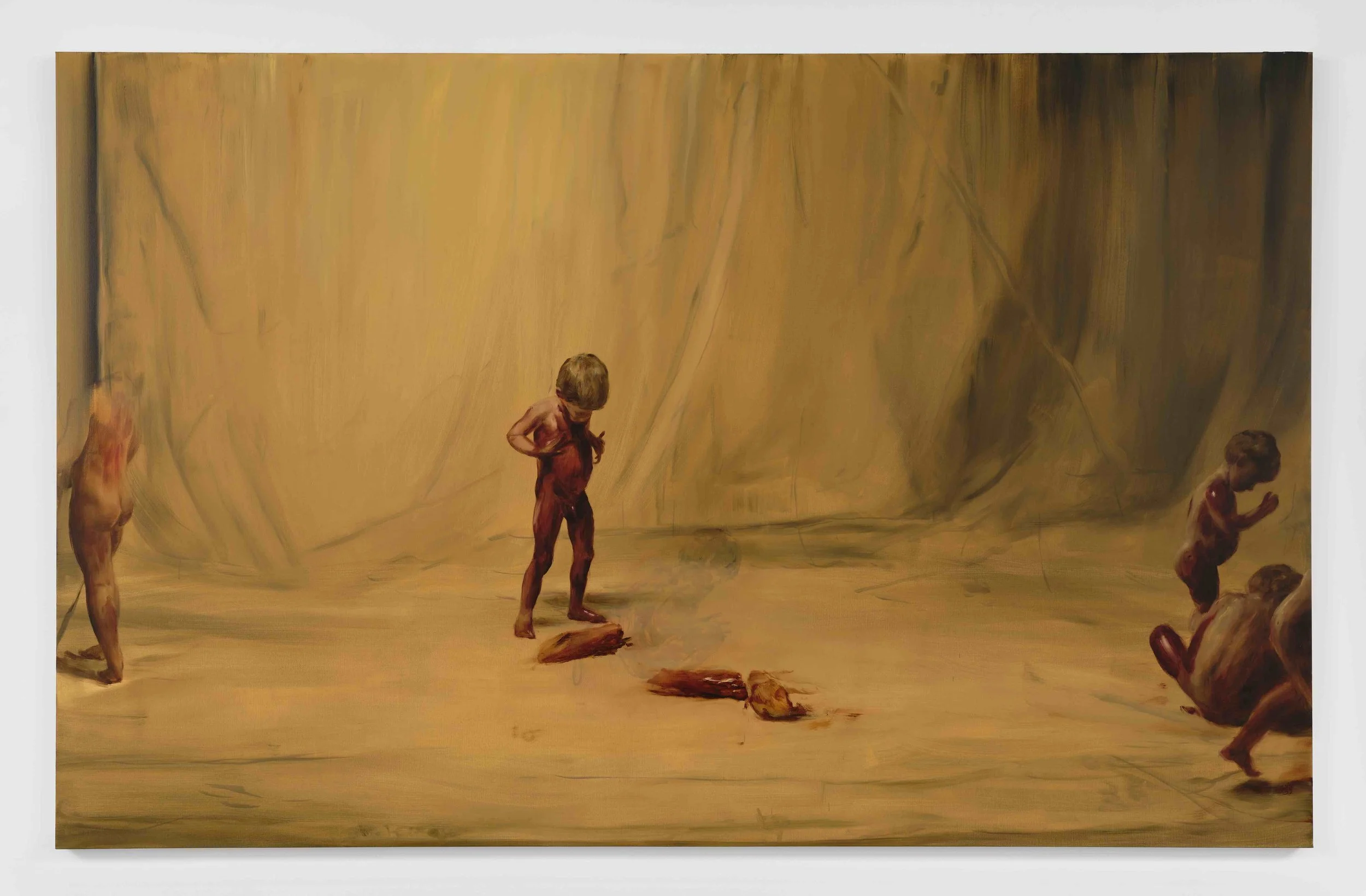
Michaël Borremans, Fire from the Sun (Five Figures, Three Limbs), 2017. Oil on canvas, Signed, titled, dated, and inscribed verso. 190 x 300 cm (74 7/8 x 118 1/8 in). Photo courtesy of Amanita.
One of the highlights of the show is Michaël Borremans’s Fire from the Sun (Five Figures, Three Limbs) (2017), in which the Belgian artist’s painterly quality is at once disarming and eerie. The captivating but dismembered figures of children allude to something quietly sinister. There is undoubtedly a visceral return to innocence through these cherubic figures, an angel-demon configuration in which the disturbance is only felt by the viewer, and never by the subjects themselves. Cast in unfinished chiaroscuro, the figures’ calm indifference to the possibility of violence provides an unsettling stage of absence and presence. Named possibly “the greatest living figurative painter” according to The New York Times, Borreman has remained faithful to his ambient reflections of the human figure. Almost a decade since this piece was created for Borreman’s solo exhibition marking the opening of David Zwirner Hong Kong, it still manages to render the familiar into discomfort.
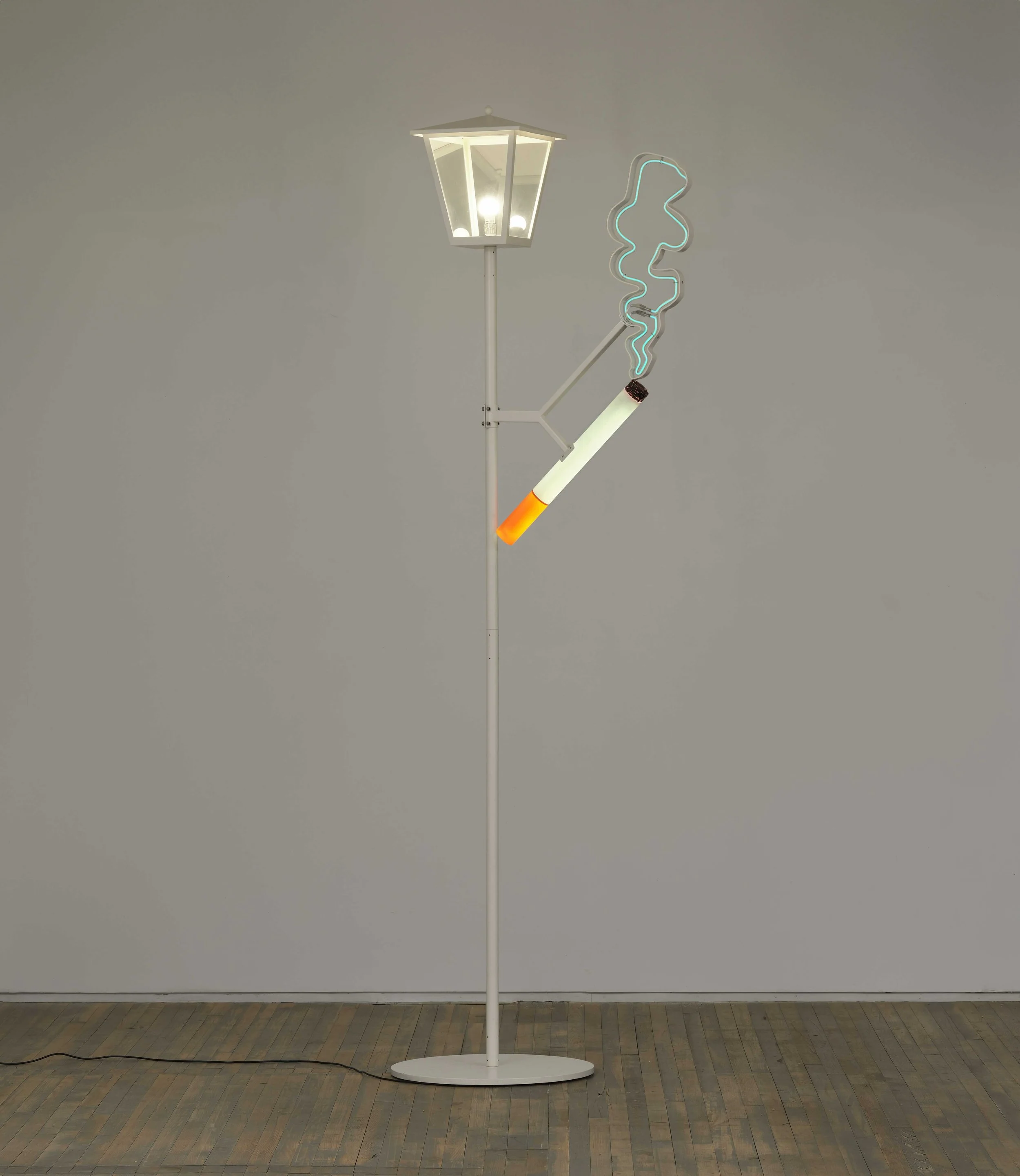
Cosima von Bonin, Smoke, 2008/2011 (CVB & Michel Wuerthle), 2011. Steel, lacquer, plate-glass, spruce; Smoke: Perspex, steel, lacquer, neon lamp, light-emitting diode. 330 x 116.8 x 71.1 cm (129 7/8 x 46 x 28 in). Courtesy of Amanita.
Anchored on opposite ends of the gallery, Cosima von Bonin’s Smoke (2008/2011) and Andrew J. Greene’s Timeless Symbols (Carlyle ashtray) (2026) draw attention to the centrality of the sought-after cigarettes for this timeless night of derelict behavior. On the one end, von Bonin’s lamps act as a guiding beacon for the deambulating soul, while on the other, Greene’s rotating ashtray adds a comedic pop as the night fades away into revolving conversation. In continuation of this theme, Greene’s Timeless Symbols (China Chalet matchbook) (2026), brings back memories of my careless 20s, questionable choices, and clandestine nights when there was still fun to be had south of Wall Street. (RIP China Chalet). Like the night, some chapters must come to an end, and all that's left are unfired flames, relics, and their possibility of cindered memory.
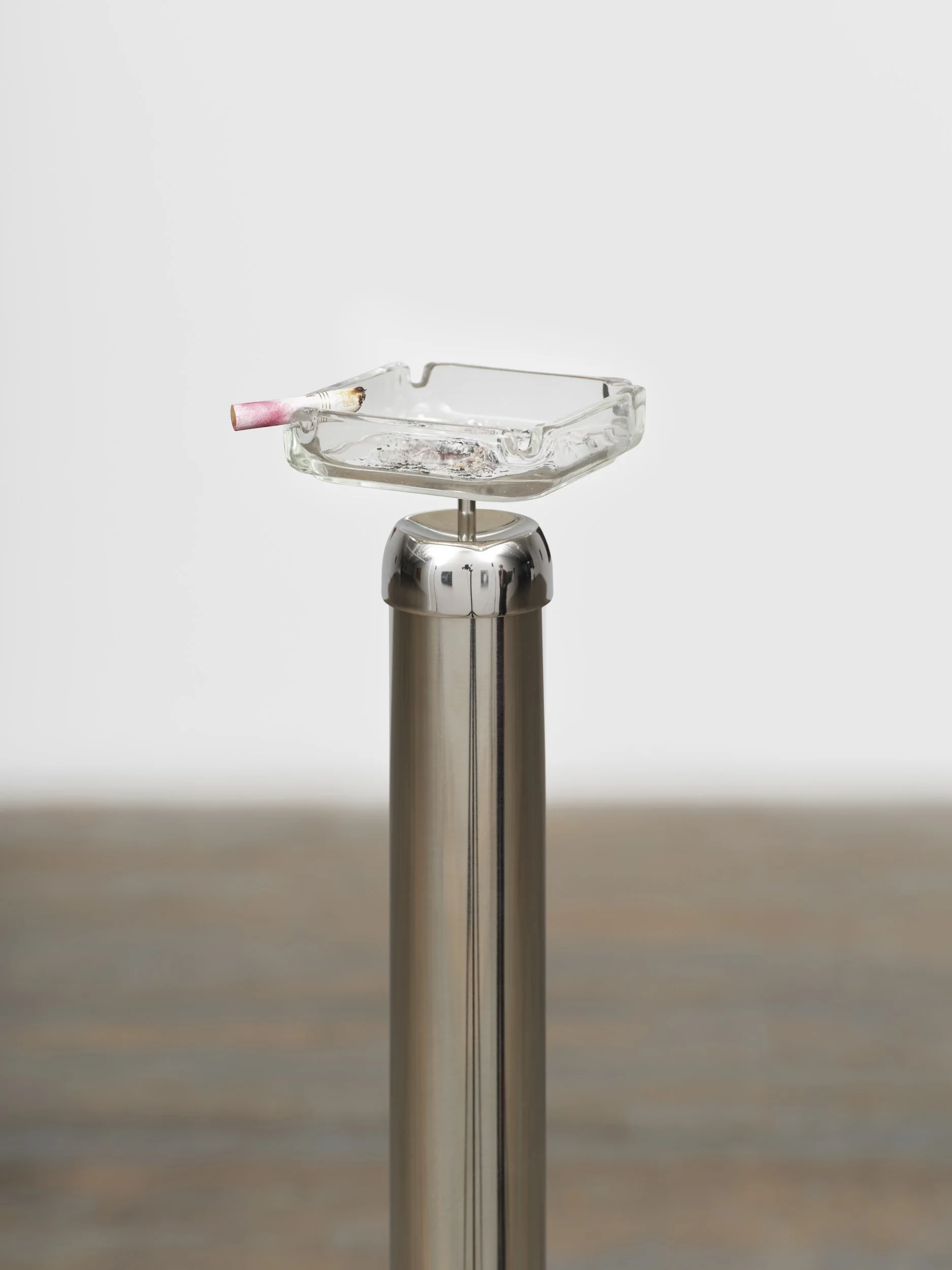
Andrew J. Greene, Timeless Symbols (Carlyle ashtray), 2026, Stainless steel stanchions, display motors, vintage ashtray, cigarette, 50 1/2 x 5 in, 128.3 x 12.7 cm. Courtesy of the artist and Amanita.
Appropriately, at night’s end is Ed Ruscha’s Rooster (1988) with its rustic coloration, the scale of time is suspended while verging on transition. It’s an image perhaps so universally well understood, it’s almost audible. As a whole, the thematic grouping leaves room for further contemplation. The celestial motifs are less alluded to than direct representations. There is humor and darkness. There is old and new. The show might not be everyone’s cup of matcha latte, but there are repeated joyous moments worth savoring. Davidson was undoubtedly aiming for the night sky and landed somewhere in the celestial ether. What parts of ourselves do we confront in the dark of night? Where does that lead us in our search for wholeness? Less humorous than her 2021 The Frog Show, Swallow the Moon shows signs of a more mature curation, but no less prompting for the questions that arise in its wake.
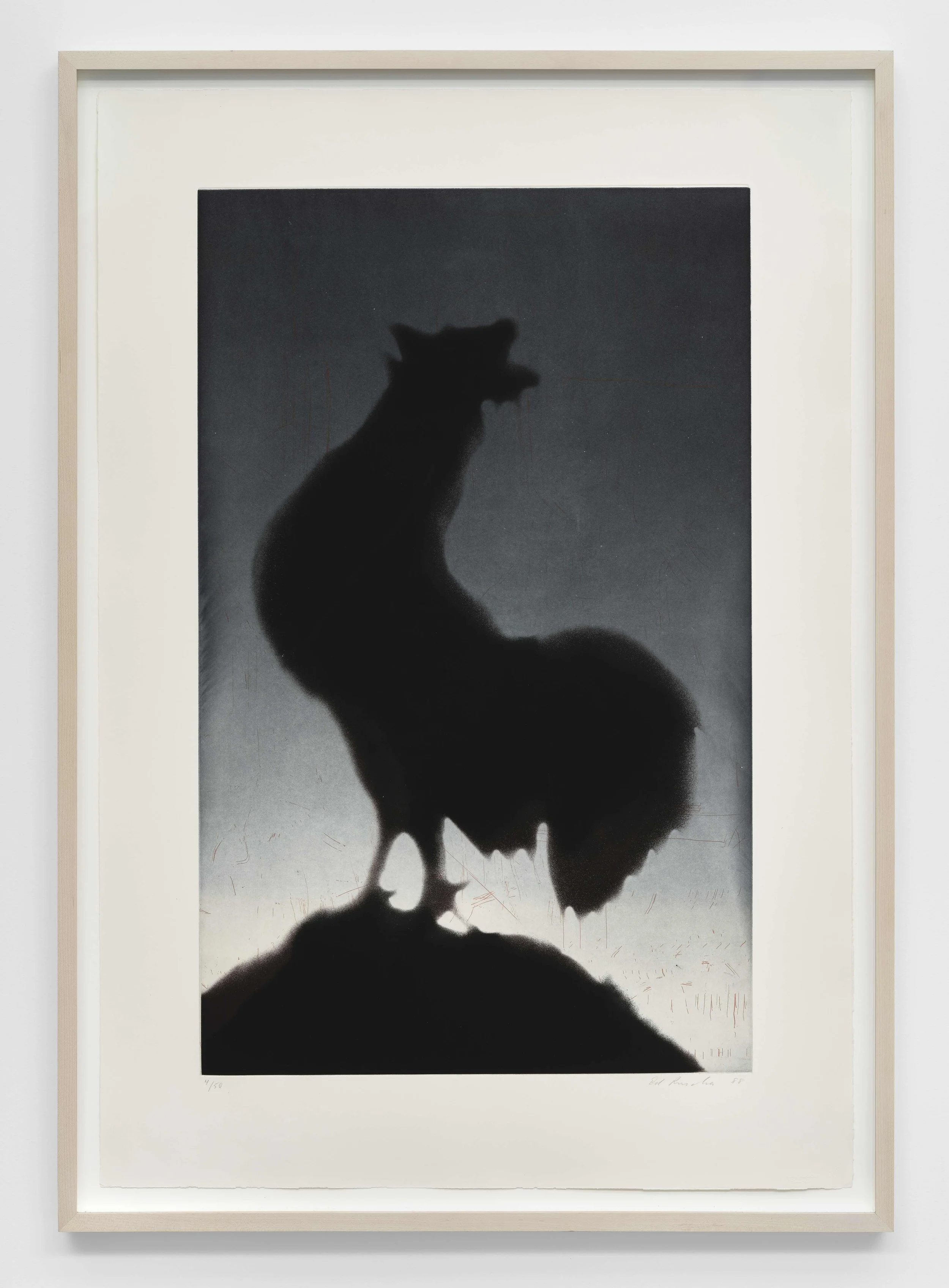
Ed Ruscha, Rooster, 1988. Aquatint and etching, Edition of 50, Sheet: 111.7 x 77.1 cm (44 x 30 3/8 in) Framed: 120.7 x 85.1 cm (47 1/2 x 33 1/2 in). Photo courtesy of Amanita.
Swallow the Moon was on view at Amanita from January 15 through February 22, 2026.