Structures of Waiting: Pictures from a Controlled World
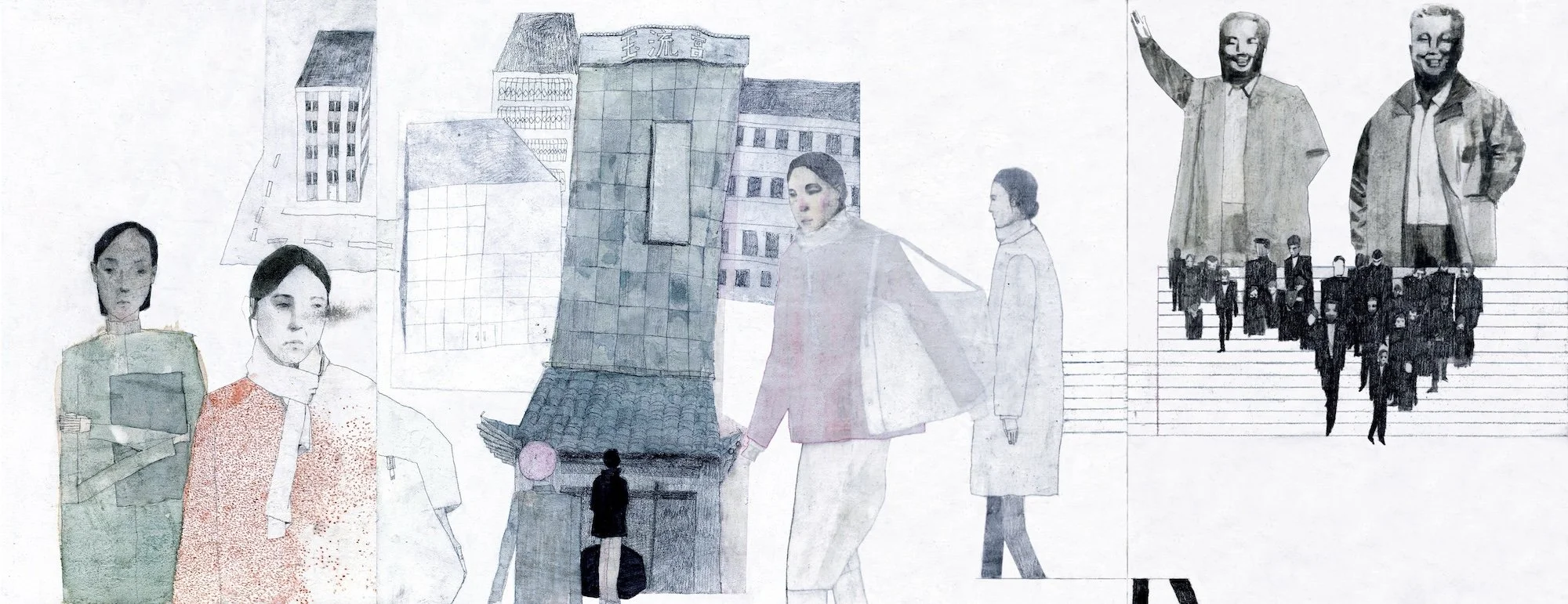
Lily Li, The One Who Walked Away (2025). Watercolor, colored pencil, marker, and rice paper on gessoed wood panel, 14 × 44 inches. From the series Northbound. Courtesy of the artist.
Lily Li is a Beijing-born illustrator and visual artist based in New York. Working across drawing, watercolor, comics, and mixed-media illustration, Lily’s practice explores migration, institutional systems, and the psychological landscapes shaped by structures of mobility and control. Through restrained narrative scenes, she examines how everyday environments, such as restaurants, waiting rooms, and other transitional spaces, can reveal larger political and social dynamics.
Her recent project Northbound draws inspiration from restaurants run by North Korean expats—spaces that function simultaneously as sites of hospitality, performance, and political supervision. Told from the perspective of a young waitress sent to work overseas, the project reflects on the tension between the promise of mobility and the reality of tightly regulated movement. Combining watercolor, colored pencil, marker, and rice paper layered over gessoed wood panels, Northbound creates quiet yet emotionally charged environments in which glimpses of another world appear close at hand yet remain inaccessible.
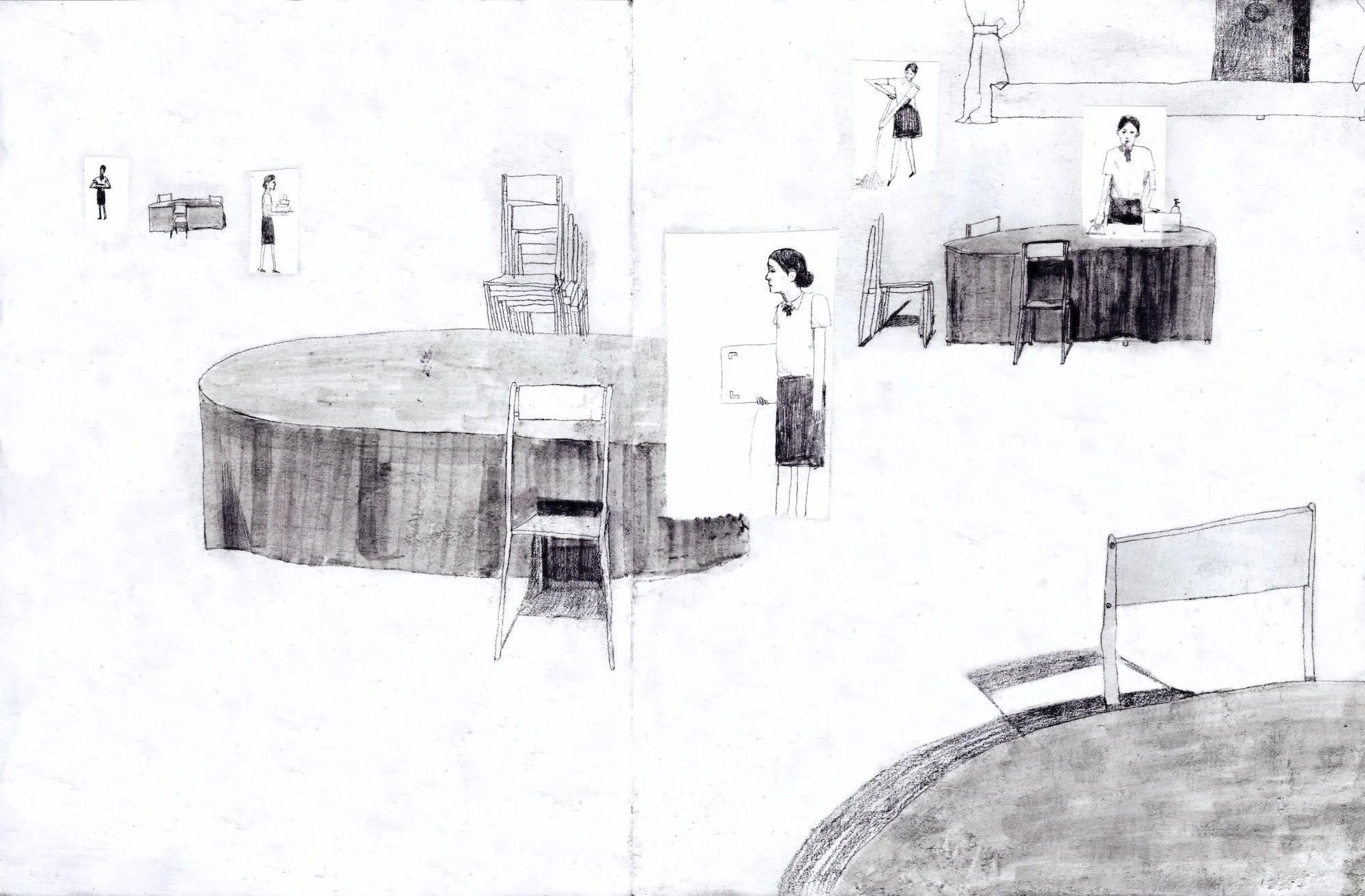
Lily Li, Dinner For Waitresses (2025). Watercolor, colored pencil, marker, and rice paper on gessoed wood panel, 14 × 22 inches. From the series Northbound. Courtesy of the artist.
Xuezhu Jenny Wang: How did the idea for Northbound and the narrative behind it first emerge?
Lily Li: One important influence for the project was Ursula K. Le Guin’s short story The Ones Who Walk Away from Omelas. What interested me most was not simply the act of walking away, but the question of whether leaving truly means escaping. Even if someone physically leaves Omelas, the system that shaped them does not disappear. The experience, the knowledge of what happened, and the compromises that allowed the system to exist remain with them.
This idea became important when I began thinking about Northbound. The waitress lives in a space that is both open and controlled at the same time. The restaurant exists outside of her country, yet the structures that govern her life travel with her. Even if escape were to be physically possible, the system that shaped her experience cannot simply be undone.
For me, the story became less about escape and more about the illusion of it. Leaving a place does not necessarily mean escaping the system that formed you. In many ways, the characters remain connected to those structures even when they appear to be moving beyond them.
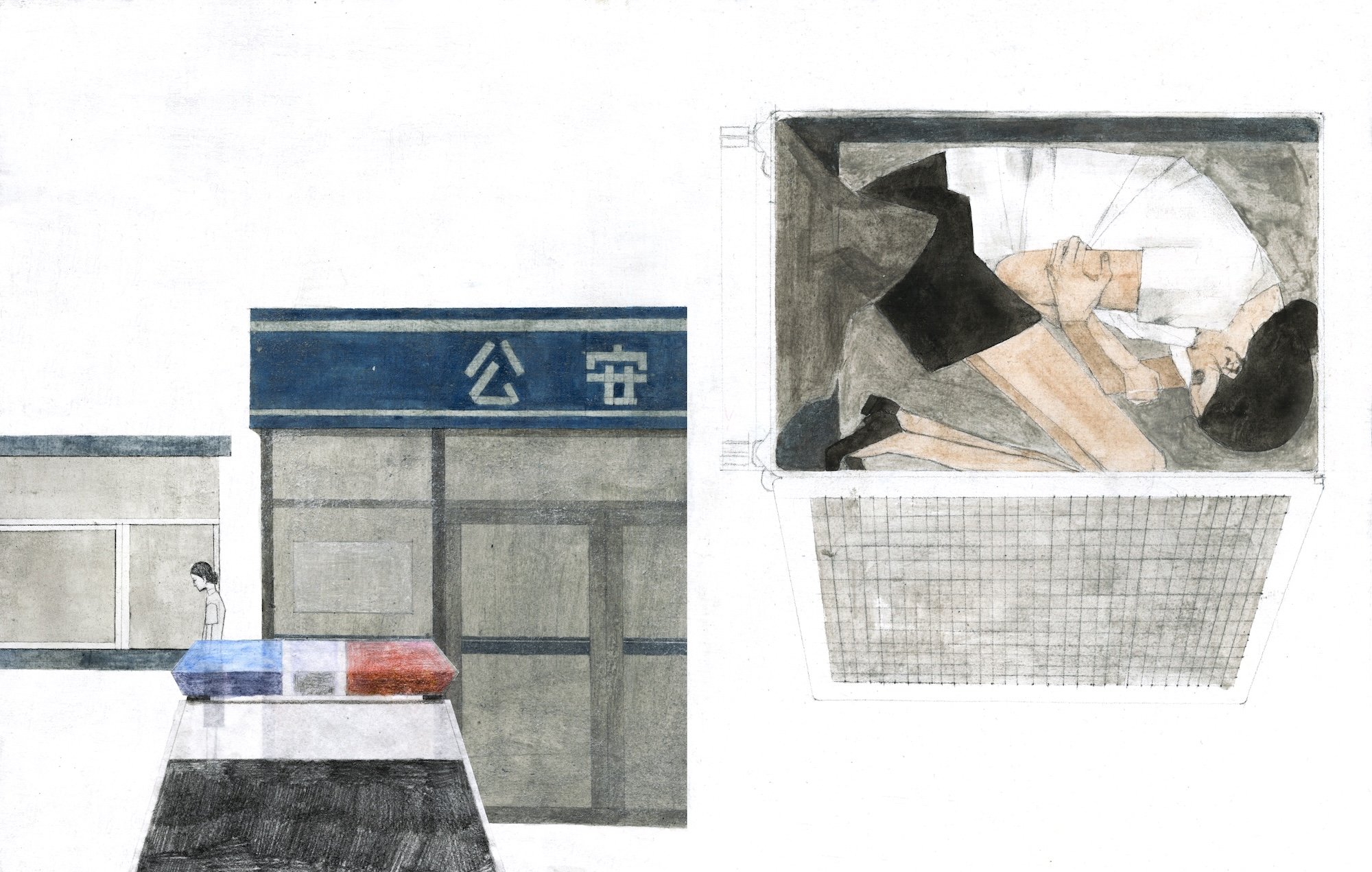
Lily Li, Capture (2025). Watercolor, colored pencil, marker, and rice paper on gessoed wood panel, 14 × 22 inches. From the series Northbound. Courtesy of the artist.
XJW: The restaurant setting plays a central role in the series. What drew you to this particular environment as a way of thinking about migration?
LL: I was interested in the restaurant because it is a space structured around an unequal relationship. In a way, the restaurant functions as a border of sorts that exists indoors. Customers arrive for leisure and enjoyment, while servers are expected to observe, anticipate needs, and remain attentive. Information and power circulate unevenly within that environment.
Within the context of migration in Northbound, this imbalance becomes even more pronounced. The waitress occupies a position where she is constantly exposed to traces of another world. Customers bring objects, technologies, and stories that hint at lives beyond her reach. At the same time, the diners themselves are often curious about the servers, sometimes observing them as much as they are being served.
This creates a space defined by mutual observation but not mutual access. The waitress can see fragments of another reality, yet she cannot participate in it. The restaurant therefore becomes a small stage where proximity and distance exist simultaneously, allowing me to explore questions of migration, restriction, and the illusion of possibility within a very contained environment.
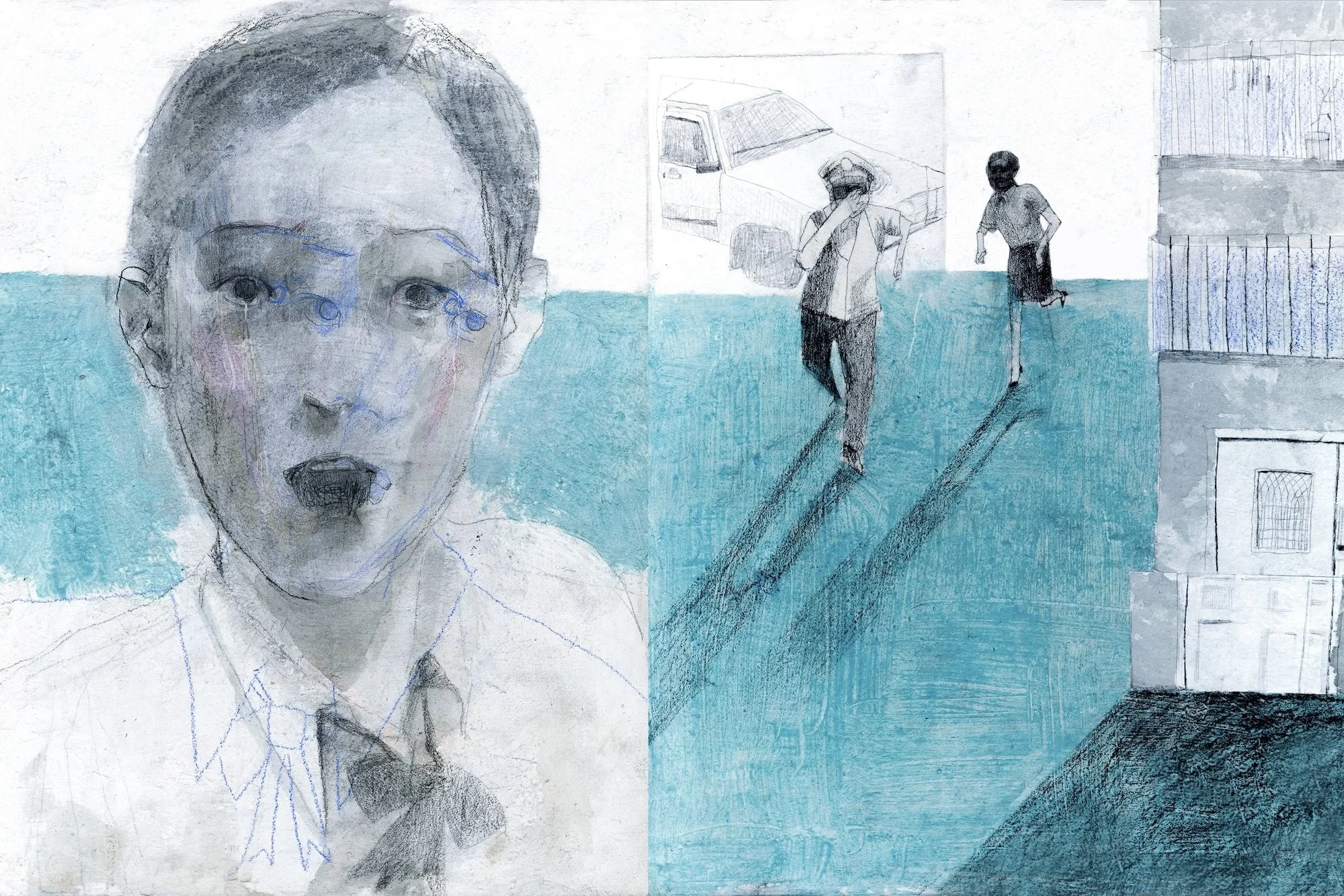
Lily Li, Escape (2025). Watercolor, colored pencil, marker, and rice paper on gessoed wood panel, 14 × 22 inches. From the series Northbound. Courtesy of the artist.
XJW: The scenes in Northbound feel calm and restrained, yet they carry a strong psychological tension. How do you approach this balance visually?
LL: I try to create tension through restraint rather than dramatic action. Many scenes take place in controlled environments, so the compositions are quiet and the gestures minimal. The tension often comes from what is withheld rather than what is shown.
Before starting the series, I also experimented with different drawing approaches to understand what makes an image feel “tight” or “relaxed.” I began to notice that the difference often comes down to gravity. When weight and balance are clearly present, a drawing tends to feel more relaxed. When that gravitational influence is reduced, the image feels more controlled and tenser. In Northbound, I avoided fully relaxed poses so the figures feel slightly held in place within the space.
Material also contributes to that atmosphere. I worked on wood panels prepared with fiber gesso, which creates a matte surface with a texture that reminds me of snow. Pencil, watercolor, and rice paper allow the surface to remain visible, so the image builds gradually while maintaining a quiet sense of distance.
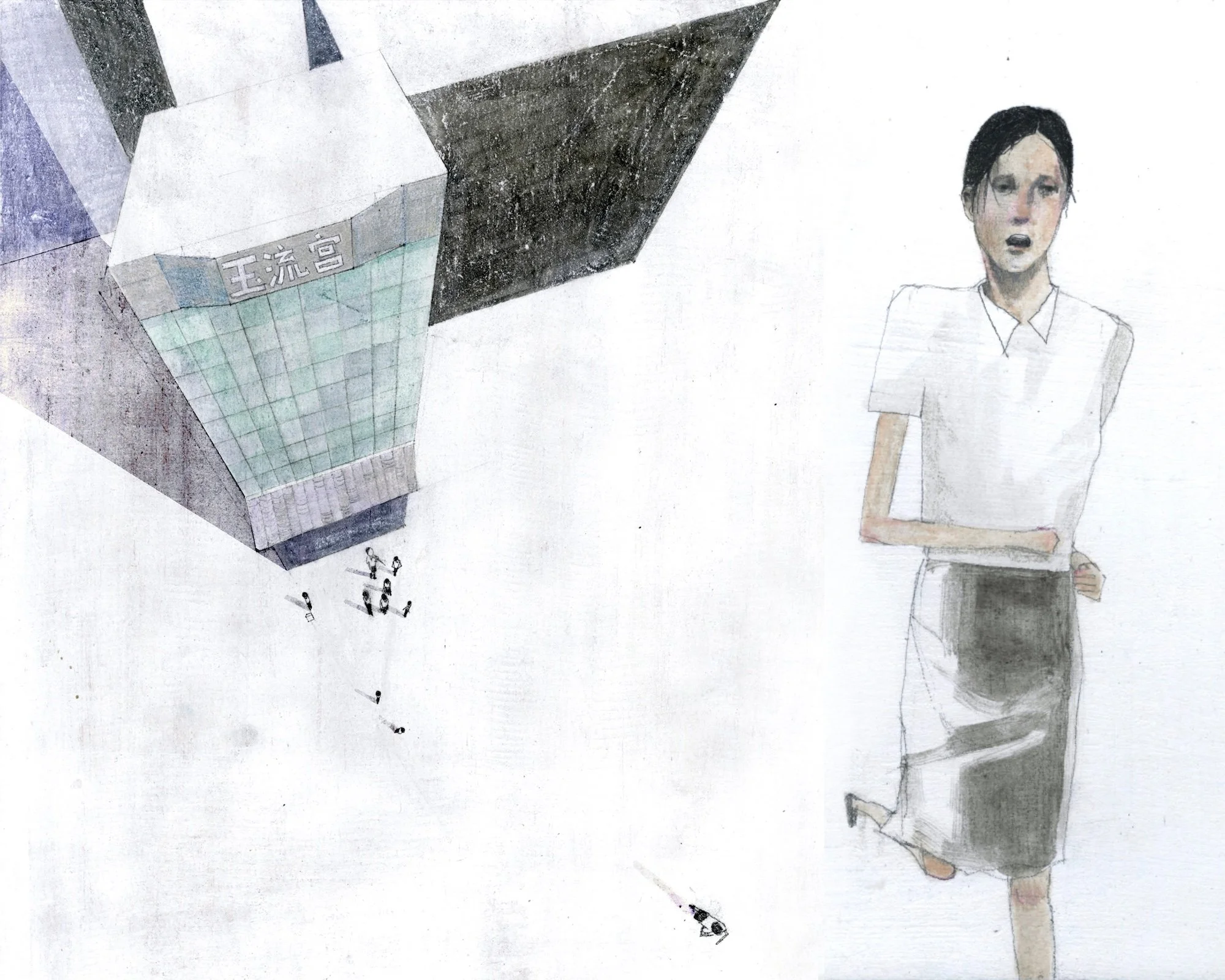
Lily Li, Run (2025). Watercolor, colored pencil, marker, and gessoed wood panel, 14 × 22 inches. From the series Northbound. Courtesy of the artist.
XJW: Many of your projects explore social or institutional systems. How does this interest shape your approach to storytelling?
LL: Systems often shape people’s lives in ways that are powerful yet difficult to see directly. Social or institutional structures rarely appear in obvious forms, but they influence how people move, what choices are available to them, and how they understand their own position in the world.
In my work I usually approach these questions through individual characters rather than abstract explanations. A single person moving through a particular environment can reveal how a system operates. Through posture, spatial distance, and carefully composed scenes, the structure of that system becomes visible within everyday moments.
Many of my projects begin by observing how these larger structures appear in ordinary spaces. By focusing on small interactions within those environments, narrative illustration can make the presence of those systems quietly perceptible.
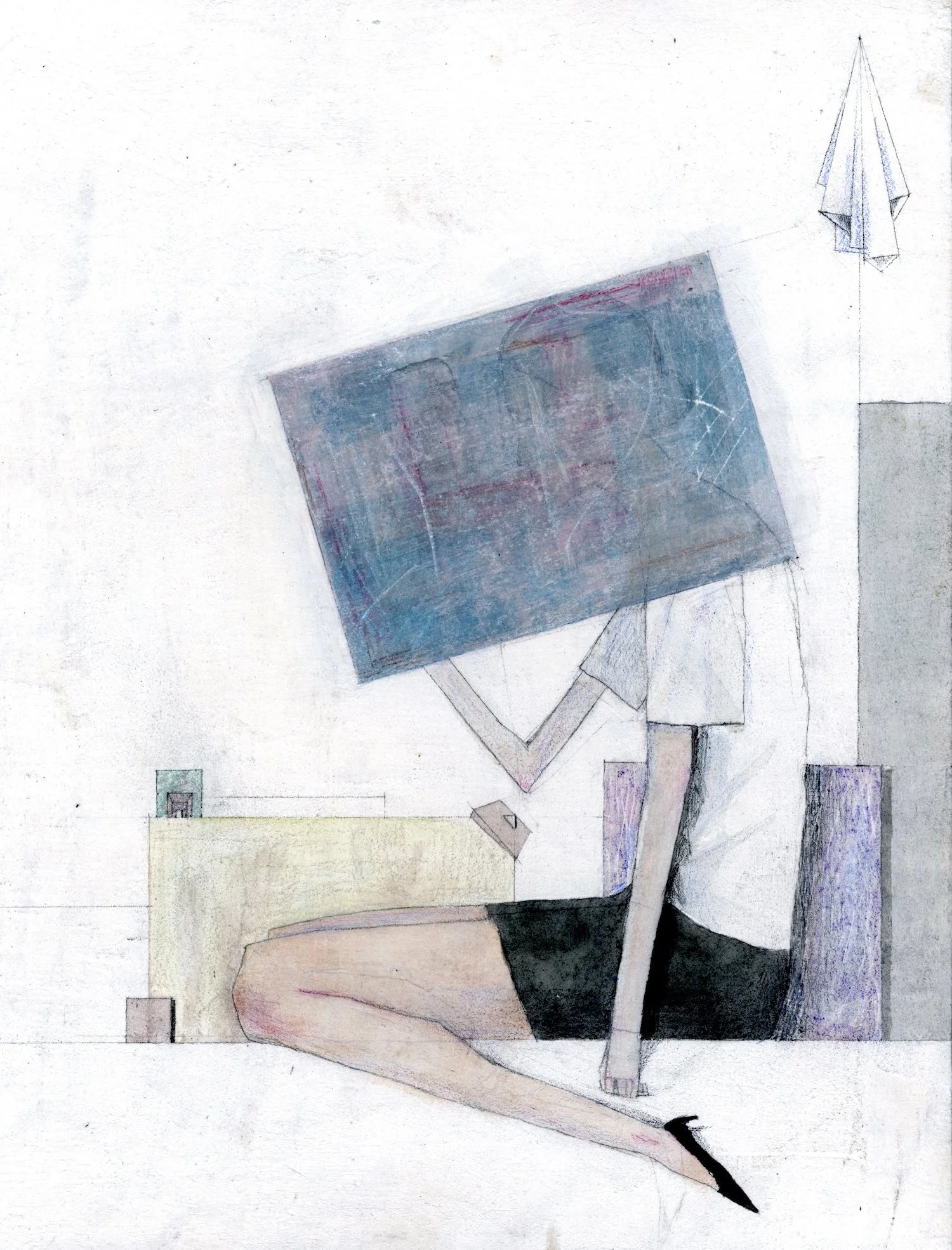
Lily Li, Trapped (2025). Watercolor, colored pencil, marker, and gessoed wood panel, 11 × 14 inches. From the series Northbound. Courtesy of the artist.
XJW: Could you describe your working process when developing a narrative illustration project?
LL: I keep what I think of as a personal archive of impressions. These come from everyday experiences, films, books, and conversations. Sometimes an idea produces a strong response, but I may not yet know how to visualize it, or I may feel I don’t yet have the right visual language to express it. In that case, the idea simply stays in the archive.
I work in cycles. At the beginning of a new cycle, I return to this archive and choose the ideas that still resonate with me and that I feel capable of developing at that moment. I begin with sketchbooks, rough compositions, and sometimes small material experiments.
When I start the final image, I rarely rely on a very detailed preliminary drawing. I usually decide the overall composition and spatial structure, but many adjustments happen during the process of painting. As the work develops, I often discover problems in the initial idea and change the image accordingly. The final piece grows through the process rather than simply executing a fixed plan.
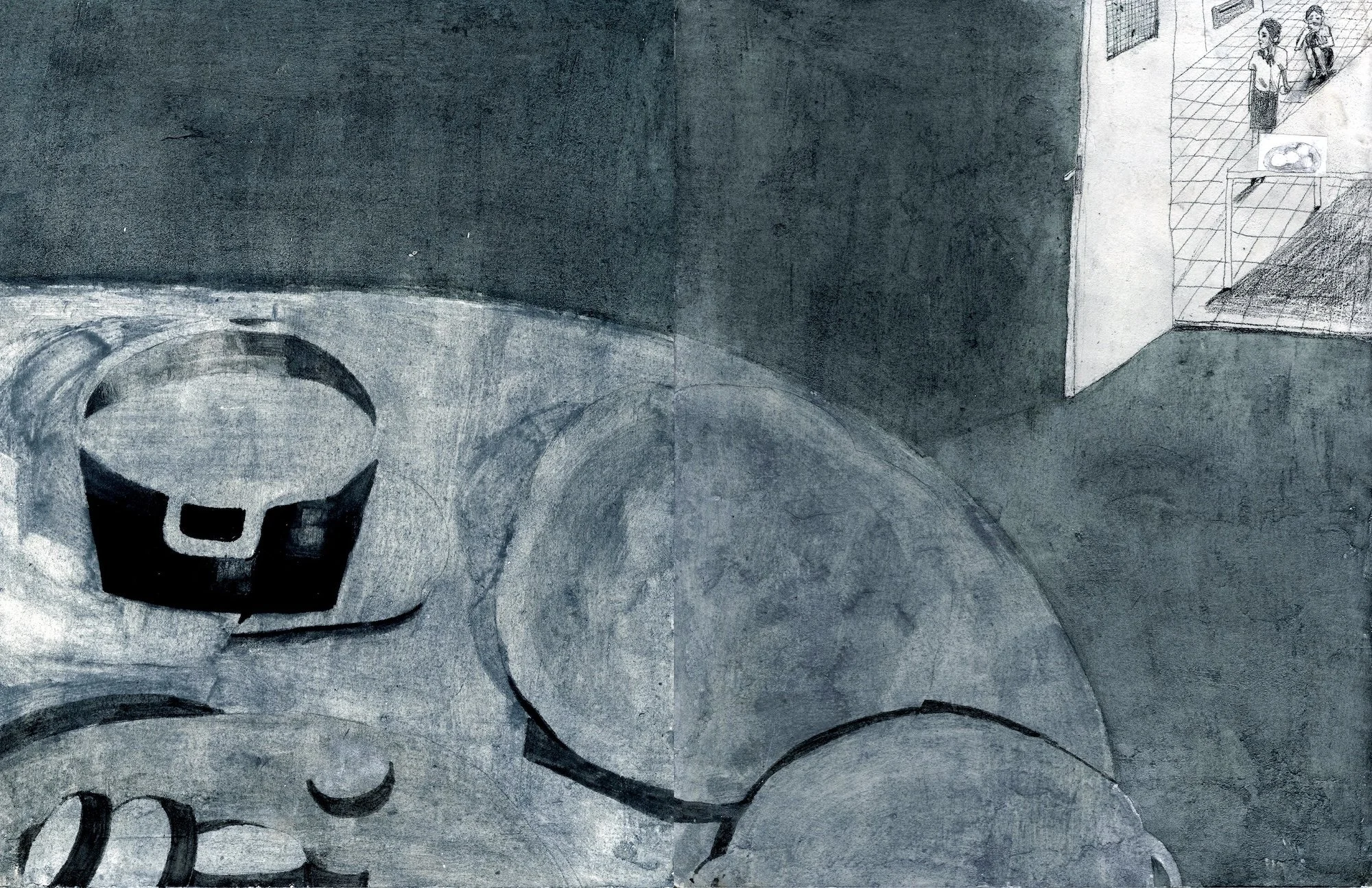
Lily Li, Up & Down (2025). Watercolor, colored pencil, marker, and rice paper on gessoed wood panel, 14 × 22 inches. From the series Northbound. Courtesy of the artist.
XJW: Narrative illustration occupies an interesting position between literature and visual art. What possibilities does this format offer for exploring complex ideas?
LL: What interests me about narrative illustration is that meaning in images can never be fully controlled. I see illustration as a form of language, not fundamentally different from literature. Both construct meaning, but they operate through different structures. Written language communicates through words and syntax, while illustration communicates through visual elements such as composition, color, material, and spatial relationships.
Because of this, the meaning of an image can never be completely fixed. Viewers interpret visual elements differently depending on their own experiences and perspectives. This openness allows narrative illustration to approach complex ideas in a less direct but often more layered way.
For me, this ambiguity is what makes the form compelling. Instead of delivering a single explanation, images create a space where meaning gradually emerges through the interaction between the artwork and the viewer.
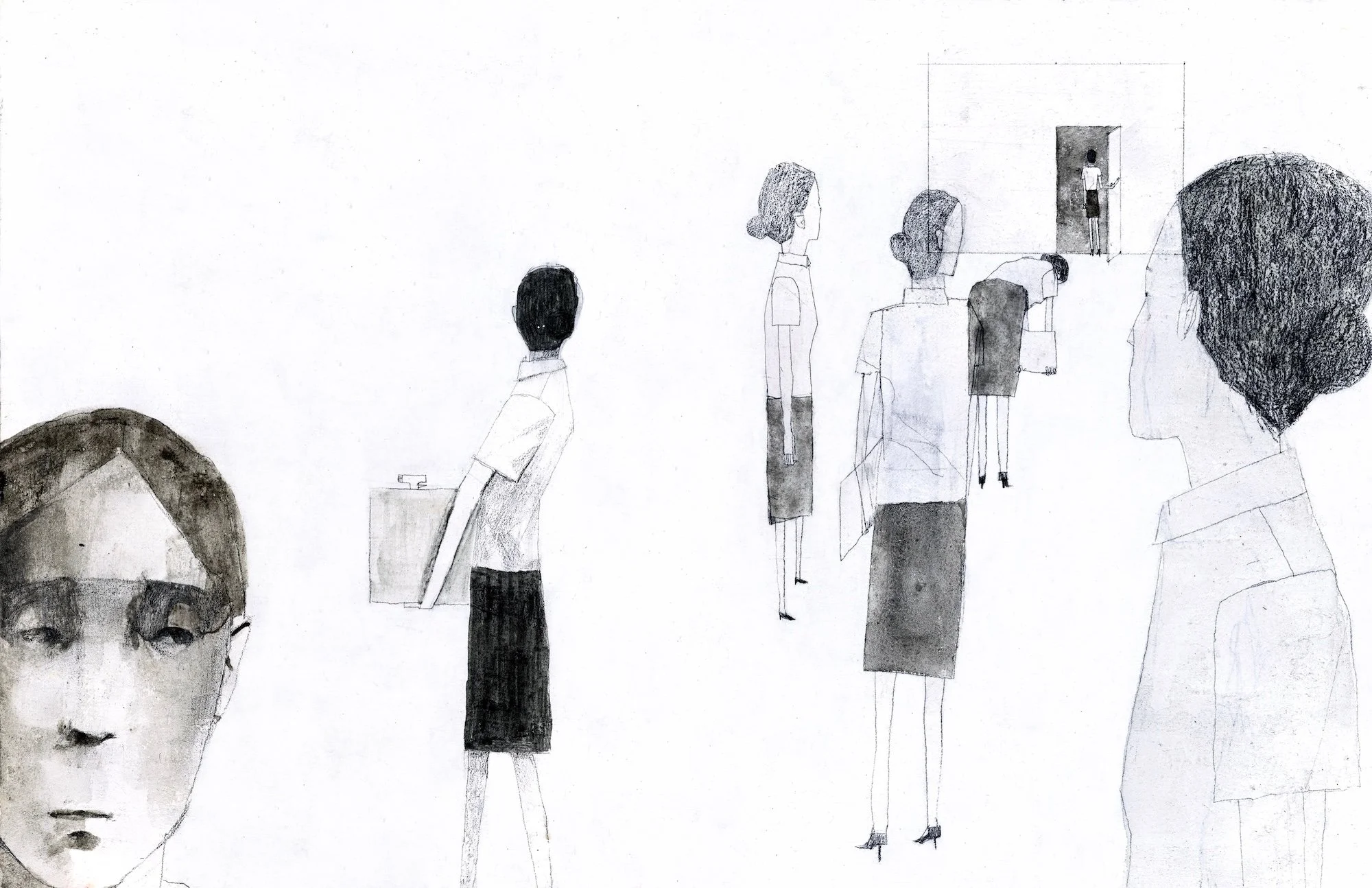
Lily Li, Look Into the Future (2025). Watercolor, colored pencil, marker, and rice paper on gessoed wood panel, 14 × 22 inches. From the series Northbound. Courtesy of the artist.
XJW: Were there personal experiences that shaped the development of Northbound?
LL: Living in New York as an immigrant has made me aware of a particular tension between admiration and distance. Cities like New York often present themselves as places of opportunity and possibility, yet many people who arrive here quickly realize that access to that promise can be uneven.
This experience shaped the emotional perspective of Northbound. The protagonist works in an environment where she constantly encounters fragments of another world—through conversations, objects, and technologies brought in by customers—yet she remains confined within the system that allows her to witness those possibilities.
I became interested in how environments that appear open can simultaneously function as structures of waiting. The restaurant becomes a place where another life feels close enough to observe but remains out of reach.
XJW: What are you interested in pursuing next?
LL: I’m interested in developing longer narrative projects that combine illustration, comics, and editorial storytelling. Many of my recent works explore how large social systems appear within ordinary environments, and I hope to expand these ideas into larger visual series and illustrated publications.
At the same time, I’m also interested in working with editorial platforms where images interact closely with text. That relationship between narrative and visual language allows illustration to engage directly with contemporary social questions.
This interview has been edited for clarity and length.