Material Reasoning in “your cost-benefit calculations”
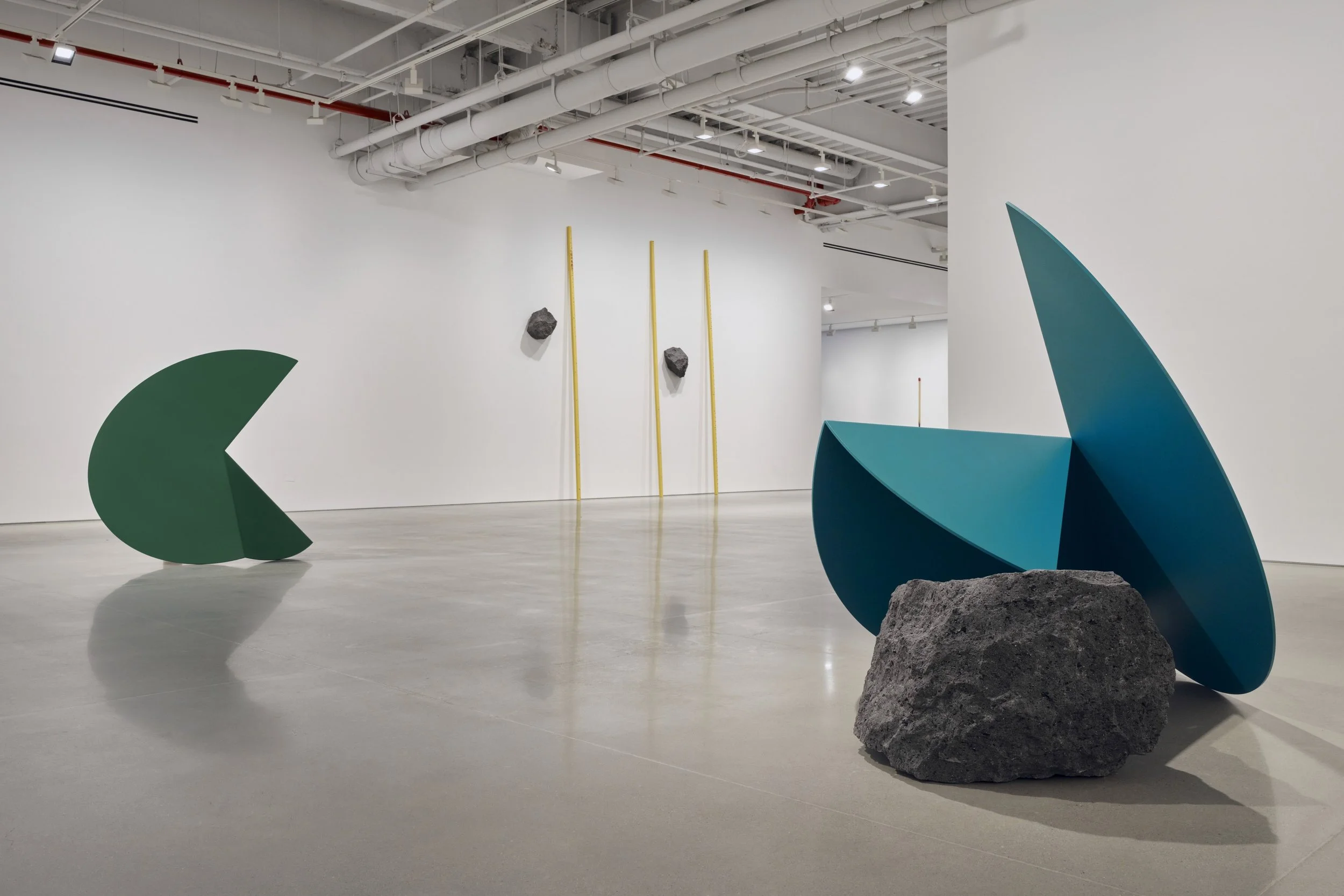
Gabriel Kuri, installation view of your cost-benefit calculations at kurimanzutto, 2026. Courtesy of the artist and kurimanzutto Mexico City / New York. Photo: Zach Hyman.
As tokens like the MetroCard and the American penny are rendered obsolete, abstract value continues its migration from concrete forms. Of course, the stuff we can touch remains the business of a sculptor, and Gabriel Kuri has devoted several decades in his studio to staging dramas of ordinary objects even as they vanish. In his solo exhibition your cost-benefit calculations, his first in New York since 2002, the Mexican-born artist continues his practice of returning abstruse ideas to the sensuous present. While the logic of credit systems, meteorology, and product testing materialized in Kuri’s 2023 survey Forecast at Museo Jumex, your cost-benefit calculations attends to even more pedestrian and personal experiences of decision-making.
The walls of kurimanzutto’s Chelsea space host groups of oversized, double-ended matchsticks in parallel bars of varying heights. Solid-colored circular forms divvied up by angular folds or raised surfaces recur in agile steel sheets twisting to pose on the gallery’s floor, and in their textile and foam analogues installed at eye-level. The outlines of octagonal tapestries carry annotations in hasty charcoal scrawl, while propped wooden poles are chiseled with simple figures along their towering heights. Kuri has implemented a geometric grammar of diagrams, yet denuded his sculptures of legible data. What they offer instead is mere feeling, leaving only the impressions of a few distinct ready-mades and the elementary principles of color temperature, scale, and texture. The familiar items that accessorize Kuri’s geometric forms hint at the value they seek to measure, which is the fundamentally emotional one of risk.
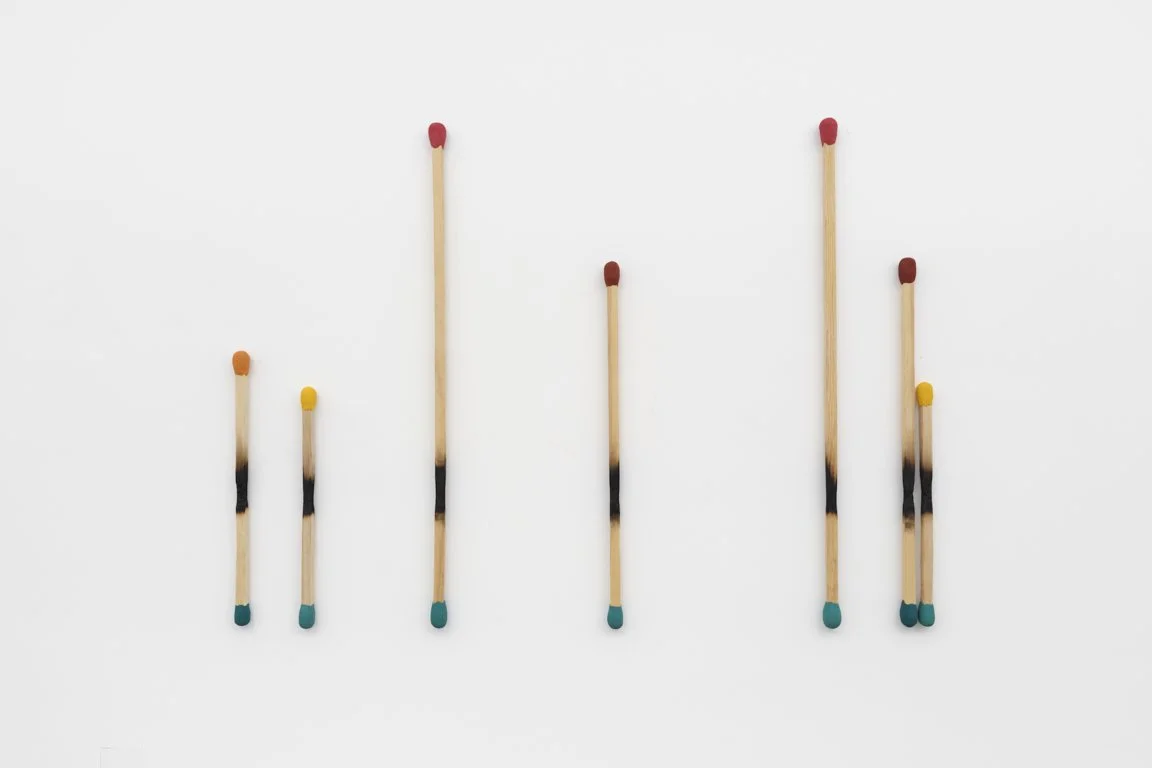
Gabriel Kuri, error bars (group 1), 2025. 5 units. Burnt wood, mixed media, 101.5 x 178 x 5.5 cm (40 x 70 x 2.25 in). Courtesy of the artist and kurimanzutto Mexico City / New York. Photo: Zach Hyman.
That is not to say that Kuri’s more explicit materials strike terror. Volcanic rocks, packaged fireworks, and eggs hovering precariously among the chart-like forms contain only latent outcomes and remain placid at some remove from their potential. The unignited heads of matchsticks and half-furled umbrella canopies, suggested by some of Kuri’s representational strokes, arrest the liminal and subconscious moments of decision-making during which we imagine probabilities. The act of abstract reasoning is then conveyed in the concrete terms at the sculptor’s disposal: within his assemblies, Kuri’s cool-toned details are placed at lower heights than hazardous oranges and yellows, which rocket up towards the gallery’s red exit signs and sprinkler pipes. Even this simple relational system, established by the artist’s own decisions when installing the show, is a testament to height and color gradations as universal signs we interpret for survival. The precise arrangements within and among Kuri’s sculptures force viewers into a form of pattern recognition that is experienced on both primal and societal terms.
But all of this calculation and deliberation doesn’t compromise the staunch realness of Kuri’s chosen objects. In some schemes, they directly replace intangible 21st-century contrivances. One work, untitled (credit score cast) (2026), roughly mimics the shape of a credit score odometer in a steel sphere attached to the wall, yet ubiquitous colors or numbers that would summarize creditworthiness are nowhere to be found. The undulating white surface only affords us something at once more palpable and more enigmatic: a cigarette butt extinguished in a red bottle cap nestled on one edge. The propped-up litter is a small vestige of the material world that resists grand-scale disembodiment and yanks future projections back into the here and now. Most importantly, it hints at the absurdist belief about the whole rigmarole of cost-benefit analysis: how pointless it is to render things in terms that aren’t as random and incalculable as life itself.
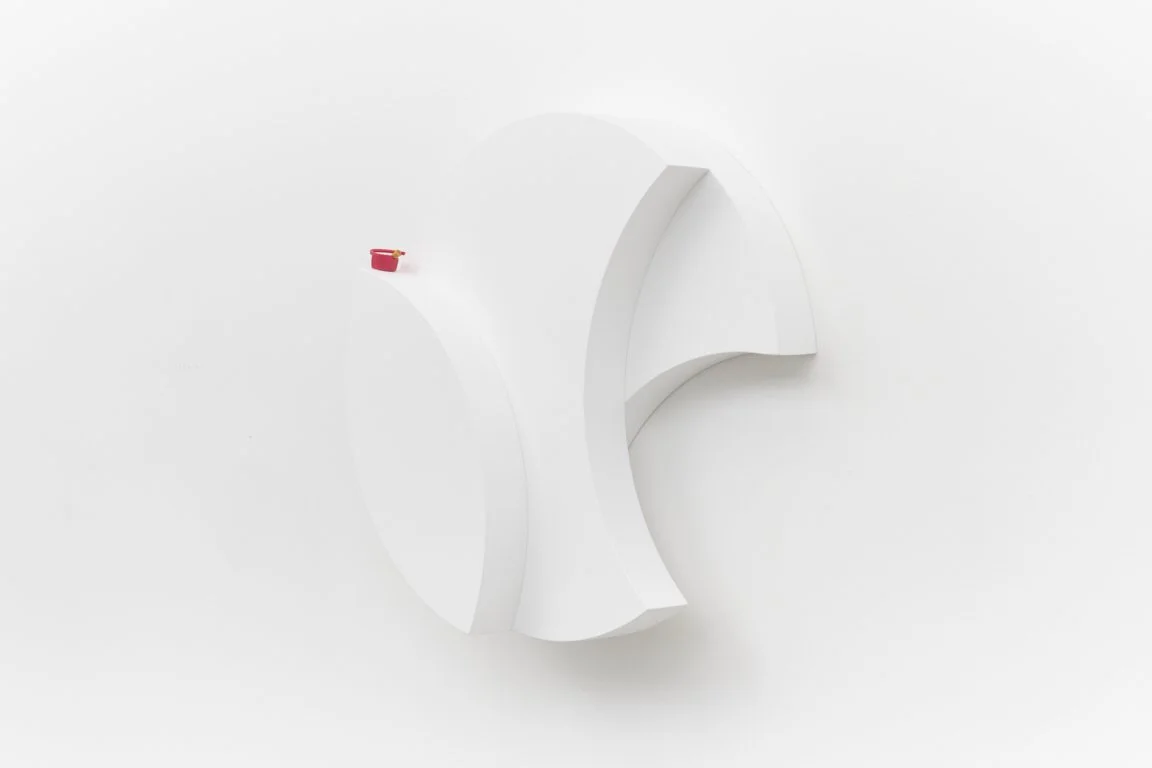
Gabriel Kuri, untitled (credit score cast), 2026. Medium high density foam, acylac, bottle cap, extinguished cigarette butt, 56 x 56 x 18 cm (22 x 22 x 7 1/8 in). Courtesy of the artist and kurimanzutto Mexico City / New York. Photo: Zach Hyman.
Gabriel Kuri: your cost-benefit calculations is on view at kurimanzutto from January 15 through March 14, 2026.