

.webp)
Marc Kokopeli: “M.Kokopeli CURSED/01” at Gladstone
Review
Six stackable plastic chairs. Two small round tables. Two medium desks. Two rectangular tables with black legs. One metal garbage bin. In a nook of the Goldfarb Gallery at York University in Toronto, Amy Ching-Yan Lam displays her installation Furniture for Three Doors (2025), in which she calculates and displays the amount of furniture sourced from York University’s storage facilities required to barricade the entrances of her exhibition, 83% Perfect. Over the course of the exhibition’s run, the institutional conditions surrounding its presentation—marked by allegations of administrative scrutiny and censorship—render Lam’s critique of evaluation, governance, and control not only thematic, but materially enacted.
At the center of Lam’s exhibition of new work is Acceptable Protest (2025), an animated video created in collaboration with illustrator Emerson Maxwell. In the animation, Lam and Maxwell examine official protest policies issued by North American universities: documents that delineate the narrow parameters of what is and is not considered “acceptable” dissent on campus. Through clipped language and procedural logic, the animation reveals how educational administrations actively shape what kinds of civic participation are possible, training individuals to fit into existing economic and political orders, rather than to question or transform them. The work exposes the bureaucratic minutiae through which radical action is managed, neutralized, and rendered inert by institutions that position themselves as sites of critical thought.
The concerns articulated in Acceptable Protest have extended beyond the sphere of display. At a book launch at the gallery in December, Lam disclosed that York University administrators scrutinised the animation and requested changes, including the removal of the word “President” from a character and eliminating a “Free Palestine” poster. These negotiations unfolded alongside the abrupt dismissal of the gallery’s director and curator Jenifer Papararo–a decision that raises concerns about the administrative interference in creative and curatorial programming. Together, these events underscore the degree to which the institutional logics examined in Lam’s work are actively operative within the conditions of the exhibition’s own display.
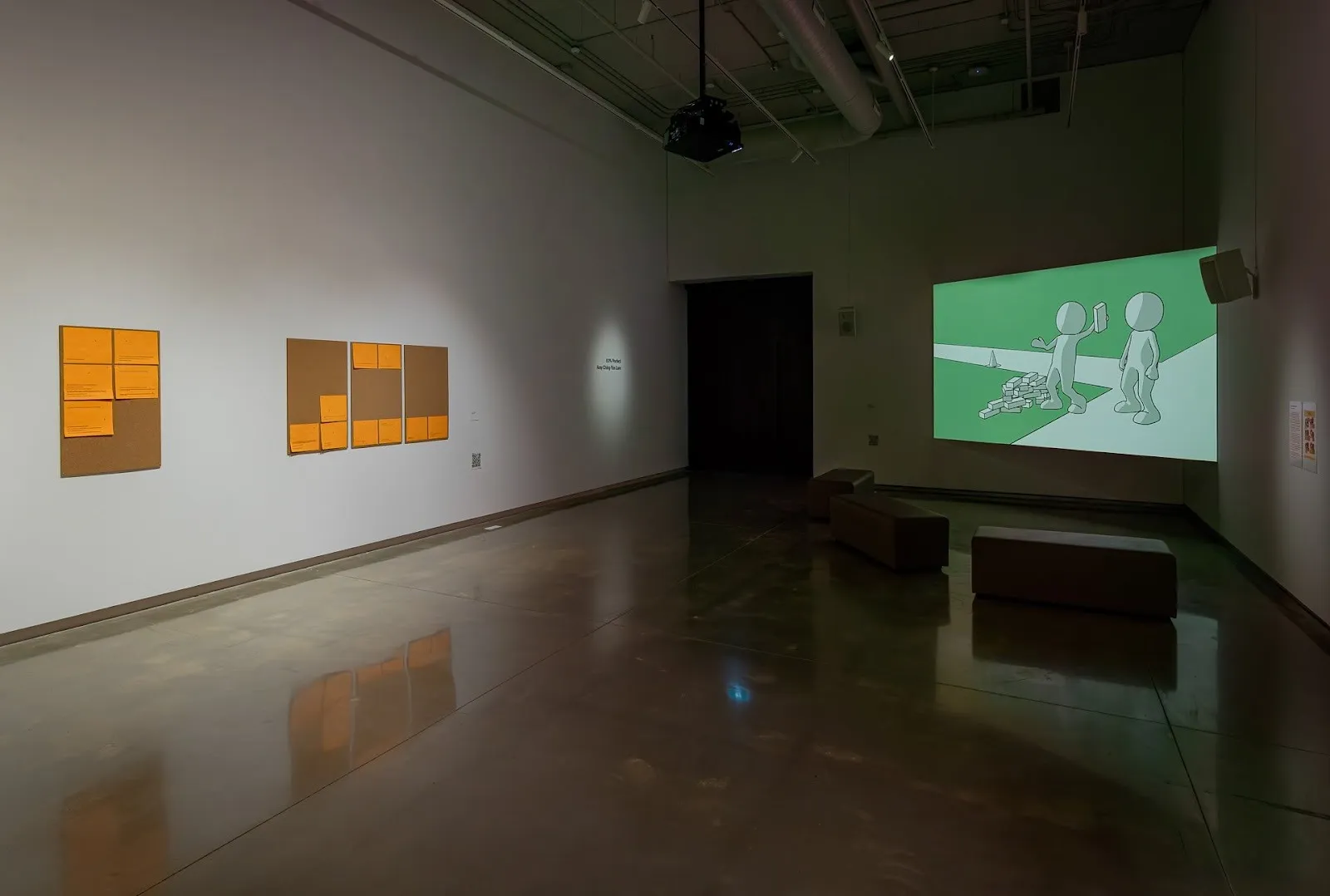
The exhibition’s title functions as a deliberate oxymoron. Pairing opposing terms, Lam foregrounds the disjunction between the promise of perfection and the reality of perpetual evaluation. This tension is elaborated through a text by the same name, printed onto neon-orange paper pinned to corkboard panels that line the gallery walls. Lam’s fable follows a semi-autobiographical character as they navigate institutionalised systems, tracing how values of individual exceptionalism are taught, embodied, and ultimately unlearned.
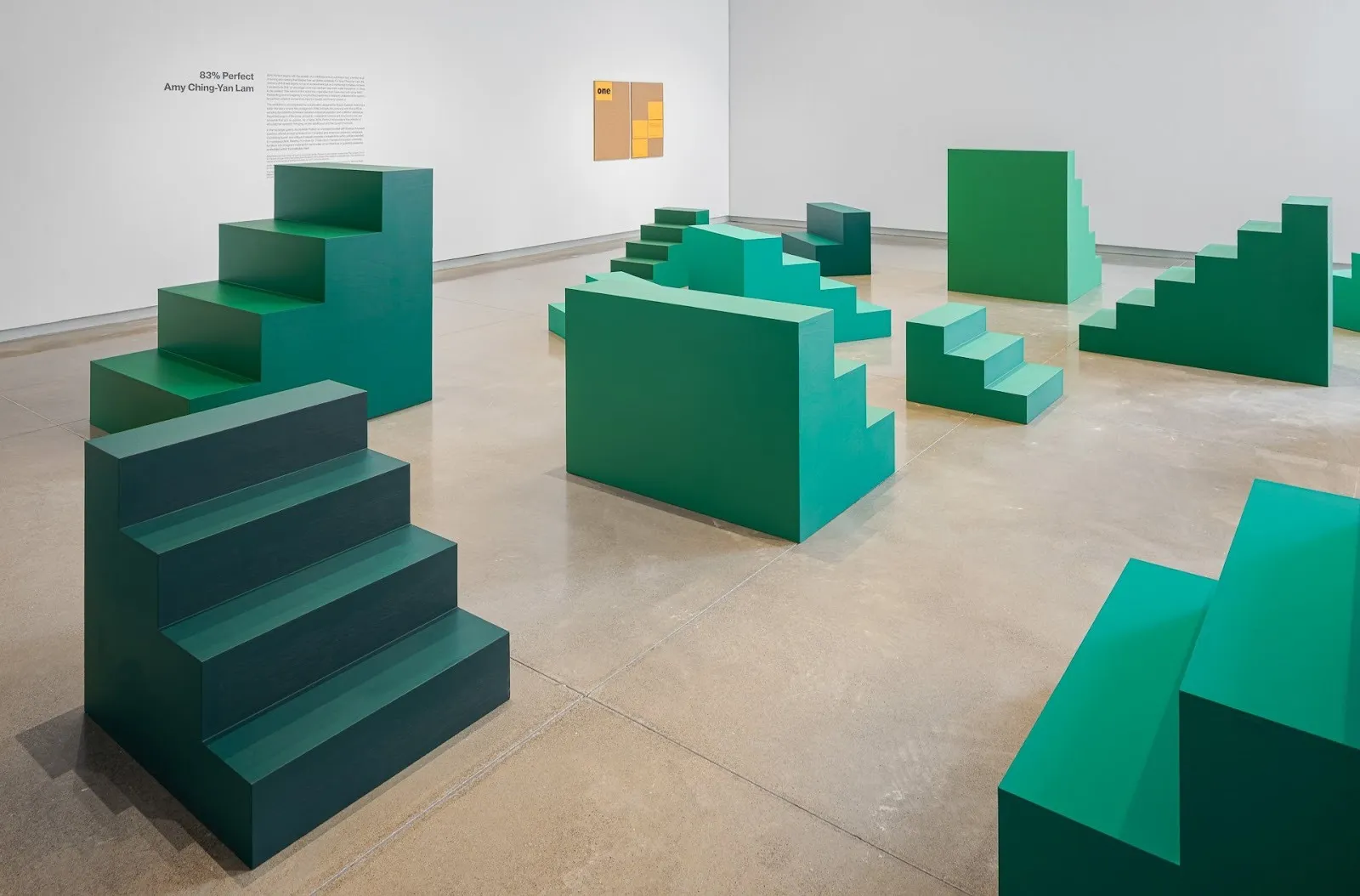
First Test (2025), which is centered around the artist’s childhood memory of a green staircase, is the exhibition’s conceptual catalyst and its most visually iconic work. In this recollection, Lam is three years old, acutely aware of being watched by adults as she navigates a detached, self-supporting staircase. Ascending and descending the freestanding prop, she experiences what she perceives as her “first test,” as much a measure of physical ability as an initiation into performance under observation. Adapting the architecture of the testing apparatus in her installation, Lam fills the gallery with multiple staircases, each slightly different from the others. Varying in height and in colour, each painted a subtly distinct tone of green, the stairs appear podium-like, implying a hierarchy of achievement.
The viewer is tasked with navigating Lam’s maze of green steps, which become stand-ins for evaluative structures that reward the reproduction of knowledge over the acquisition of skill or critical thought. The installation highlights assessment’s function as a key technology of power: by ranking, grading, and sorting students, its subjects learn to anticipate expectations, internalize external evaluations of success and failure, and adjust their behaviour accordingly.
Along with the exact quantity of filing cabinets, chairs, tables, and desks required to barricade the exhibition spaces, in Furniture for Three Doors, Lam provides a poster offering practical details for the blockades. “For doors that open outwards,” Lam’s poster states, “the main principle is to make it really difficult to dismantle: stack as much stuff as possible together in weird ways, and tie it all together with rope and/or bungee cords.” In the context of the exhibition’s contested governance, Lam provides the infrastructure for dissent. In doing so, she charges the space, intimating that the architecture meant to discipline and contain might instead be mobilized to fracture and reimagine the conditions through which knowledge and dissent take shape.
Amy Ching-Yan Lam: 83% Perfect is on view at the Goldfarb Gallery at York University in Toronto from September 26, 2025 through January 31, 2026.