

.webp)

Marc Kokopeli: “M.Kokopeli CURSED/01” at Gladstone
Review
Diane Simpson’s sculptures challenge how far the logic of an outline can survive in space. The geometric folds and interlocking planes of her simultaneously dimensional yet flat sculptures test the boundary that distinguishes sculpture from drawing by becoming sites of passage between two-dimensional systems and embodied three-dimensional forms. Formal Wear at the American Academy of Arts and Letters, Simpson’s first institutional solo exhibition in New York, brings together thirty works from 1976 to 2022 across two galleries that underscore this logic. The lower-level gallery features only Simpson’s drawings, early collagraph prints, and one constructed print, standing in contrast to the ground-floor space, which focuses entirely on the artist’s sculptures. Visitors retrace the artist’s process of converting a drawing into a sculpture by either descending from object to plan, or ascending from concept to realization.
The ground-floor gallery feels ceremonial and spatially tense. Directly to the left of the entrance is Chaise (1979), a wall-bound sculpture made of intersecting muted blue panels of corrugated archival cardboard that extends out from the wall like an open page from a pop-up picture book. The upper plane of this sculpture leans against the wall, similar to a relief sculpture, testing how much architecture it can absorb before becoming an obstruction. Here, the wall is not a support, but a limit that refuses the allowance to see the sculpture in a complete 360-degree view, which creates an uncanny feeling that the sculpture’s momentum is stalled. Visually, the sculpture reduces the chaise lounge to its skeletal geometry, preserving its recognizable outline in the form of supporting planes, angles, and visible joinery. Rubbed crayon adds a painterly sense of artificial depth to an otherwise flat surface. This gesture draws from Simpson’s formal training in drawing, painting, and printmaking at the School of the Art Institute of Chicago, where she received her BFA in 1971 and her MFA in 1978. In this early stage of her career, Simpson was primarily interested in the human figure as a subject. Although the figurative body is absent from Simpson’s later work, it reenters indirectly through Simpson’s sustained attention to how the spectator’s body is positioned, oriented, and disciplined in space.
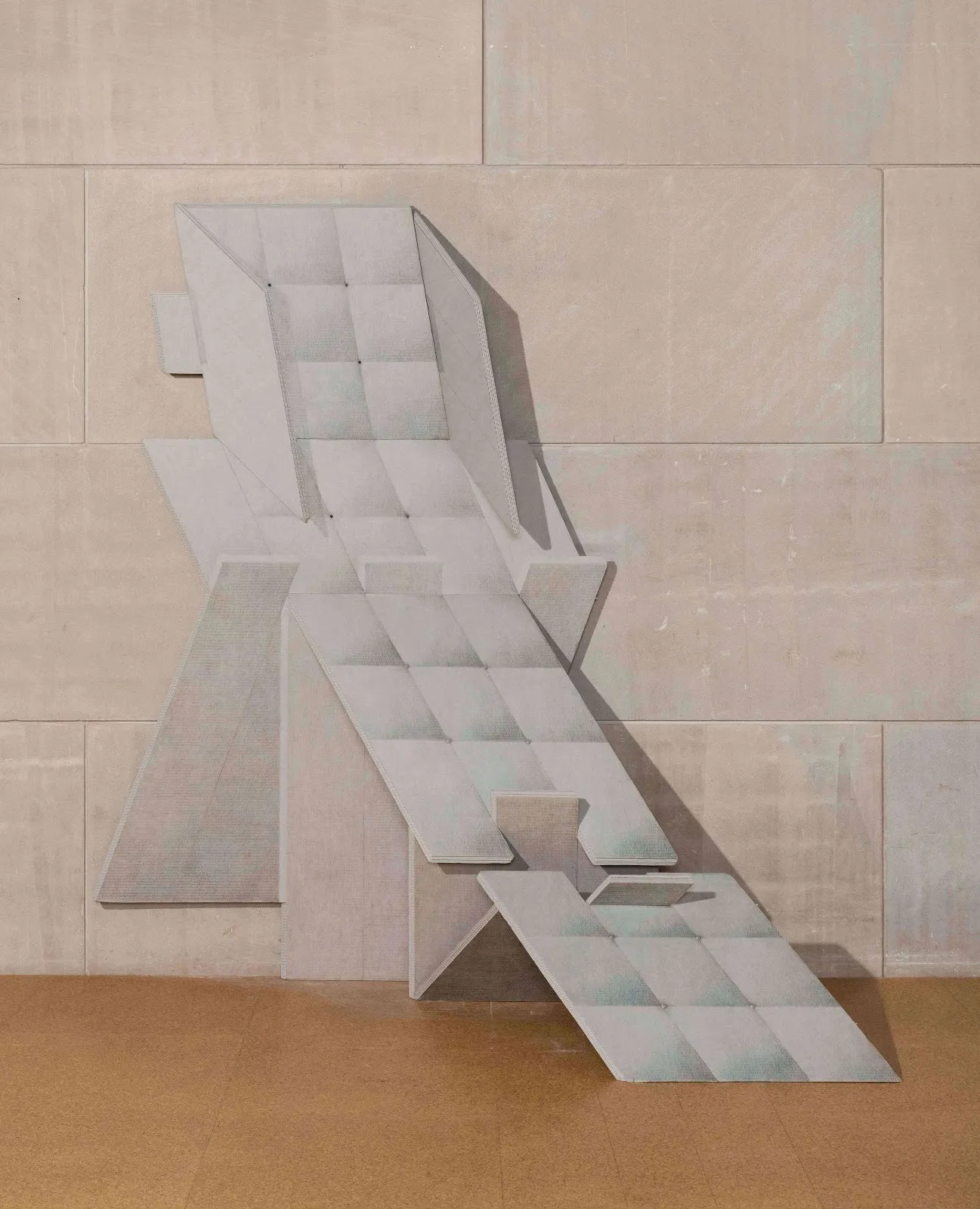
Chaise reads as a diagram of repose rather than a place of it by implying a resting body through its form while withholding the conditions of comfort. However, the body isn’t missing as much as it is misplaced. The chaise itself is inclined so steeply that it reads almost like a ramp or chute that an imagined body would be sliding down, creating a tension where a figure is assumed but structurally impossible. This sculpture is the clearest articulation of Simpson’s method of turning a drawing into a sculpture without it becoming furniture: making objects that look usable but behave analytically. When an object appears usable, it cues the viewer to approach it through habit. Furniture, garments, and architectural elements all carry ingrained scripts—how to sit, walk through, wear, lean, or rest. Simpson borrows these scripts visually to activate recognition but refuses to let the object complete the script by suspending function, thus her sculptures behave analytically. The corresponding axonometric drawing for this sculpture, Drawing for Chaise (1980), in the lower-level gallery, shows the object tilted at a 45-degree angle, similar to the oblique projections architects use when drafting to show the potential for other views while simultaneously suggesting a frontal, correct view. Frontality in Simpson’s sculptures is provisional, almost like instructions that demonstrate the suggestion of where to look before giving way to multiple, misaligned views produced through movement.
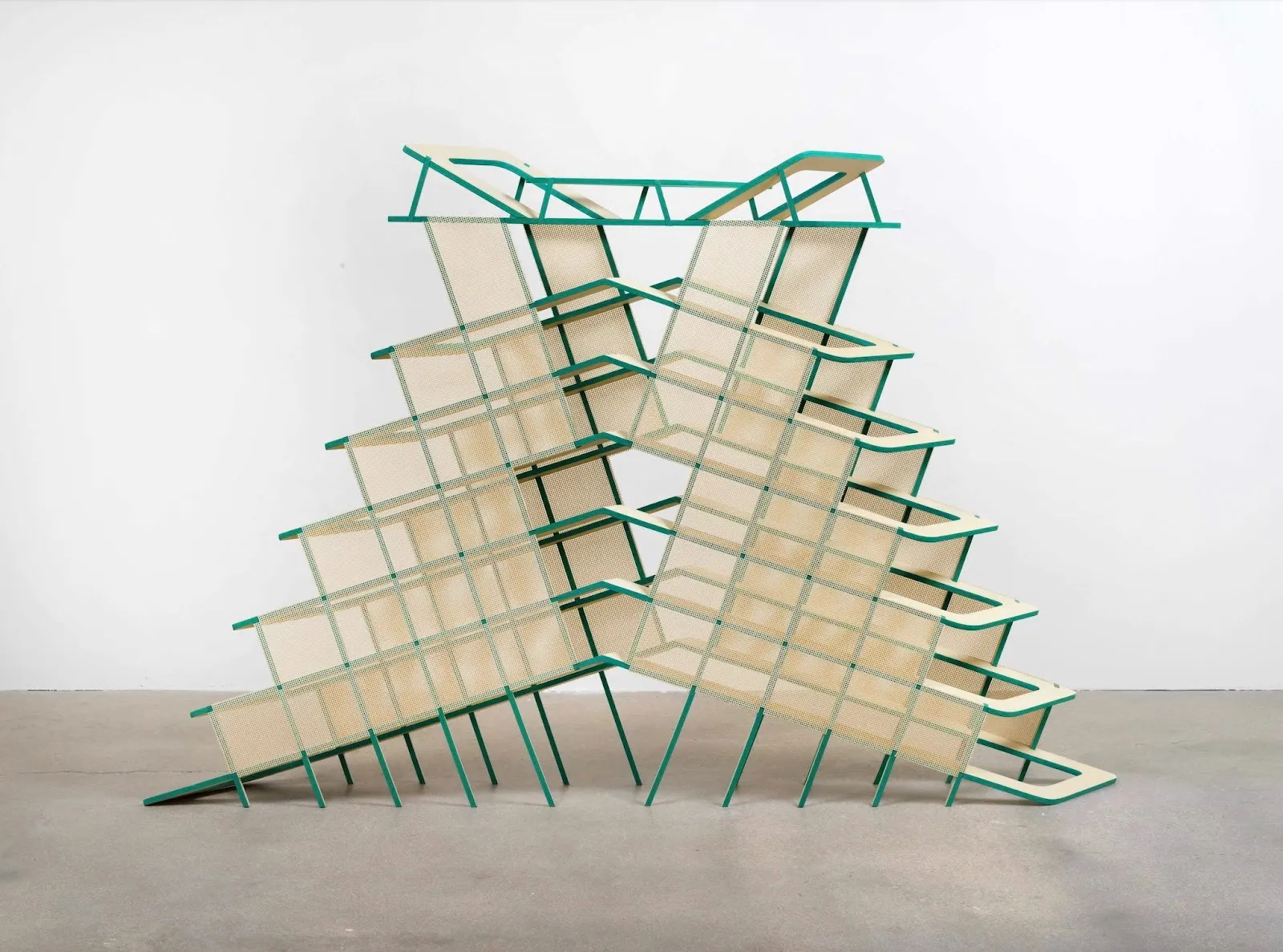
Across from Chaise is Underskirt (1986), a lean and linear sculpture modeled after a pannier, or side hoops, that reads as delicate and rigid, protective and imprisoning. Historically, this cage-like support manufactured space around the wearer’s body that allowed women to take up more space than men and was normally worn with formal gowns and within court fashion in Europe between the 17th and 18th centuries. Underskirt does not represent a garment, but the structural tension tied to the historical function of a garment that produces visibility while enforcing control. Simpson literalizes this tension by making space the sculpture’s primary material. The grid-like structure of this sculpture is optically penetrable and even when the planes align, they do not read like walls, but as screens that can be seen through while they occupy volume. The interior volume is not empty; it is the work’s central form that approximates bodily presence without depicting it, allowing for the body to not be absent or hypothetical, but instead indexed.
Worked down to the floor and placed away from the wall, Underskirt stands on its own but is not autonomous. Oriented spatially at a 45° angle, like Chaise, the green outline of oil stain and acrylic on MDF only resolves into alignment when one stands in front of the sculpture at exactly the right spot, a precise frontal position. However, Underskirt requires circulation to be legible, treating perception as a temporal activity, not an instant one. In this sense, Simpson’s sculptures draw on theatricality, a condition in which an artwork’s meaning or affect depends upon the viewer’s presence, duration of looking, and an awareness of oneself in relation to the artwork. This is a quality that the art critic Michael Fried anxiously criticized in his 1967 essay Art and Objecthood, which framed theatrically as a failure because it rendered the artwork dependent on its encounter with the viewer. Underskirt neither commands nor resists movement; it cooperates with it. This spatially open sculpture fully realizes Simpson’s interest in drawing becoming sculpture while resisting the implication that theatricality as a whole is good or that Fried was wrong. Instead, Simpson’s sculptures made in the late ‘70s and ‘80s exist in the shadow of the logic of the ‘60s by making a subtler claim that sculpture cannot avoid duration or movement. Simpson’s sculpture requires moving around it to see its form oscillate between flatness and depth as integral to experiencing it, emphasizing the fact that to see a sculpture is to slowly and intentionally walk around it, watching how shadows shift and planes are reorganized into a unified spatial experience that gives meaning to form.
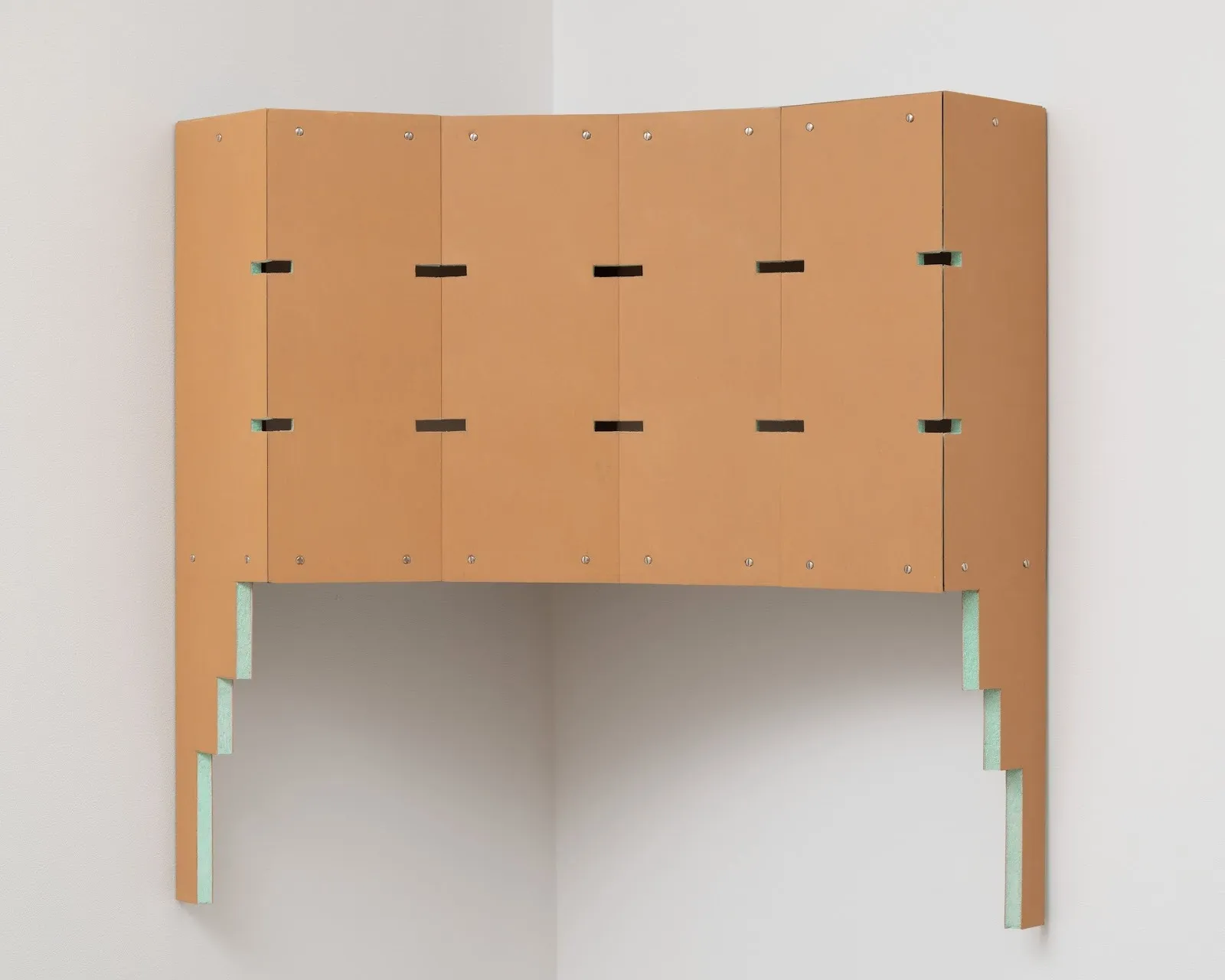
While the majority of the sculptures in this room invite movement, only one truly constrains it. Placed in a corner, Portico (2021) fuses with the room’s threshold, becoming both architecture and embellishment. Portico uses the corner as an authorial force. Simpson is not just placing a sculpture in a corner; she is outsourcing compositional control to architecture itself. Unlike a wall-bound sculpture that allows lateral movement or a freestanding sculpture that can be circled, Portico makes bodily restriction legible as it can only be approached through withdrawal. Vision is flattened into a single, sanctioned view when experiencing this sculpture, making the brown planes of this work read rigidly. By replacing her usual spatial oscillation between flatness and volume with enforced frontalism, perception is turned into compliance. If the wall-bound Chaise imagines a body that cannot rest, Portico addresses a body that must obey. Here, the corner becomes a disciplinarian, telling bodies where they can and cannot go while showing what it wants and denying the rest. There is no invitation to test this sculpture with movement, making Portico feel more prescriptive than any other work in the exhibition. Interestingly, this is one of the most recent sculptures included in this exhibition and the only work that demonstrates a moment when Simpson’s sculptural system loses contingency. One can argue that because flatness and depth no longer compete, placing a sculpture corner stabilizes the object too fully. However, this is not a failure in Simpson’s sculptural logic, but a deliberate tightening that allows the Portico to reveal the cost of certainty through spatial restriction.
Simpson treats each sculpture as actively engaging with its surroundings, shaping how viewers move through and perceive space. Whether she chooses to graft a sculpture to the wall, as with Chaise, place it in the center of the room, as with Underskirt, or position a sculpture in a corner, like in Portico, the sculptor understands that sculpture is in a reciprocal relationship with place. Each sculpture in this exhibition is like a punctuation mark in space, instructing visitors to pause, pivot, and eventually shift their attention before moving on to the next work. This is not simply a theatrical spectacle, but a sort of deliberate quiet choreography.
Diane Simpson: Formal Wear is on view at the American Academy of Arts and Letters from September 27, 2025 through February 8, 2026.