In Conversation with Gao Hang
Interview
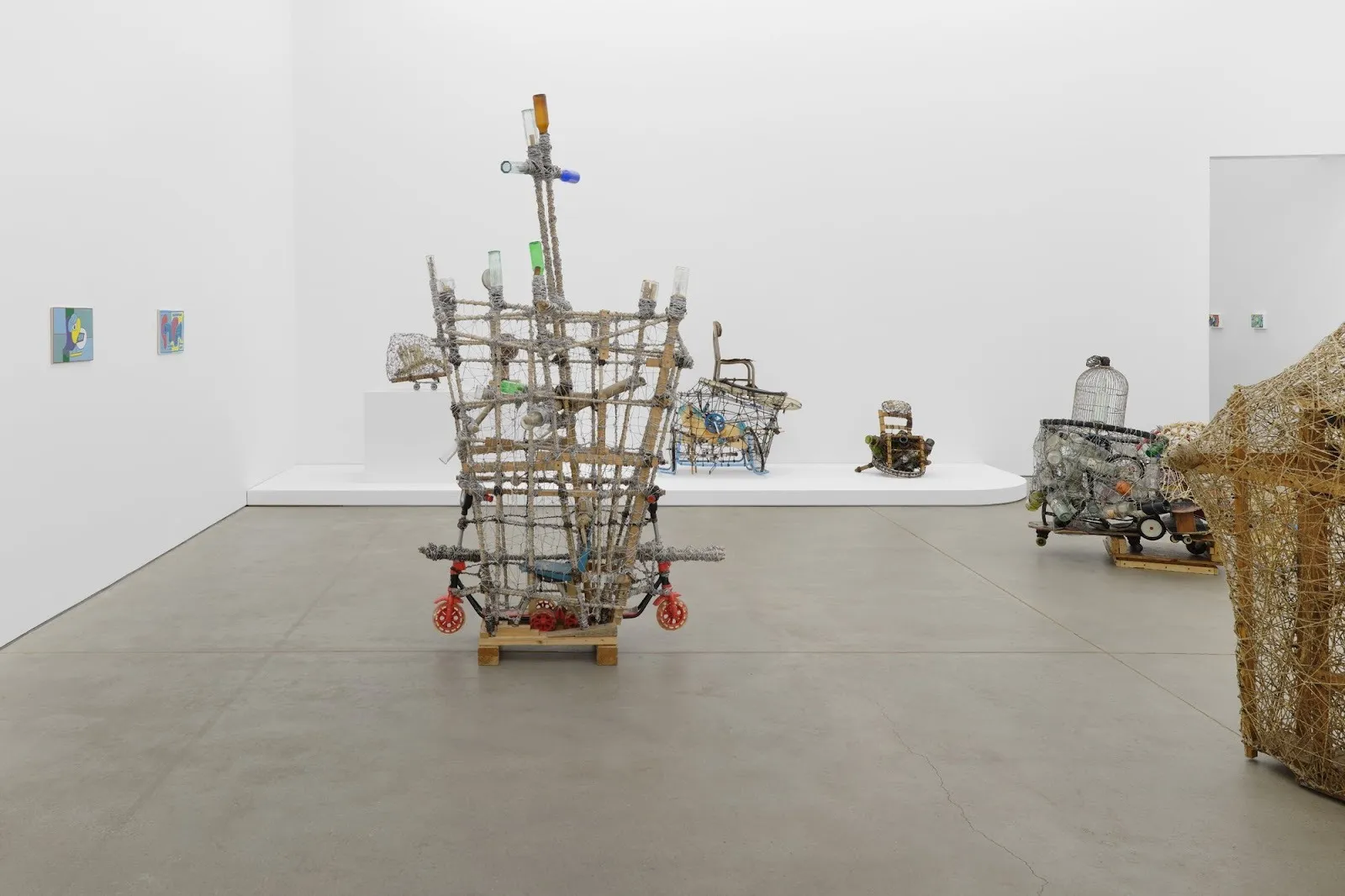
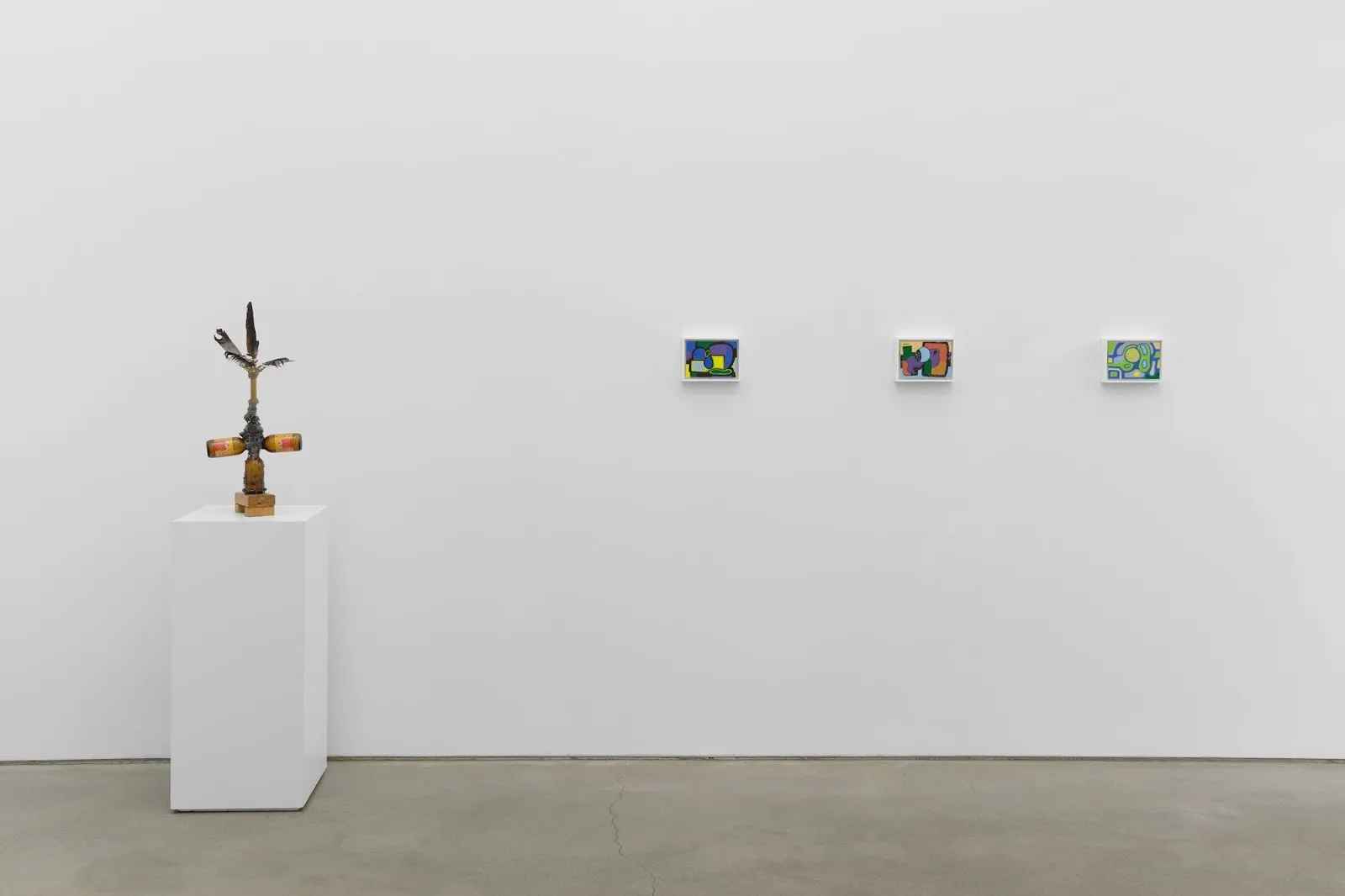
Arthur Simms’s works utilize free association as a methodology and starting point, in which found objects are assembled in space to become formally and conceptually connected to the artist’s subconsciousness, art-historical precedents, and various folk cultures. Recently, his solo exhibition, Caged Bottle, at Karma presents a selection of sculptures and two-dimensional works from over three decades of the artist’s practice, tracing Simms’s continued engagement with concealment, balance, and the narrative capacity of found materials.
Xuezhu Jenny Wang: Your work stems from the unconscious and evokes a surrealist sensibility. There’s a synthesis between art historical references and motifs from folk cultures of Jamaica, Haiti, and the Americas at large. Can you point us to a few ways in which this is accomplished?
Arthur Simms: Every piece has multiple meanings. While free association stems from Surrealism, I have been making objects since I was a child in Kingston, Jamaica. It is second nature to me. After receiving a formal education in the US and traveling abroad, I began pulling bits of history and aesthetics from various cultures to create a whole.
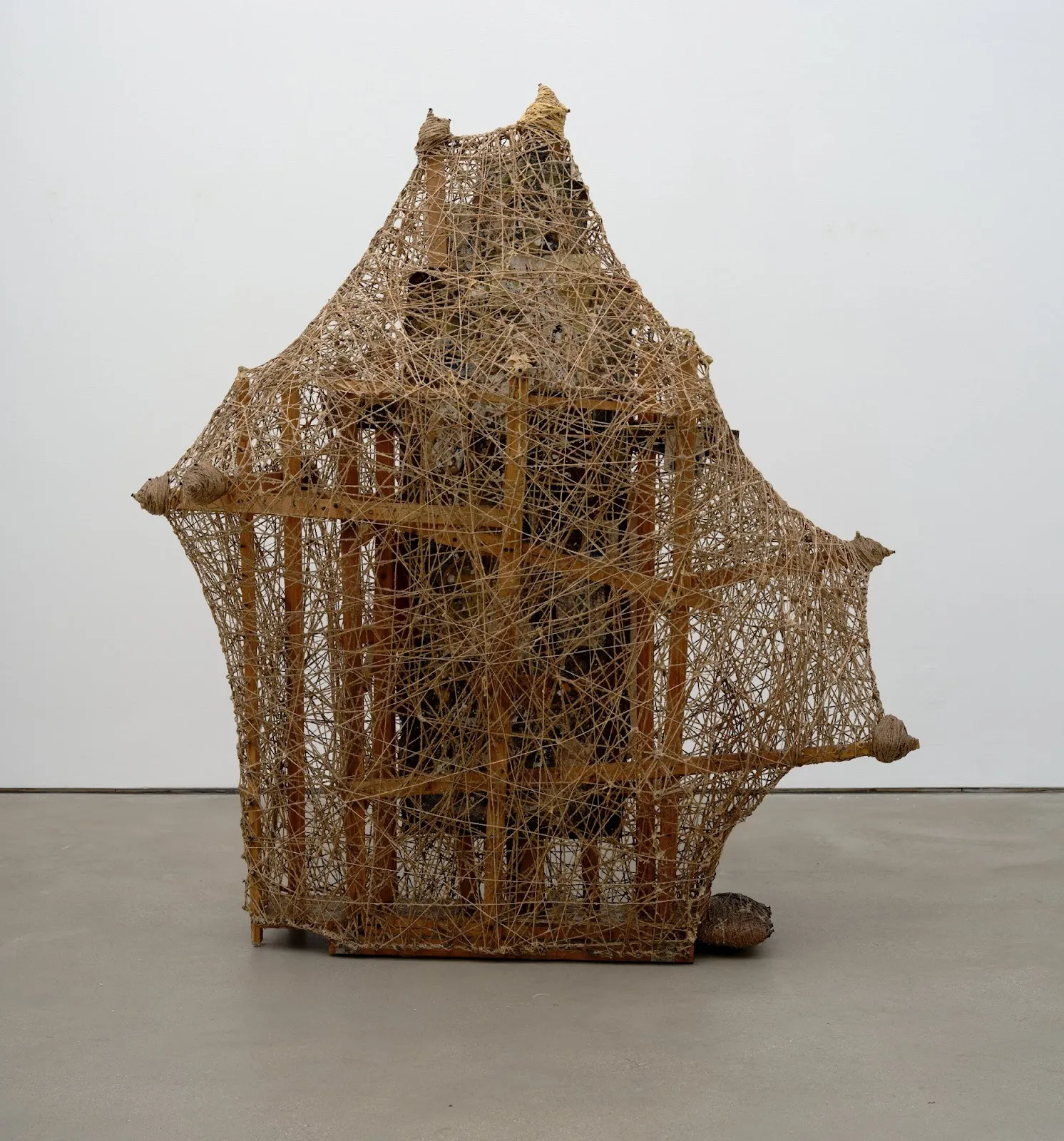
Dreamcatcher IV (2017) references “bottle trees” found in the Caribbean and the American South. That tradition originated in West Africa and was brought here by enslaved Africans; the idea is to hang reflective objects to ward off evil. Sexual Tension (1992) contains a drawing in its “belly.” The inclusion of the drawing is a nod to Robert Rauschenberg’s “combines,” which blurred the line between sculpture and painting. It’s wrapped in ropes—concealment is actually a very African theme. In Nkisi or Nkondi figures, a shaman places ritualistic objects inside the “belly” of a carving to be known only by them. While you can see the structure of this particular piece, I have other works from the ’90s that are so tightly bound you cannot see inside at all.
XJW: How did you land on wrapping these sculptures with ropes?
AS: In the mid-to-late 1980s, I began making sculptures using disparate objects that required a unifying agent. I recalled a work by the Canadian post-minimalist Jackie Winsor titled Bound Square (1972)—four logs wrapped in rope. I decided to try rope myself. I initially used hemp ropes, which have a direct cultural reference to Jamaica. In this way, a single material bridges post-minimalist art history with my own cultural background. Later, I started using wire because it offers different physical properties, as it is shiny and light-reflective.
XJW: These sculptural pieces almost feel like drawings in space.
AS: Exactly, I do think of them this way. In fact, I consider the works on the wall to be drawings rather than paintings because of the heavy involvement of line. I remember specifically the feeling of “drawing” with the rope while creating these sculptures. It is so ingrained that I even find myself drawing with ropes in my dreams.
XJW: Between working three-dimensionally and two-dimensionally, how do you situate your practice?
AS: Since I am known for my sculptural works, many people are surprised to learn that I also make many drawings. The works in this exhibition are acrylic on panel and on aluminum. I got the idea for painting on aluminum from my teacher and friend, Lois Dodd. Those also reference retablo paintings from Latin cultures, which are devotional paintings used to thank or petition the gods.
My three-dimensional works and two-dimensional works are separate practices, but they all come from free association. When working, my mind’s eye might pull an image of an eye from an African sculpture. In other pieces, the colors might be reminiscent of Bob Thompson or Georges Rouault. A rock sitting atop one of my sculptures might refer to the ostrich egg in Piero della Francesca’s Brera Madonna. I have always used art history to help articulate who I am. As a young student, I painted self-portraits in the garb of Rembrandt and Velázquez. Artists have always borrowed from other cultures and eras to express their ideas. I try to be respectful of the cultures I study while acknowledging that this exchange is a fundamental part of art.
XJW: What does free association look like when working three-dimensionally? Do you start with a single object and build around it?
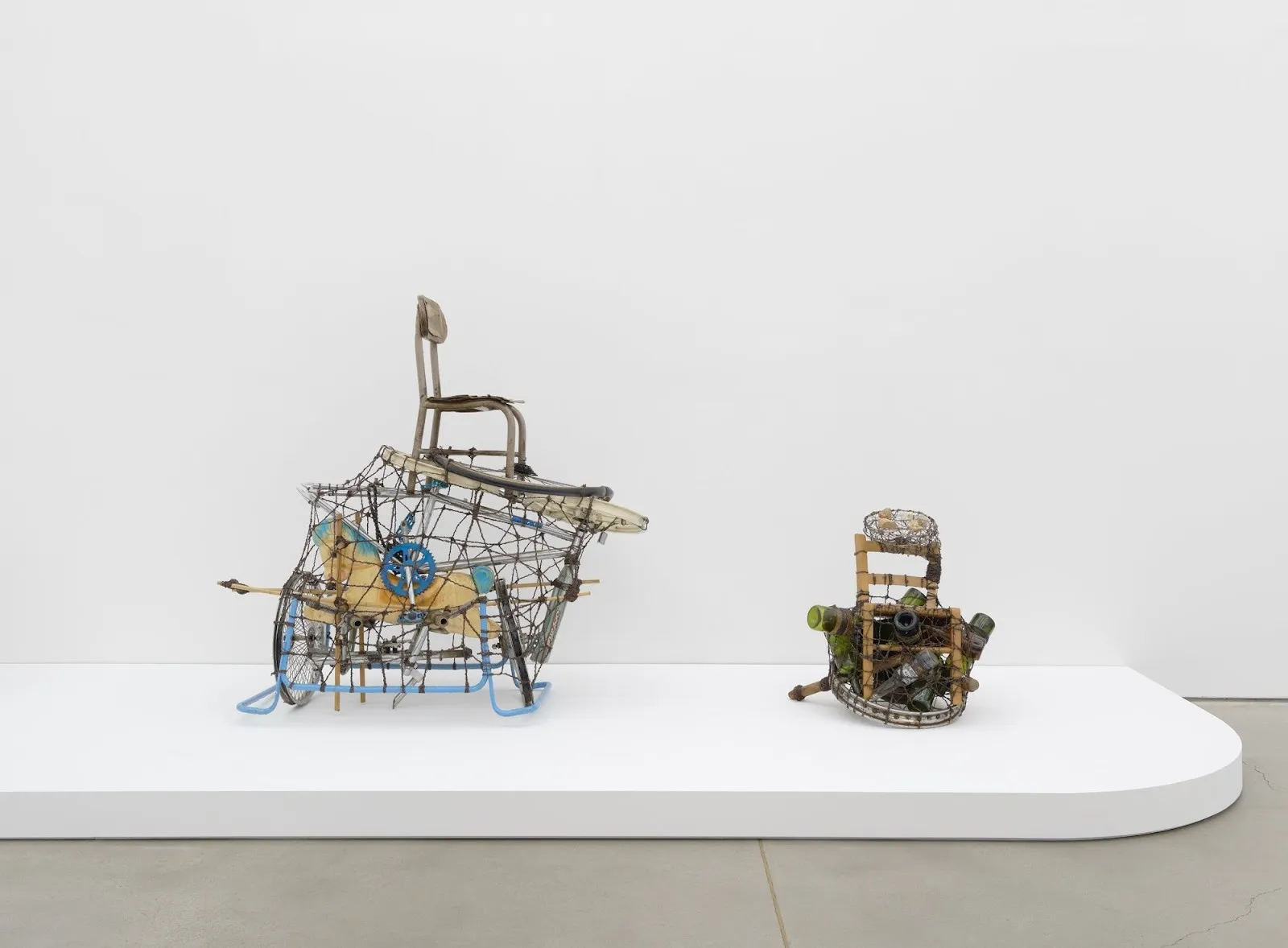
AS: Usually, yes. I might live with an object for a long time before something clicks. For example, I had a child’s chair from a public school and two skates I found on the ground. Eventually, I put one thing down, placed others next to it, and the piece materialized. Even if I visualize the outcome beforehand, I am always adjusting during the process.
XJW: How do you view the relationship between collecting and creating?
AS: I am a collector. I collect art when I travel, but I also gather objects that intrigue me for future use. I’ve collected everything from Asian bells to a praying mantis embedded in polymer. That bug references Kafka’s The Metamorphosis, a theme I’ve worked with since the late 1980s, including a nine-foot-tall piece that looks like a giant cockroach.
XJW: Sculptures like Skunk (2011), Insect in the Wall (2024), Bug in the Cars (2024), and Caged Bottle (2006) include wheeled vehicles. Is this a form you gravitate toward?
AS: I think of Constantin Brâncusi: what is a base, and can a wheel be a base? Practically, wheels make heavy objects easy to maneuver, but they also represent implied movement. They reference my journey to this country, the African diaspora, and spiritual movement. Many of my sculptures look like vessels, and it’s all about exploring the theme of movement and its various cultural references.
XJW: I also noticed the abundance of feathers.
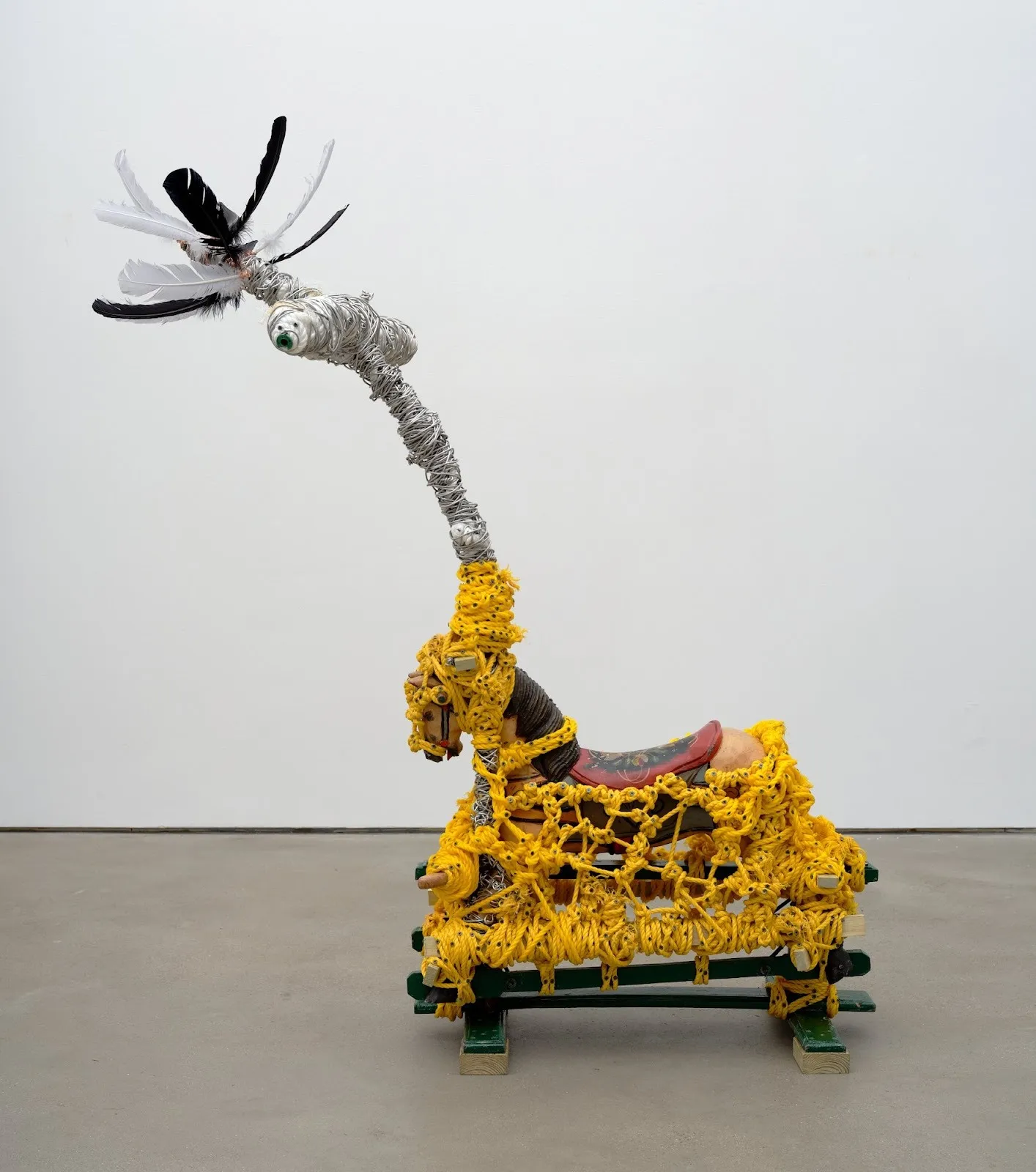
AS: In many cultures, feathers are used for spiritual references and decorative headdresses. Beyond that, I am working with the tension of fragility. A feather is something you can easily break. I combine that with classical ideas of counterpoise; if a piece is leaning, will it fall if pushed? I want to explore that aspect of danger.
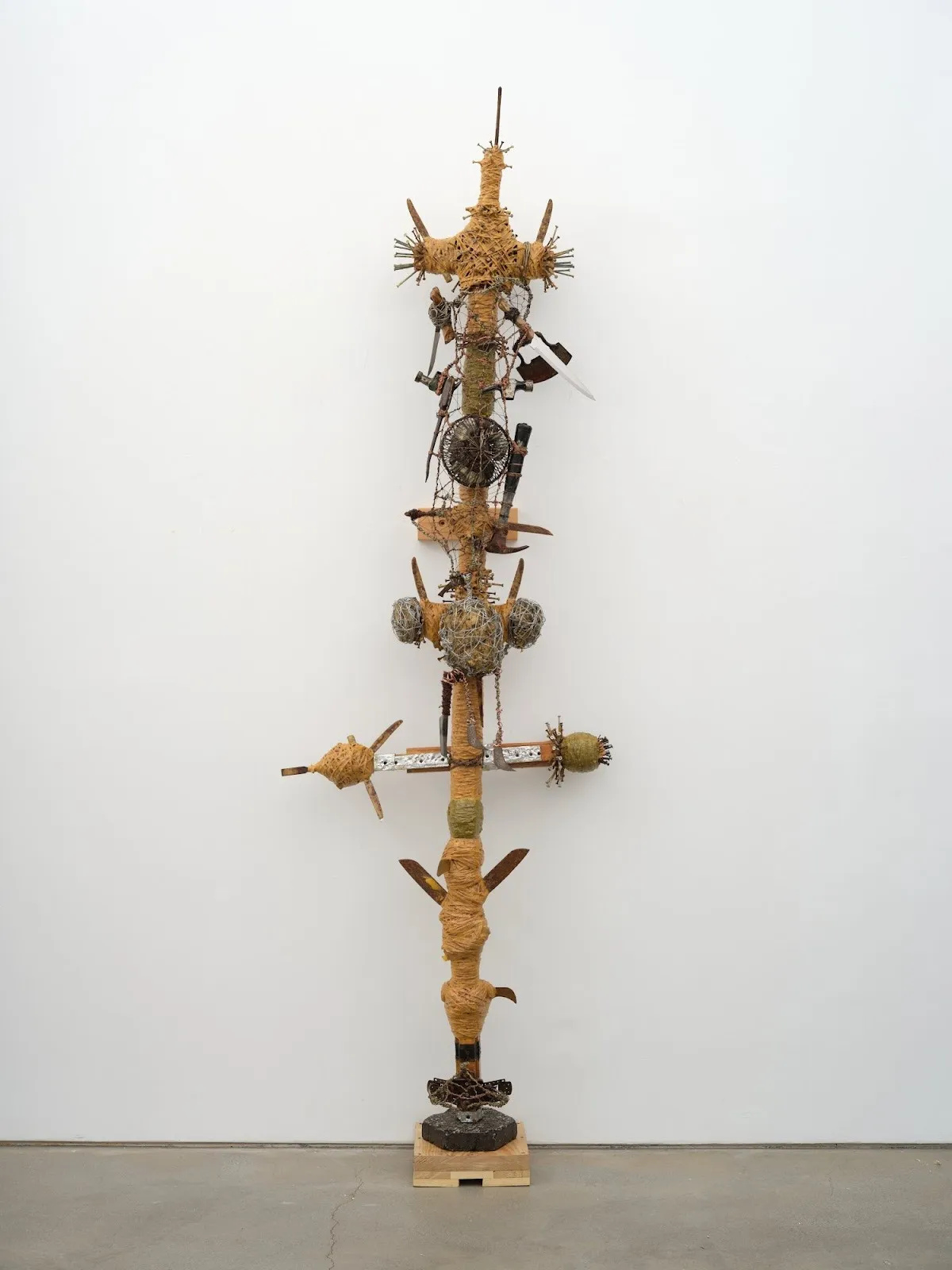
In this room, I’ve used knives. When I worked at the Brooklyn Museum, I handled African throwing knives. They were beautiful objects, yet designed to injure. It gave me the idea that something can be beautiful and dangerous simultaneously. I think of Richard Serra; his steel pieces are massive and have even caused fatalities. I am working with that sense of fear. These are real, rusty knives. Their formations carry multiple meanings; it could be an Ethiopian cross or a float in Jamaica.
XJW: You mentioned you aren’t religious.
AS: I am not religious, but I am a spiritual person. I believe in a universal consciousness and the ancestors who came before me. While I don’t follow one specific religion, I am inspired by the great works created in the name of religion. When you see a cross in my work, it is a conscious reference to the symbol and its ramifications.
For example, I created a piece during a residency at the Irish Museum of Modern Art. It uses Irish beer bottles and references crosses and Catholicism. Nothing is random. Even in free association, you eventually realize what the work has become, and as the artist, you choose to leave it or change it.
XJW: It sounds like a contradiction because free association sounds like a submission to randomness.
AS: It is a contradiction. But because I have been doing this since I was five years old in Jamaica, there are constants in my work. Even when doing something “random,” a realization eventually occurs. As I work, ideas manifest in my mind’s eye and show me where I am going.
XJW: Do you see these works as past self-portraits, since they are coming out of your subconscious?
AS: Metaphorically, yes. An artist’s work reflects who they are. As I work, I might think of my childhood in Jamaica, or I might think of Michelangelo, Bernini, or my former teachers. All these influences go through my mind and influence the piece.
XJW: As your work comes from such a personal place, how does the viewer relate to it?
AS: As an artist, I have no control over the viewer’s reaction—whether they love, hate, or ignore the work. Control only exists in the studio. I may provide a reference point in the title, but the interpretation is up to the viewer.
XJW: The understanding of art history is a result of learning. On top of that, as an educator, do you think that “aesthetic discernment” can be taught?
AS: You can sharpen someone’s skills and open their eyes to what art can be. I tell my students that art can be anything and everything. I remember teaching a second-grade class where one student ignored the assignment entirely. He sat by himself, but what he was creating was fabulous. I just left him alone. You never know how creativity will happen. I’m just here to help the process by offering suggestions or other artists to look at.
This interview has been edited for clarity and length.
Arthur Simms: Caged Bottle is on view at Karma (22 East 2nd Street location) from January 9 to February 14, 2026.