

.webp)

Marc Kokopeli: “M.Kokopeli CURSED/01” at Gladstone
Review
Joy Curtis’s studio feels more like an environment than a workplace. In the center of the space hangs a sewn canopy suspended by weighted cushions or bags that sprout branches. The carcass of a creature dangles overhead, a skeleton of dyed fabric and metal armatures. Soft spikes protrude from its spine, curving downward into a bulbous tail. Uncanny cushions are gathered below in its shadow, resembling pink skulls or fossils. Openings in their surface seem to invite the insertion of limbs or other objects. Standing underneath, one gets the impression of being transported into the scene of a ritual; each object opens the possibility of an action, a history of actions, growth, and decay.
Surrounding the enclosure hang various textile works that intervene, in various ways, into three-dimensional space. The fabric is dyed with natural plants and materials that are gathered or sourced by Curtis. She collects walnuts from a park in the Bronx on her lunch break, which creates a rich brown ochre. Layered with an iron wash, it deepens to an earthy umber. Some things are constructed from silk, others from cotton or heavy canvas. Natural materials harmonize with the natural references in Curtis’s work, as the textile emerges into tree branches or bodily forms. The objects insinuate different movements or interactions; they are not stagnant.
Some of Curtis’s work is more explicitly wearable than others. Certain textile pieces have holes for the neck to pass through and string to tie around the arms and waist, like a kimono or an archaic garment found on bog bodies. They are adorned with various stuffed ligaments, spikes, or embroidered details. The garments feel intended for mystical purposes or vehicles for performances. They work as enclosures for the body, but when worn, transform it.
Curtis’s exhibitions have been the site for performances that have activated the work in different ways, although sometimes not in the way that she would expect. Letting another—even a trusted performer—interact with the sculptures requires her to surrender certain control. The nature of the work poses a difficult question: how much can the audience be permitted to touch? Which parameters are intuitive, and which need to be defined? Drawing from folkloric imagination and Jungian psychoanalysis, Joy Curtis quite literally weaves different threads to create things that mutate between plant and animal, form and function, sculpture and environment.
— Jonah James Romm
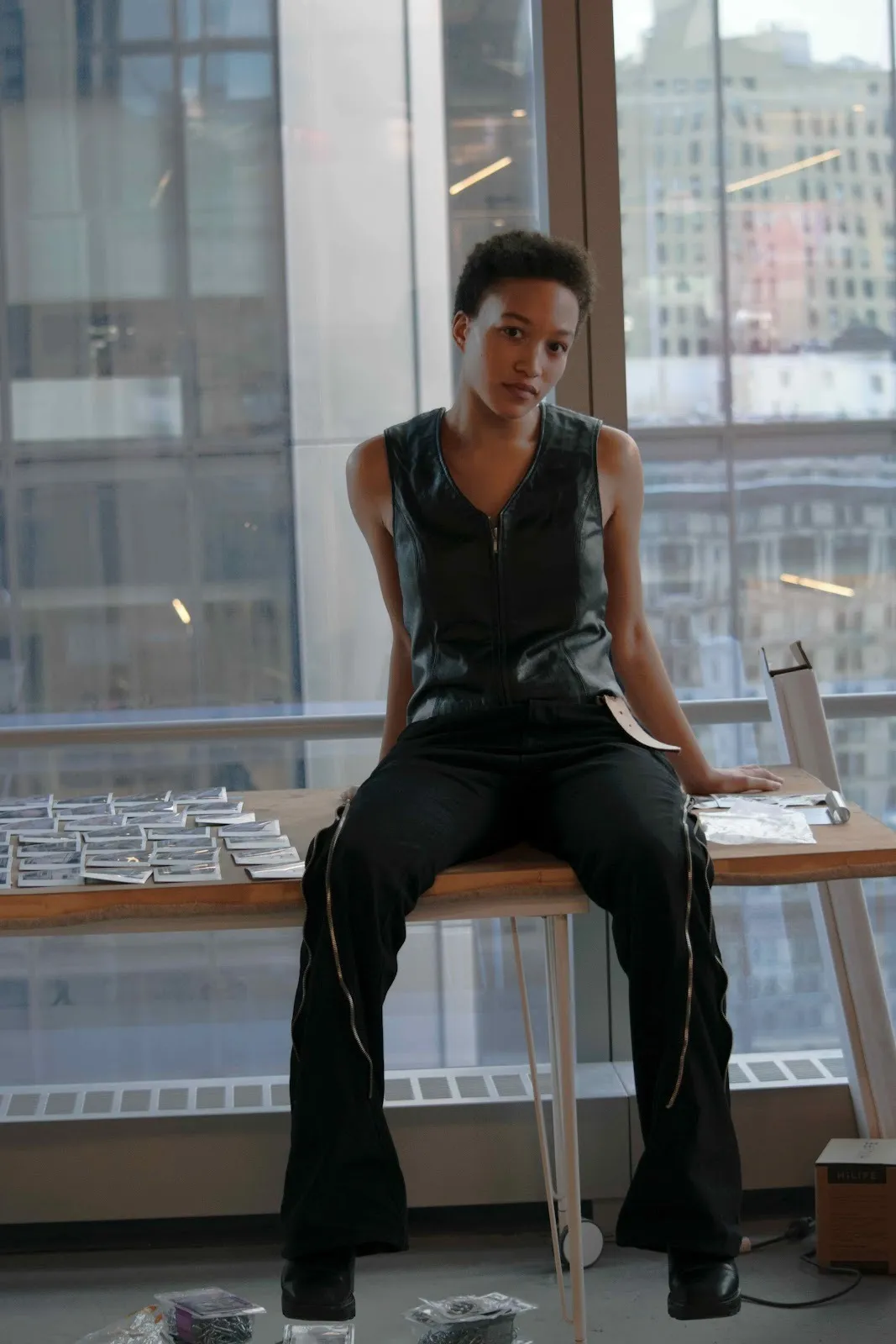
Asia Stewart, currently an artist-in-residence at Silver Art Projects, is a performance artist critiquing systems of power and efficiency. Her work takes on an operational, procedural quality through its focus on the completion of tasks and the reaching of material goals. Though not temporally bound, Stewart is still an artist of endurance who hyper-focuses on these actions in pursuit of various levels of deliverance, for her, her audience, and her participants.
Stewart’s studio space becomes a kind of facility for exhibiting the artifacts of her performance, testaments to the moments the artist endured. For a performance artist, the artifacts are the only material left, besides potential documentation. Thus, the question of “the work” and where it lies remains salient, and the nature of Stewart’s task-oriented performances leaves a nuanced material relic. In cat got your tongue (2025), where the artist chews through 600 packs of watermelon-flavored gum in attempts to jam a walking treadmill, the final treadmill is just as much the work as the performance. In her studio, two of these treadmills whirr in tandem, caked with gum shavings and mounted with video performance documentation. Stewart’s objects are irreparably transformed, mutilated, and used to their endpoints; the artist’s practice inevitably becomes interlaced with sculpture. Her props are intentionally considered in each performance’s aftermath—not just as documentation, but as indexical vessels of emotional resonance.
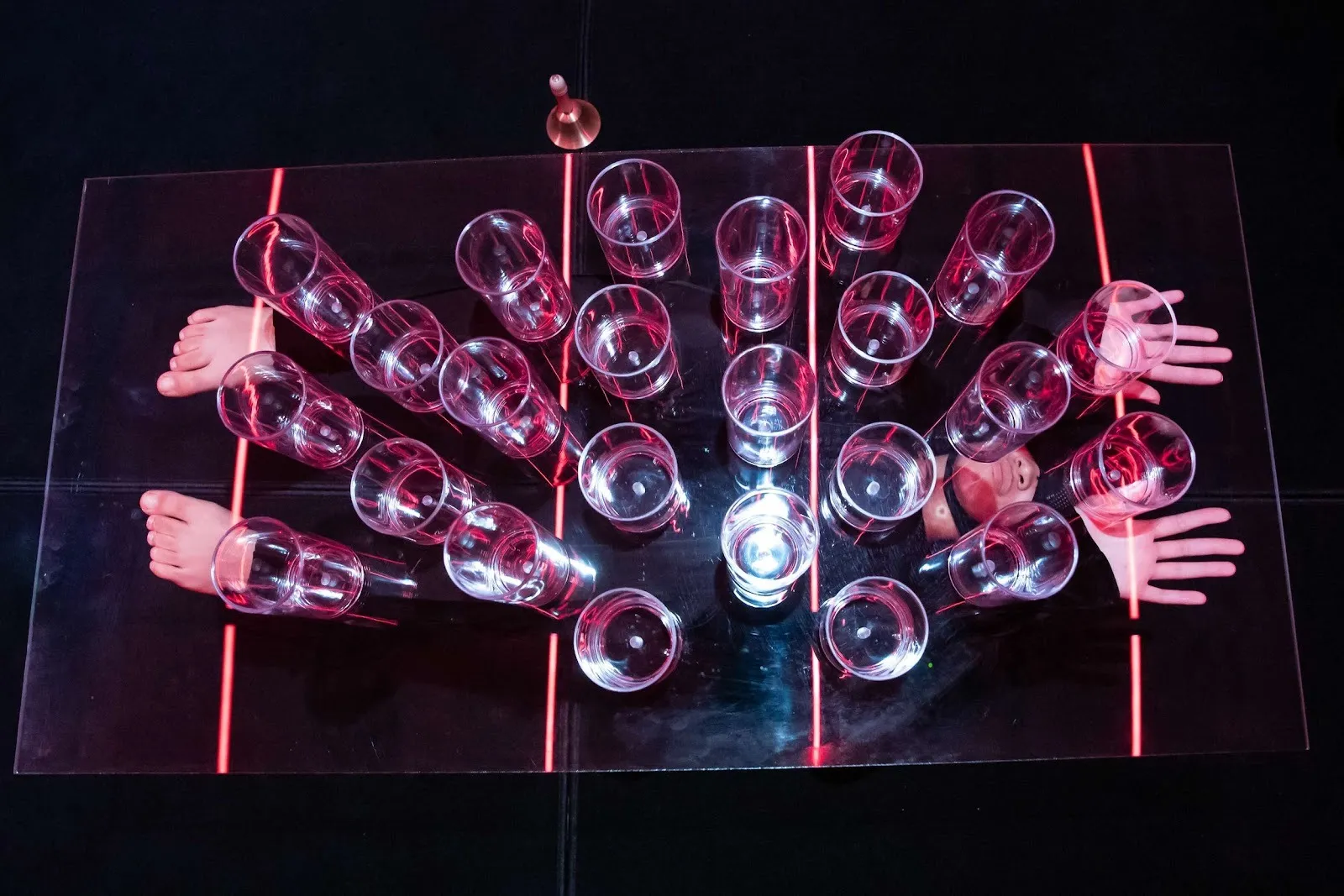
The quality of endurance in Stewart’s performances also makes her an anonymous actor who has the power to obfuscate and implicate other participants. In addition to the question of its artifacts, the performance artist always interacts with questions of audience surveillance. In her studio, Stewart speaks about how participation in a performance is always “earned,” not automatic. She continues to explain the conditions she sets up for her performances to feel more inviting for viewers to enter, many of which center anonymity.
For her performance leach (2025), the entire room was dark save for one lightbulb. Reflecting on this work, which asked the audience to confess secrets and wash their hands with handmade soap that the artist was chained with, Stewart recounts how emotional many participants became. Set in conditions of anonymity, quotidian props and artist-as-stranger elicited deeply personal and intimate confessions. The work gave Stewart, for a brief moment, a ritualistic legitimacy—a keeper of secrets.
During any experience with men and alcohol (2025), the participants wore obscuring, numbered ski masks. Through these individuals donning both physical and archetypal obscuration, Stewart relays how they became more comfortable taking part in the work, completing tasks like sending Stewart money and ordering food for delivery. The performer is an earner of trust, responsible for creating a space outside time. In turn, she must also endow trust in her audience. Through choreographing a timeline and a space, Stewart transports her actors and audience to a secondary world, where negotiations between artist and audience take hold.
— Victoria Reshetnikov
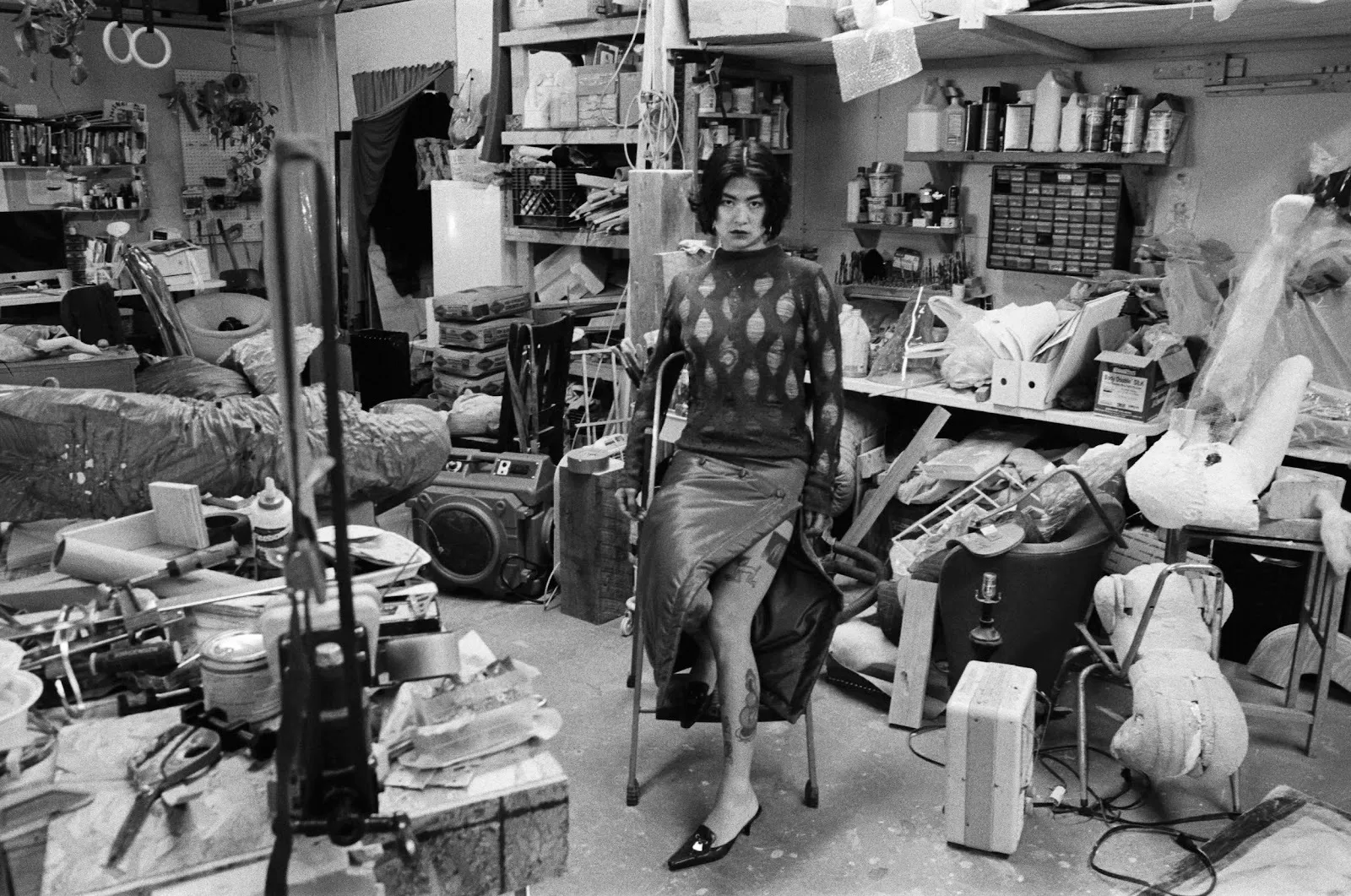
Cato Ouyang’s favorite thing might be making something so beautiful and well-crafted that the only option is to destroy it. A true polyglot of materials, Ouyang works across moving image, carving, glass, performance, photography, and painting. They are also a magician of presentation, sliding across scales of representation and abstraction, subtlety and brutality. Thematically, their sensibilities orbit ideas of disobedience, misuse, and individuation, with a reverential fervor for the dank, guttural, and less desired. According to the artist, they have spent the last two years “latently fixated on the erotic valence of sewers.”
I’d like to call their practice seamless and effortless, but nothing Cato does comes without effort. Making, for Ouyang, is arduous and exacting. I’ve known them for over ten years, and I was thrilled to hear that they—direct quote—“almost had fun in the studio” last week.
The longer you sit and stare into their studio, the more small revelations appear. An impeccably carved wooden arm extends an open palm that pushes you away as much as it beckons you closer, simply because it is so well made, you cannot help but look. Nearby, a perfectly smooth egg-like form rests on a table, topped with the gnarled, stretched, hollowed skin of a plush toy. Hard becomes supple, soft becomes rough; pleasure commingles with pain. Penance manifests everywhere: material devotion and transcendence through experimentation. This readiness to experiment has become more central to Ouyang’s way of working in recent years. No material, no form, no process behaves the way it is supposed to. Misalignment becomes generative, the engine of the next move. Leave your expectations at the door.
Ouyang is currently working on a series of cyanotypes, a cameraless photographic process producing Prussian-blue images using salts, sunlight, and water. The medium has been so romanticized and carefully preserved by its devotees that even the word can feel overly precious, but Ouyang immediately refuses that reverence. Their prints absorb other materials, and these textures and interruptions become a refusal of purity. As Cato puts it to me: “How do I use a process that’s so hungry for the sun to make images that are wet and dark?” A brilliant query.
Just as Cato suspends themselves within this journey of material revelation, they ask the viewer to do the same. To look at any given work by Ouyang is like watching a film: materials cut, blend, and transition with a cinematic quality, scenes unfolding with the conviction of a New Wave auteur. There is a lot to learn from Cato: how to be brave, how to follow curiosity, and, most importantly, how to make art that is both genuinely good and genuinely strange.
— Jesse Firestone
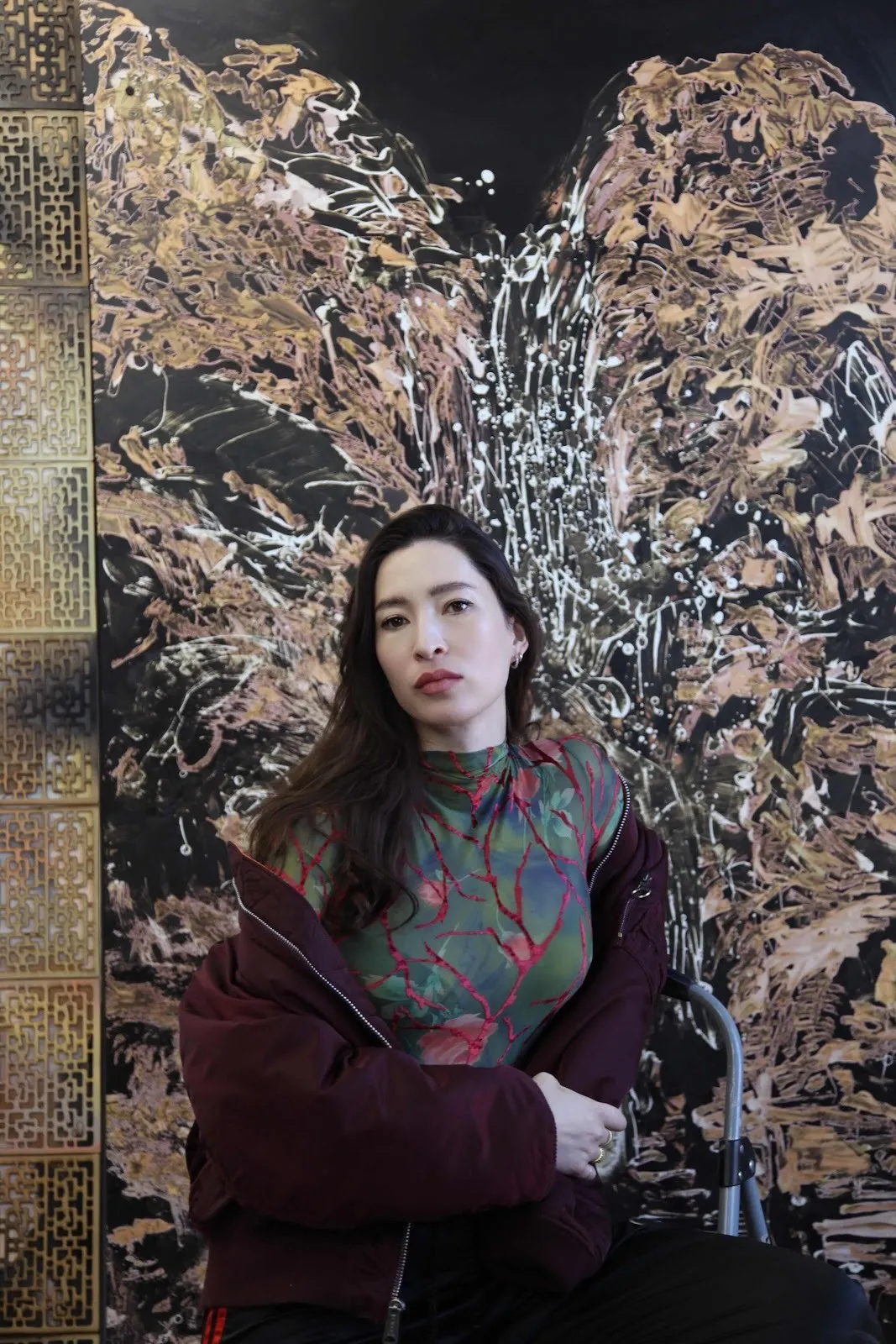
Alchemical greens overlay and undergird dark structures within an image slipping in and out of focus, centrally placed among quadrants within Antonia Kuo’s photochemical painting Super Collider (2024). I look closely towards the lower left quadrant, asking how Kuo made the sculptural metallic portion that seemed punctured by rivets, and they matter-of-factly reply, “Those are bullet holes.”
Industry, in its fierce alchemy, brutal mechanizations, and extractive relationship with the land, has long been an interest in Kuo’s practice. During a visit to the artist’s Brooklyn studio, Kuo relayed their family’s history working in copper mines in Butte, Montana, and her partner, the artist Douglas Rieger’s family were coal miners in Pittsburgh. Standing next to Super Collider with its delicate chemigrams combined with found metal elements like the bullet-rippled aluminum, I am reminded of the longue durée of the US industrial revolution from the 18th through 20th centuries that contributed to the construction, and now deconstruction, of the so-called American Dream amidst an impending 21st-century manufacturing crisis. The non-linearity of such histories of innovation and intersecting capital traffic across the surfaces in Kuo’s works, leaving traces in photographs, found objects, and abstraction patterns.
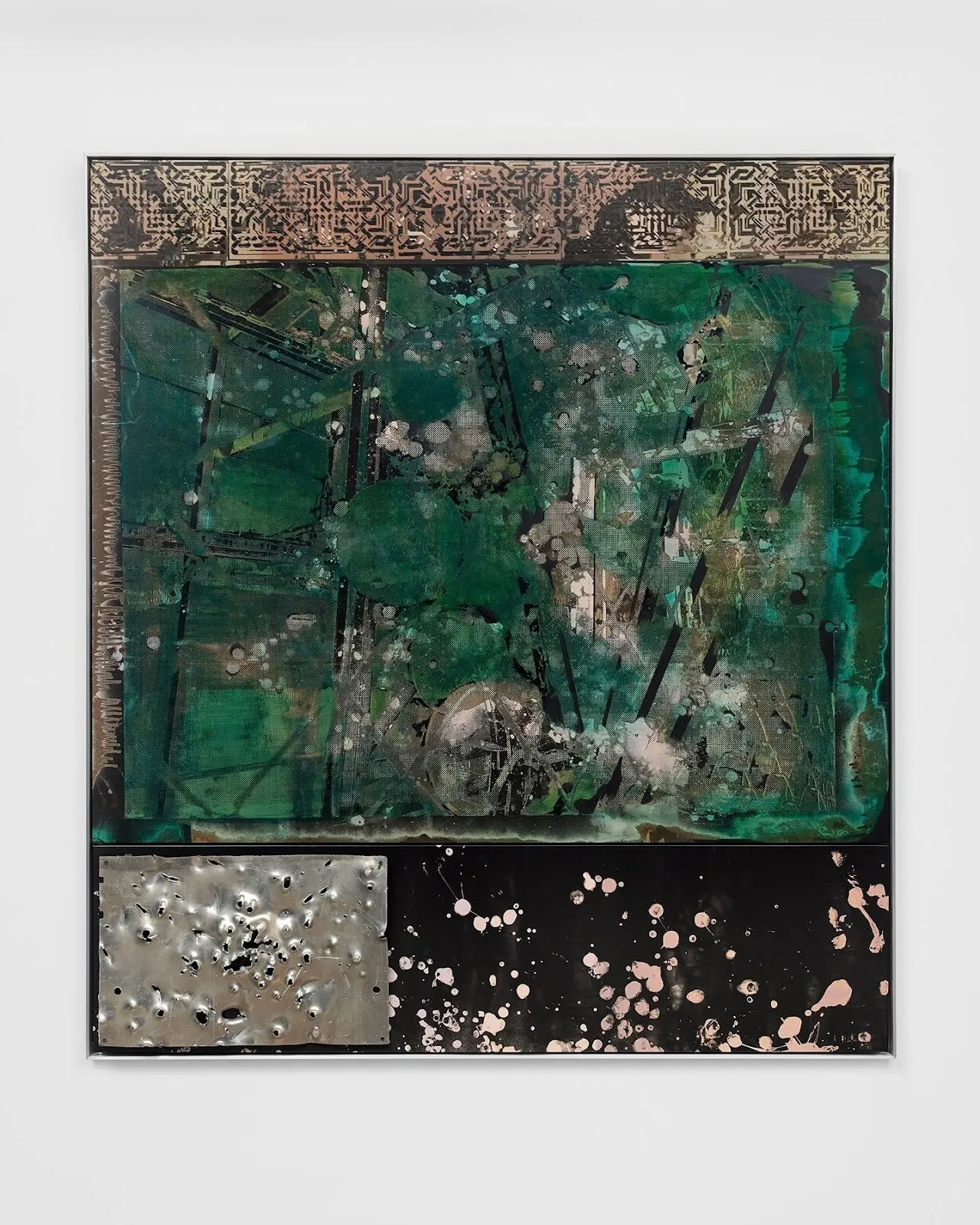
Alongside these fleeting visions of slow national empire-building and its decay, Kuo infuses interior ruminations. References to the shan shui style of traditional Chinese landscape, which historically emphasized the largesse of the cosmos in comparison to the smallness of humankind, come from their Taiwanese mother’s artistic practice, while ultrasound imaging of a fetus in utero comes from the artist’s own experience. Kuo’s collaging of macro and micro scales evokes the underbelly of post-industrial decay—the memories, hauntings even, of its impact in the US psyche—alongside the miraculous intimacies of the everyday.
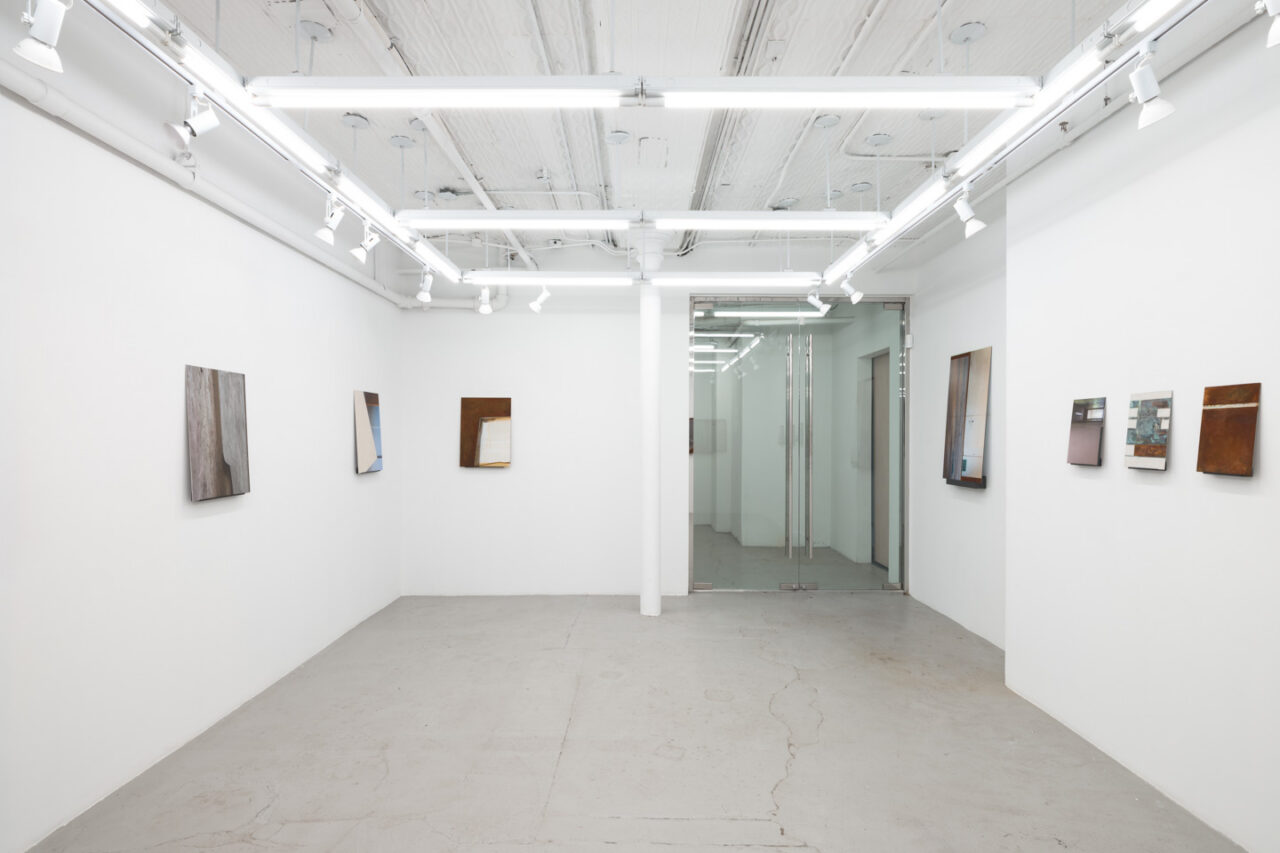
Arranged in quadrants, many of Kuo’s works show an apparent modernist grid only to trouble its interiority. Solar Array (2025), shown in Milk of the Earth at Chapter NY, and Triple Blind (2025) in Antonia Kuo & Douglas Rieger at Cooper Cole, problematize the objectivity of sight and the truthfulness of images in their titular references to the conversion of sunlight in solar refraction and data analysis concealed to eliminate biases. That Kuo subdivides the painting plane among the seemingly precise tools, such as photograms, x-rays, and metal reliefs, adjacent to the chemical painting portions—those that the artist describes as having unknown outcomes—deepens her investigation of history, memory, and the psyche as relatively unknowable.
— Laurel V. McLaughlin