Review: “What We Take”
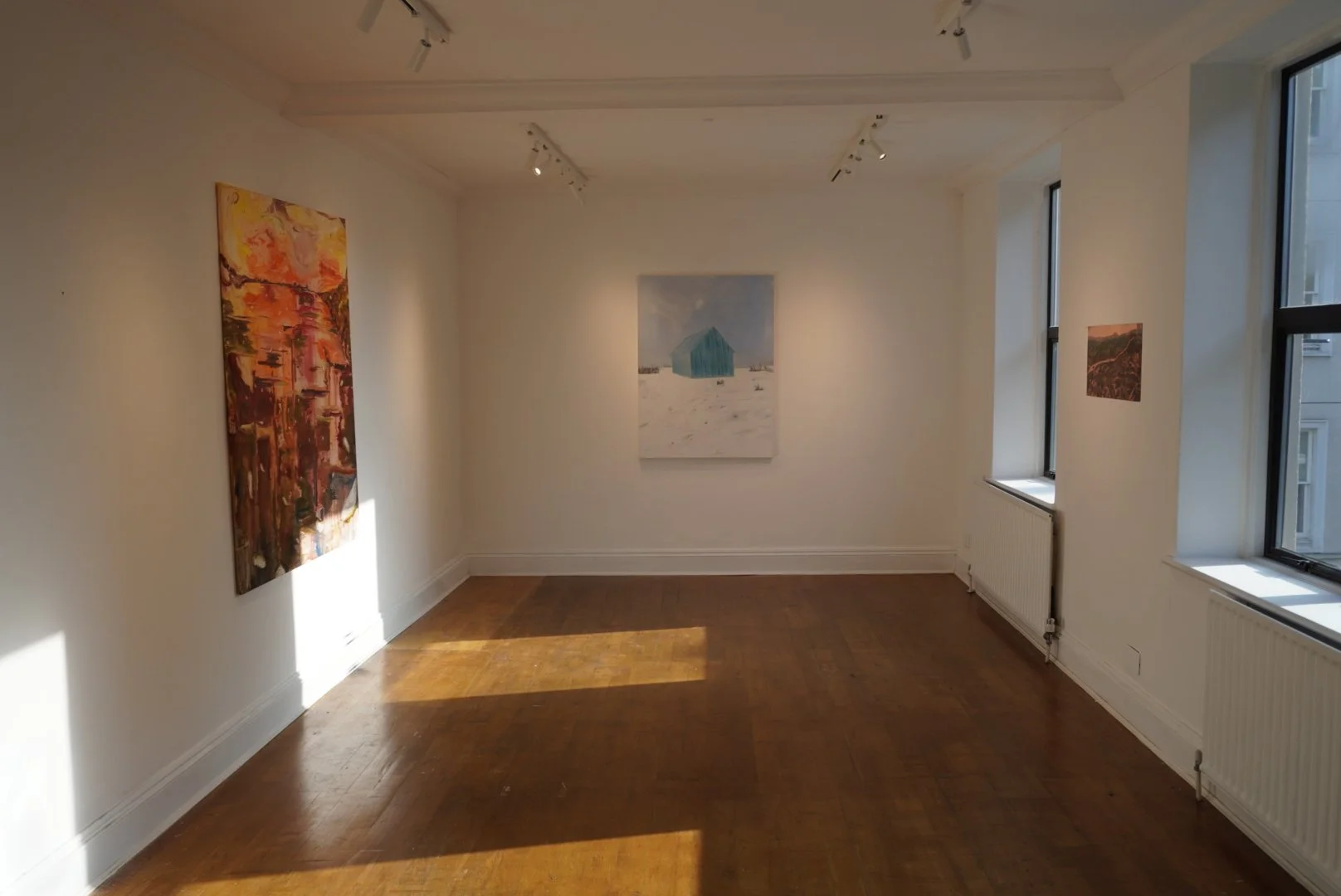
Installation view of What We Take (2026) at Pipeline, London. Courtesy of Art in Latin America and CM Art Advisory.
The act of departure marks a symbolic rupture, an initiation where journeys begin and identities start to fragment. In What We Take, artists Alessandra Risi, Nelson Hernández, Benito Ekmekdjian, and Eliel Martínez navigate the questions that leaving home has made them carry, bringing together their own individual experiences spanning from Peru, Argentina, Chile, and Mexico. The exhibition, co-curated by Art in Latin America and CM Art Advisory, is part of a broader mission by both platforms to foreground the Latin American art community in London. What We Take does not rely on distances when speaking of migration, but rather interprets diasporic identity through expressions, stories, conversations, philosophies, objects, and rituals, as curator Celeste Melgar states: “We carry memory. We carry language [...] We carry ways of seeing.”
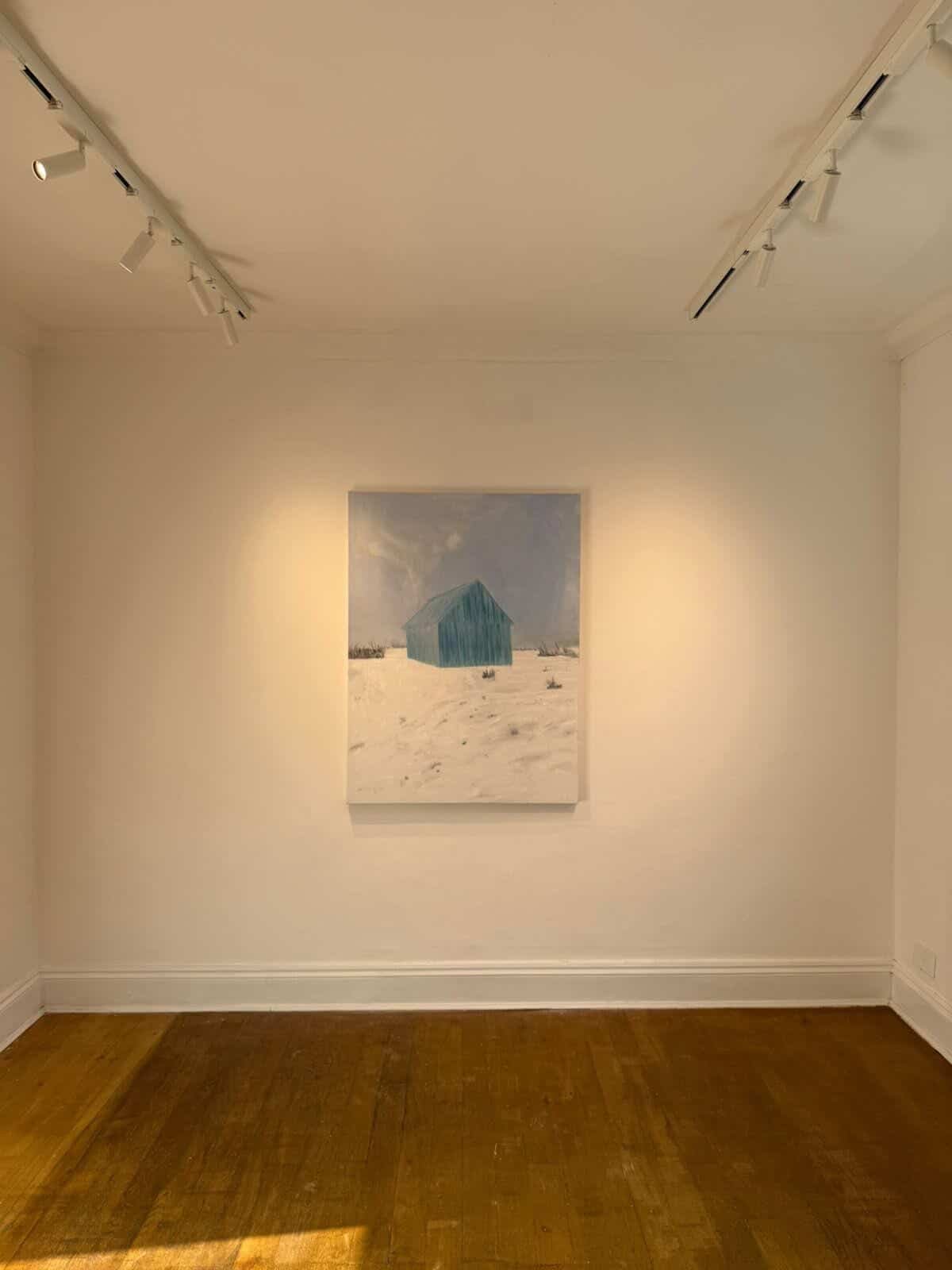
Benito Ekmekdjian, The studio, 2026. Oil on canvas, 120 x 90 cm. Courtesy of Art in Latin America and CM Art Advisory.
Stuart Hall defines cultural identity as “a production, not as an accomplished fact: which is never complete, always in process, and always constituted within, not outside, representation.” [1] This process is introduced through Benito Ekmekdjian’s The studio (2026). Upon entering the exhibition, one is confronted by a small blue shed sitting silently in a frosted winter landscape. The act of walking towards the painting becomes symbolic; it resembles the act of walking towards a familiar place, perhaps home. For Ekmekdjian, the closed shed is an homage to his studio, a sacred space that enables him to be his truest self. The shed is rendered with precise transparency, as evidenced by the foliage in the background, suggesting the fragility that exists between internal and external landscapes. This duality is further emphasized by the question Ekmekdjian writes with pencil, disappearing in the snow: “¿Qué hago con todo esto?” (What do I do with all of this?).
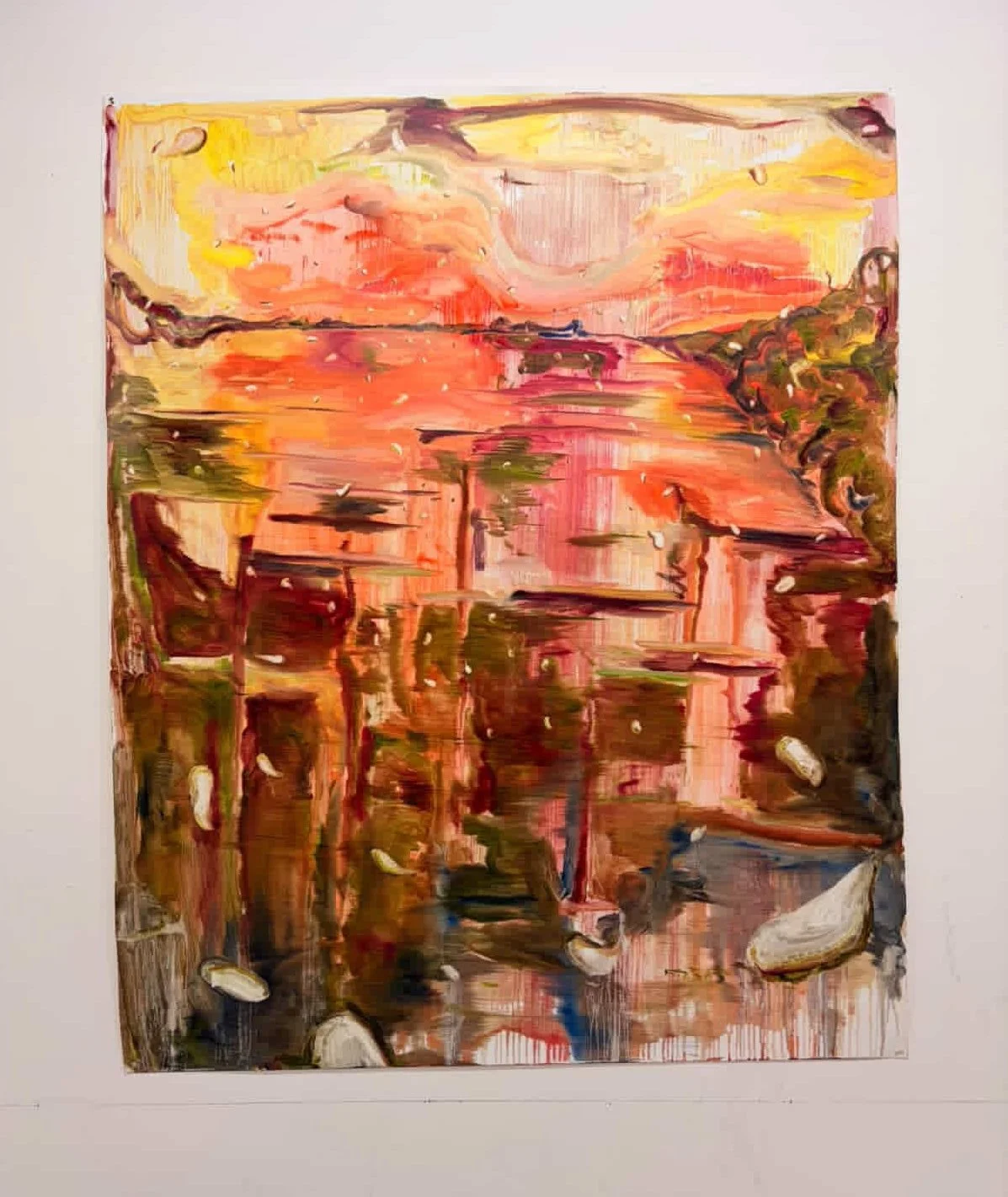
Alessandra Risi, Tierra Utero Mio, 2026. Oil on canvas, 160 x 130 cm. Courtesy of the artist.
Internal and external landscapes are of equal importance to Alessandra Risi’s practice. In Tierra Utero Mio (2026), the artist works from memory, painting her personal experience of a trip into the Peruvian Amazon. The painting, with a fiery sky and warm colours, becomes a testimony of the landscape's surrender to flames. Her powerful brushwork emulates a crying, bleeding landscape, with paint dripping downwards. Small white speckles are scattered through the composition, imitating raindrops that turn into symbols of hope, balance, and rebirth. Risi explains that ultimately, heavy rain was responsible for extinguishing the fires. The landscape becomes inseparable from the artist, as nature’s movement and terrain mirror the artist’s internal emotions. A sensory dialogue occurs between the warmth that radiates from Risi’s work and the coldness from Ekmekdjian’s work, translating internal emotional states through an exploration of colour.
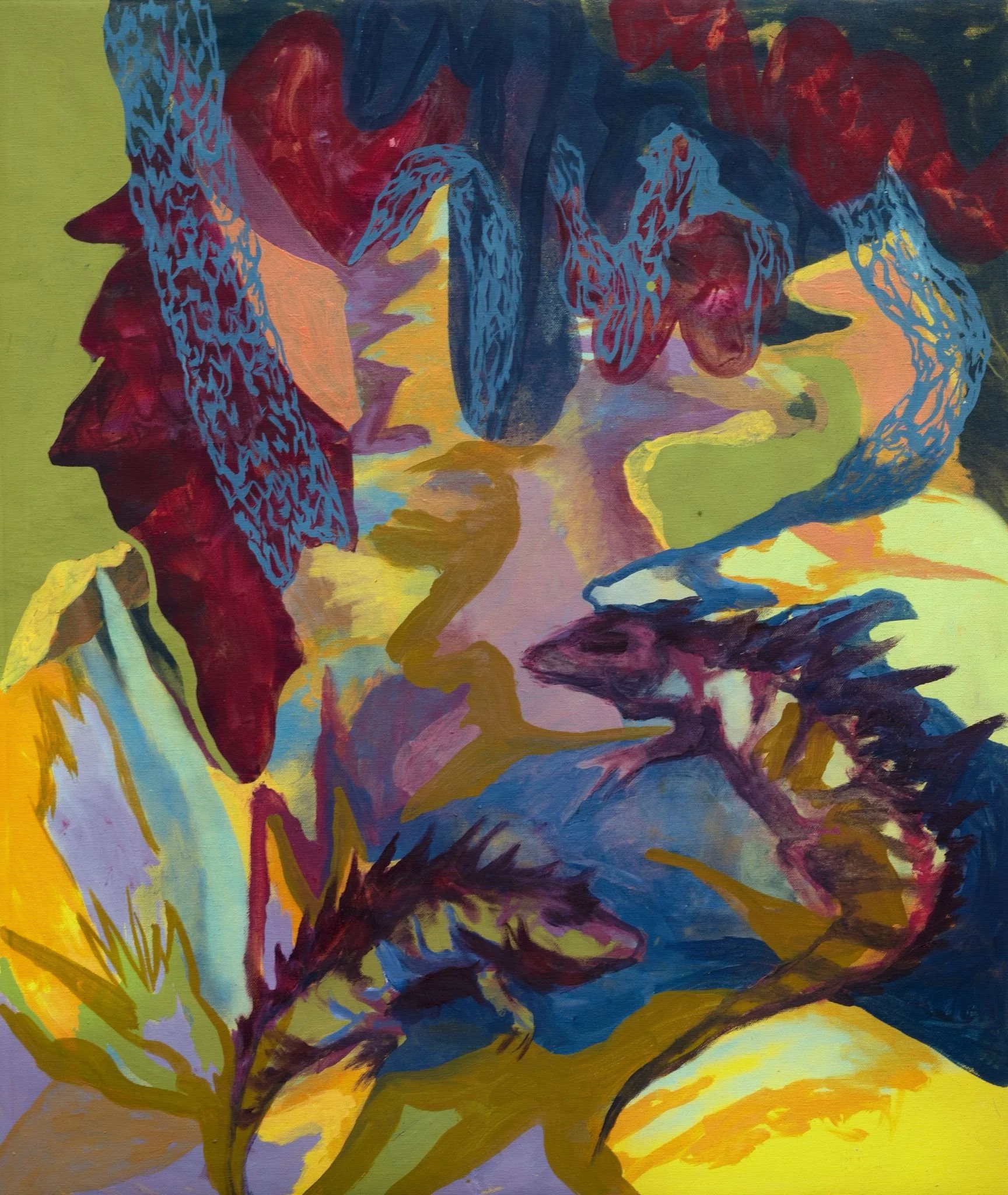
Eliel Martínez, Sobre Rocas y Agaves, 2025. Oil on canvas, 80 x 70 cm. Courtesy of Art in Latin America and CM Art Advisory.
Sobre Rocas y Agaves (2025) by Eliel Martínez addresses nature’s take on migration. Martínez’s experience of leaving Mexico led to an interrogation of the meaning of migration. Through this, Martínez learned that relocation is considered a natural process in the animal world. Two iguanas, which are abundant on the coast of Oaxaca, are lying to the right of the composition. They blend into the background in a sort of camouflage, which echoes their forms in a variety of directions and colours. Reptilian-like patterns, replicating snake movement, are found on the upper section of the canvas. The composition replicates the density of layers found in foliage and the resilience that animals such as iguanas have in navigating through these spaces.
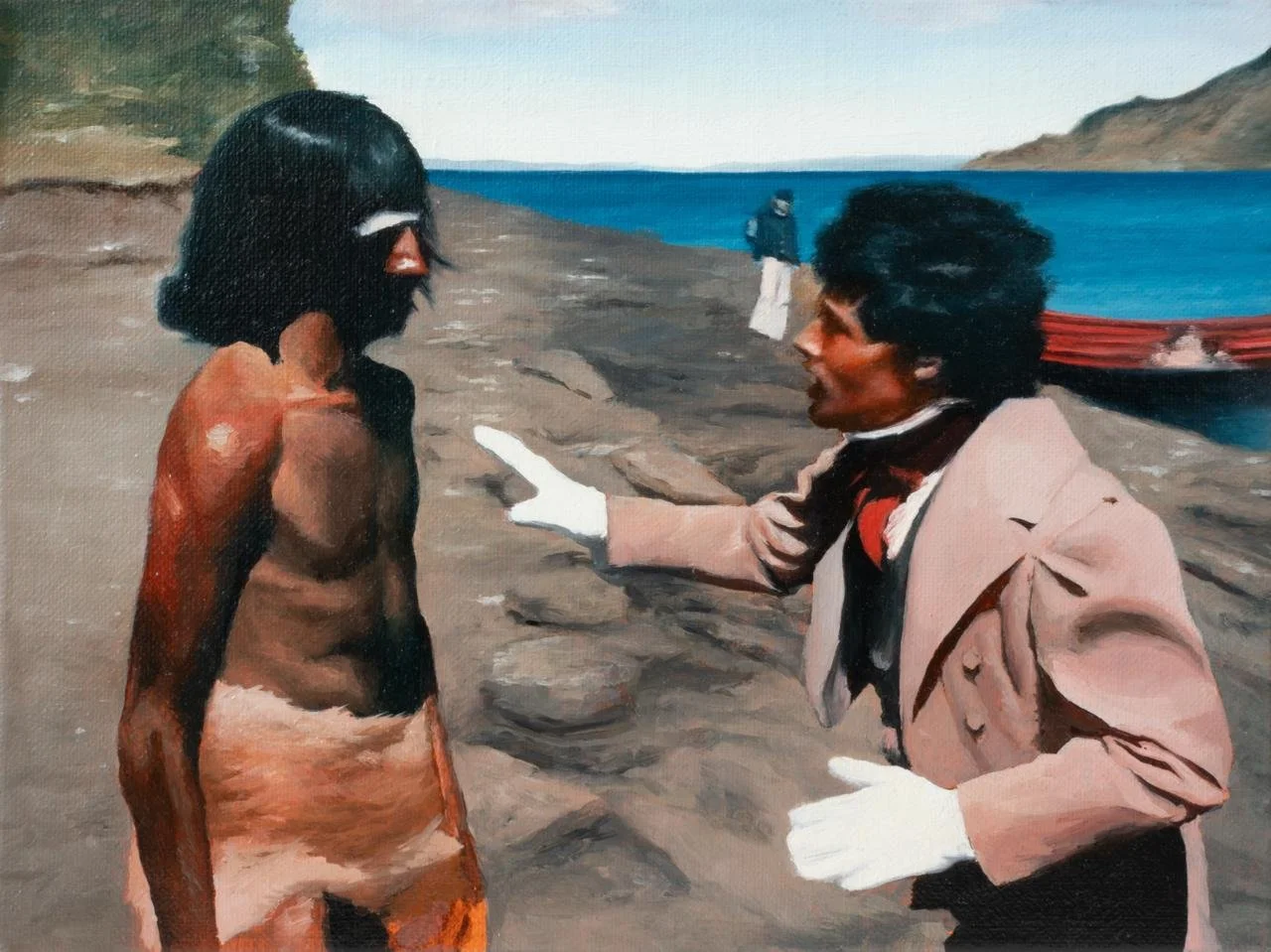
Nelson Hernandez, Have you forgotten your own language?, 2025. Oil on canvas, 15 x 20 cm. Courtesy of Art in Latin America and CM Art Advisory.
Nelson Hernández’s Have you forgotten your own language? (2025) speaks to Britain’s colonial past and its relationship with Chile. When Hernández arrived in the United Kingdom, one of his first encounters was with a person who told him, when he introduced himself as Chilean, that during times of slavery, a Chilean was sold for £1. This memory stuck with the artist, which led to the creation of Have you forgotten your own language? The painting contains two figures interacting face-to-face. The man on the left has a rigid posture, his face hidden in shadow, whilst the other, with his hands in gestures of explanation, suggests intrusion. A boat is seen in the background, a mode of transportation with a strong symbolic tie to colonial exploitation, trade, and exploration. The interaction is tense, exemplifying the complex history of human migration, one characterized by racial inequality and violence, with repercussions that are ever more present in today’s world. In contrast to Martínez’s interpretation of migration, which considers natural patterns, instinct, and cycles, Hernández approaches the topic from a more grim angle, framing human migration as marked by historical oppression, politics, and forced displacement.
Overall, What We Take is an exhibition charged with rich interpretations and questioning behind the meaning of migration, resisting fixed notions of diasporic identity formation and allowing a fluid, relational dialogue amongst the featured artists. In this way, the exhibition becomes a space that witnesses the exploration and ongoing becoming behind identity, as explained by Stuart Hall. Across the display, themes such as human nature, the environment, and oscillations between the internal and the external are interwoven. In What We Take, the artists find refuge and familiarity in painting as they confront a distant environment.
What We Take is co-curated by Art in Latin America and CM Art Advisory and is on view at Pipeline, London, from March 6th to March 28th, 2026.
Reference:
[1] Hall, Stuart. “Cultural Identity and Diaspora.” Identity: Community, Culture, Difference, edited by Jonathan Rutherford, 222–237. London: Lawrence & Wishart, 1990.