

.webp)

Sonia Boyce: “Demonstrate” at the Queens Museum
Review
Itala Aguilera holds a distance between her body, her collaborators, and her audience in her newest set of performances, Tierra Mojada. In six video works she calls “stripteases,” the artist allows her clothing to be dissolved, melted, scraped, and even eaten by collaborators, both human and elemental. Yet however much the artist’s body is exposed, however much the surface of her skin is flooded with rain or melting matter, she maintains an inner psychic world stubbornly beyond access or interpretation.
To watch Aguilera slowly stripped by two collaborators in Washing (2025) is reminiscent of Yoko Ono’s Cut Piece (1964), the infamous feminist performance in which Ono sat still as members of the audience cut off pieces of her clothes with silver scissors. However, where Cut Piece anticipates gendered and sexualized violence in the incremental creep of scissors, the striptease of Washing holds its power in the calm, implicit trust between the artist and her collaborators. Aguilera, dressed in a delicate ensemble of camisole, ruffled drawers, and lace-up slippers, stands tall yet pliable, allowing her limbs to rest on the knees and backs of her collaborators. With oversized yellow sponges, they saturate, soak, and scrub the water-soluble clothing from her body. Their expressions betray no emotion beyond their determination to dissolve the clothing. Their gazes do not meet the artist’s; they do not engage the erotic potential of this slow striptease.
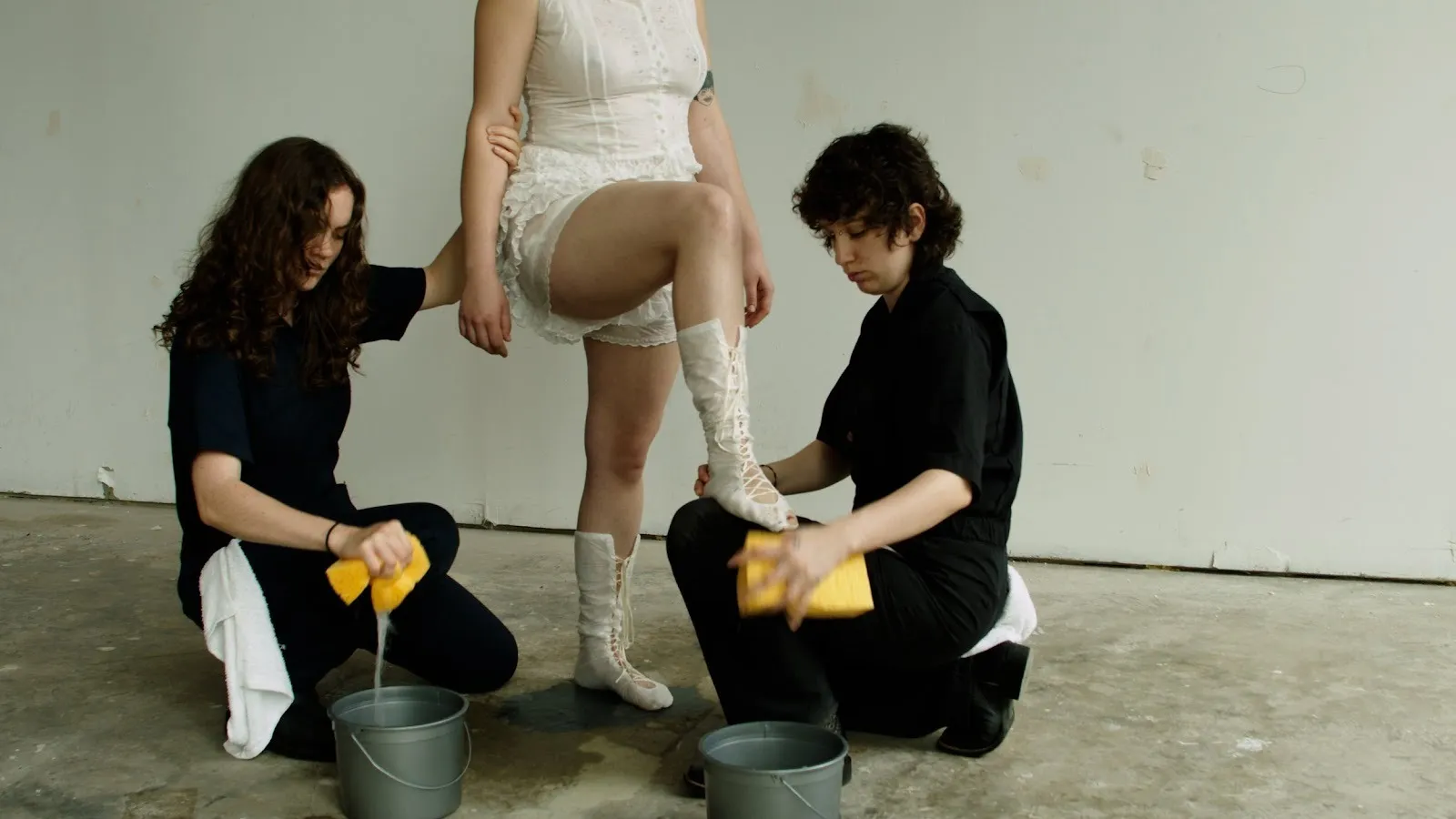
The neutral affect of the collaborators is compounded by the setting of the performance itself: a sterile room with white walls and concrete, and the collaborators’ own matching utilitarian jumpsuits, sponges, and grey buckets. After they scrub Aguilera’s clothing away, they buff her body with fresh white towels, almost as if she were a car leaving a garage. For all the drip and ooze of dissolving fabric, and wet revelation of the artist’s nude form, the performance is remarkably sexless.
Why strip without sex? Why engage the intense vulnerability and trust of placing your body in the hands of another at all? The answer lies perhaps in the title of the exhibition, Tierra Mojada (Wet Land), which is derived from a poem of the same name by Mexican poet Ramón López Velarde. Read in English translation, the poem unspools a series of vignettes lush with sensual desires expressed through moments of contemplation and transformation: “girls grow limp beneath/the drumming of raindrops on the roof,” he writes; “ . . . a young girl ages/ before the flameless brazier of her hearth/ awaiting a suitor who will bring a glowing coal.” [1] These moments of sensuality, while they anticipate the participation of a “suitor,” are complete moments of embodiment within themselves. The girl doesn’t need the suitor, anyway: it ends before he comes.
So too are Aguilera’s performances defiantly self-actualized. Her determination to create art and experience the sensations of these strange, melting ensembles for her own satisfaction is most obvious in the performances with her non-human collaborators of time, rain, and sunlight. She stands (or lies) still and lets the work wash over her: dissolving corsets, dripping milk, melting ice.
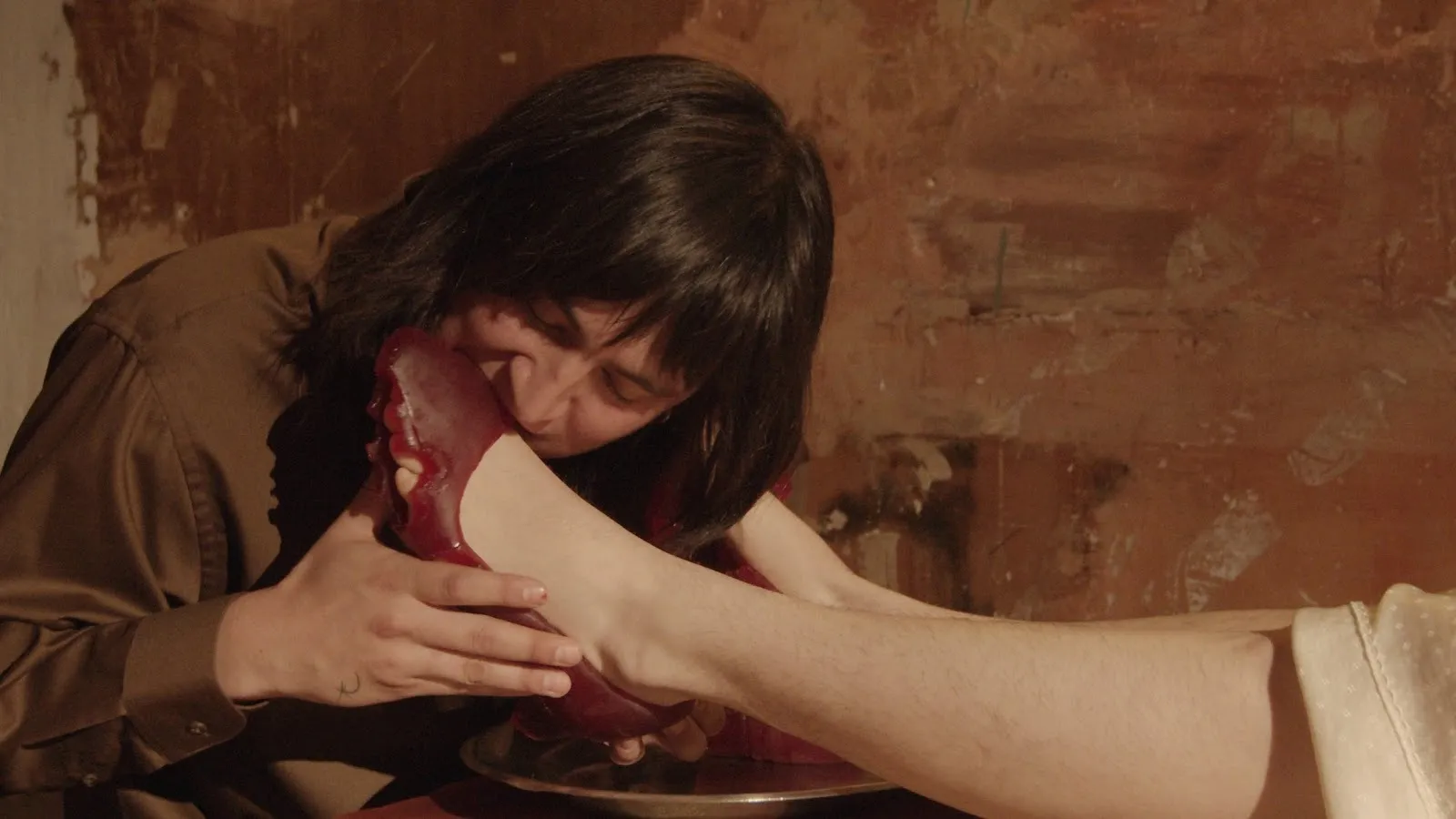
But even when playing with others, Aguilera is there for herself, as seen in the opening frames of Lunch Time (2025). After a close-up shot of Aguilera’s feet, enshrined in ruby-red gelatin shoes on a golden plate, the video shifts to the rest of her body, lying on a shimmering organza tablecloth in a grubby, subterranean room. Aguilera adjusts her arms behind her head and turns her gaze into the distance. Her collaborator enters the frame and sits at her feet. They glance towards Aguilera’s gaze and, receiving no acknowledgement from her, begin to eat her shoes. The camera pans into the frenzied feast. We do not see Aguilera’s face again.
By refusing the participation of herself beyond her body’s presence on screen, Aguilera will not be consumed by her collaborators, both human and non-human, or her audience. Each striptease physically exposes her, yet retains her emotional agency, a psychic withholding that leaves the viewer wanting more. Thus, consumption of the artist’s body is relegated to the relics of her performances on view in the gallery: sublimate your desire onto the ice shoes in the freezer, the gummy shoes on the plate (so close you can smell them, raspberry lemonade), the organza replicas of clothes from Washing hung in the window. Her body, herself, is stubbornly unknowable beyond its surface. Held behind a video screen, it must be imagined. Sticky gummy shoes, slick butter gloves, the white mucus of a melting corset. In the cold November rain, my own body covered neck to toes, I imagine how it might feel.
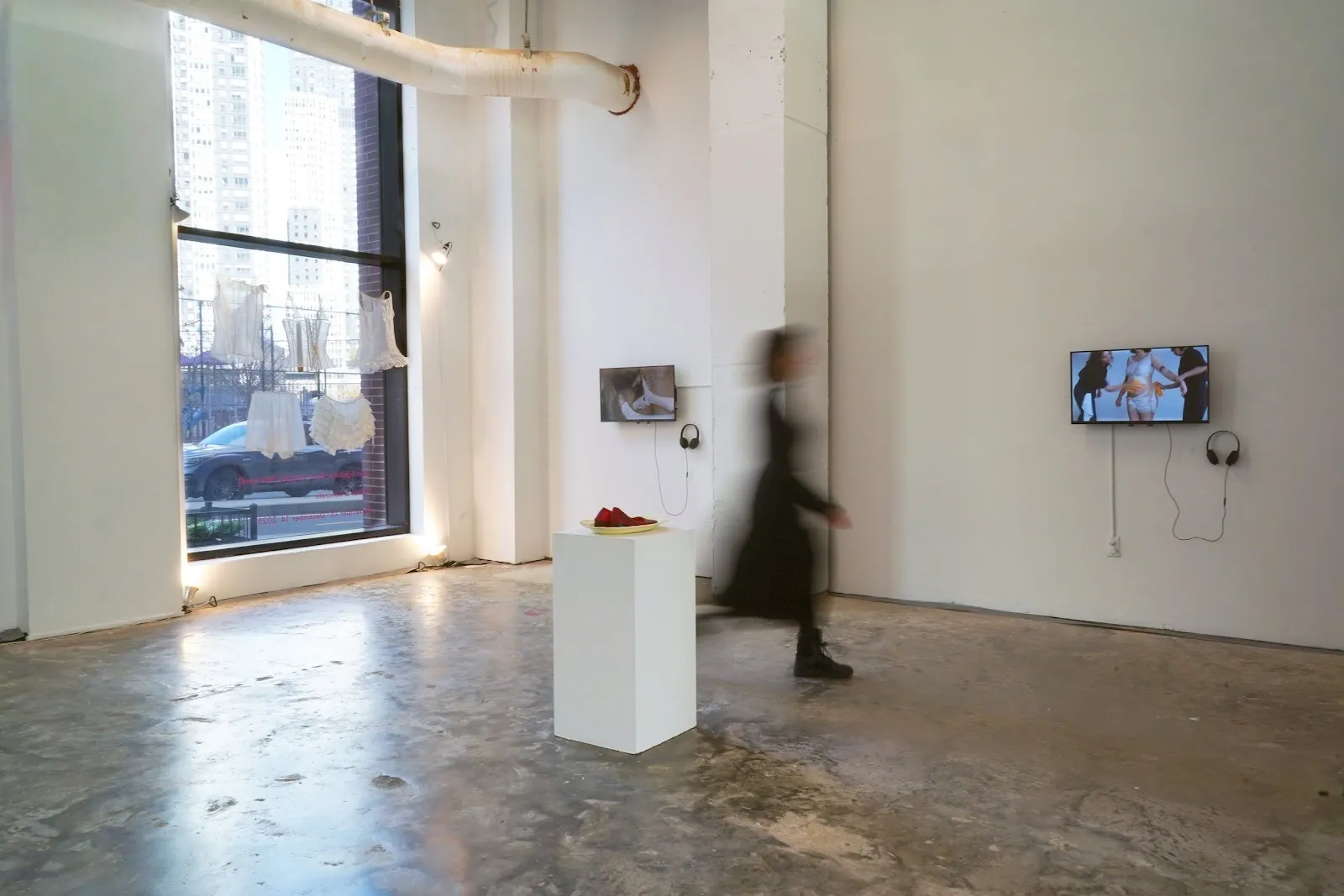
Itala Aguilera: Tierra Mojada (Wet Land) is on view at Flux IV through January 11, 2025. The exhibition coincides with the artist’s residency at Textile Arts Center, where she performed on December 6, 2025.
[1] Ramón López Velarde, “Tierra Mojada (Wet Earth),” in Song of the Heart: Selected Poems of Ramón López Velarde, trans. Margaret Sayers Peden (University of Texas Press, 1995), 23.