

.webp)

Marc Kokopeli: “M.Kokopeli CURSED/01” at Gladstone
Review
It’s an old story, the tension between photography and paint. Recall Baudelaire, who in his critique of the Salon of 1859, said that “if photography is allowed to deputize for art in some of art's activities, it will not be long before it has supplanted or corrupted art altogether.”[1] His invective was indicative of a belief, widely held, that photography was something rather scientific, not pictorial—that its place, as he would go on to put it, was as “secretary and record-keeper,” capable of accurate representation but not much high art. And if photography were to continue its growth unabated, Baudelaire warned, then the end result could only be the praise of sight rather than dreams, of “results of material science” rather than “those things that are most ethereal and immaterial.”[2]
That paradigm persisted even as later critics tempered their tone. Let’s trot out old Walter Benjamin, whose theories on mechanical reproduction have become misguided shorthand for photographic flatness versus painterly richness.[3] Amid his dialectical diagnoses of art’s arc toward reproducibility, Benjamin, too, traffics in binaries—a painter is a magician, a photographer a surgeon—and while he ends up affirming photography and film as the artforms par excellence for the emerging collectivist age (if only!), the fact remains that his brush and his lens can only occupy antithetical modes: myth and science; magic and surgery; cult object or mass form.
Later still, writers like Rosalind Krauss or Roland Barthes would quantify photography’s objective qualities as its “indexicality”—its ability to gesture at reality with minimal mediation or distortion.[4,5] But images have changed, and paradigms of objectivity or materiality no longer seem as rigid as they once were. Some of the most interesting work in New York right now finds painters looking to lens-based practices to inform their approach. Two current shows—one at Olney Gleason in Chelsea, another at David Zwirner’s space uptown—showcase the wildly divergent strategies available to the painter seeking to negotiate with photography on material and conceptual grounds.
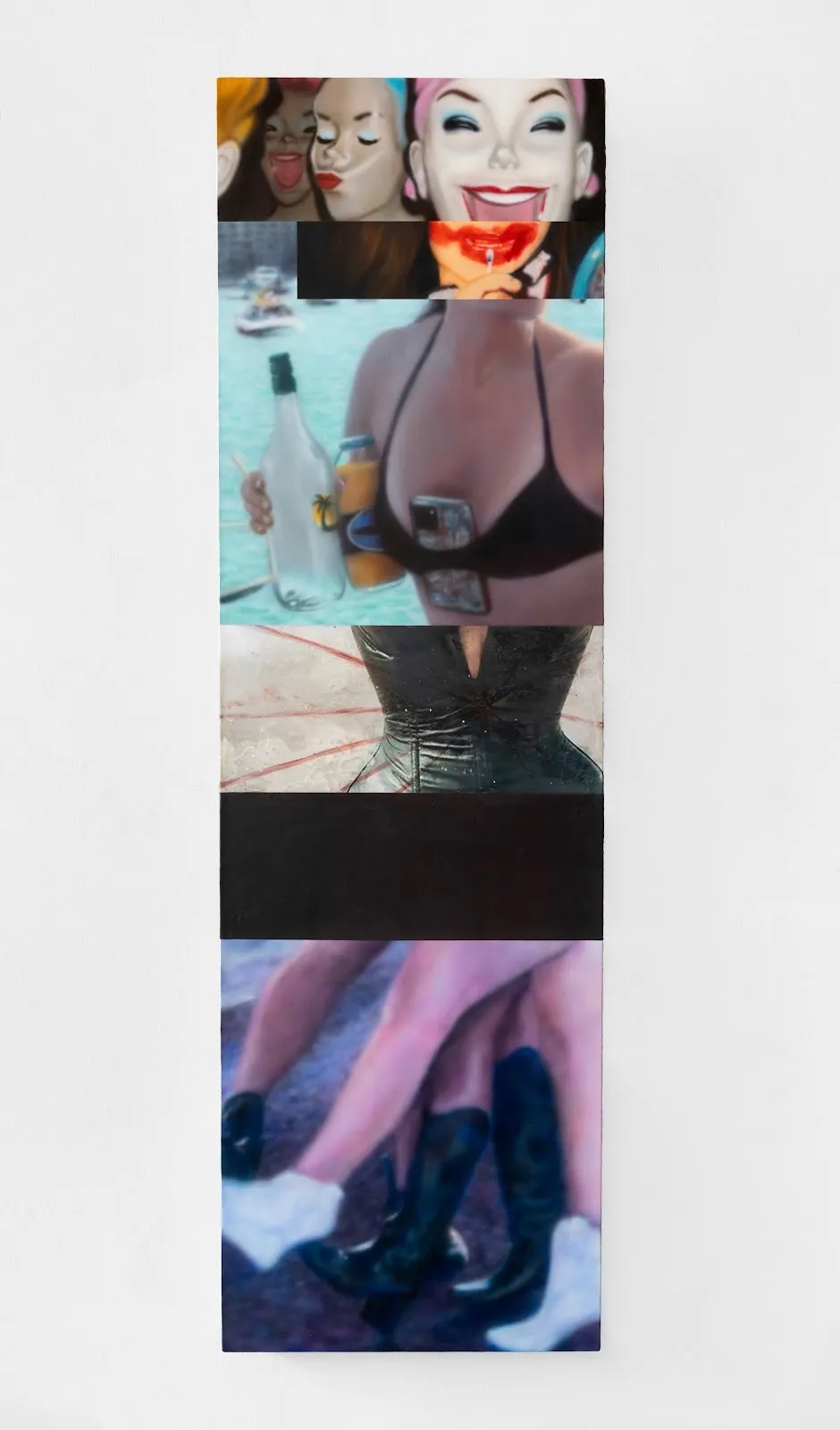
At Olney Gleason, Painting, Photography, Painting suggests one approach: an integration of digital image logic into mechanics specific to painting. These works, by seven different artists of around the same age, are studies in synthesis. Take Liza Jo Eilers’s Laminar flow (love&war) (2025), for example, which is part of the show’s opening salvo of works. It’s a rectangular stack of six different pictures on one canvas, with some scenes rendered in airbrush, some in pigment transfer, one even in heat-activated thermochromic ink. These variations in medium, along with Eilers’s vertical composition, contribute to a sense of seriality, of random images thrown in conjunction with one another on social media or on film, even as they carefully lock together to produce a kind of Frankensteined female form—mannequin masks at the top, bikini-clad torso in the middle, disembodied boots at the bottom. It’s like Duchamp’s Nude Descending a Staircase, No. 2 (1912) smeared across a doomscroll, rather than striated across time, and it functions as a great opening note: material specificity in productive tension with the free-floating immateriality of digital source photographs.
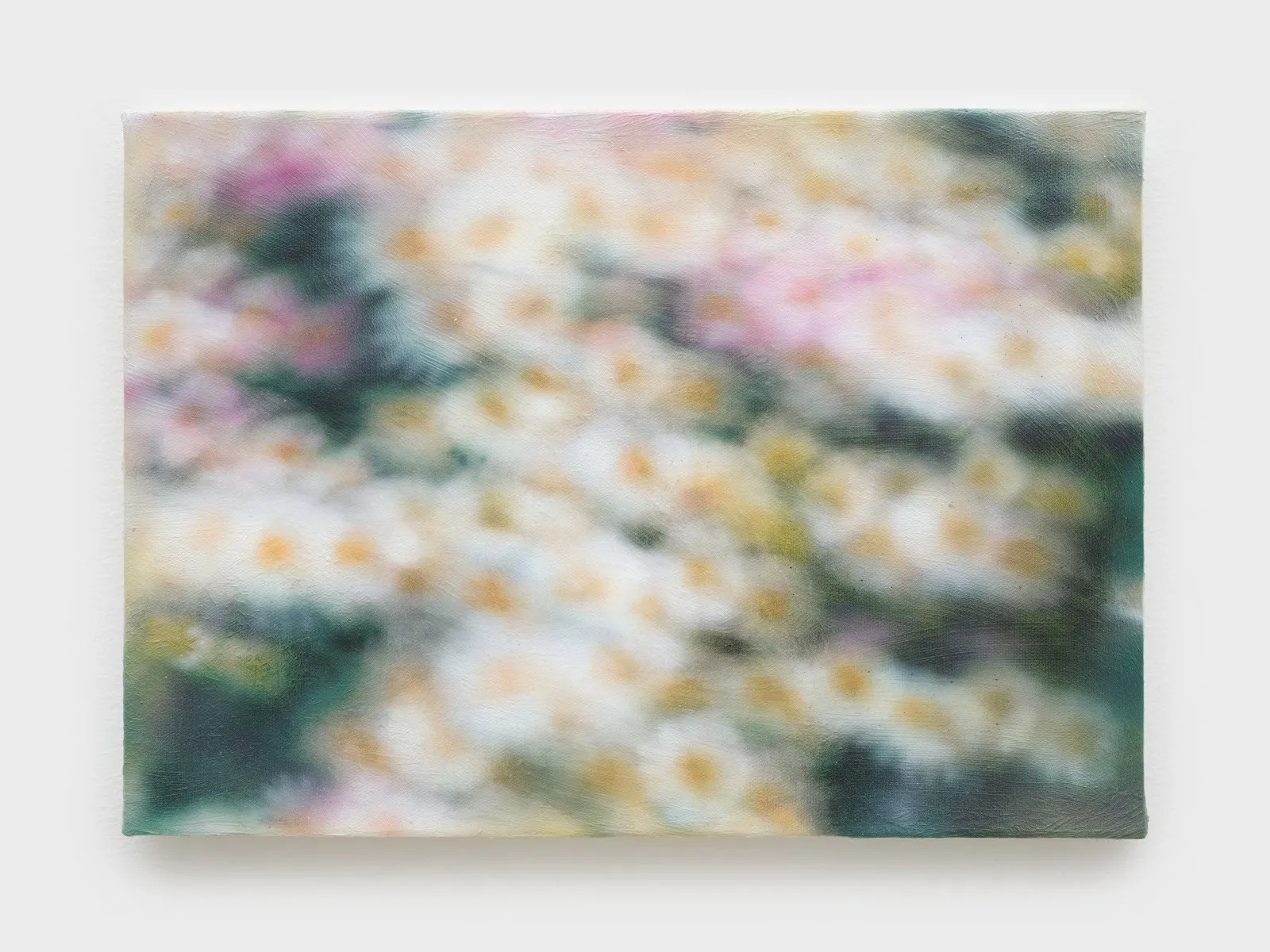
In the same room, Leon Xu’s Friends to lovers (lovers to strangers) (2026)utilizes airbrushing to produce a picture that looks like motion blur; elsewhere, Xu’s airy application method enhances a non-conventional aerial perspective of a piano in a concert hall, again imbuing it with a sense of arrested motion, almost flight. The cross-fades in Julia Mauri’s works enact a similar temporal arresting, but instead of freezing camera movement, they freeze montage, turning the grand dissolves of Old Hollywood cinema into architectonic compositions that operate on two planes at once.
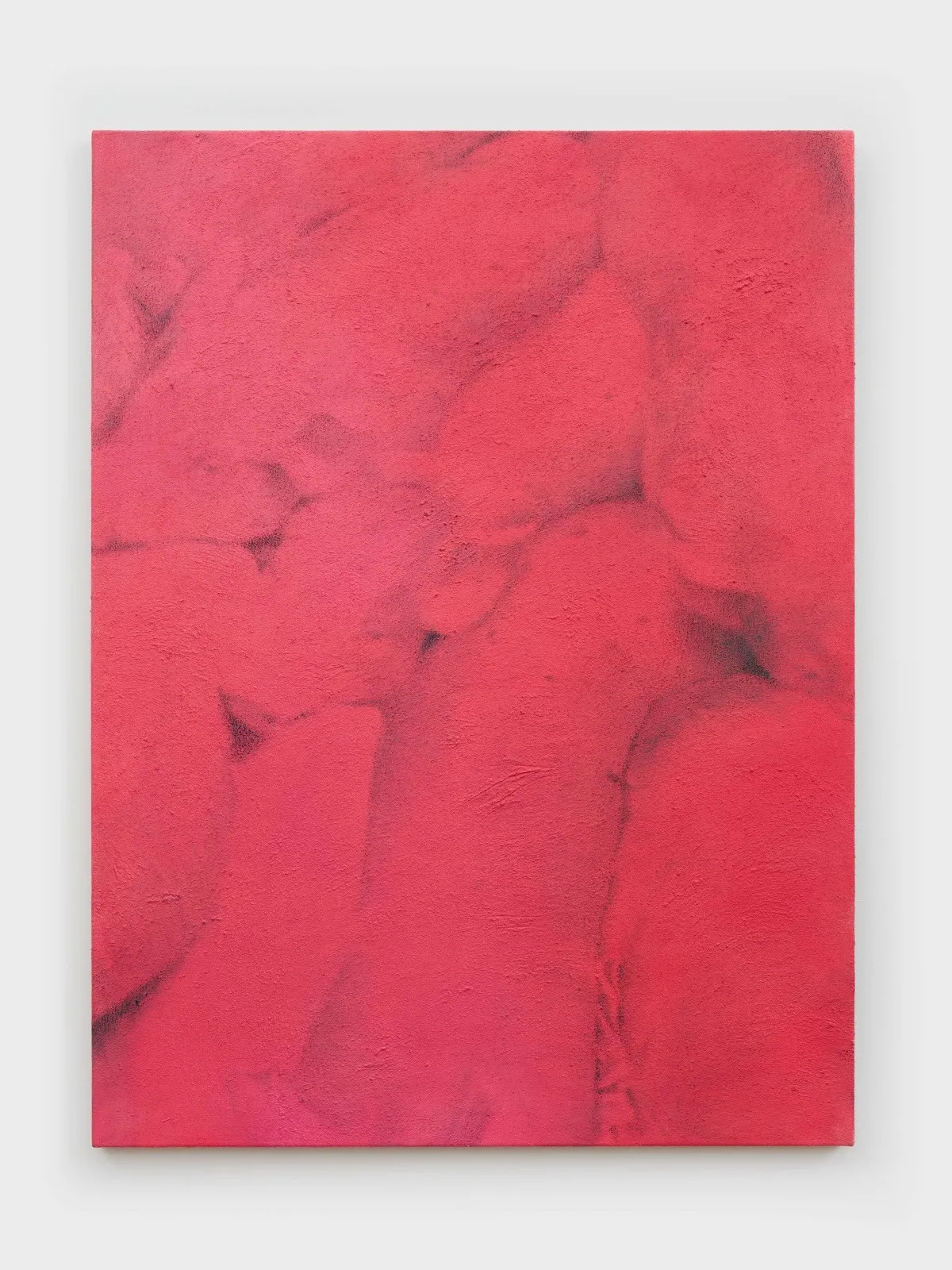
Photographic technique and painterly materiality come together perfectly in Nana Wolke’s 00:02:46,625 --> 00:03:35,750 (Earth Erotica) (2025). The painting construction appears as a red field, seemingly undifferentiated on first glance, but soon resolves into an overhead image of a mass of pigs, bodies squeezed in so tight their black outlines are just barely visible. Many of its compositional elements feel like they take meaningful cues from lens-based imagery—the perspective, for one, which is top-down and cropped, implying a kind of impersonal video feed, not to mention the color, which feels like heat-mapped surveillance. All of this is embedded in a thick, pebbly substrate of gesso mixed with construction sand, giving the entire painting a grainy feel and a uniform texture. The picture feels at once thickly tangible and one-dimensional, like it’s embalmed behind a mediating layer.
The title of the exhibition, Painting, Photography, Painting, is taken from an essay by Carol Armstrong, in which she refutes the earlier modernist notion of lens-based art forms dialectically subsuming and replacing the painted image.[6] Art is a cycle, she posits, not a forward-moving line, and in negating the Hegelian logic of, say, Benjamin’s arc toward reproducibility (or Baudelaire’s problem of sight subsuming magic), Armstrong charts out a convincing case that photography can’t replace painting, but that the two can rather repeatedly re-interrogate one another’s techniques. The best works in this show enact a similar move, showing how photography, bent back into painting, can produce new kinds of pictorial thinking.
A vastly different program is on view at David Zwirner’s uptown space, with Elisheva Biernoff’s Elsewhere. The exhibition, which consists mainly of Biernoff’s to-scale recreations of found Polaroids and other photographic ephemera, would seem at first glance to enact a similar synthesis. Every aspect of the original photographic facture—color, cropping, imperfections of light—is perfectly preserved in acrylic, and there is a genuine weight to Biernoff’s meticulous verisimilitude. But the paintings fall flat, feeling ultimately like ersatz simulations of photography rather than meaningful cross-medium syntheses.
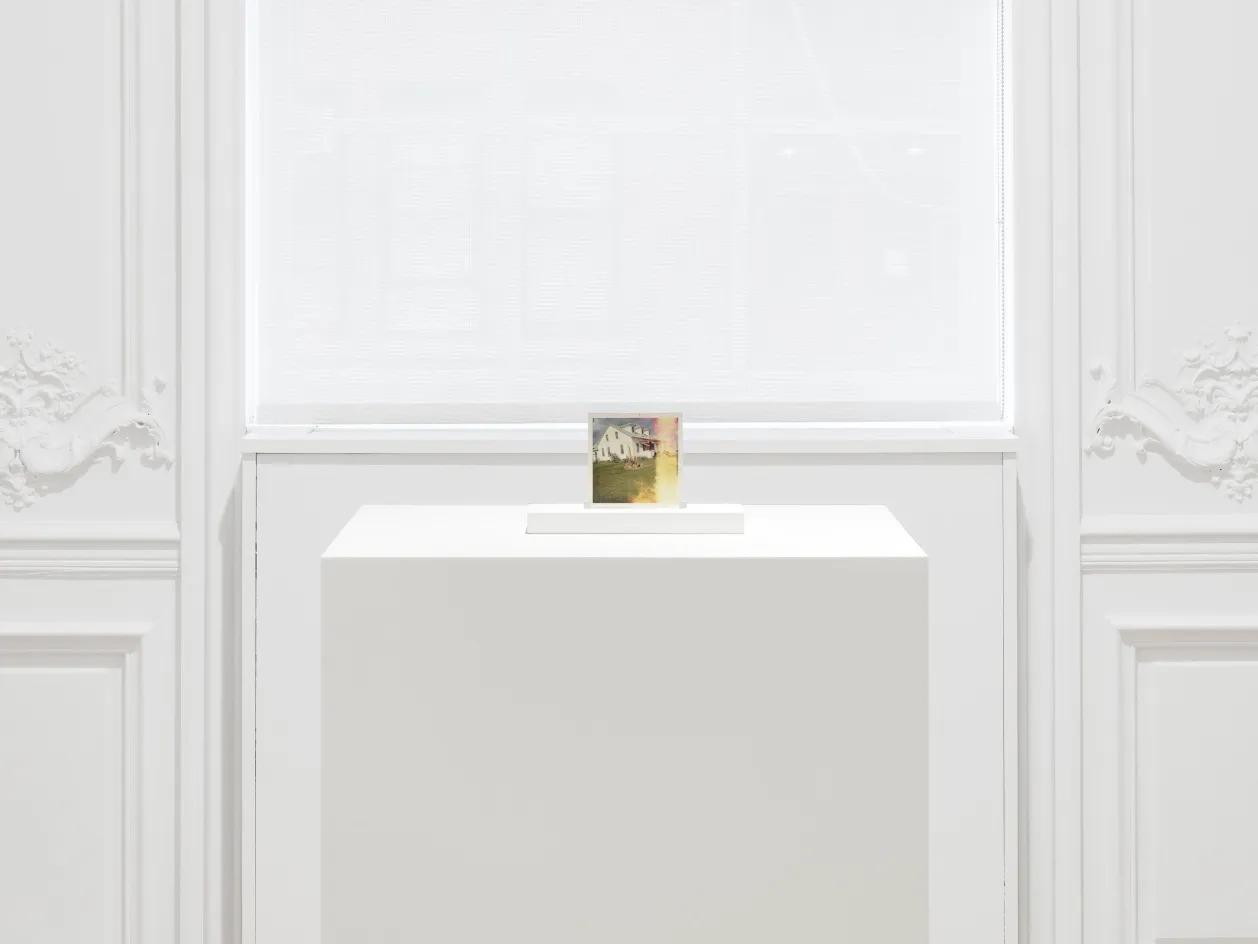
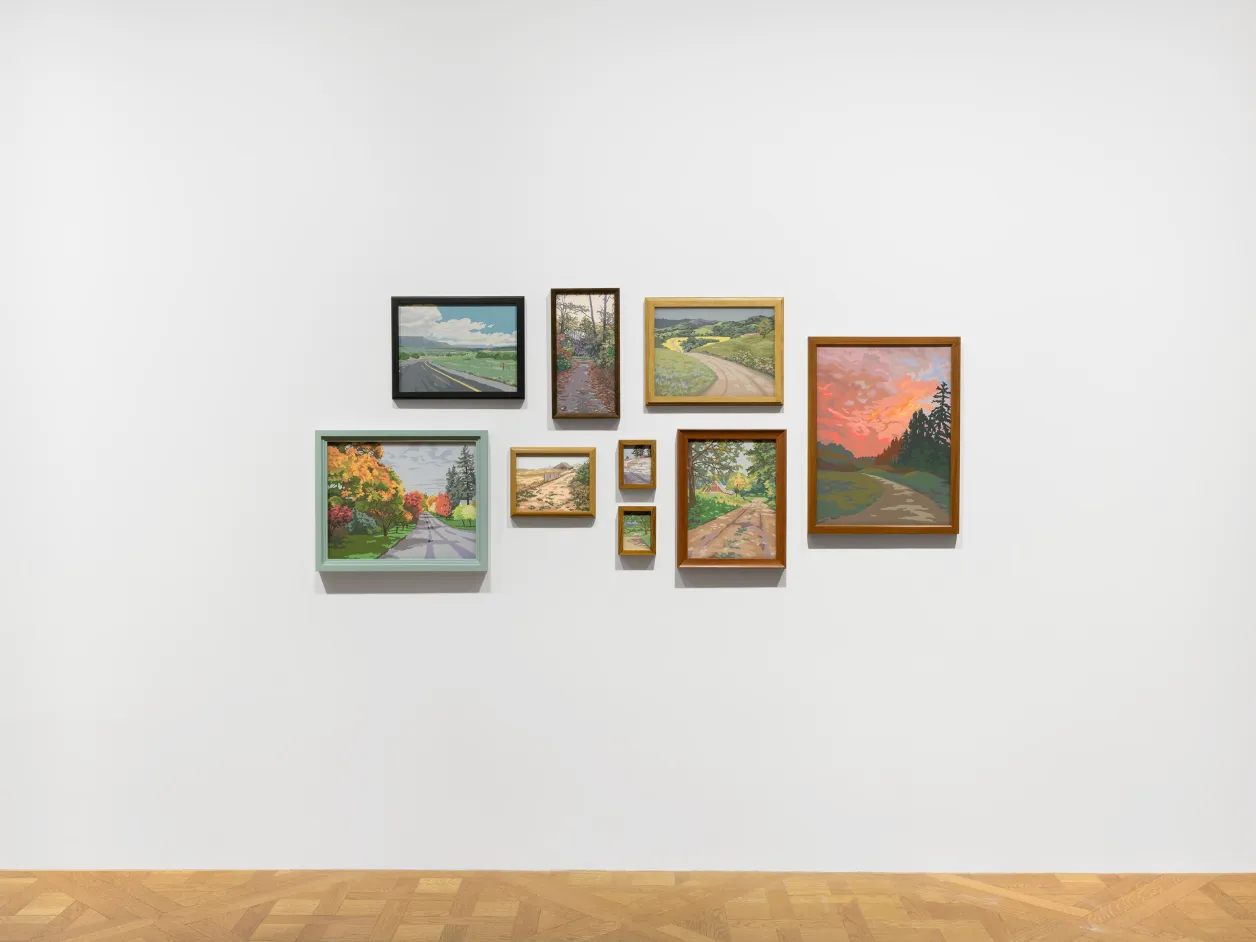
Biernoff is, of course, working in a slightly different lineage than the artists previously mentioned. Her referents are specific analog objects, for one thing, not decontextualized digital imagery. The Polaroid paintings are situated alongside a host of other trompe l’oeil works, including canvases painted to look like wood paneling and compositions made to look like paint-by-number, all of which point to an interest in vernacular picture-making rather than photography itself.
Still, the Polaroids are the star of the show, and much is made of Biernoff’s process in the related press material, including her months-long dedication to producing each picture (she produces just four per year). Something about this positioning, though, is alarming: paint positioned as a mere membrane through which these images pass, almost entirely unchanged, with the real value being the artistic effort expended.
It may also be that analog photography now belongs to a separate realm of object than the digital image, which is not only endlessly more reproducible but in fact bears interesting pictorial evidence of its reproduction by way of artifacting and compression. By comparison, a found Polaroid photograph feels as individual and unique as a painting—and ends up being thin fodder for any cross-medium negotiation. Maybe that is why there seems to be no tension between material here, just a neat absorption of one into the other. It is as if Baudelaire’s nightmare had come true: that paint has “prostrated itself before external reality,”[6] content to reproduce images and not drag them into its own material realm.
Painting, Photography, Painting was on view at Olney Gleason from January 6 through February 14, 2026. Elisheva Biernoff: Elsewhere is on view at David Zwirner, 69th St from January 8 through March 14, 2026.
[1] Charles Baudelaire, “Salon de 1859,” in Curiosités Esthétiques (Michel Lévy frères, 1868), 261.
[2] Baudelaire, “Salon de 1859,” 262–63.
[3] Walter Benjamin, “The Work of Art in the Mechanical Age of Reproduction,” in Illuminations, ed. Hannah Arendt (Schocken Books, 1969).
[4] Rosalind Krauss, “Notes on the Index: Seventies Art in America,” October 3, no. 1 (1977): 68–81.
[5] Roland Barthes, “Rhetoric of the Image,” in Image, Music, Text,
ed. S. Heath (Hill and Wang, 1977), 32–51.
[6] Carol Armstrong, “Painting Photography Painting: Timelines in Medium Specificities,” in Painting Beyond Itself, ed. Isabelle Graw and Ewa Lajer-Burcharth (Sternberg Press, 2016), 123–144.
[7] Baudelaire, “Salon de 1859,” 262.