
Ranbir Sidhu: “No Limits”
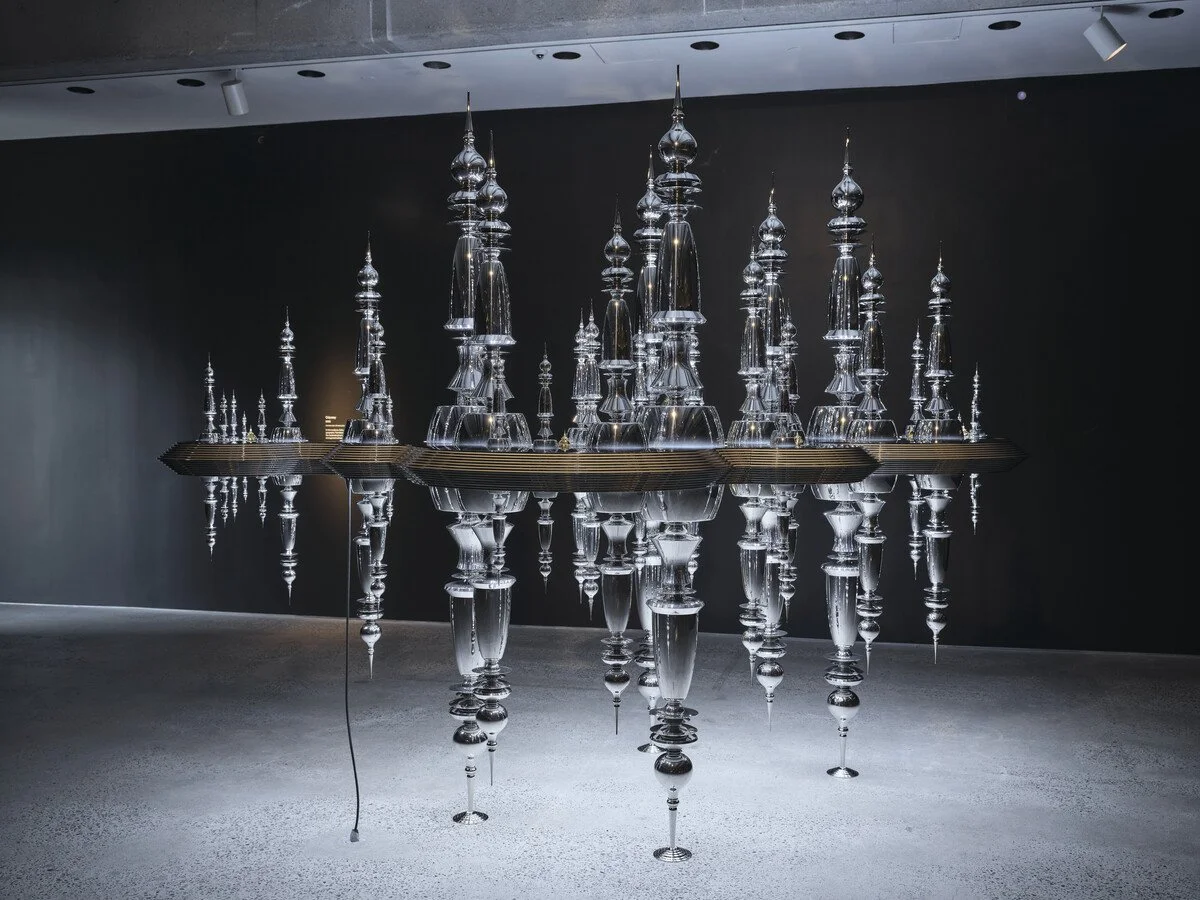
Installation view, Ranbir Sidhu: No Limits, December 13, 2025 – January 3, 2027, Art Gallery of Ontario. Artworks © Ranbir Sidhu. Photo AGO.
In the Art Gallery of Ontario, one can find a Canadian canon: the Group of Seven’s idyllic landscapes, work by Indigenous artists expressing a presence shirked in isolated coastal portraits, and several works of abstract expressionism meant to place Canada in a canon of modernism which typically unfolds on the New York–Paris axis. A new exhibition by the designer and artist Ranbir Sidhu might be indicative of a hope that the Toronto-based artist will lurch a national oeuvre into a more accelerated contemporary terrain—a hope of finding in the technical prowess of materials engineering and the marks of otherworldliness a route toward futurism.
Sidhu might be best known to viewers as the designer commissioned by Drake in 2021 for a brass and acrylic coffee table finished with Bentley paint, diamond dust, and 24-karat gold. At the time, Sidhu’s design studio Futurezona looked to create what Forbes called “ultra-bespoke pieces” of furniture; the AGO show seeks to position Sidhu’s technical skill as conducive to a more thorough artistic practice. Similar considerations emerge, though: how metal might curve to reflect light, how angular engineering tricks or projection lighting might best express a liveliness in the ostensibly inert.
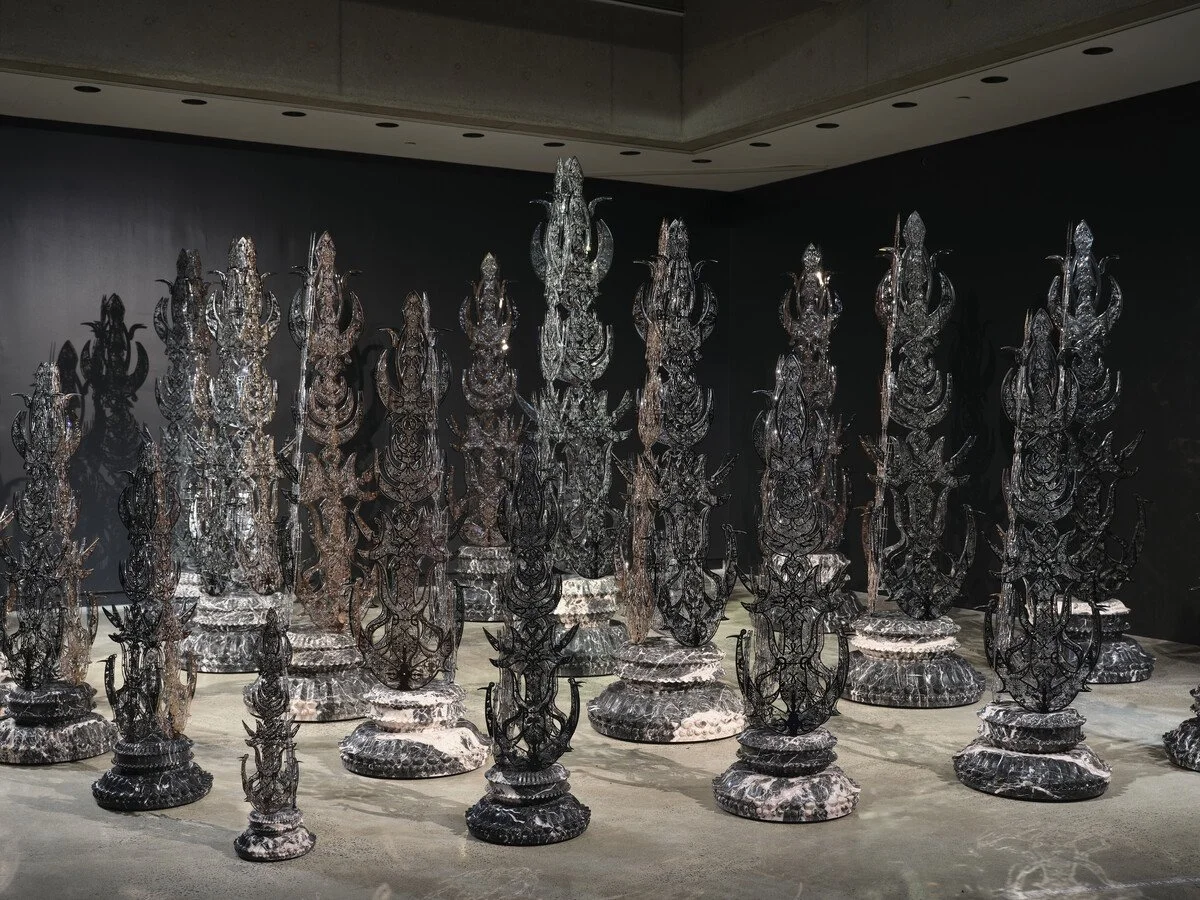
Installation view, Ranbir Sidhu: No Limits, December 13, 2025 – January 3, 2027, Art Gallery of Ontario. Artworks © Ranbir Sidhu. Photo AGO.
Viewers can enter No Limits after a second-floor passage beginning with the Henry Moore Sculpture Center, through a Gehry-designed atrium filled with smaller sculptures by Barbara Hepworth, Germaine Richier, and Beverly Pepper. Moore’s sacred anthropomorphic forms and the weathered bronzes flooded in light are a jarring primer to the rigid, sleek surfaces in Sidhu’s work, which wait for visitors at the end of the hall.
At first glance, Odyssey (2025)appears to be suspended, floating in space. A ridged beam curves around the middle of the piece, reflecting mirrored scenes of protruding steel towers akin to Islamic minarettes or Renaissance spires. Made of stainless steel and 24-karat gold, the sculpture draws on spiritual cartography, elegizing a microcosm of architectural extension into the earth and sky. One might imagine walking through the towers of mirrored steel and feeling dwarfed by grandiosity—not least an ode to the divine practice of engineering, and a scale model of a world that exists elsewhere.
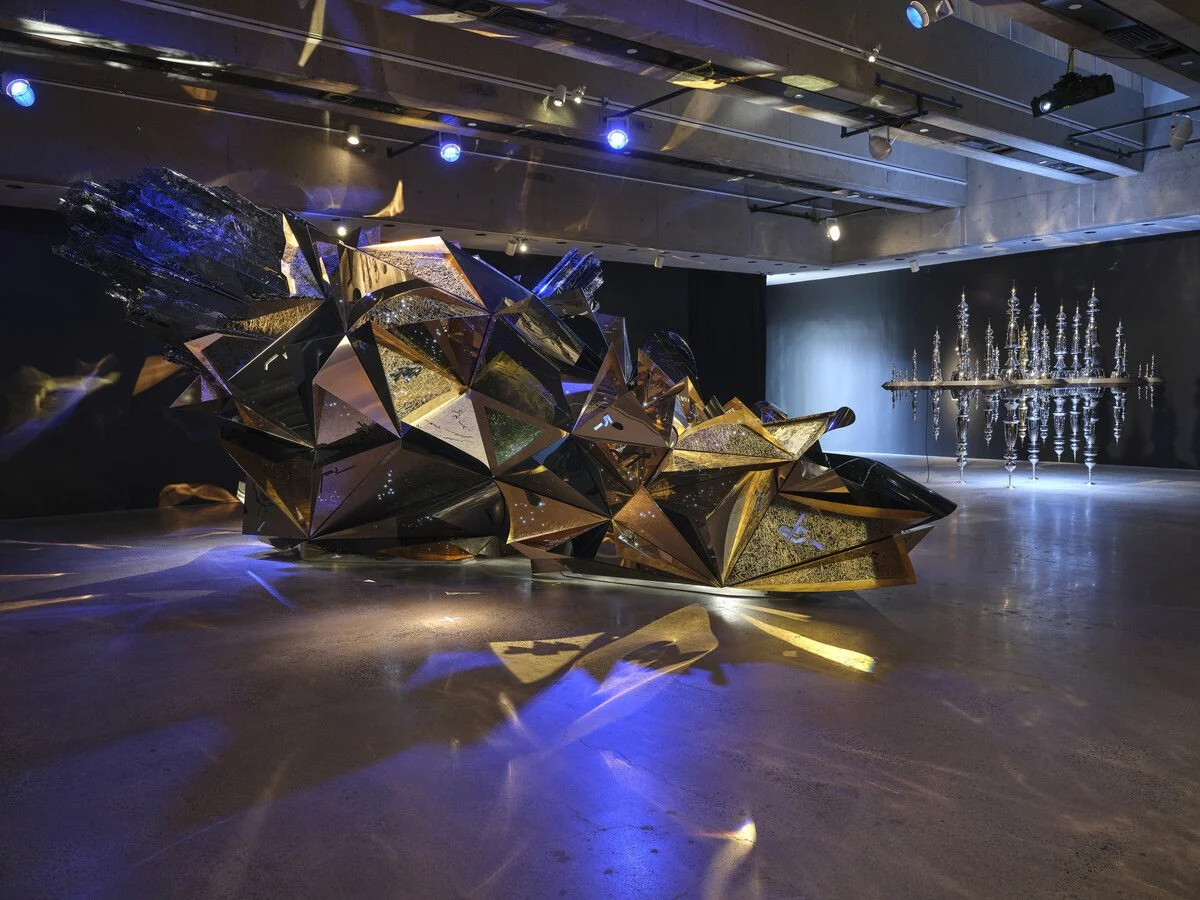
Installation view, Ranbir Sidhu: No Limits, December 13, 2025 – January 3, 2027, Art Gallery of Ontario. Artworks © Ranbir Sidhu. Photo AGO.
Nearby, Asteroid 3033 X1 (2025) accomplishes a corresponding feat: the 5,000-pound rock formation is made of aluminum and stainless steel, accented by gold foil, with chemically-etched patterns throughout resembling both the organic complexity of mineral patterns and the intricate laminated networks of printed circuit boards. What emerges as tunnelling systems and concealed crevices, alongside a combination of curved and pyramidal shapes with crisp seams, convey a liveliness to the work’s sharp corners and an interest in fractals’ capacity to imply worlds contained within each other. “Celestial” was used to describe Sidhu’s project: the soundscape and LED lights, which reverberate from inside the sculpture, lend a hint at transcendental formlessness to the otherwise postindustrial assemblage. The jagged form is inspired by azurite, and mirrored sheaths create the effect of mineral deposits within the sculpture itself; etched into different panels are what Sidhu calls “futureglyphs,” an invented language which the sculpture makes material. Asteroid 3033 X1 is both teeming with life and starkly artificial, accentuating Sidhu’s interest in steel as an elastic, malleable medium rather than a dead artifact of a postwar boom.
In Memory Palace (2025), metal’s immersive potential is on display. Laser-cut in steel are emblems known as the dastar bunga, a wrapped turban used by Sikh warriors. The interlocking forms are layered in three sheets of black, silver, and rose gold steel, and stand stark in a garden of industrial metal. While Odyssey and Asteroid underscore the engineering required to make component parts of metal sculpture into a cohesive whole, Memory Palace implies a connectedness in the space between each towering construction. The futurism rehearsed in sculptures drawing on industrial design and materials science, in which the object is a trace of elsewhere, is here transposed onto a scene with more directed sentiment.
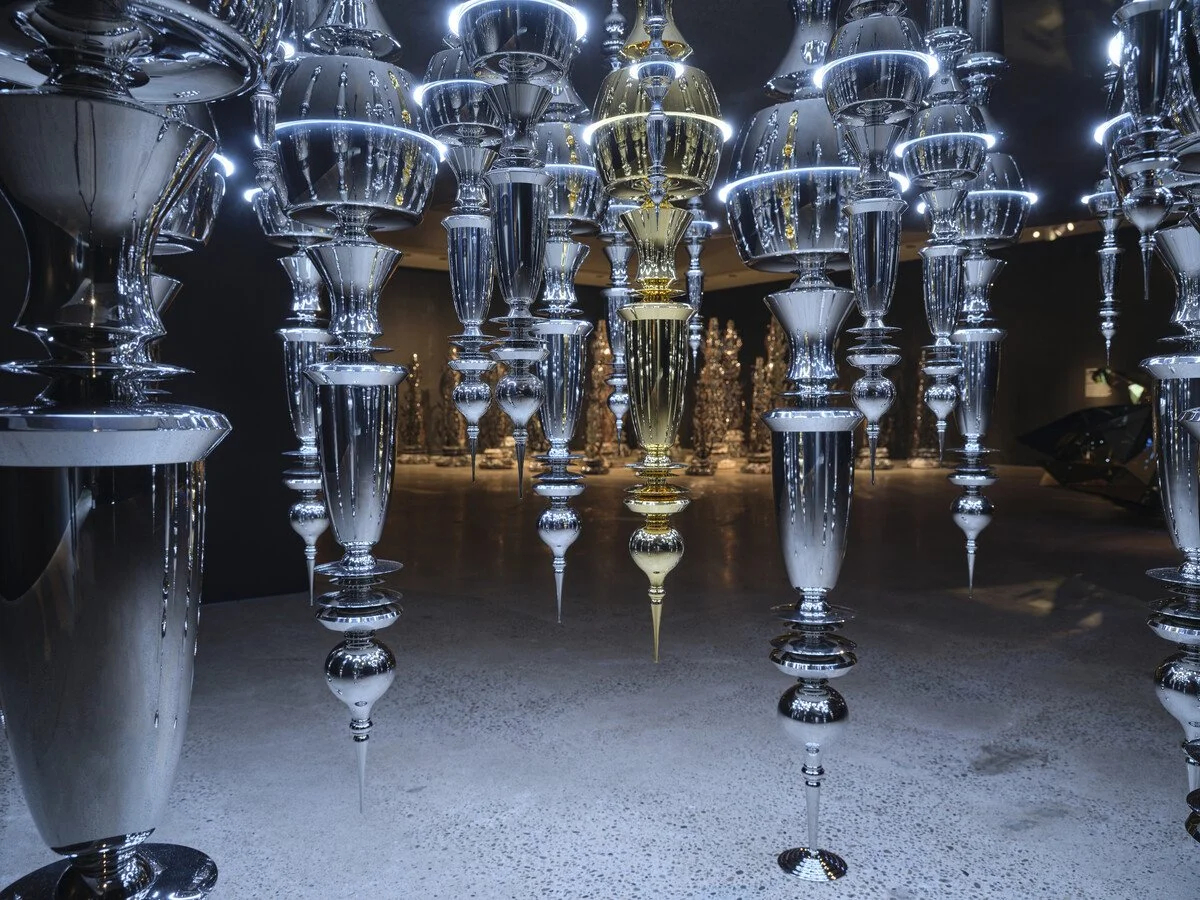
Installation view, Ranbir Sidhu: No Limits, December 13, 2025 – January 3, 2027, Art Gallery of Ontario. Artworks © Ranbir Sidhu. Photo AGO.
One is likely to be impressed by the magnitude of machinic labor contained in the sculptures’ intricacy. The extensive use of chemical etching and laser cutting in construction requires execution free of error and refinement only after extensive research and development—a pageant of achievement that can turn the show into a display of technical precision and command. Ranbir, who has a background in manufacturing, was first introduced to metal fabrication as a child in his father’s studio, and his attention to the spectacle of raw material’s mechanical transformation is clear: worlds reflect each other in mirrored steel.
Toronto is an unplanned construction of reflective glass. The city has one of the largest skylines in the world, a portrait of endeavors in new wares and commitments to the material furnishing of condominium towers and hotel lobbies on every block. This can supply, in equivalent dose, a picture of investment in modernization and a suggestion of eroded public space one might index in a Cronenberg film (the city’s greatest export): materials engineered for projects of the new might find themselves towering above all that’s fatigued and festering in their reflection. Sidhu’s exhibition hopes that the rigidity of something like steel might be rendered as lively forms—that the processes of materials engineering might grant some textural depth to an otherwise flat surface.
Ranbir Sidhu: No Limits is on view at the Art Gallery of Toronto until January 3, 2027.