Shifting Substrates: In Conversation with Tschabalala Self
The vibrant portraits of Tschabalala Self speak for themselves. Her textile collage compositions close the gap between painting and the body, their creation seemingly more akin to mending a well-worn sweater or fastening the buttons of a lover’s dress than constructing an image. She doesn’t write herself into art history, but rather, cuts it open, refashioning a world brimming with a vivacity that exceeds its substrate.
Self grew up in Harlem and remained in the city until this past fall, when she moved upstate; she now maintains a studio in the Catskills. On a crisp February day, we both found ourselves in Provincetown, Massachusetts, an alluring, remote locale of a different ilk. I had the chance to sit down with her at the Fine Arts Work Center, where we discussed scarcity and abundance, the energetic charge of materials, and the sophisticated beauty of the natural world.
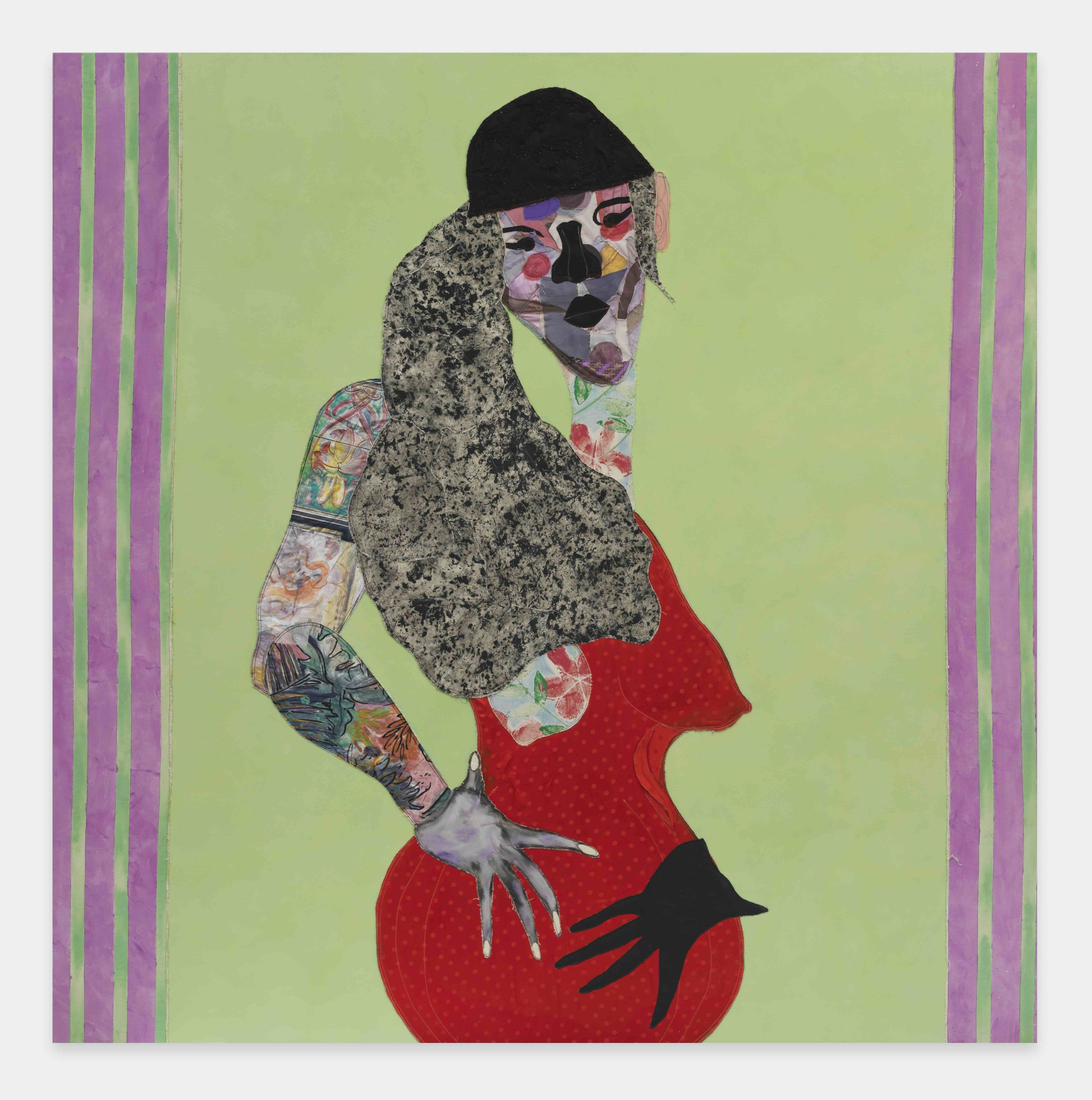
Tschabalala Self, The Observer (2025). Courtesy of Tschabalala Self.
Emma Fiona Jones: I want to begin by asking how the figures in your work exist in your mind. Are they characters? Mystical beings? Or simply images, referents, an amalgamation of memories and signifiers?
Tschabalala Self: I think of them as characters, because each of them is working within the narrative. They each have their own narrative, but they also work within this metanarrative that spans across my entire practice. I feel like they are playing a part in the way that I feel like all people play a part. They’re almost fictions of themselves.
I develop the characters by pulling from memories, previous works, different social constructs, archetypes, stereotypes, belief systems, and expectations that are projected onto the female body. So they become these amalgamations of different things—many different ideas, realities, and potentialities.
EFJ: I often hear your characters talked about in relation to fashion. Is that something you consciously put into your work, or a reading that’s projected onto it? And do you ever think about creating work that is meant to be worn?
TS: I think that’s something that’s projected onto the work because of the materiality. I mean, it completely makes sense—with the textiles, and also the repetition, the pattern-making that happens within the paintings.
My work also pulls a lot of energy and inspiration from pop culture, so I’m never surprised when people read this fashion aesthetic or narrative within the paintings. But it’s not something that’s at the forefront of my mind when I’m working.
I have worked with fashion houses previously. I’ve collaborated before with Louis Vuitton for a handbag, and I’ve also done collaborations with Ugg. I have another one that’s going to be coming out this year, but it hasn’t been announced yet. So it’s not that I don’t enjoy fashion; I personally love fashion, and I have thought about doing more with that. I just haven’t figured out exactly how to approach it in terms of something that I’m making on my own, directly from my studio, not in collaboration with a fashion house that already exists. It’s just that I’m still wrapping my head around it. But it’s funny you bring it up, because it’s something I was talking about earlier today.
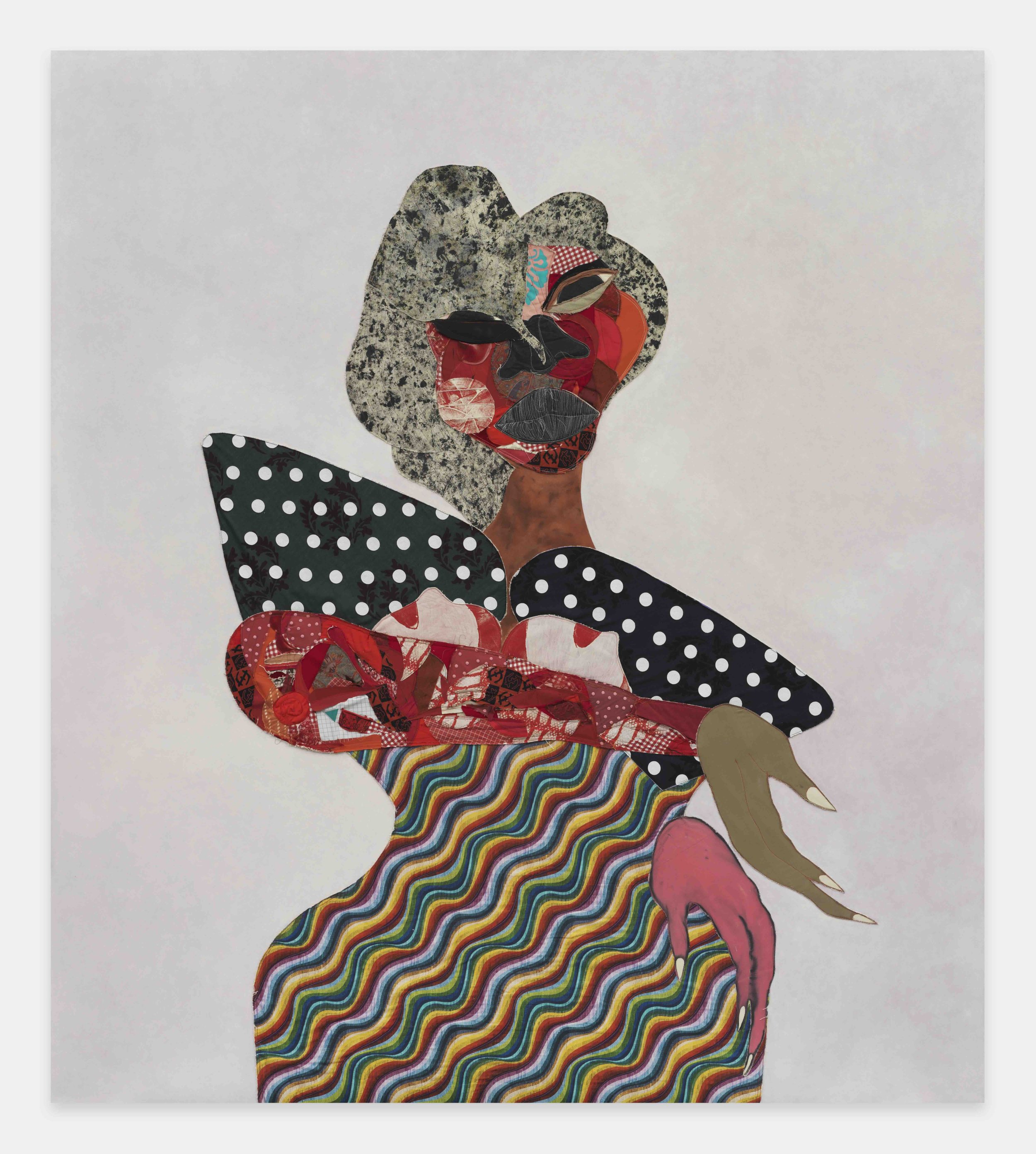
Tschabalala Self, Madame (2025). Courtesy of Tschabalala Self.
EFJ: Do you think of canvas as a textile?
TS: I absolutely do! I don’t have this kind of hierarchy with materials. I feel like that is a big conceptual aspect of my work as it relates to its formal construction. When I was in my MFA program, there was so much conversation about deconstructing painting. I really took that conversation to heart because I thought that it was an important prompt. And the way I approached that was exploring the materiality of painting. That’s when I came to the somewhat obvious conclusion, once you think about it, that the substrate itself is a textile. By equating it with other textiles through fabric collage and assemblage, I think I’m able to bring light to that.
When people become aware of that fact, it shifts their interpretation of what painting is and what it means on a political level as well. Because I think that there’s still this belief that painting is intrinsically rooted in a European, male art historical narrative. But the idea that the substrate, the foundation, is itself a textile, separates it from those myths around the medium, and you start to understand that it has this relationship to other craft traditions and other textile traditions throughout the world. And yet those other textile-based art forms are typically relegated to a whole other spectrum beyond the category of fine art.
So just realizing that the substrate itself is a textile helps people break down a lot of these arbitrary boundaries they have in their mind about what painting is, what it means, how it functions, the ways in which it is siloed and elevated. I don’t like the hierarchies that people construct around these mediums or modalities, because I think that they just perpetuate a lot of unproductive ways of thinking. It creates more divisions in the ways people make and view art.
EFJ: Textiles are imbued with stories; they carry legacy. Quiltmaking and other craft traditions have often served as a means of archiving for non-dominant communities whose stories are left out of the Archive with a capital A. How does your practice relate to memory and time?
TS: For me, painting functions like a diary entry. What’s in a particular work reflects what is happening in my life and in my studio at that time. Textiles mark life cycles within my work. Once a bolt of fabric runs out, and I know that it will no longer appear in future paintings, it’s like the end of an era within my studio practice.
But at the same time, the act of accumulating these materials and fixing them together is a way of bringing them into the future—it’s a gesture of preservation. I think a lot about the immortal quality that’s assigned to paintings. And in a way, quiltmaking, which is connected to my work as well, has the same emotional draw: for instance, you can take a child’s nightgown that’s deteriorating and use a swatch of it in a quilt, thereby keeping a fragment of that moment in time alive. It’s the same motivation in my paintings.
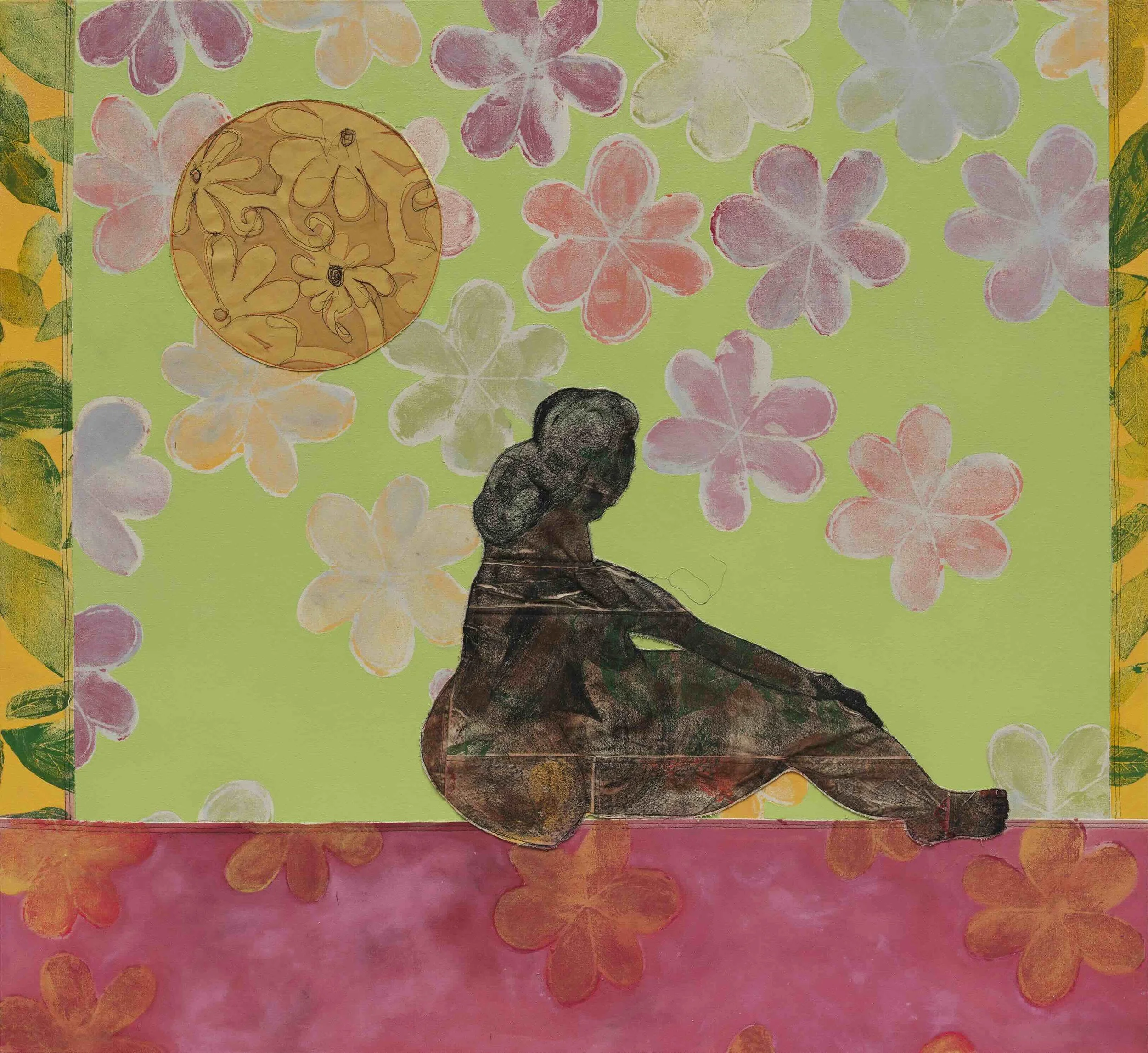
Tschabalala Self, Study of Odalisque on Rose Bed (2025). Courtesy of Tschabalala Self.
EFJ: Something I’ve been thinking about lately is the shrinking life cycle of textiles—fast fashion, synthetic fabrics, not to mention our alienation from the production of garments. It’s hard to imagine we’ll have anything worth passing down to the next generation.
TS: I think a lot about the sorts of fabrics and materials that I collect, and that end up in a painting. I generally try to use materials that are natural fibers. I just feel like, energetically, they are more powerful than something that’s made from plastic. Synthetic materials, for me, just don’t carry the same energetic charge.
EFJ: You often cite Ana Mendieta as an influence, who believed deeply in the animate qualities of materials, the spirituality of rocks and dirt and flowers.
TS: I feel that different objects and materials have different qualities to them, and I feel like the quality can be otherworldly—it could be spiritual, it could be cultural, it could relate to your own personal memory or to collective memory. I also think that each fabric or material has a different sensory effect on people, and I think that sensory effect is where you can lift that significance from.
EFJ: You moved to the Hudson Valley this past year. How is it different working there as opposed to in the city? Has it had any effect on your thinking or practice?
TS: The biggest change for me about being in Hudson Valley is that I have a lot more space. Where I am now is a really small, tight-knit community, and there are a lot of creative people. So the social fabric has changed for me personally, and that informs my work.
The pace is different as well; time moves differently for me there, and that also informs my work. Having that time and solitude allows me to be more focused than I could be in New York.
And being so close to the natural world has made me think differently about a lot of previously held beliefs I had around art and artmaking and what’s important in an artwork—beliefs I didn’t realize I was holding onto. Especially this idea around beauty and its association with being unsophisticated. Particularly within an academic art setting, there’s an unspoken belief that if something’s too beautiful, it’s dumb. But being in nature, you realize that there is a supreme sophistication that allows for beauty.
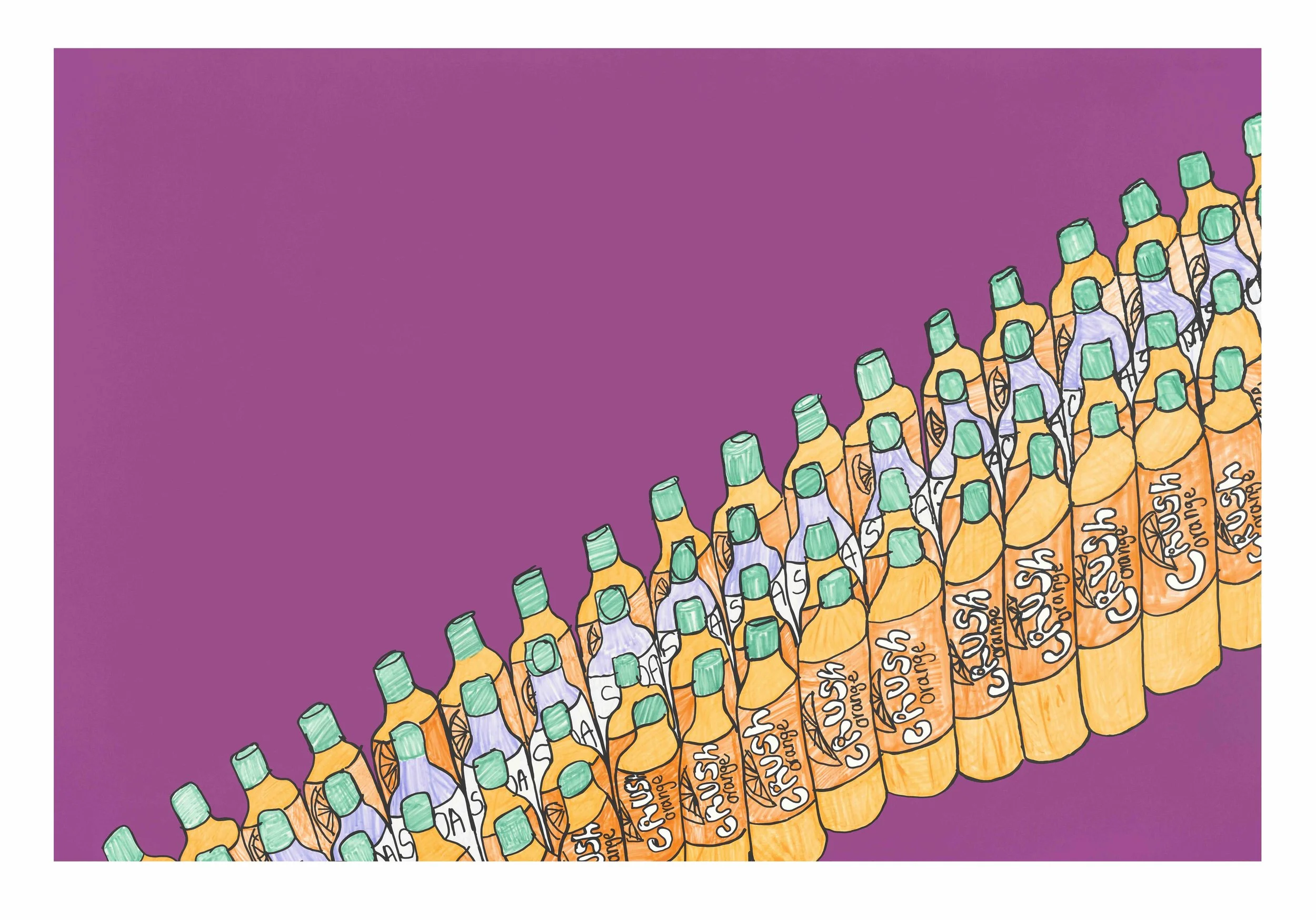
Tschabalala Self, Orange Crush #6 (2024). Courtesy of Tschabalala Self.
EFJ: When I’m walking around New York, I often think about Bodega Run, which explores the architecture of social environments, and how architecture produces a particular social environment. Have you thought about how this manifests itself in the Hudson Valley?
TS: I have, although I’m still unpacking it—because unlike the city that I grew up in, I feel like I don’t understand that environment as well yet. When you’re in an area with so much more nature and so much more space, there’s a feeling of abundance. The city subconsciously produces a feeling of scarcity. You always feel like you need to hustle, you need to gain resources, because hustling is really collecting as many resources as quickly as you can. And you’re doing that because the architecture of the landscape is reminding you that you’re small, that you’re one among millions, and that there’s not enough for everyone. There’s so little to go around that people need to be stacked—literally. Vertically. Everything has a vertical orientation. And you want to be up, you don’t want to be down. So just the architecture alone of the city gives you that subconscious need to operate in a hustle mentality.
The Valley, as opposed to the city, is very horizontal. There’s something equalizing about that, something soothing, leveling. That alone eases a bit of the anxiety. There’s no need to move quickly or hustle or gather as many things as possible, because there is abundance in the landscape.
Another thing is that being in a place where you can’t clearly see the sky has a big mental impact on people. When you can’t see the sky, you’re not reminded that there are things beyond the Earth. All secular concerns, all secular anxieties, become magnified. Any anxiety you have around your ego, your resources, your corporeal reality—am I satiated enough? Can my body survive?—very primal needs become magnified.
Whereas when you can see the sky, when you can see the stars, you’re reminded that there’s so much more beyond yourself, beyond this world, and I think that that helps you put things in perspective. I think that allows you to be less worldly in your thinking. And I think that that realm of thinking is a great place for creative people, a great place to create from. When you’re in that space, you can have very expansive and generative thoughts. It can only benefit your practice.
Just because of the way that people are wired, they’re always looking for something to latch onto that’s bigger than themselves. So I think that when you’re in a more natural environment (because I do think that humans are a part of nature), you can look to a system that’s outside yourself, that’s not manmade, to give some kind of order to your thinking. When you’re in the city, everything that surrounds you is manmade. Whoever is the top in man’s world is who you look to, and that can be very oppressive. Those systems of power you’re operating under—money, influence—become the systems that structure your thinking.
It’s liberating to understand that there are grander, more sophisticated systems beyond that, and have your immediate environment, your physical surroundings, reflect that reality.
This interview was edited for clarity and length.