
.webp)

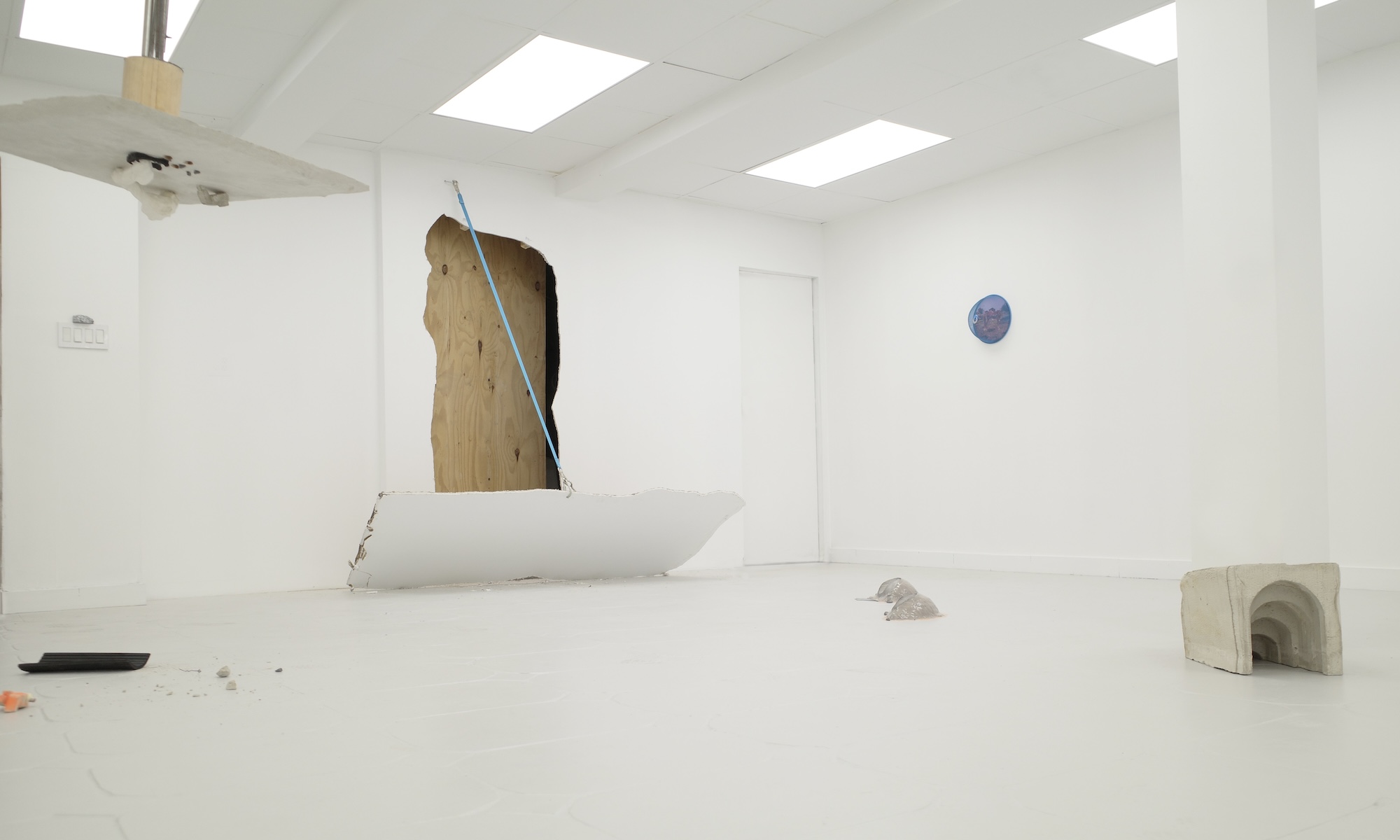
Paz Sher: “Dumb Luck”
Review
The Island (2025), the titular work of Hito Steyerl’s Fondazione Prada show at the Osservatorio in Milan, opens with an uncanny replica of the TikTok dashboard. What follows is a slop-filled meta-film in which science fiction, quantum mechanics, and AI-generated imagery collide—ostensibly to diagnose, and perhaps resist, the contemporary crisis of media ambiguity.
Occupying this feed is a modern-day reincarnation of the superhero, Flash Gordon, who has reappeared in the 21st century as a low-level internet influencer in an off-kilter wig and khakis. He runs a didactic science channel that is being threatened by an encroaching wave of AI slop that renders his videos unwatchable. At the same time, an AI-generated holiday is making its way to the Croatian island of Korčula. Flash, with his front-facing camera switched on, prepares to fight the onslaught of AI. The stakes become clear: defeat the slop, and Flash saves the day.
In preparing for this interdimensional battle—one that will take place between the IRL Flash and his AI-generated clone—the physicist Tommaso Calarco advises him on how to leverage quantum principles to defeat the slop. As the standoff approaches, a scene in the AI world appears where a European man, dressed as a daytime television host, announces over the stampede of an AI-generated crowd, “destroy the image and you will break the system.” This omniscient morsel of wisdom wavers between platitude and parable: hyper-prompted, data-derived visual hallucinations are threatening the order and rule of our current system of knowledge intake. Destroying or subjecting the image to critical discrimination is the solution for understanding the powers that be.
Yet as Steyerl disentangles the conditions for slop, The Island ultimately leaves unresolved whether the artist has identified a life raft out of the wave of informational overload. The exhibition’s proposed “solutions”—science fiction, quantum multiplicity, and media sabotage—may function less as orientational tools than as obfuscating references, reproducing the very condition the work claims to critique.
Pulling heavily on science fiction frameworks, specifically referencing the works of science fiction critic and academic Darko R. Suvin, Steyerl employs the pseudo-reality of science fiction as a foil for making sense of AI image inundation. Suvin himself appears heavily in the exhibition: two prints of his poems open the show; a copy of his 1979 book Metamorphoses of Science Fiction perches below; his interview footage plays on both levels of the two-story space. In his works, there’s a pointing to how science fiction has been able to make sense of historic crises. In her reverence for the thinker, Steyerl implies that this fiction may be a way to rationalize and organize the events of today.
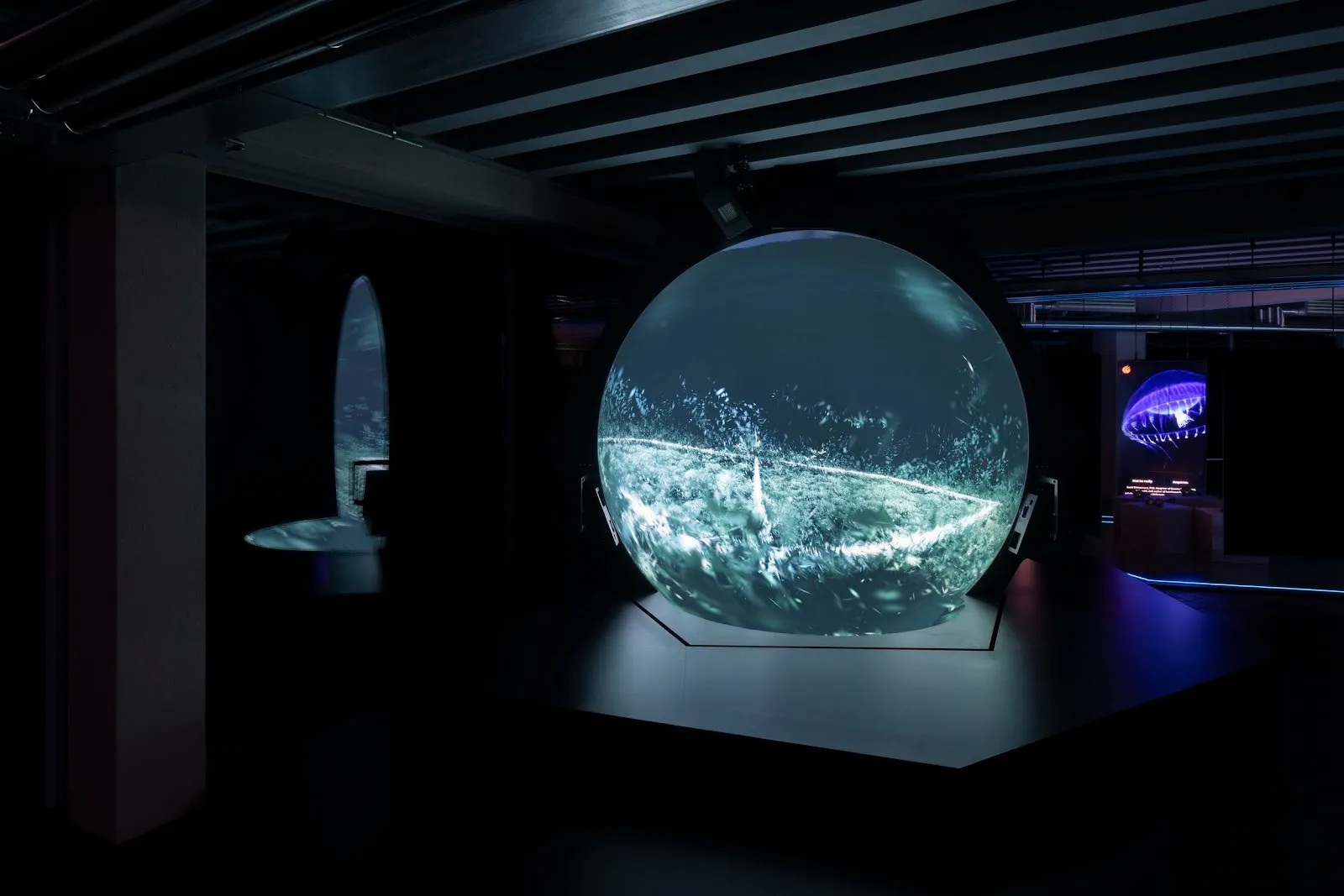
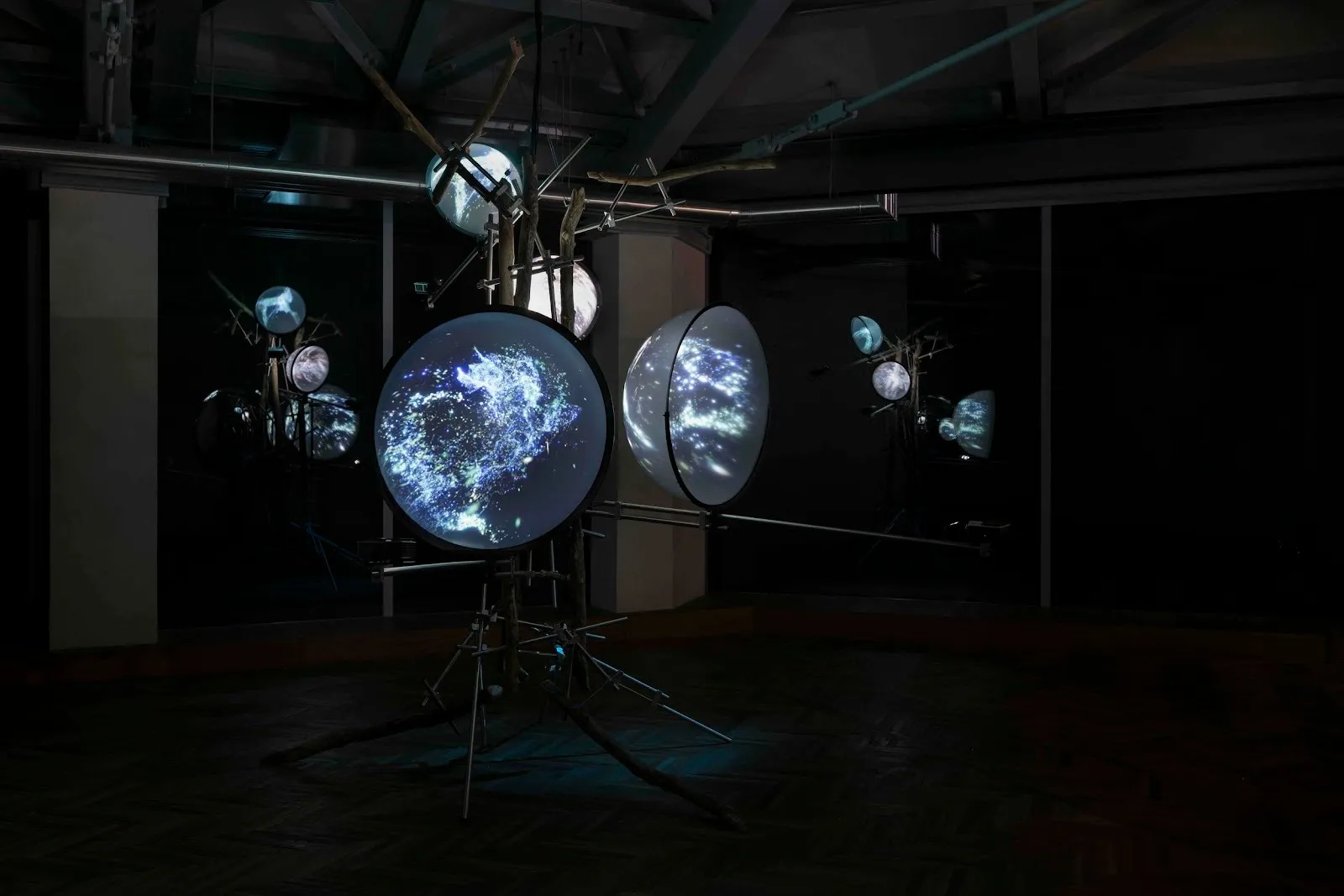
Furthermore, the exhibition’s scenography is executed with such precision and immersion that it functions as a form of cognitive priming. Like the carefully choreographed environments of a theme-park queue, the space prepares the audience to enter Steyerl’s speculative logic before any argument is explicitly made. At the entrance of the nearly blacked-out exhibition, blue glowing spheres undulate by means of projected light particles that contract and expand to form the scan of a submerged Neolithic island found off the coast of Korčula.
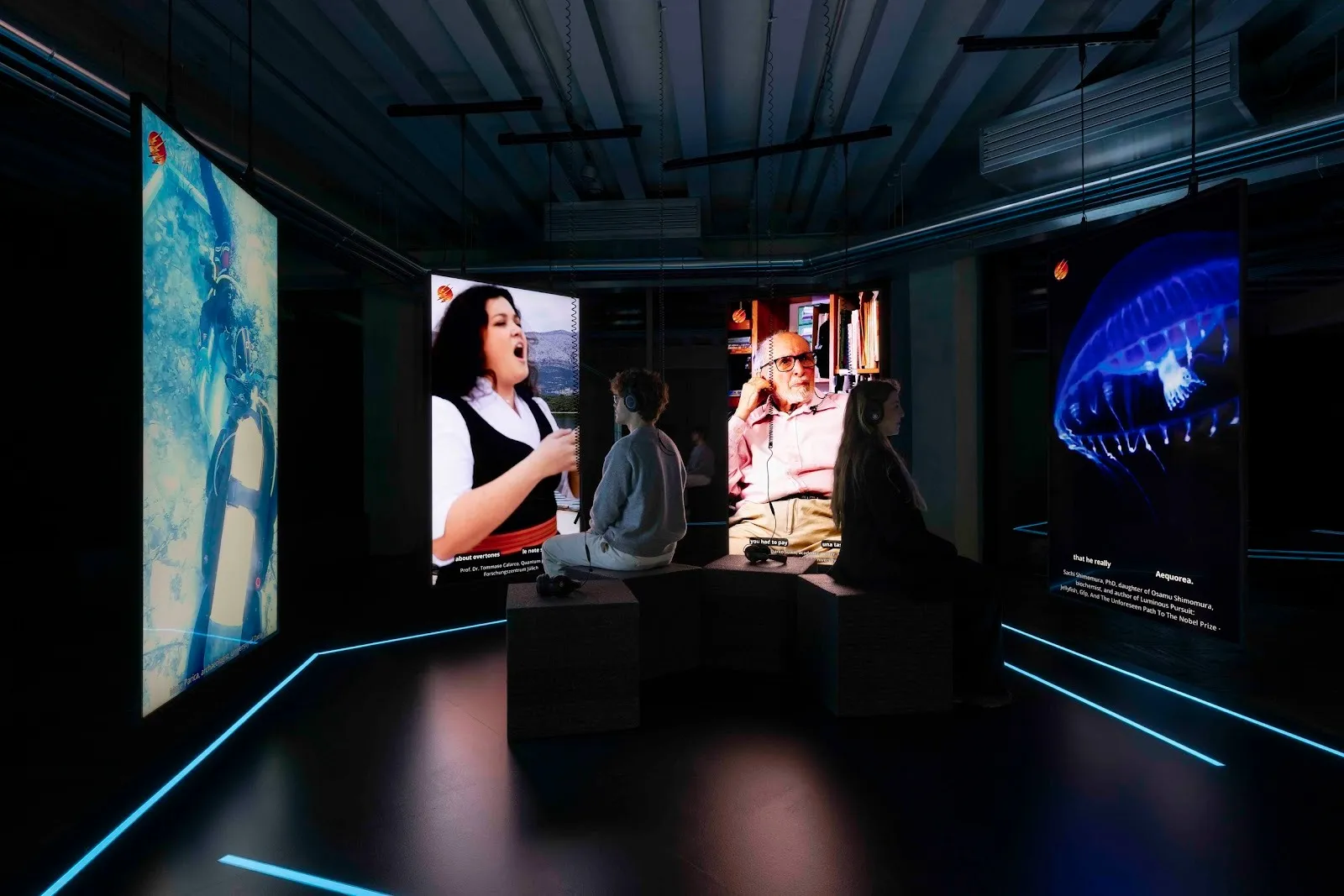
Throughout the exhibition, the orbs are dotted throughout the space. Curling headphone wires drop from the sky as if they’re attached to the piloting quarters of The Matrix’s Nebuchadnezzar. Blue LED strips light a path that looks as though it will lead to the set of the Tron universe. The sophistication of this constructed “science-fiction world” signals how seriously the artist regards the genre—not merely as an aesthetic, but as an effective methodological tool. The space itself becomes a laboratory where Steyerl’s media references can be stretched and manipulated to theorize on possible methods forward. But how exactly does this laboratory seek to interrogate the AI image?
The exhibition begins to falter when the problematics of contemporary media, the addictive nature of slop-filled social media, is not given the same nuance as its science fiction frame. In the film, the scenes that depict the AI world are full of people with contorted limbs, distorted faces, and other aesthetic trademarks of the creepy, nightmarish forms spit out by early generative models. By showing the failed, uncanny image, the film writes off the ever-refining mimesis that has tricked so many into believing the misinformation that these AI videos hawk.
In a similar vein, the artist also includes scenes with the characters from “Italian brainrot,” the viral trend of AI-generated characters with rhyming names that included the airbound Bombardiro Crocodilo and the feminized teacup, Ballerina Cappuccina. In choosing this cast from the AI media landscape, which even in its name acknowledges how it appeals to the lowest common denominator, Steyerl frames AI as a cheap trick. What is missing, however, is an account of why such images are so seductive—why they are addictive, persuasive, and capable of holding attention at scale.
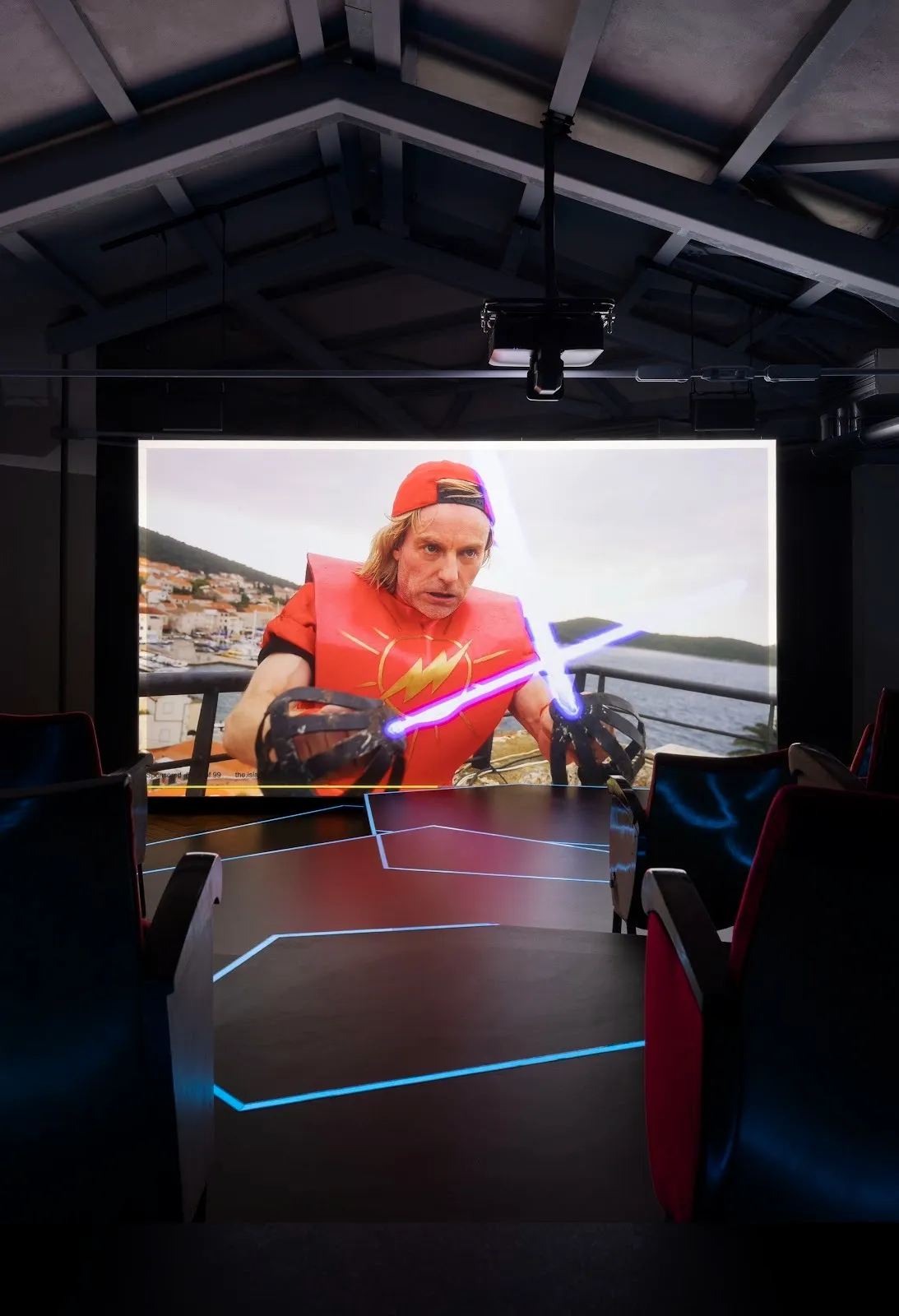
All the while, they are accompanied by the artifice of the film’s Flash Gordon. With his polyester wig and budget superhero costume, he is presented as a bumbling, low-rate actor who looks like he was found from an online listing. He lacks the shine of the contemporary influencer. Even in YouTube’s most niche genres, media personalities, through repeated posting and performance tracking, are able to articulate a targeted aesthetic that speaks to a certain fantasy their viewers have. Steyerl, in making her influencer out to be a kind of fool, makes it clear her disdain for the form. Thus, she misses the link as to why these forms of media have come to be so prevalent and, ultimately, deprives her work of an empathetic understanding for the effective inculcation that has been enabled online.
As a result, the exhibition’s battle tactics, drawn from the hard sciences and high-level schools of thought, against this new generation of pervasive media feel increasingly untethered from the problem at hand. Quantum mechanics, as explained by Calarco, gestures toward multiple coexisting states and worlds. But what does this mean for someone’s carefully curated online persona? How does harmonic resonance speak to a subscriber who has watched the same creator for years, building a tender, parasocial relationship to them? Quantum physics here risks functioning as a familiar science-fiction trope: an esoteric, near-mystical answer deployed where a more grounded analysis of attention economies might be more illuminating.
Ultimately, The Island recreates the conditions of media saturation without clearly distinguishing between critique and participation. What is intentional and what is excess remains ambiguous. The accumulation of references—Italian brain rot, science fiction theory, quantum mechanics, geopolitical history—doesn’t so much as destroy the image as reproduce its logic, further submerging the audience in the very flood of unstable, unbelievable visuals the work seeks to confront.
Hito Steyerl: The Island is on view at the Galleria Vittorio Emanuele II of Fondazione Prada Osservatorio, Milan from December 4, 2025 through October 30, 2026.