


"Fill’d Them, Emptied Them" at Sheerly Touch-Ya Curated by Isabella Achenbach
Review
To write about UNAROMA is to reflect on Rome itself. The major group exhibition at Museo MACRO, curated by current MACRO Artistic Director Cristiana Perrella and her immediate predecessor Luca Lo Pinto, brings together forty Italian and international artists from different generations. The main section of the show, titled “SET,” unfolds on the ground floor of the museum, with two accompanying chapters hosted in venues across Rome: “LIVE,” a performance program, and “OFF,” a speaker series, extend the project beyond the walls of the institution.
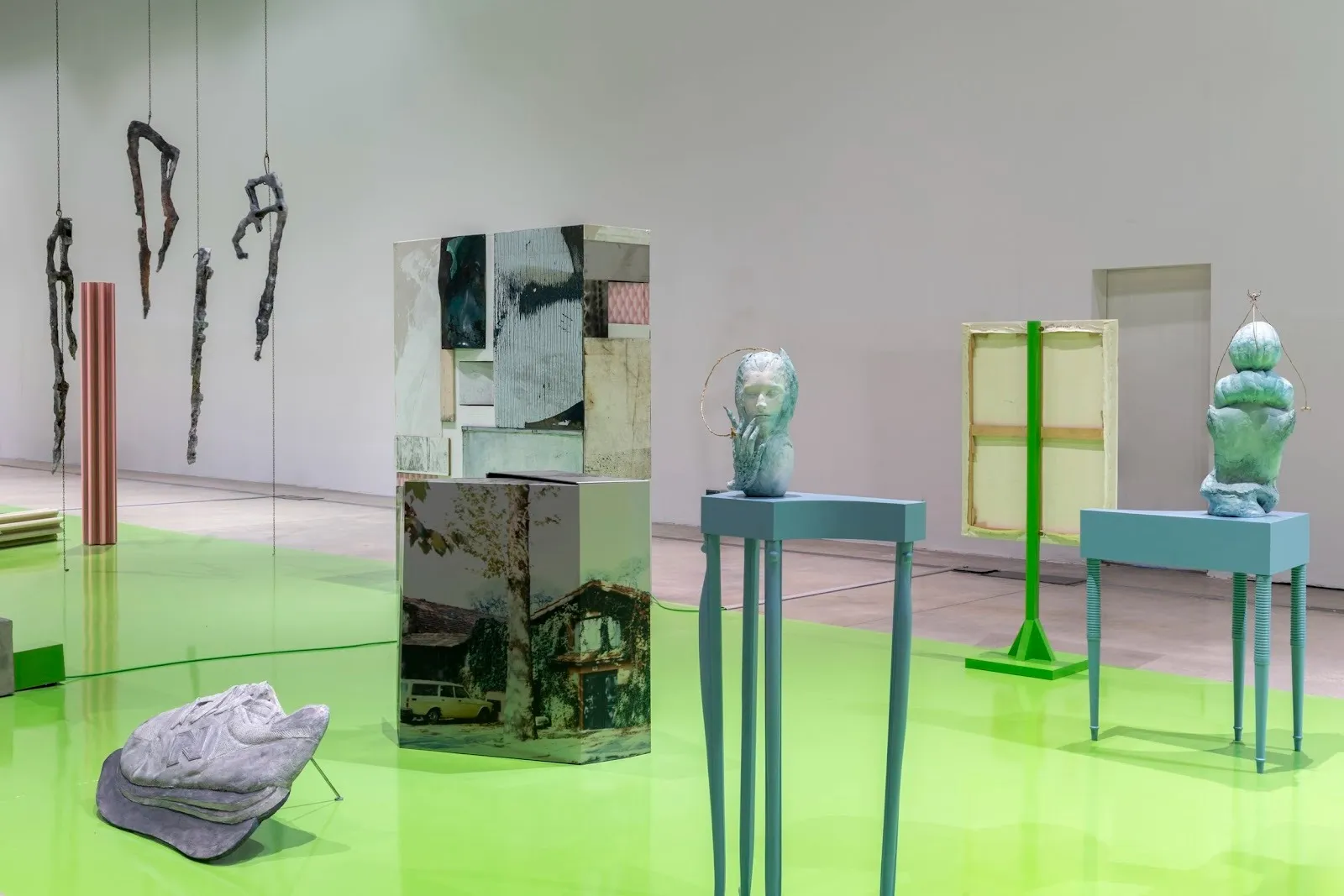
UNAROMA aims to channel overlapping histories of Rome through the cinematic metaphor of the long shot, a wide framing geared to capture a scene in its entirety. The curators simultaneously invoke the green screen as a compositing technology that allows the background of an image to be removed and replaced with another, enabling elements filmed separately to coexist within the same visual frame. At MACRO, this metaphor is translated quite literally into the exhibition design. A continuous sheet of green PVC is mapped across the gallery floor, evoking chroma key not as a backdrop for film production but as the literal ground. Paintings, sculptures, video pieces, and sound installations rest and hang above these swathes of bright green, which promote a sense of connection across heterogeneous pieces. These galleries, with such high ceilings and an open, non-linear layout, would seem conducive to a sort of continuous, almost cinematic progression of artworks.
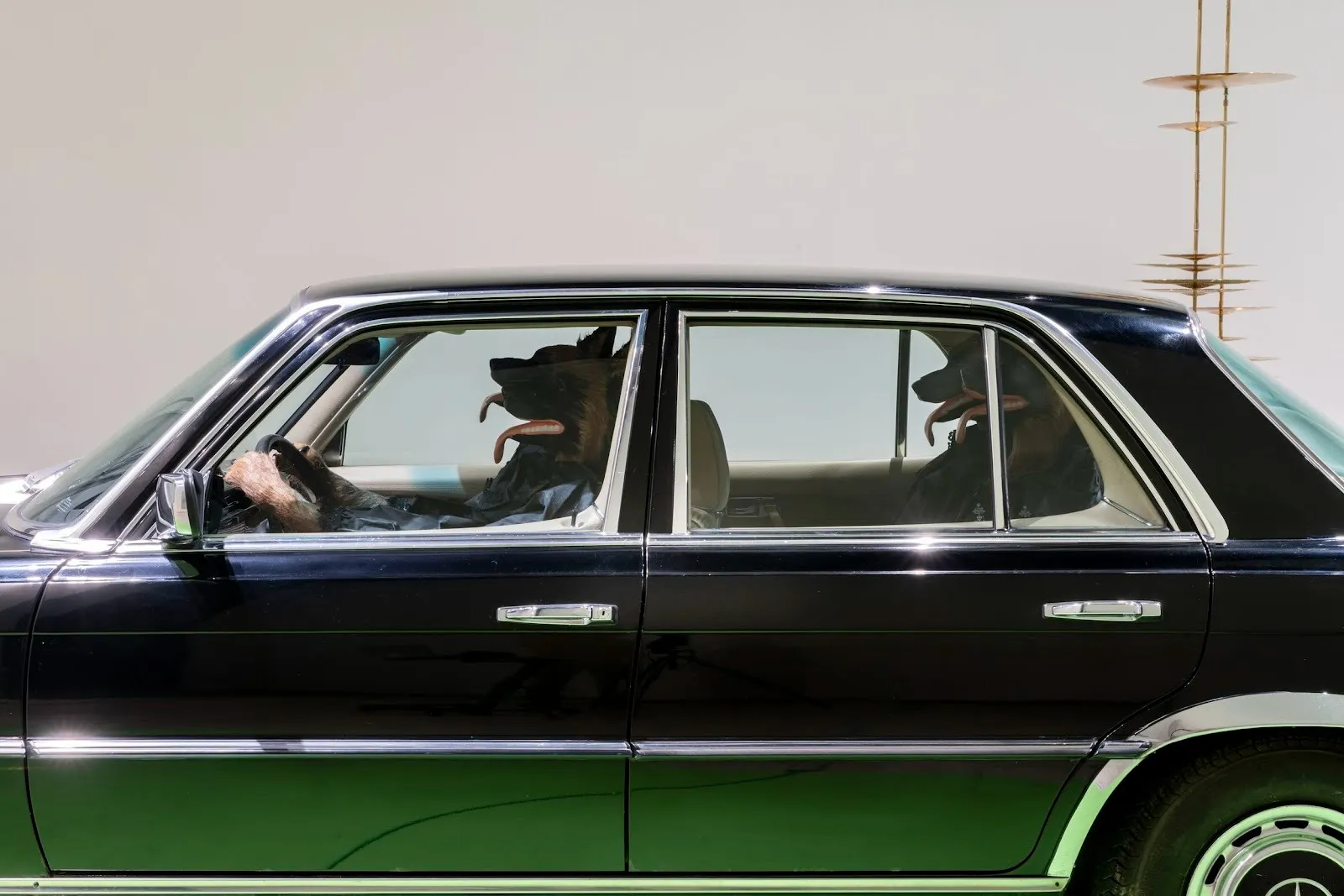
Rome and cinema are inextricably linked: Cinecittà, the nerve center of much of Italy’s film production, is home—whether by birth or adoption—to directors who make films as declarations of love to the city. Fellini, Rossellini, and Sorrentino, among countless others, have sought to capture the essence of Rome’s stratified cultural fabric, where remnants of distant eras endure, forced into silent harmony. Within the oft-dubbed “Eternal City,” time seems suspended, as if a thin, constant patina transforms every experience into something dreamlike, visions repeatedly mediated through filmic frames. Though Rome often appears static—its monumental past seemingly fixed in place—the city is also shaped by quieter, ongoing transformations: shifting social dynamics, contested public spaces, and the often uneasy coexistence of discordant historical layers. This underlying tension, however, finds little room to emerge in this particular exhibition.
Despite the visual continuity created by the uniform green flooring, the curatorial approach underpinning the selection and arrangement of the works remains elusive. The title “UNAROMA” would seem to suggest that all of the artists share some form of connection to Rome, but it remains unclear how their respective relationships with the city inform their inclusion. The first work on display is anomalous in its explicit engagement with the city: Pauline Curnier Jardin and Feel Good Cooperative’s video, Per soldi, per piacere (2025), features a conversation recorded during their past collaboration Triviale at MACRO in 2024. Following along the pathway, however, visitors are left to infer the logic underpinning this presentation in its largely oblique engagement with the particularities of the city and its expansive histories. The exhibition text offers little clarification, instead reiterating the metaphor of the film sequence, which hovers between a structuring device and a convenient catch-all.
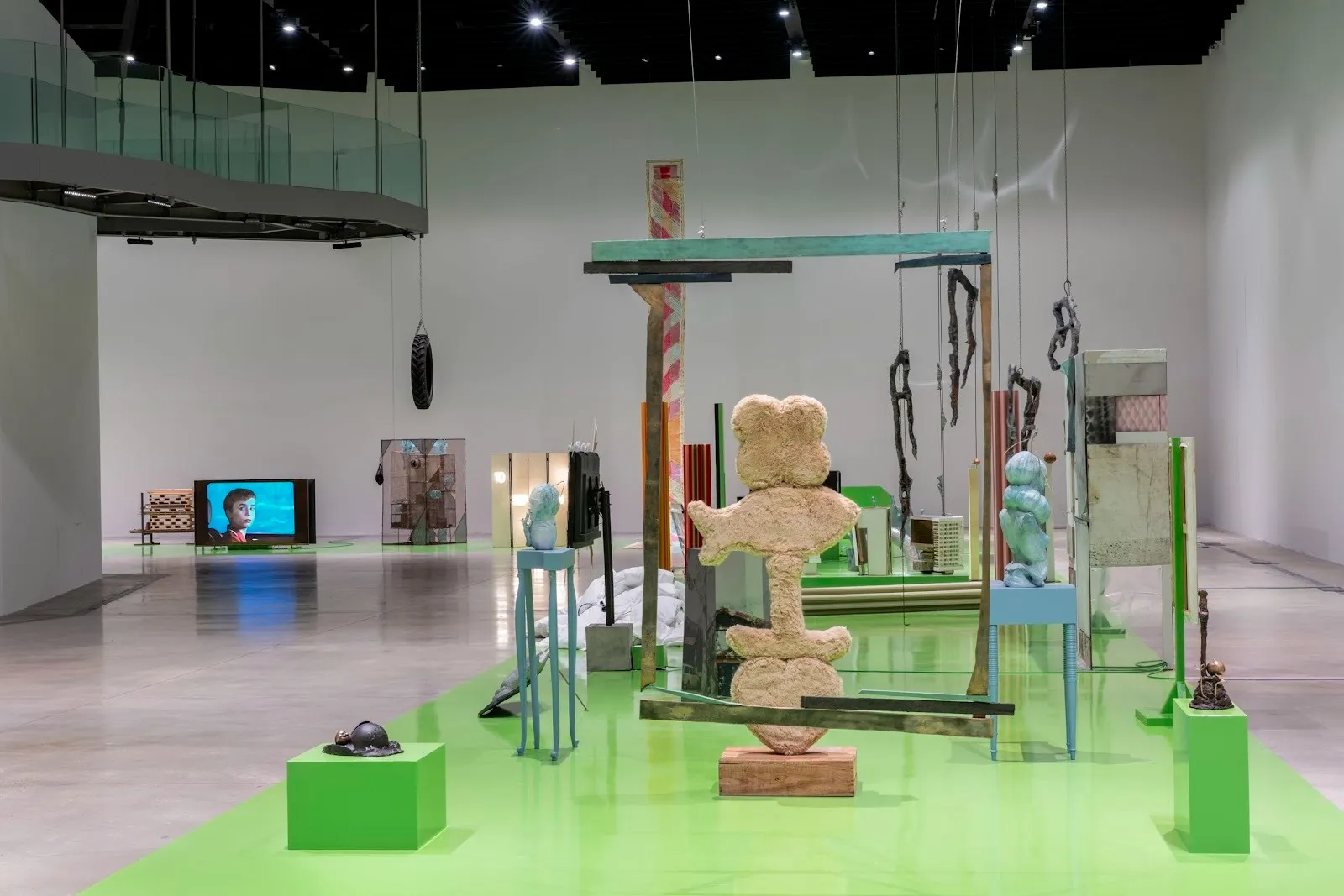
The works, tightly arranged atop the “green screen,” vie for attention. This cacophonous mise-en-scène—with a number on the ground linking each work to an entry in the accompanying brochure—is reminiscent of the crowded displays of art fairs, seeming like more of a provisional display than a cohesive curatorial presentation. Works like Anouk Chambaz’s unnerving looping film, Di Notte (2025), and Tommaso Binga’s layered sound installation, OperaPoesia (2025), stand out due to their intrinsic strength, resonating independently, without necessarily engaging in a broader dialogue. It’s perhaps tempting to link the overwhelming eclecticism of this presentation to the shifting institutional structure of MACRO. UNAROMA marks the first exhibition under Cristiana Perrella, who succeeds Luca Lo Pinto as artistic director. The two have co-signed this exhibition as a symbolic transition between curatorial approaches.
UNAROMA denies a clear narrative or cohesive vision of Rome. Instead, the exhibition presents a fragmented distillation of the evolving urban landscape, while resisting a sense of linear resolution. Perhaps the exhibition finds meaning precisely in this ambiguity, in presenting a city that is inherently disjointed, even internally contradictory in its layered temporalities. In this sense, the exhibition succeeds by conveying a multifaceted vision of Rome as an urban amalgamation resisting stable compartmentalizations. The cinematic history of the city testifies to the legacy of Rome as itself a sort of green screen, a surface onto which successive cultural imaginaries have been projected.