(LA)HORDE Becomes What It Cautions Against in “Age of Content”

(LA)HORDE, Age of Content, 2025–26. Photo: Maria Baranova.
Multidisciplinary collective (LA)HORDE’s Age of Content (2025–26), performed in collaboration with Ballet national de Marseille, drops us directly into the disembodied digital landscape to which we’ve become desensitized by our screens. Their newest work, which gave its North American premiere at the Brooklyn Academy of Music, hits shuffle on the barrage of images fed to us online and brings them into physical reality. The result is an encounter with the uncanny, stripping back humanity to confront what scraps are left over. Age of Content forces us to recognize how the digital world is hurdling towards collapse, but by the end, the performance trips and falls into its own trap.
The opening finds itself in the world of video games, where pixelated women traipse tauntingly over digitized designer cars for players to steal. (LA)HORDE’s car, possibly thanks to a partnership with DIESEL, is more eerie than those in Grand Theft Auto. A dove grey sheet slowly slips off its hood, and when the car slowly crawls forward onto the stage, you see that it's hollowed out, revealing its mechanical bowels through the metal skeleton.
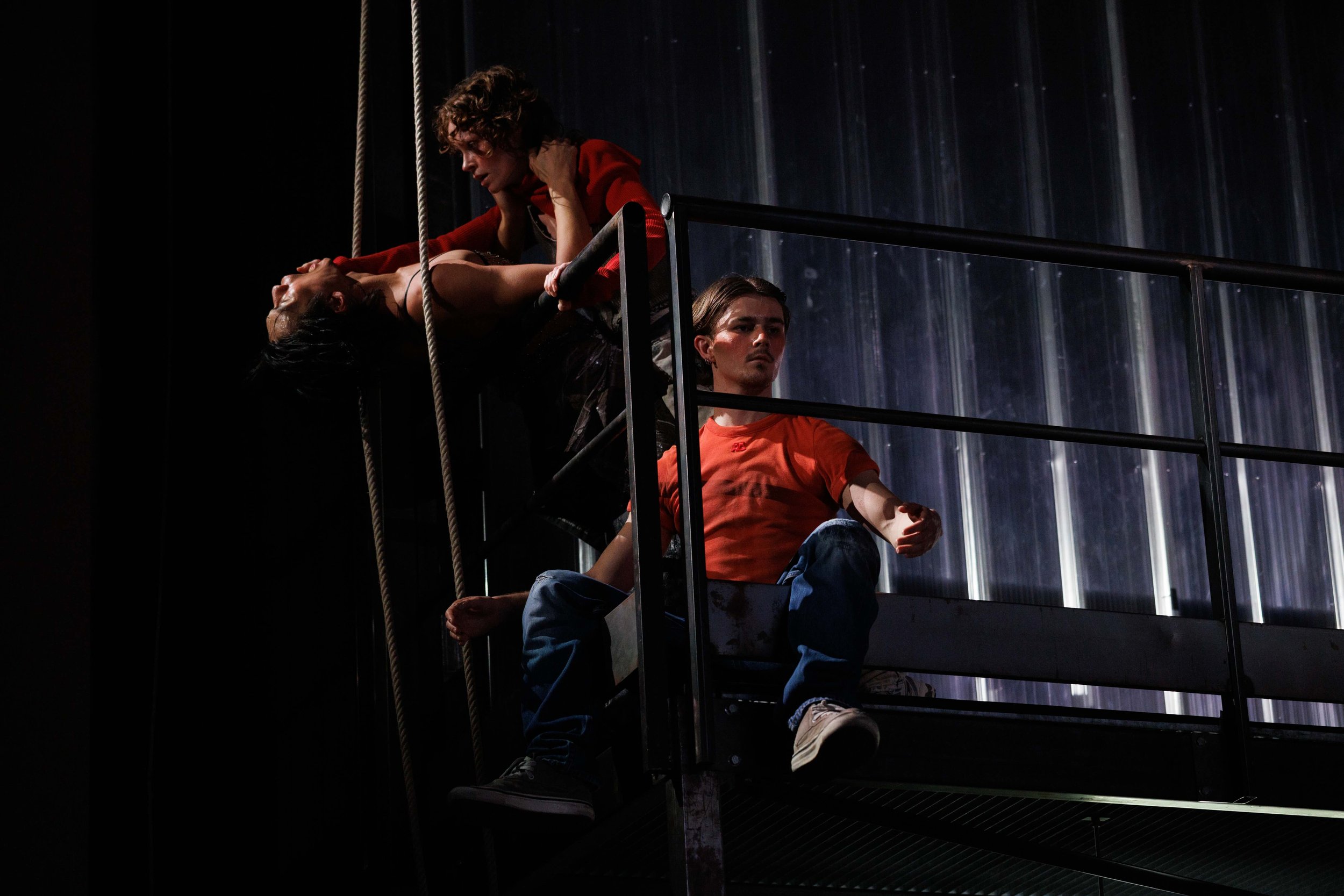
With a thunderclap and a plume of smoke, a dancer bounds onto the acrylic hood of the car, dressed in a sea foam green velour sweat suit, with “juicy” bedazzled across the shoulder blades and bottom. They slide across the car, hips rolling and legs spread, like they’re begging to be watched as synthesized sound buzzes around them. From on top of a platform, someone leers, nearly motionless, clad in a t-shirt and jeans. It feels like the men behind the screen who consume digitized female bodies. As they tip their head back with their legs opened into a split, you notice that the face is a mask of putty-like and barely-defined features.

(LA)HORDE, Age of Content, 2025–26. Photo: Maria Baranova.
Soon, the dancer is joined by another seafoam green tracksuit-clad figure, and another, and another, until the stage is filled with a sea of them, wearing the same putty-like mask and the same long brown plastic-y curls slipping out of their velour hoods. Their movements feel auto-loaded, like they’re non-playable characters in an open format rather than active agents, or even people at all. Individuality is stripped away. They roll their asses and hold up their fists like they’re preparing for a fight, switching between movements as if it's a twitch, compulsive.
We’re thrown into a different digital landscape when someone crashes in from the ceiling, falling to land behind the pile of cardboard boxes. They pop up, blank-faced and wide-eyed, rocking their weight back and forth, back and forth, bouncing like a video game character. More claps of thunder bring more dancers until the stage is filled with the ensemble. They wear jeans, sneakers, mini skirts, glittering body jewelry, and armor: an amalgamation of clothing that doesn’t quite fit together, but has certainly been sold on Temu or Depop.
As the dancers navigate around each other, the whole ensemble becomes a meadow of avatars created in physical reality. They rock, back and forth, conversing and grouping together with their auto loaded actions; arms pulled up like they’re holding a rifle, or held in front of their chest ready to block a punch. Underpinning it all is persistent combativeness, violence, and detachment. Eventually, two dancers land downstage, alone, and their voices ring out through the speakers as a track with a plasticky lack of humanity.
What they say speaks to the dissociation and hopelessness circulating in the minds of many, caught between radical optimism and nihilistic realism. “We’re watching the skies,” the track calls out in a disembodied voice, the dancer mouthing along, “We’re hoping for the best and expecting the worst.”
(LA)HORDE, Age of Content, 2025–26. Photo: Maria Baranova.
When one of the “speaking” avatars collapses, another dancer catches him by the jaw, fingers crooked inside the corners of his mouth. With helpless surrender, he’s dragged around like a horse being pulled by its bridle, tugged into sinewy body rolls, and thrown to the ground. Soon, they are all dragged around by the jaw, digital beings left to the whim of the machine. At one point, someone dangles over the fence of the platform, held back only by the fingers hooking them by the mouth. They pile on top of each other into a train, each hooking on to the person in front of them, dragging each other in serpentine waves.
The waves eventually grow into rugged thrusts. Unhooked, the dancers form pairs, rhythmically rolling against each other. It's compulsive and unfeeling, with a grotesque lack of intimacy and rampant sexuality. The dancers throw each other over their shoulders, feet locked behind their partners’ heads, before dropping to the ground with forceful twerks and hip rolls. It’s evocative of the way sex is represented online, and the potential for the human element to be stripped away in exchange for views or currency. (LA)HORDE forces us to reckon with the consequences–compulsive, constant consumption of commodified and pixelated bodies.
In its final act, Age of Content ultimately undermines itself and falls into the very pitfalls it warned against. Backed by a Philip Glass score, the dancers cycle at the back of the stage in a line, breaking out of their walk incrementally with plasticky smiles shining towards the audience. They bounce from twerking and ass-shaking to Broadway showgirl movements with cheesy grins, as if begging to be watched, be consumed, by the content machine.

(LA)HORDE, Age of Content, 2025–26. Photo: Maria Baranova.
The sinister, uncanny inhumanity is not the only source of discomfort in this section of the work. (LA)HORDE creates a slapstick out of crumping and twerking—movements that stem from Black American social dance, which exist outside of the digital landscape and were practiced in Black communities long before social media content was widely circulated. Age of Content effectively dismembers and disembodies movement practices that have deep ties to Black communities and African diasporic forms of dance, appropriating them by taking the movement out of its human context.
Age of Content plays right into its own trap by completely ignoring the human element of its subjects. Instead, the creators blindly take movements seen on social media and consume them without regard for their roots within communities of color. Following the release of Ogemdi Ude’s Major, which sparked conversations among dancers and choreographers online due to problematic comments from critics, it is more critical than ever to recognize when artists on either side of the stage fall into harmful stereotypes and assumptions about movements they don’t fully understand.
(LA)HORDE and Ballet national de Marseille: Age of Content ran at the Brooklyn Academy of Music from February 20 through 22, 2026.