Reclaiming the Spell: Witchcraft at the Crypt Gallery
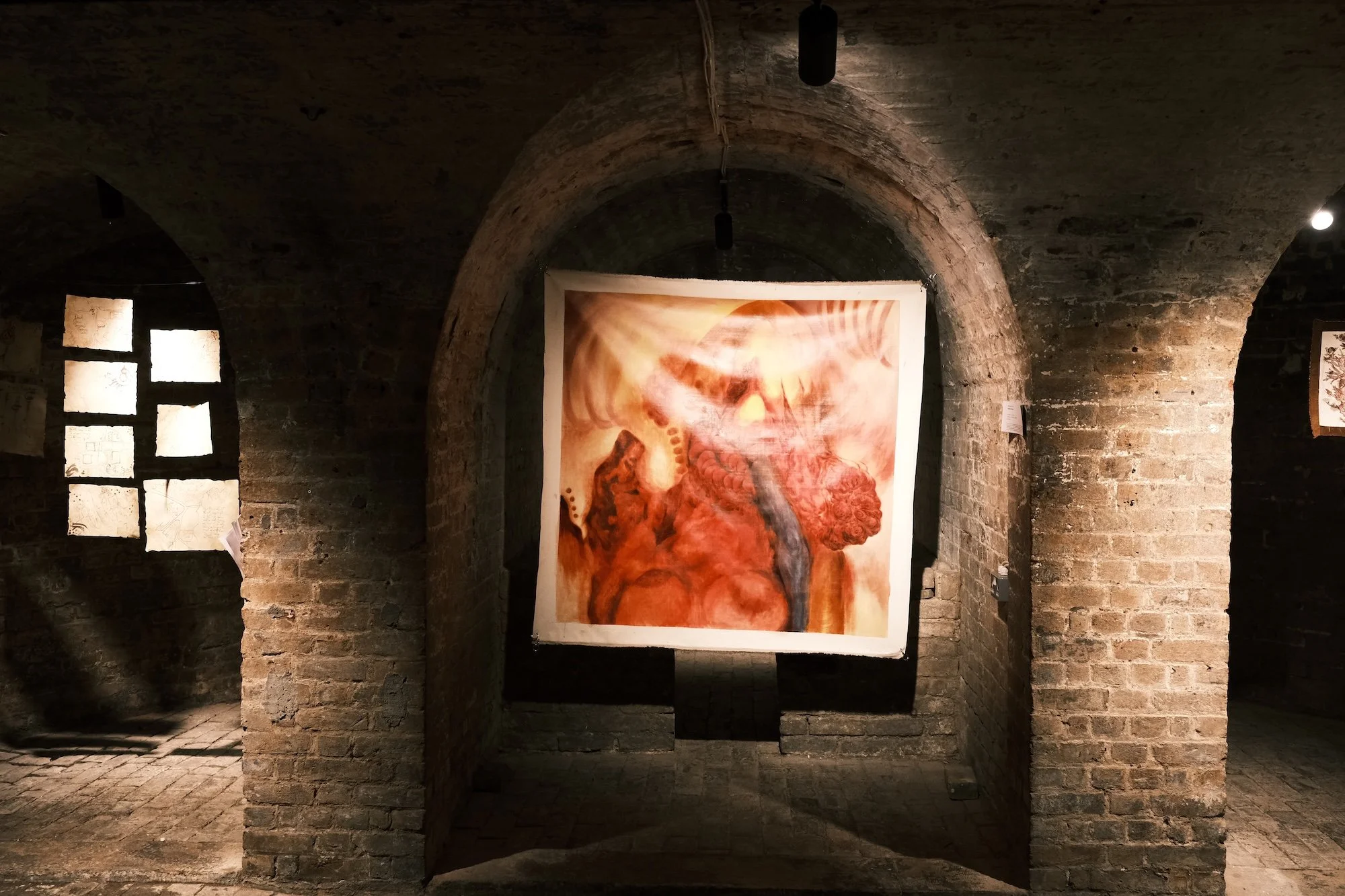
Installation view, They Call Me Witch, Crypt Gallery, London, 2025. Photo by Yiming Zhang and Wenqi Zhang.
Risograph prints of vegetally tattooed goddesses arrest the viewer upon entering the Crypt Gallery in Camden, London. They are botanical beings beckoning close contemplation, their maternal bodies inscribed with distinctive ecological ciphers of the Eastern Mediterranean. These fictional figures, created by artist Ayshe-Mira Yashin, reflect Cypriot belief that tying strands of hair on trees can invoke wish-granting by spirits that dwell upon the plants. The artist renders this ancient ritual in album-leaf format, yet underneath the formality lurks a wry satire of contemporary cultural production: Yashin has spent months drawing ancestors now locked away behind glass in the British Museum, unraveling figures stolen, looted, and kept by an institution that still proudly wears its badge from the colonial past without apology.
Occupying the underground crypt of a working Parish church, the gallery’s unique architectural layout sets the tone for an exhibition that aims to defy long-standing stigmatization of witches—women whose practices and philosophical bent appear threatening to mainstreams. The curator, Wenqi Zhang, chose this location to transform a contested site of scrutiny and alienation, reclaiming it as a locus of feminine authority and creativity. Combining artworks across mediums, performances, and workshops by 11 female and non-binary artists from the UK and abroad, the exhibition feels like a collective construction of a matriarchal togetherness.
Titled They Call Me Witch, the exhibition is a part of programs initiated by Which Witch Collective (W.W.), a London-based curatorial group. Originally started as a film festival in Glasgow, Which Witch has now expanded to exhibitions in spaces that defy conventional “white box” ways of display but cut under the skin of long perpetuated social norms and stereotypes. Historically, witches have been condemned, punished, and feared for practices that reject rational evidence-based explanations—for their refusal of “control.” Yet rarely this fear is directed against those who violently persecuted the witches. This exhibition inverts that gaze, positing that the witch is not a figure to be feared but one who fears nothing, who reclaims the very practices that once warranted her burning.
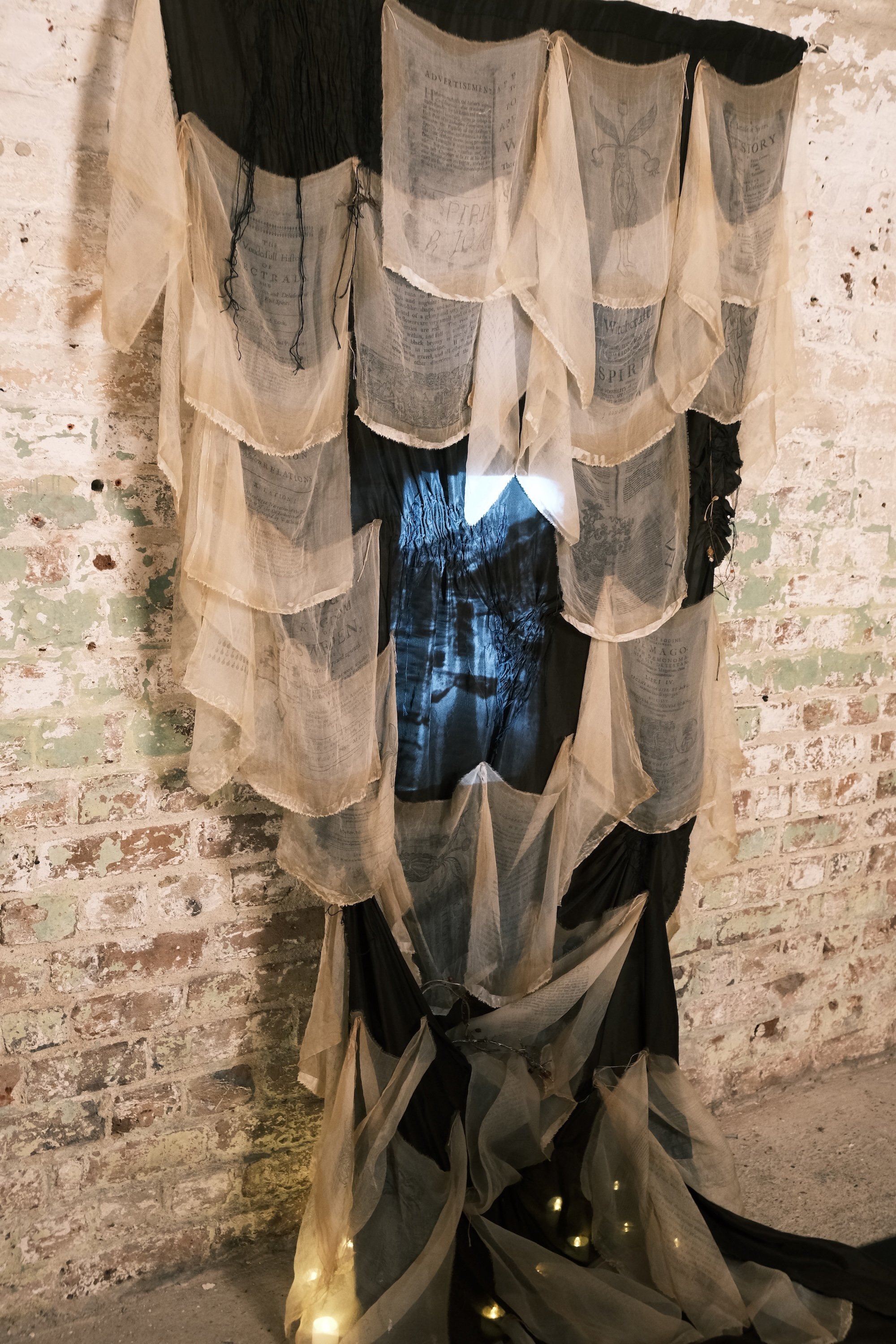
Dr. WhiteFeather Hunter, Palimpsest (2022). Silk, embroidery floss, devil’s cherries, mandrake root, beeswax, waxed linen, projected video, dimensions variable. Photo by Yiming Zhang and Wenqi Zhang.
Dr. WhiteFeather Hunter’s video textile work Palimpsest complicates the identity dualism imposed upon witches. Conceived during her 2022 residency at the Museum of Witchcraft and Magic in Cornwall, the work draws archival materials of 17th-century witchcraft accusations and convictions from the museum’s collection, projecting them onto translucent silk that renders spectral tremor. Dr. WhiteFeather Hunter bolsters these texts with hand-stitched smockings and herbal treatment, framing it as a voyeuristic screen upon which her performance video is projected. The work aptly juxtaposes a fundamental paradox embodied by female magic users: witches, though deemed as hereditary threats, were still expected to embody conventional femininity. She was simultaneously the “diabolical witch” who strayed from docility yet was still one bound to domestic duty. In the video, the artist repeats rinsing movements with pieces of fabric. One may be reminded of the physical and spiritual purging witches endured, or what Simone de Beauvoir called the “enchantment in these alchemies” of domestic labor, where the transmutation of substances becomes a source of knowledge and power. The water both washes and develops palimpsests; history, like fabric, holds its stains.
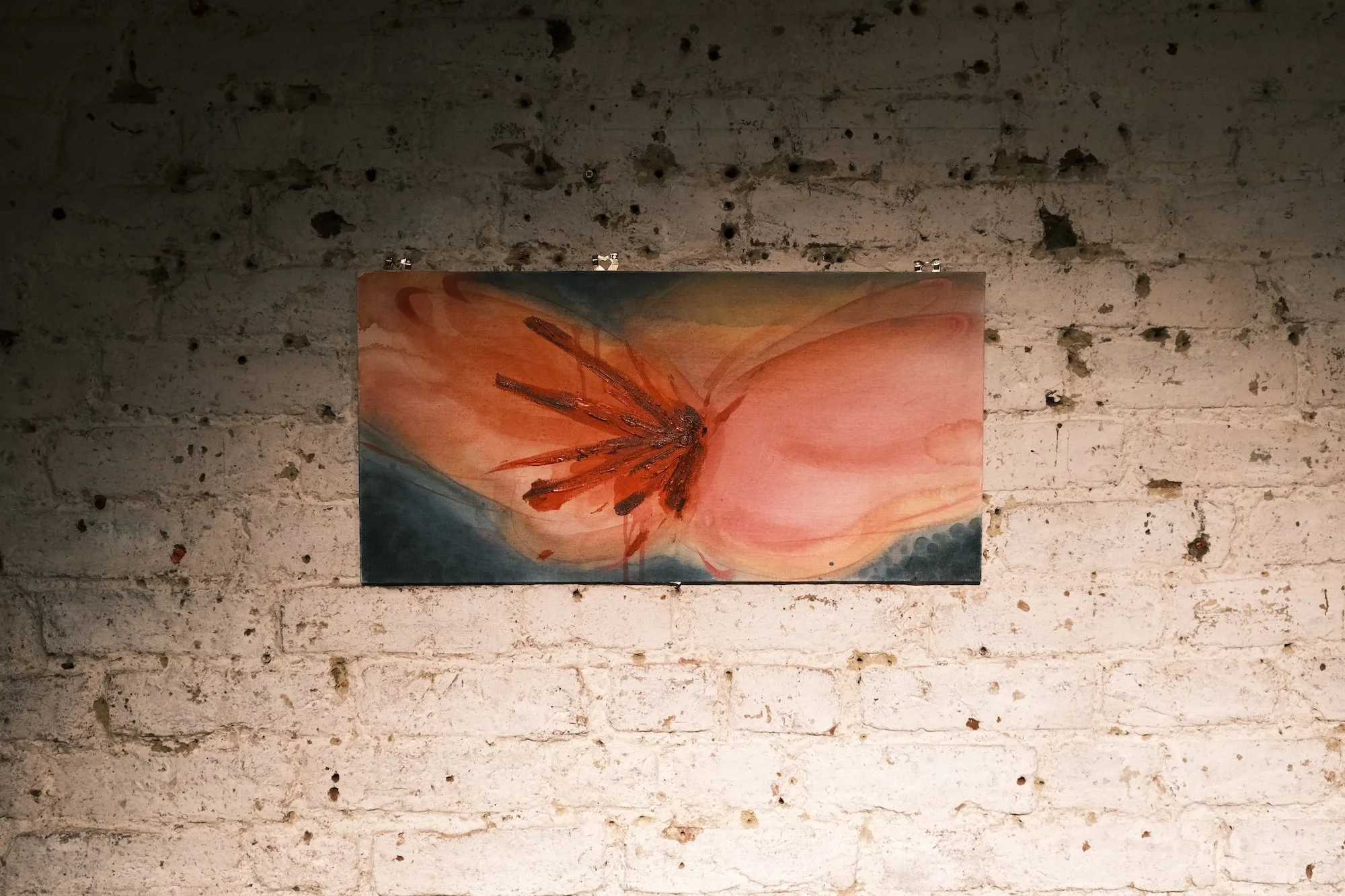
Wenjun Xie, Menstruation, Woman’s Volcano (2023). Acrylic on canvas, 30 x 42 cm. Photo by Yiming Zhang and Wenqi Zhang.
As the viewing continues, the curator’s direction anchors the exhibition in undeniable corporeality. Wenjun Xie’s small-sized painting Menstruation, Woman’s Volcano demands unflinching looking, as it directly references Gustave Courbet’s notorious painting L'Origine du monde yet appears all the more poignant and confrontational. Legs of a woman splay open against a stretch of navy blue background that dissolves traces of realism, her menstrual blood erupting from the vulva in violent, spike-like formations. Where Courbet wielded realistic female nudity as shock value—a provocation aimed at the male gaze of 19th-century salons and academia—Xie exposes a deeper fragility of the male artist, or even of any man: the persisting hypocrisy to appreciate femininity only in its sanitized, pristine status, and the inability to countenance the female body in its actual reality. The exhibition shows the material truth of embodied femininity: the visceral, the residual, the raw, and the messy.
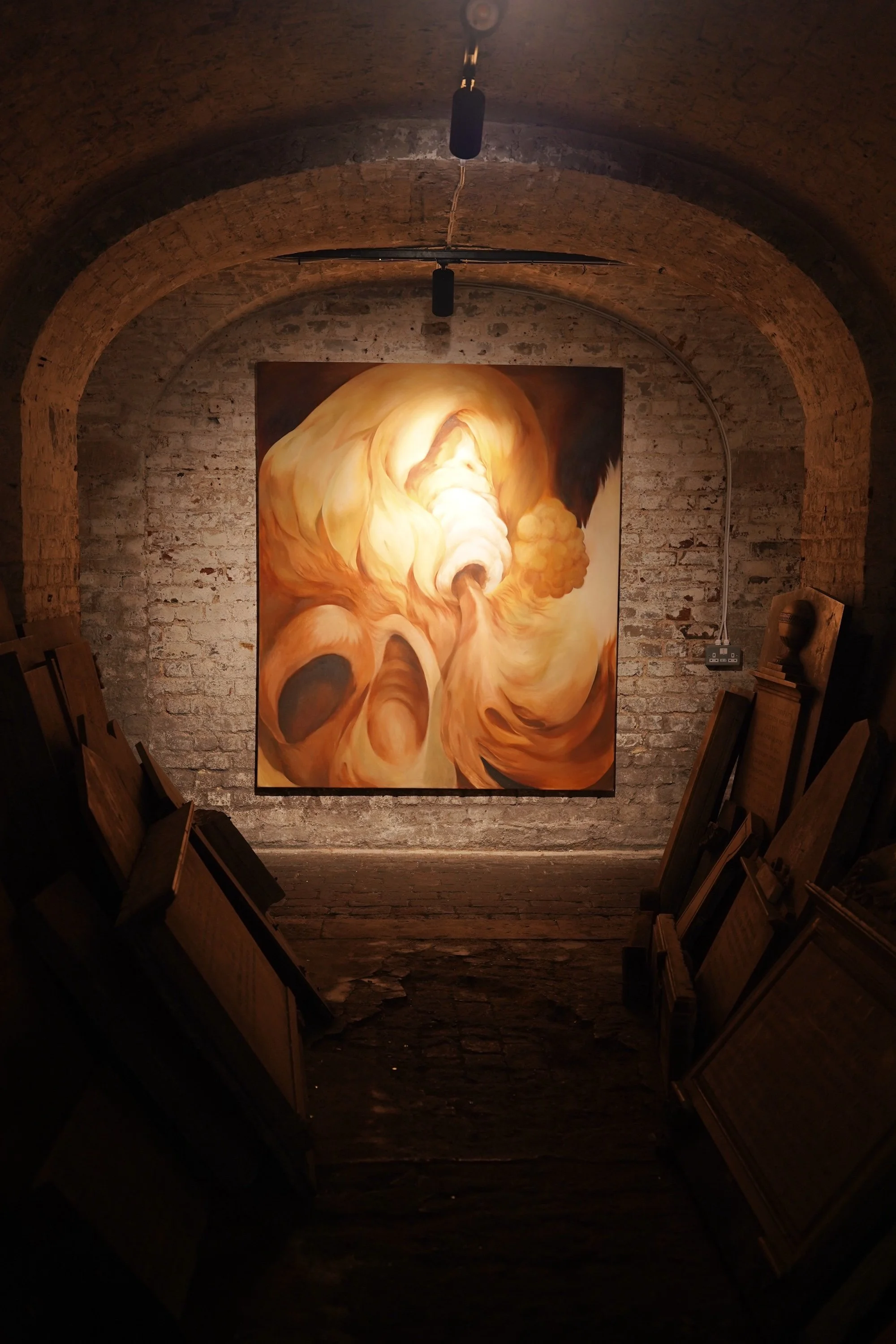
Xinqiao Fu, Bit my Tongue (2025). Oil on canvas, 180 x 154 cm. Photo by Yiming Zhang and Wenqi Zhang.
Similarly across the aisle, the curator places canvases by Xinqiao Fu on which the artist captures body organs in their deformation and laceration, echoing the transformation of female bodies under the weight of biological processes and self-gazing. Body tissues become clouds, and wounds become cyclones, deconstructing the boundary between inner and outer selves, where the latter often defines the former. The witch’s body—the body deemed monstrous, uncontrollable, requiring punishment—is simply the female body beheld without euphemism.
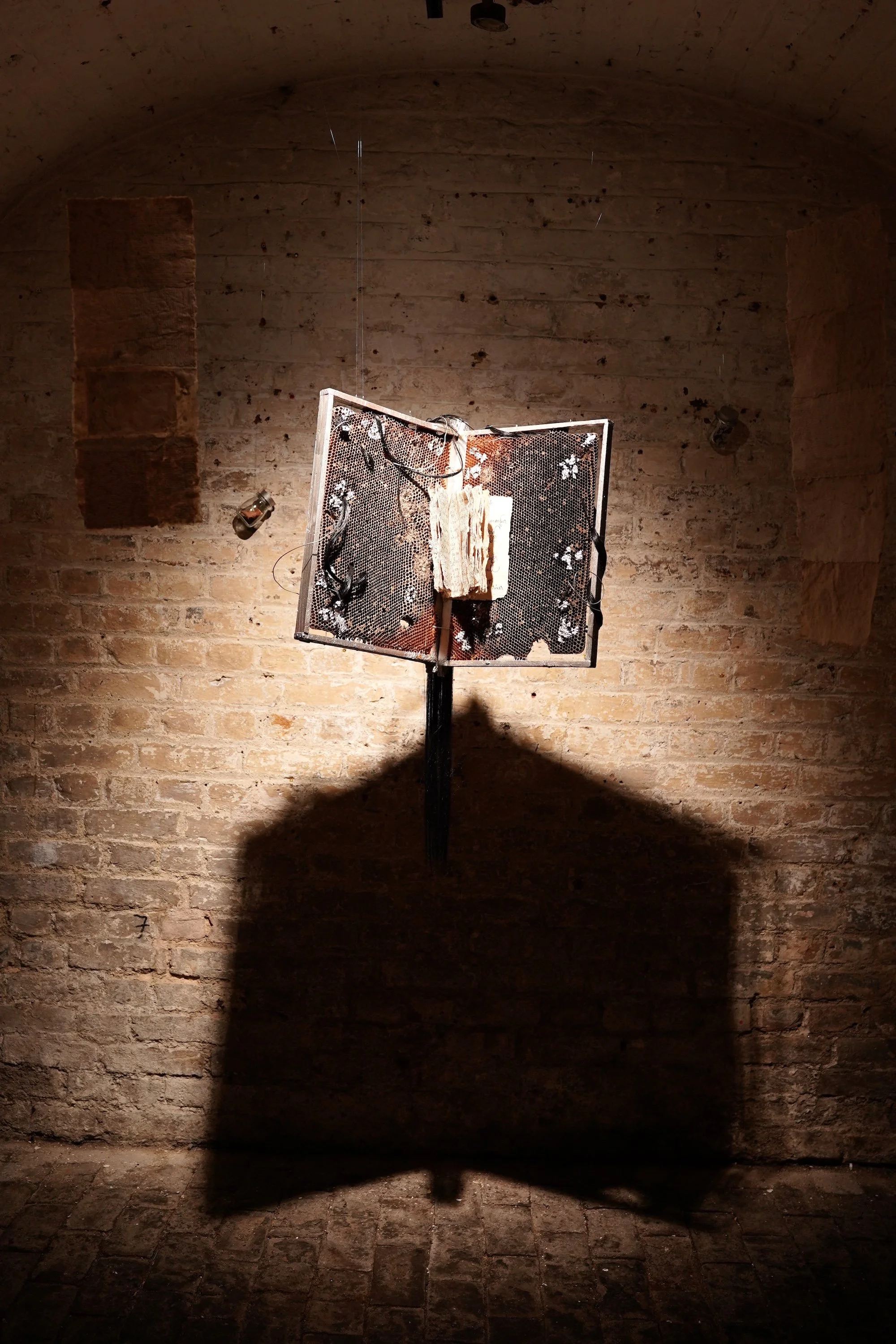
Byuka aka Fortune Tailed Beast, Miraculous Alchemies (Turn my lead to silver) (2025). Old honey combs, silver leaf, hair, handmade paper, metal wire, dimensions variable. Photo by Yiming Zhang and Wenqi Zhang.
Byuka Makodru aka Fortune Tailed Beast’s Miraculous Alchemies (Turn my lead to silver) (2025) manifests another kind of fluidity: transness. Inspired by their grimoire, the work links writing, which Donna Haraway identifies as a practice of resistance for all colonized groups, to archaic alchemical operation. Yet here, alchemy extends beyond material transmutation to invoke cross-special imagination. As hummings reverberate through the crypt, consciousness drifts across bodily vessels, destabilizing the hierarchies that separate culture from nature, human from nonhuman, man from woman.
Exhibitions themed upon witchcraft often leave visitors in the lurch of overt romanticization and mystification of the past. They Call Me Witch, however, refuses nostalgia for an imagined feminine arcadia. By interlacing interactive installations, video projections, paintings, and sculptures across chambers in the crypt, the curator Wenqi Zhang has gone to great lengths to obviate appraisals of strict chronology, but help the artists to seize the apparatus of meaning-making itself. To overlook this curatorial architecture would be to miss the exhibition’s most radical proposition: that the reclamation of feminine agency begins not with what is shown but with how showing itself is reconceived. It is precisely this curatorial methodology that warrants closer critical attention.
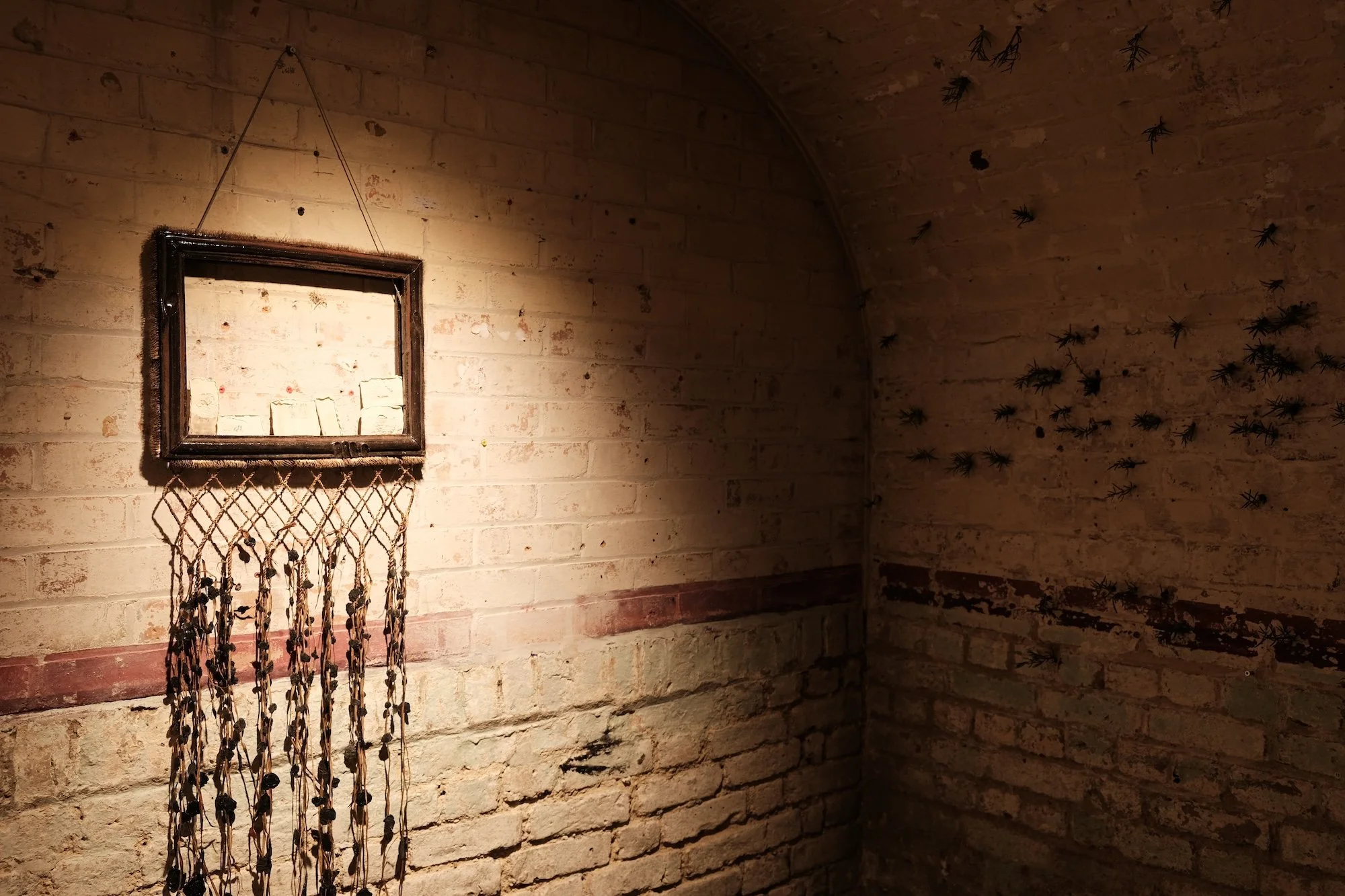
Ashleigh Fisk, Ephemera (2025). Ceramic, plant materials, others, dimensions variable. Photo by Yiming Zhang and Wenqi Zhang.
This coven that the exhibition conjures casts a collective spell across mediums, disciplines, and bodies. What remains is a reclamation of agency, through stories that were censored, texts erased, and identities stifled. But the meticulously arranged artworks transition from historical rumination to contemporary counter-testimony, where feminine knowledge systems speak on their own terms. Through Zhang’s curation, the figure of the witch becomes less a subject of historical inquiry than a methodological proposition: what happens if female and non-binary art refuses its assigned position as object of contemplation, or as passive surface awaiting interpretation? The works do not wait to be looked at; they look back. They bleed, they transmute, they hum with frequencies older than the church above them.
They Call Me Witch was on view at The Crypt Gallery, London, from November 13th to 19th, 2025.