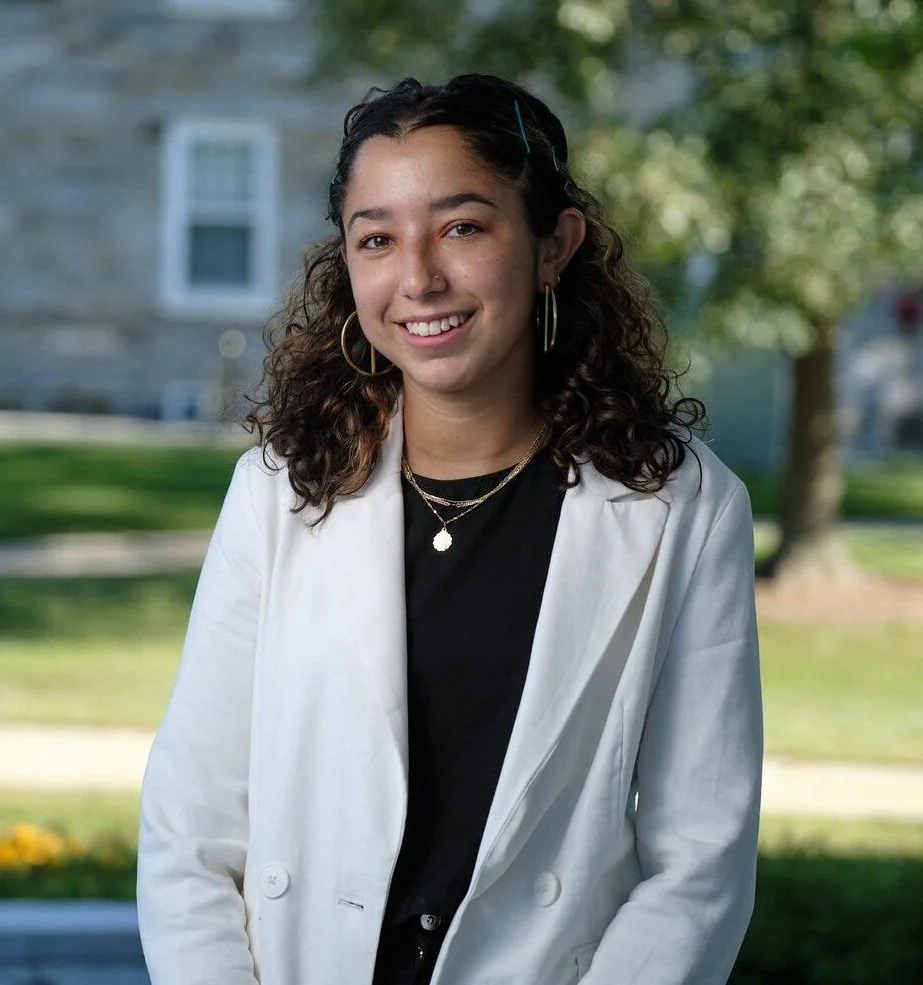
AAF Collector Spotlight: Piper Rasmussen
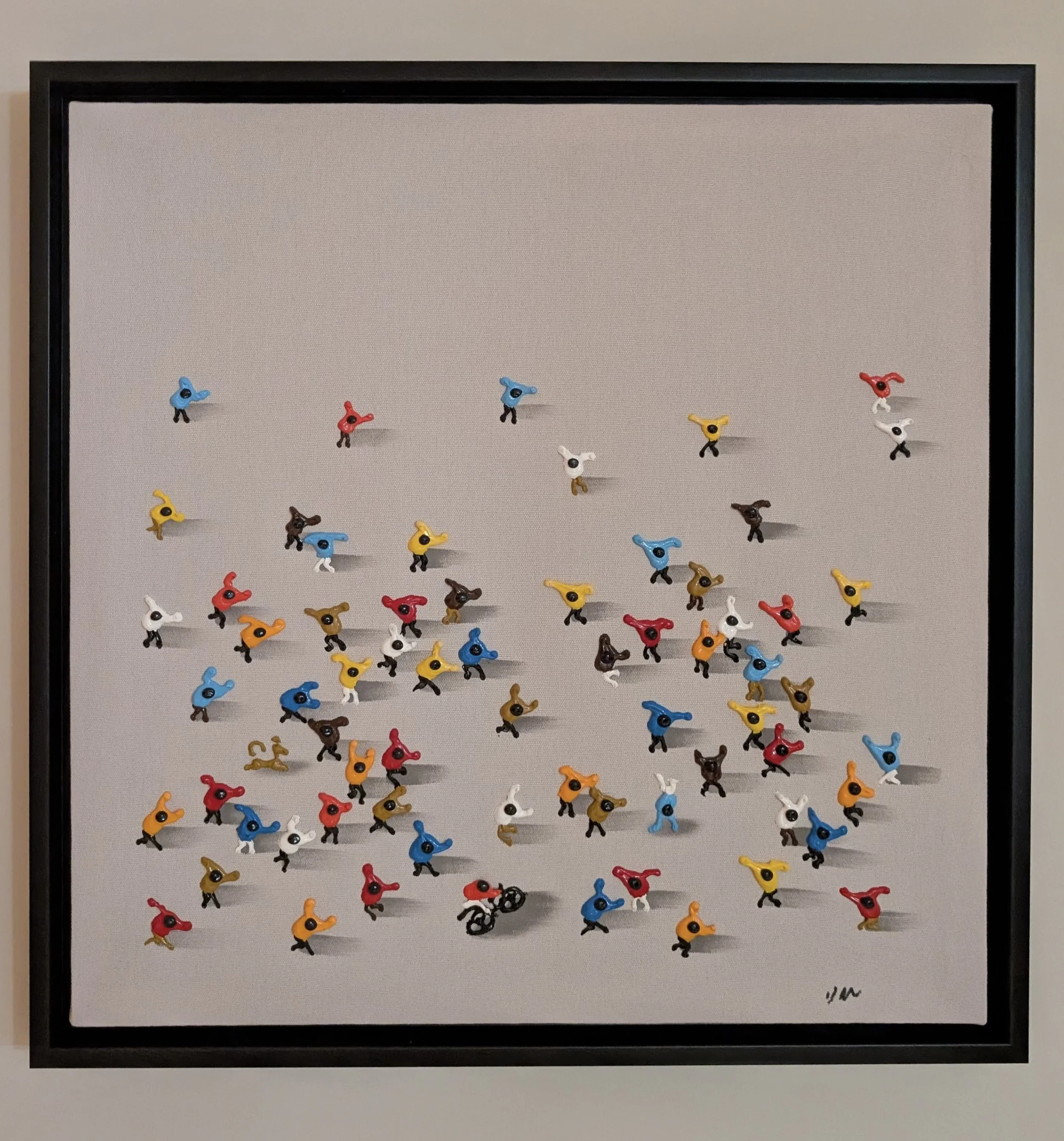
Courtesy of JJ Marino and Able Fine Art
In September 2025, the Affordable Art Fair (AAF) returned to New York at the Starrett-Lehigh Building in Chelsea. The fair, which began in London in 1999, has since expanded to sixteen cities globally. This year’s fair brought together more than 400 established and emerging artists from over 75 galleries. The prices for artworks started at $100 and were capped at $12,000. As the cost of living skyrockets in the city, art collection often feels out of reach for a younger generation of art enthusiasts. Still, AAF creates a viable option for even those art admirers to start their collections.
In partnership with AAF, IMPULSE Magazine interviewed several collectors from the fair’s latest iteration. As might be expected, collectors ranged from professional full-time gallerists to artists, hobbyists, and everyone in between. In this first installment of AAF collector conversations, IMPULSE spoke to Piper Rasmussen, who is the daughter of two artists and grew up surrounded by the artwork of her parents and their students. Despite having purchased artworks, Rasmussen eschews the term “collector” and speaks about having “imposter syndrome about the art world.” Having spent most of her career in the nonprofit world, she is currently on what she refers to as a “career break” while she pursues both an MFA in creative writing and a Master’s in library science. Throughout this conversation, Rasmussen reflects on defining her artistic tastes, finding a middle ground with her partner’s taste, and her method for scouring pieces at the fair.
Alexandra Jhamb Burns: How did you learn about the Affordable Art Fair?
Piper Rasmussen: We live in an apartment on the Upper East Side that has a lot of bare walls. As we’ve been building and nesting, I’ve been looking for art. My parents are both artists. Actually, that’s my mom’s (pointing to the wall behind her). They both taught at the Columbus College of Art & Design, and I would get dragged to a lot of openings when I was little. I started with their work, and some of their students left work behind when they graduated. I would just be like, “Is anybody coming back for this?” And they’d be like, “No, it's been four years.” I'd be like, this is mine now. My collection started from discarded art, basically. It’s such a rare opportunity.
But we had a lot of empty space on the walls. I kept ordering prints, which are great. I respect printmaking as a discipline a lot. But it ends up being the only thing you can reliably get on the internet that you can predict how it’s going to look. What you see is what you get. I really wanted actual paintings because the paint texture is something that you can't read through a screen that well. And we didn't have the money to just show up to galleries and be like, allow me to inspect this seven-thousand-dollar artwork as if I'm going to buy it, because I’m not. I was looking at Saatchi and a lot of these Etsy-like places online. They were either too high-market or made for shipping in a way that I wasn’t particularly interested in, because I had already gotten all the prints that I wanted. That’s how I found the Affordable Art Fair, just tooling around online.
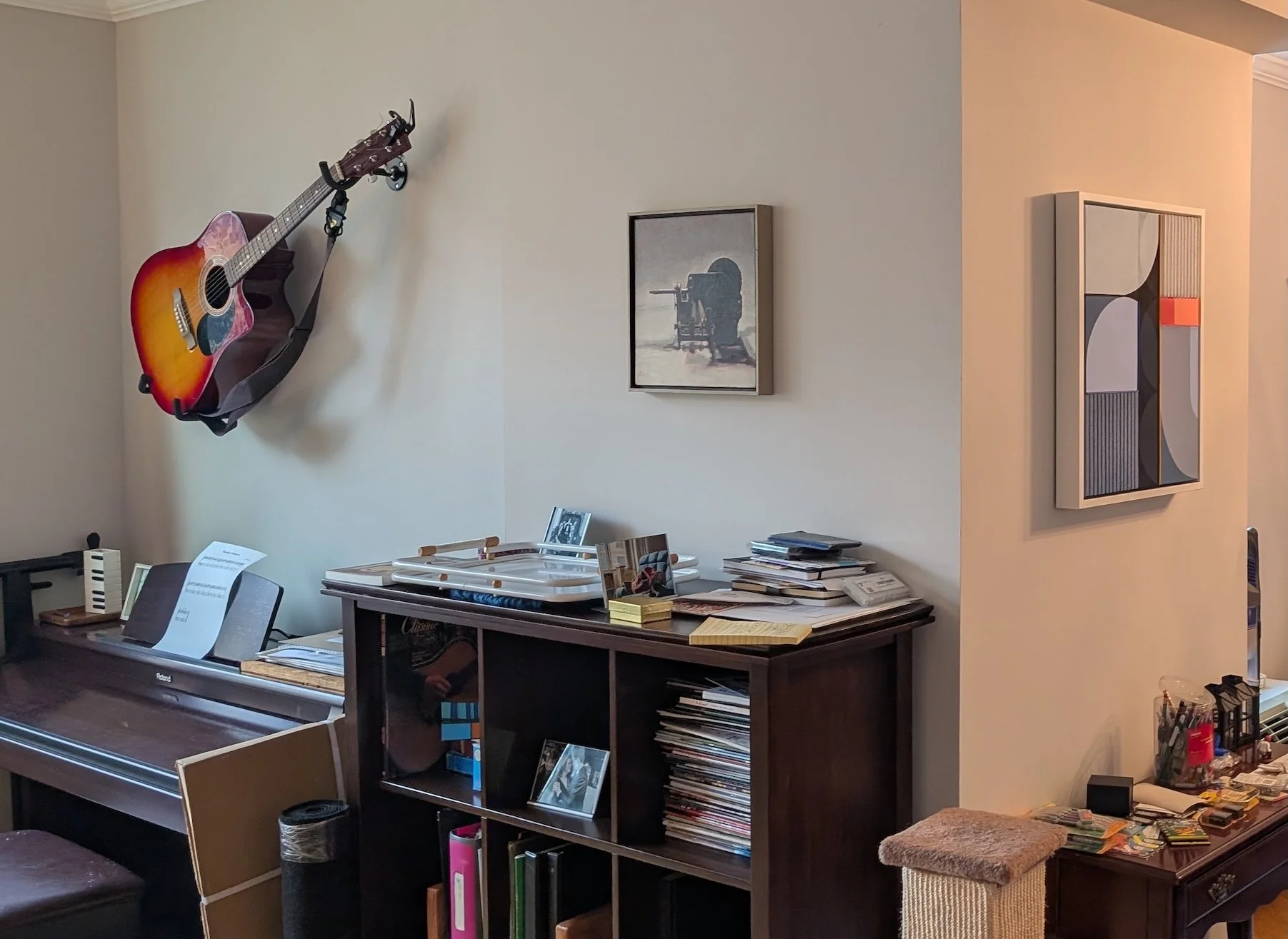
Courtesy of Piper Rasmussen
AJB: Did you preview any of the work or the artists before attending?
PR: Yes, I went online and went deep. I looked at the artists, took a map of the space when it’s available, put little circles around the places that I want to go based on what’s available. And then the stuff that I took home was absolutely not what I circled online.
First of all, it was crazy. I actually only attended on the preview night. I warned my husband for weeks, like “tell everyone you’re offline, we’re going.” We showed up at 6 pm; I had my little map in my hand, and it was so crowded, just wall-to-wall people. My plan flew out the window. There was no way I was going to see the things that I wanted to see. It was really fun but also really overwhelming. I felt like I was in the pit at a concert with all of these people around me. There was definitely artwork we missed out on because it was so packed. And I’m from Ohio. Maybe my expectations for how much elbow room I get, even after 10 years in New York, is a little bit higher than other people’s. And everyone is so much cooler than me, like the art world turned out. I love art, but I’m a fairly beige human. There was a party after the event, and I was like absolutely not, not my scene.
AJB: How do you and your husband’s tastes compare, and how did that come into play when looking for art for your apartment?
PR: My husband and I actually have pretty different tastes. I love a good realist still life or a figurative drawing. I love people, places, and things. My husband is more of a landscape guy. He likes what I would call geometric designs. So we had to go around the space and identify things that we liked. And we’d look at something and discuss the options. Having dozens and dozens of galleries and that kind of diversity around us really helped us make decisions quickly.
AJB: Tell me about the purchasing experience at the AAF.
PR: We bought two pieces that night, both below a thousand dollars. I was really pleasantly surprised. They have a “treasurer's wall” where you can find work under a thousand dollars, but pretty much every gallery had something available that was in our price range. We had bought two tickets; I couldn't make it over the weekend so my husband took his friend. They both bought something. My husband brought home a nice oil painting of a cat. We ended up getting three pieces total that weekend.
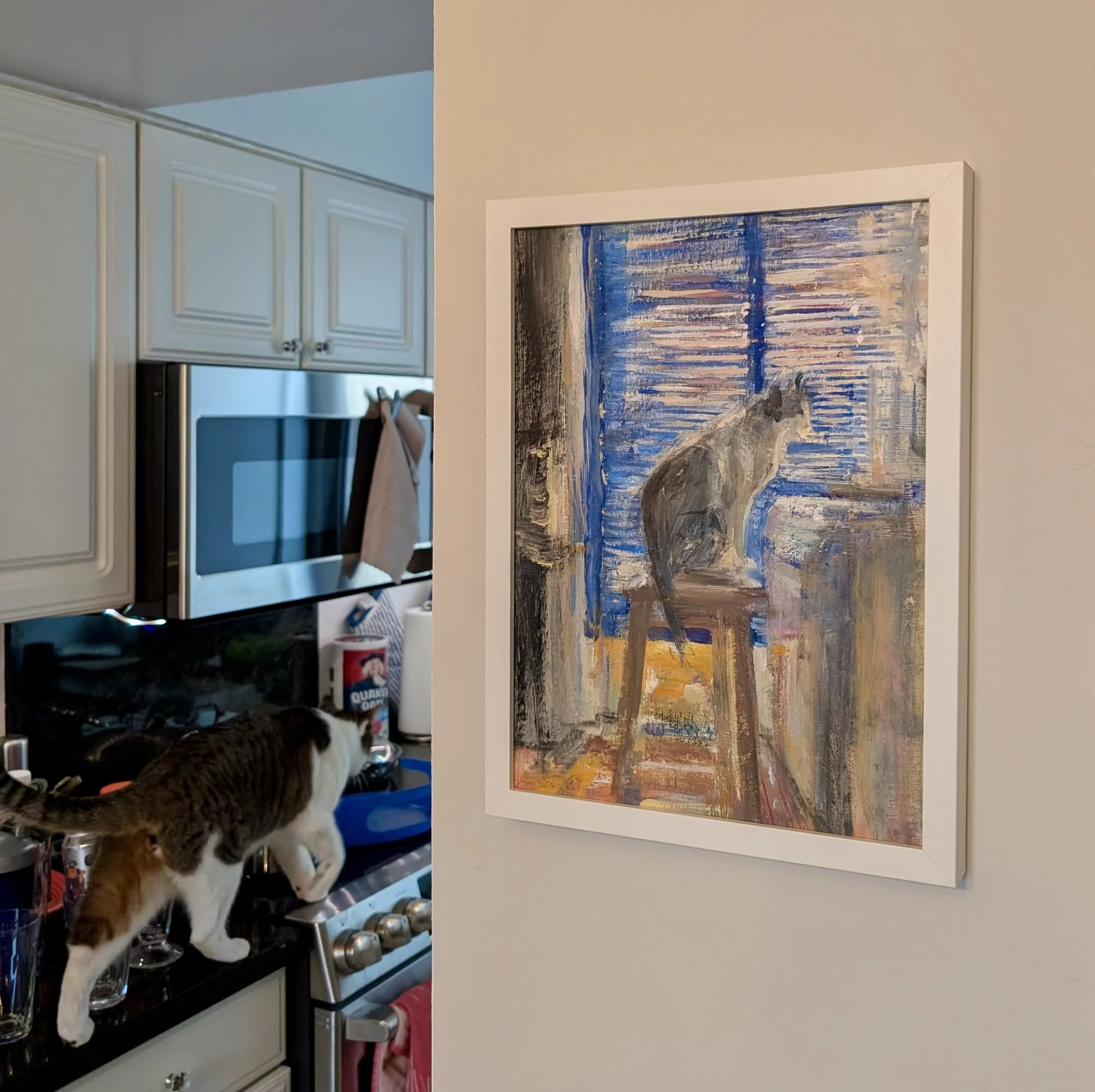
Courtesy of Piper Rasmussen
AJB: Are these works hanging in your home yet?
PR: Oh yeah. Immediately! It was a “come home, rip off the wrapping, put the nail in the wall” kind of deal.
AJB: Do you identify as a collector?
PR: No, because I think when our apartment is full, I will be done. There are definitely people in my life who have storage for their artwork, which they view as investment. My experience of art is not at all about financial investment. I never plan to sell what I buy. Maybe I’d give it away. I think also being a collector implies that you’re looking at value. Finding something that both my husband and I like is not the same as evaluating what I’m getting a good deal on. If you read advice to collectors online or articles that offer tips on “buying your first four paintings,” they’ll suggest you find somebody who is early in their career whose work is undervalued. Or they suggest you find somebody who has a strong artistic voice and a wide career ahead of them where their work will end up having resale value. And I just don't care, not even a little. If I like a work, then that’s enough.
AJB: Would you say your parents are collectors? And what kind of art do they make?
PR: They collect their own work. As professors, sometimes their students gifted them one or two pieces, but I would say there are less than five in their house. They live in rural Ohio, and it’s not a house that people visit, so their home is not a “collector space” in that sense. Purely for storage, my mom's paintings are all over the walls. She likes to make big oil paintings—like six feet by eight feet.
Before he retired, my dad worked as a sculptor and photographer. He was in the Air Force. And then on the GI Bill, he went to get an MFA in sculpture from Carnegie Mellon. He has these huge sculptures, and one is hanging in the American Motorcycle Museum. They look like flying machines—that’s him bringing forward his love of planes and having the aeronautical engineering degree. But they’re huge and not for apartment living. I would never be able to have one in my house. So I just have a lot of my mom's paintings.
This interview has been edited for length and clarity.