America’s Cuba in Coco Fusco’s “Tomorrow, I Will Become an Island”
For months now, there has been consistent news coverage of boat strikes in the Caribbean by the US military. These now regular strikes are operating under the current administration’s suspicion of “narco terrorists” coming from Venezuela to inundate the US market with purported, though unverified, large quantities of drugs. While the legality of such strikes is contested both domestically and on an international level, it is a stark reminder that, despite the decades of brushed-off political tension, the Caribbean remains a hotly contested stage, and that the neighbors to the south—particularly Venezuela and Cuba—continue to occupy central roles in American boogieman narratives about its ideological Other.
In her latest exhibition, Tomorrow, I Will Become an Island at El Museo del Barrio, the globally recognized, Cuban-American interdisciplinary artist and professor Coco Fusco reminds us that her beloved and battered island, whose image has been widely appropriated for anti-imperialist iconography, remains the home of a people often overlooked by the more exigent borders of political difference and phantasmic imagination.
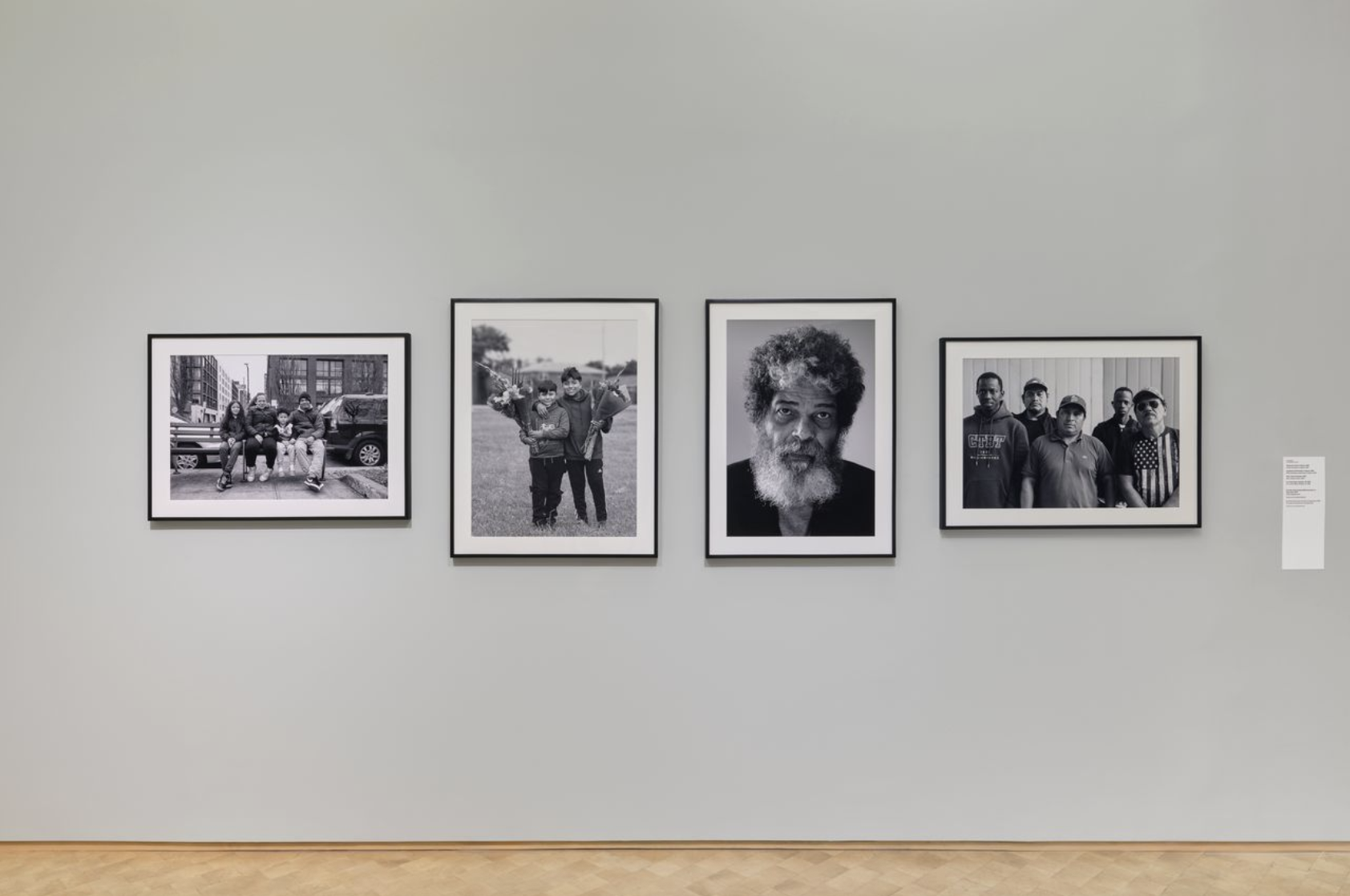
Partial view of Coco Fusco: Everyone Who Lives Here is a New Yorker, 2025. Courtesy the artist and Mendes Wood DM.
Curated by Susanna V. Temkin, the exhibition is a rich, expansive, and thought-provoking collection of Fusco’s work from the past few decades. From text to photography to prints to video installations, the abundance of the work displayed here is as delightful as it is generative, even if the conversations they incite may be uncomfortable—which is precisely the point. Organized into four thematic units, the show’s breadth spans issues of immigration, intercultural miscommunication, military and sexual violence, and, in rather romantic fashion, poetry and national politics. Cuba, of course, remains central as the protagonist of the exhibit, and it is also the through-line by which these more diverse topics are brought into conjunction.
In Fusco’s latest photo series, Everyone Who Lives Here is a New Yorker (2025), a set of twelve pigment prints draws close attention to the tender faces of individuals whose personalities are on full display. Shot and framed as streetside, contemplative portraits, these earnest gazes re-ground this idea of Americaness and New Yorker identity in a fashion reminiscent of the late Diane Arbus. Their beauty is less bound up in their technical virtuosity than in the meekness and sincerity of their regard.
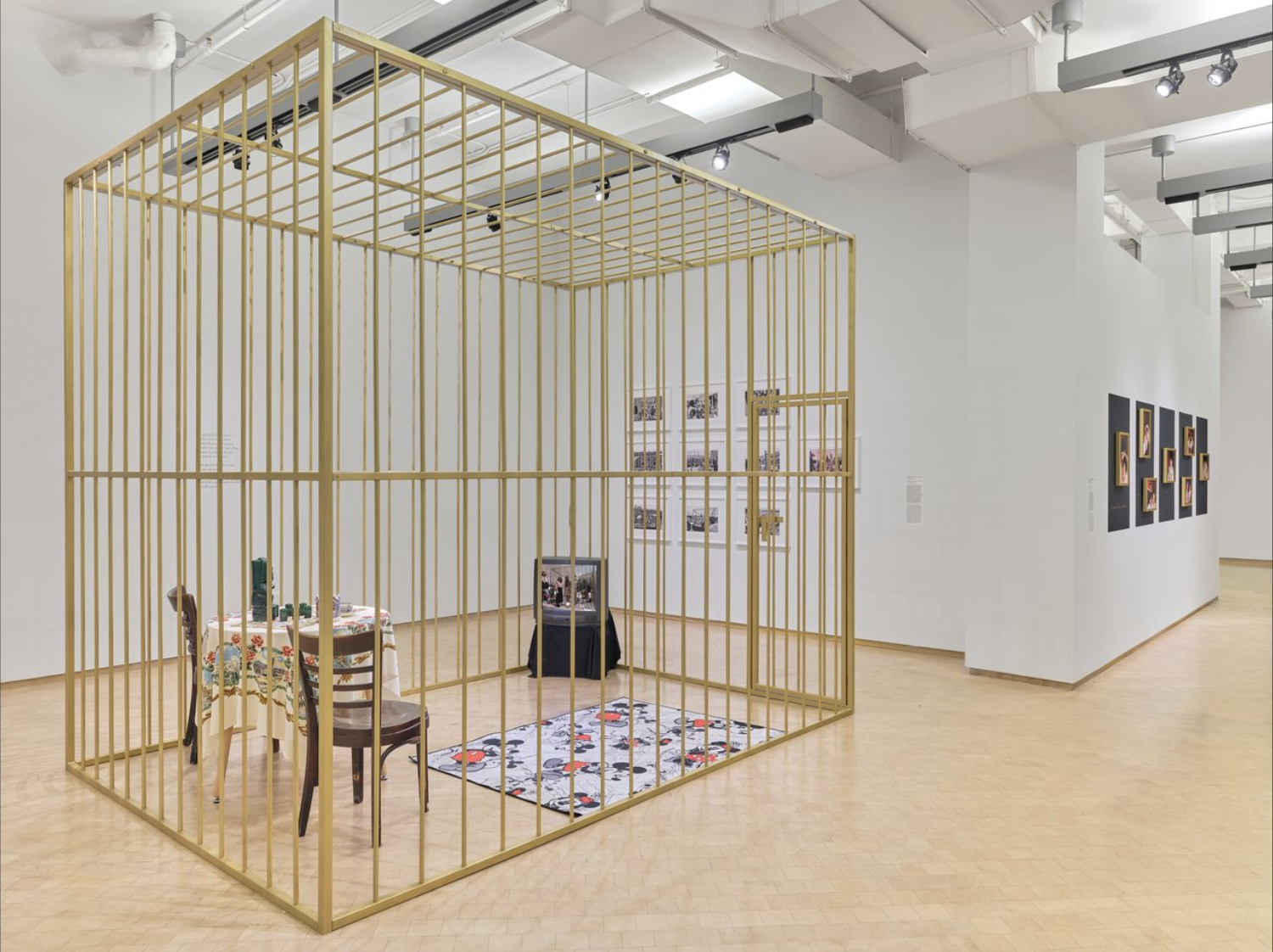
Coco Fusco, Two Undiscovered Amerindians Visit the West, 1992/2025. Courtesy Instituto Paz.
Moving from flat image to more conceptual multimedia installations, Two Undiscovered Amerindians Visit the West (1992/2025) offers a fresh take by remixing Fusco’s earlier collaboration with Guillermo Gomez Peña. Though not the centerpiece of the show, the gold-painted cage, into which viewers can enter, draws attention to itself by its sheer size and novelty. Bolstered by the textual and visual accompaniments on the adjacent walls, the cage conjures both past and present images of a type of carceral violence and a voyeuristic handling of dehumanized Indigenous bodies. A container for the barbaric Other, this porous golden prison also features, unironically, a prominent Mickey Mouse carpet and a small television set playing footage of Fusco’s earlier performances of the original exhibition tour.
Trapped with the smug, smiling face of one of capitalism’s most iconographic caricatures, Mickey’s unassuming presence, even in a golden cage, draws attention to the unabashed global forces that make his ubiquity both detestable and awe-inspiring. Lying flat on the floor of this otherwise barren abode, this rug is a cartoon reminder of the global calamity that was both the commencement and seemingly logical conclusion of the transatlantic slave trade, where goods and humans—or humans as goods—were conceived in equal terms of profitable exchange.
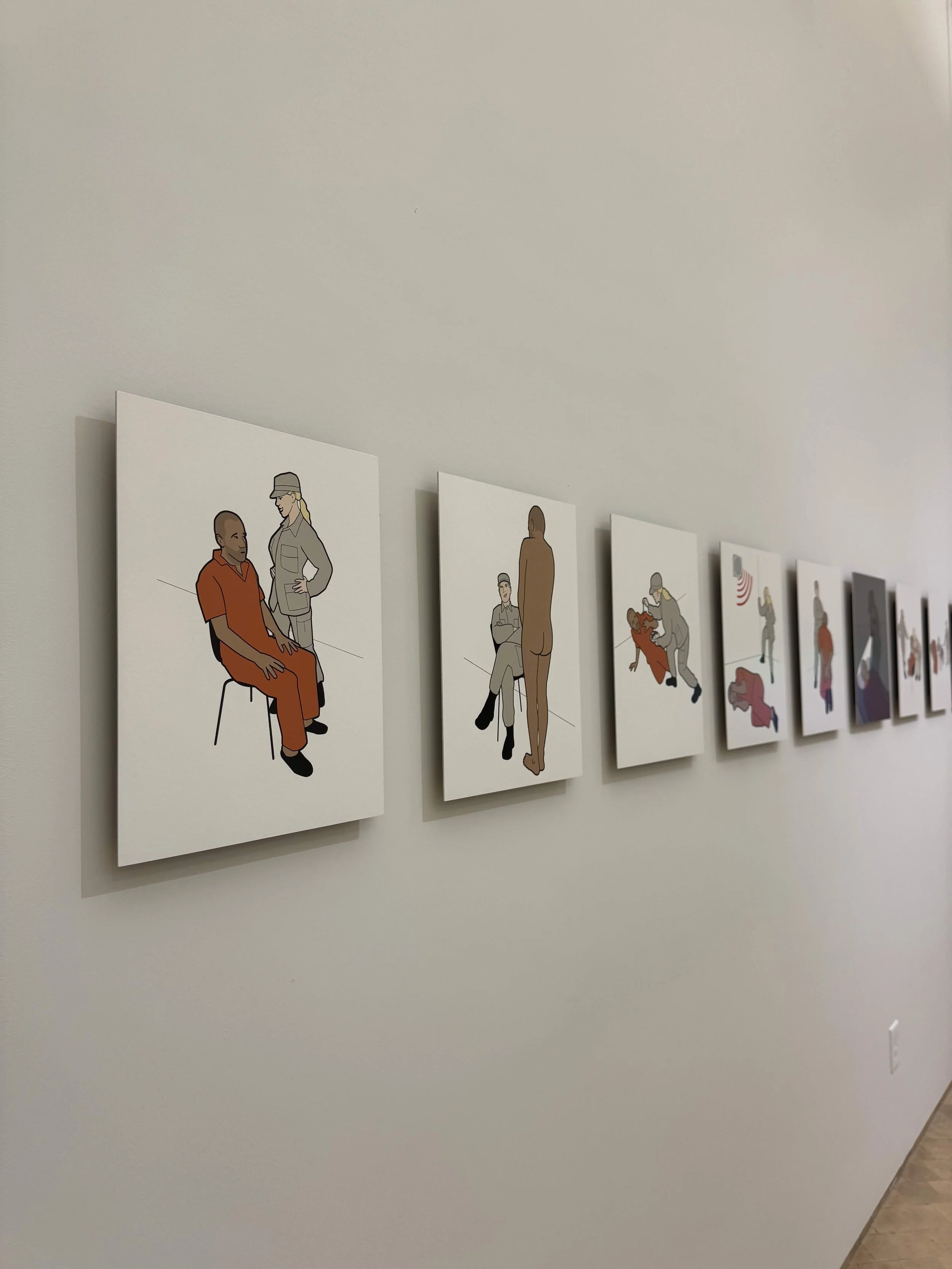
Installation view of Coco Fusco, The Feminine Touch, 2008. Photograph by Vinh Phu Pham.
While most of the show draws on the heavier sentiments related to our unrelentingly depressing politics, there are also elements of humor, such as with The Feminine Touch (2008), where sixteen digital prints on aluminum demonstrate scenes of ward and prisoner confrontations. The deadpan wit in these depicted scenes is undoubtedly dark: in each print, a female ward exerts her torturous finesses toward a visibly perturbed prisoner, who must bear the grunt of her comic aggression—a witty tragi-comedic girlboss whose posture and composition are reminiscent of Guantanamo or Abu Ghraib. There is a clear intentionality here in the scenes recalling images of political torture of the previous few decades—perpetrated by the “peacekeepers” of our world.
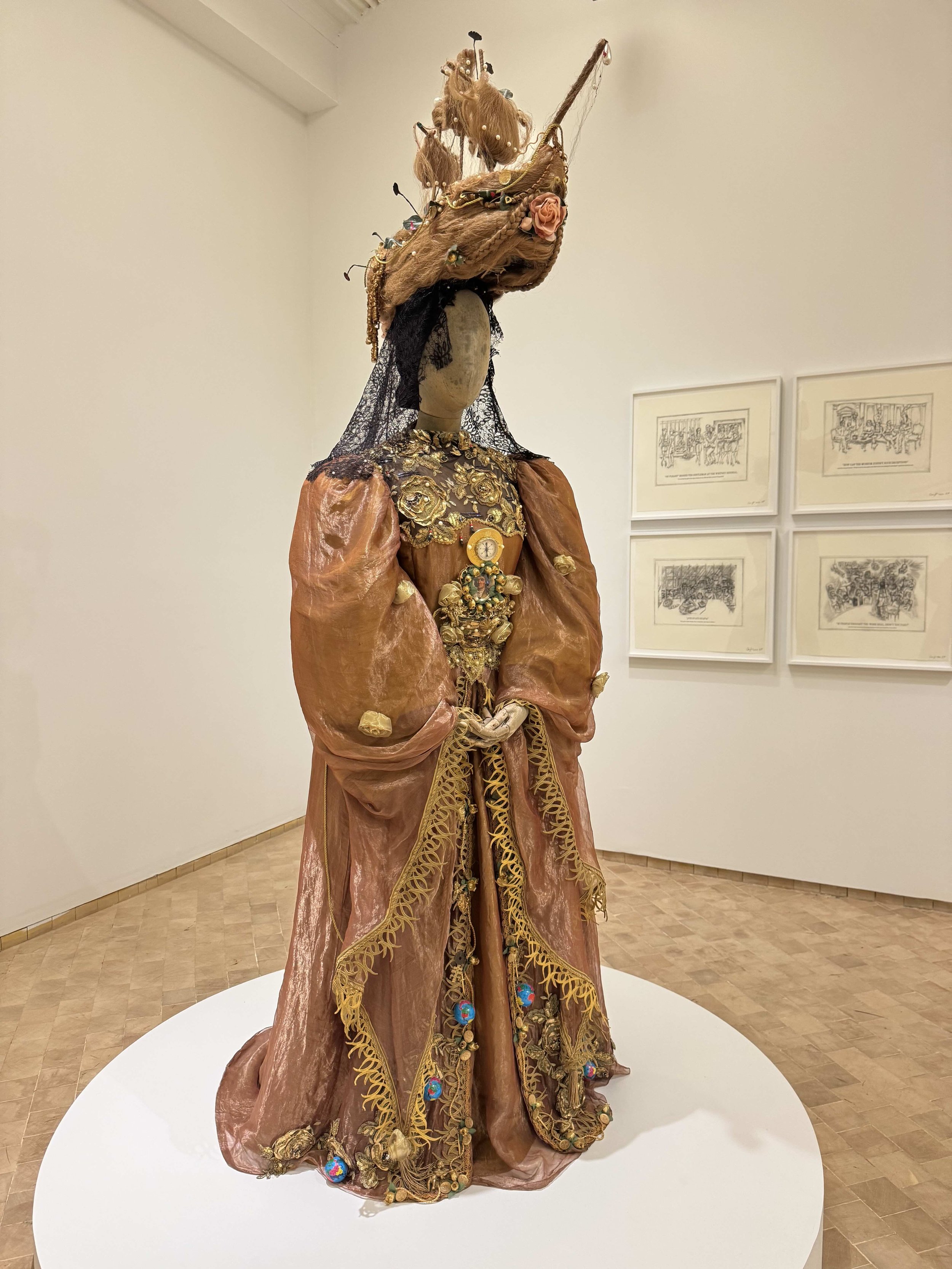
Pepón Osorio, costume created for La Chavela Realty Company, 1991. Collection of El Museo del Barrio. Gift of Coco Fusco. Photograph by Vinh Phu Pham.
Special attention should be given to the show’s broader display of video installations, several of which are quite substantial, with one lasting over an hour. La noche eterna (The Eternal Night) (2023), for example, is a film based on the Cuban writer Néstor Díaz de Villegas, who was sentenced to six years in prison for writing a poem. There is also Vivir en junio con la lengua afuera (To Live in June with Your Tongue Hanging Out) (2018), which adopts a rhythmic documentarian approach to memorialization and presents a poetic homage to the queer, exilic Cuban writer Reinaldo Arenas by returning to Havana’s Lenin Park, where three contemporary Cuban artists recite his most famous poems.
Fusco’s latest show is just as politically poignant now in its current iteration as it always has been. Cuba stays in the American consciousness as an enigma awaiting resolution: the underlying tensions with its giant neighbor to the north remain foreseeably unresolved, and the deep-rooted history of their complex relationship lingers in the air. Indeed, Cuba as an island is not reducible to its rum, cigars, and a sideshow of revolutionary fervor. For those desiring to see an artist’s longing for America’s perpetual ideological other, conjured with the precision and commitment only an artist of Fusco’s tenure and caliber can bring, the ride uptown is entirely worth it.
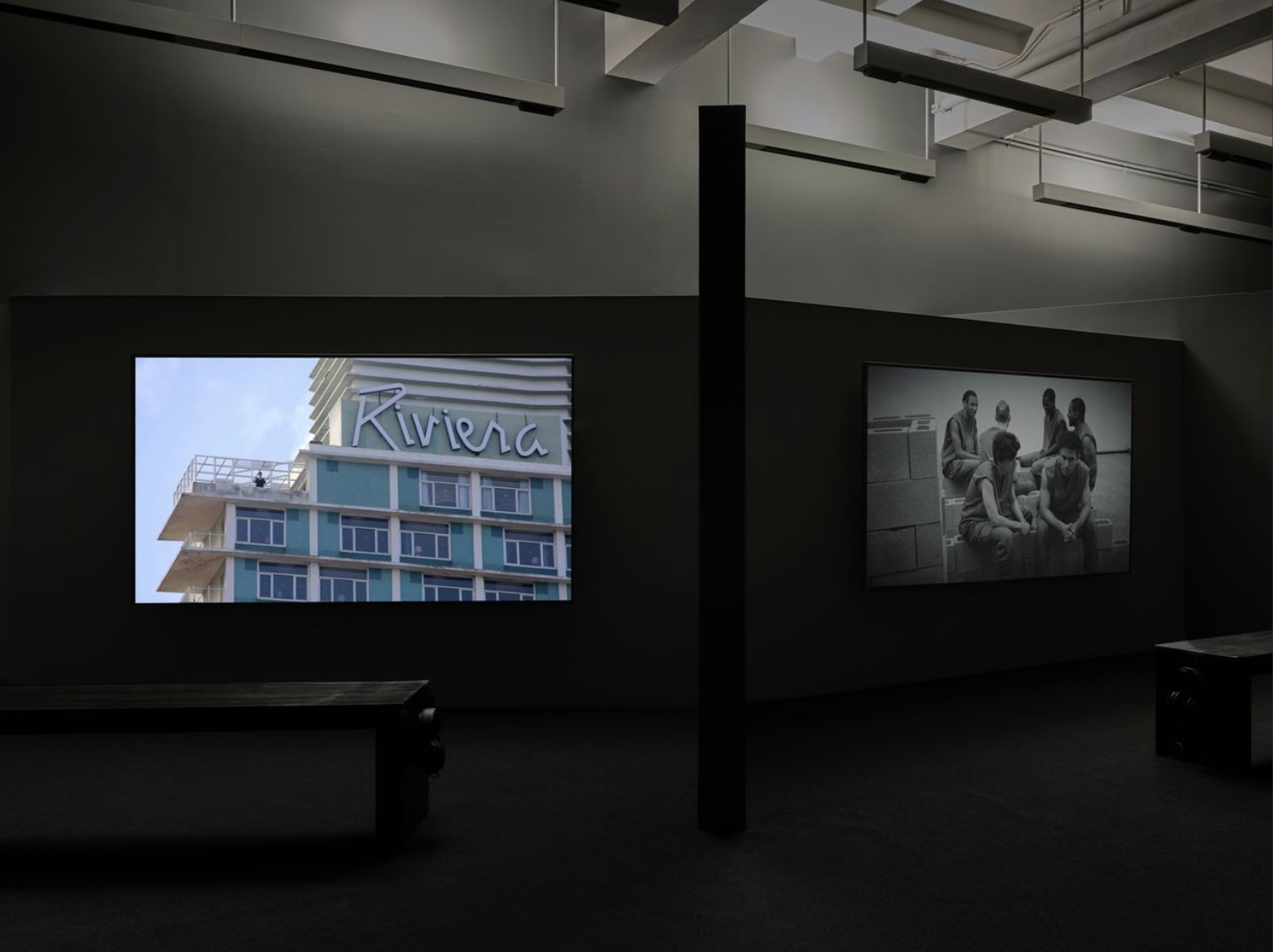
View of La noche eterna (The Eternal Night), 2023. Courtesy the artist and Mendes Wood DM.
Coco Fusco: Tomorrow, I Will Become an Island is on view at Museo del Barrio from September 18, 2025 through March 1, 2026.