
.webp)

Santiago Gómez: “Cabalgando Entrañas / Riding Entrails” at Plaga
Review
Eight paintings on the eighth floor; a set of boundaries in different stages of dissolution. Orange bricks collide with expanses of spackled violet. The differentiation between foreground and background is dissolved; what appears monochromatic at first reveals layers of angsty scribbles, erotic caricatures, and fragmented scenes. A sea of vulgar images floods the surface with engraved markmaking. This is Monika Baer’s Schweine Steine Scherben at Greene Naftali, which translates to Pigs Stones Shards.
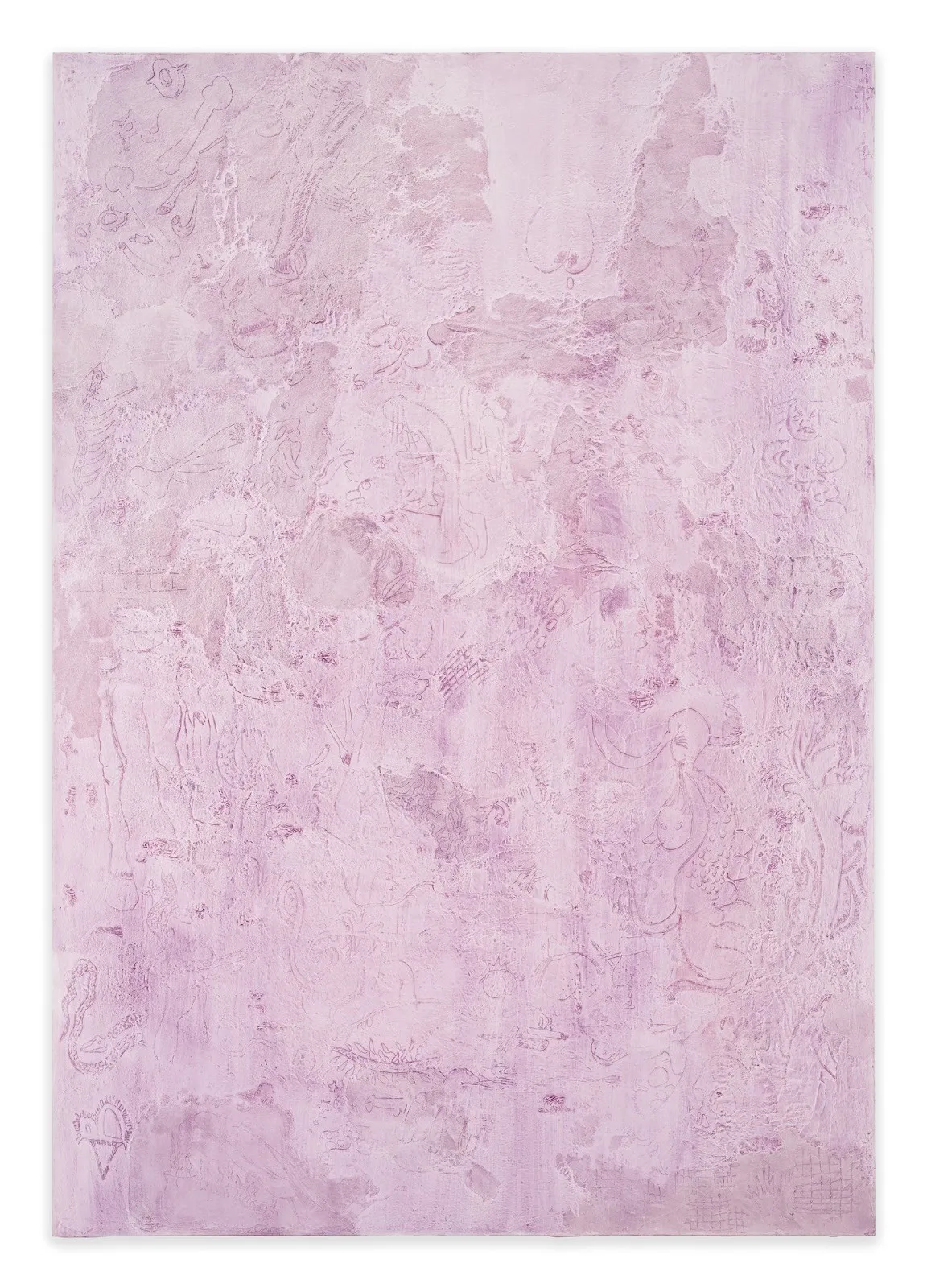
What could be called immediately piggish is the violet hue of the paintings, which completely covers the canvas in three instances: Lavender Wall (1) (2024), Lavender Wall (2) (2025), and Lavender Wall (3) (2025). The shade is desaturated, not quite pink, and uncannily hard to place—undeniably feminine, but somehow lacking a certain assumed delicacy. It could conjure the fleshy tone of pig skin: pink but thick, coarse, and frequently sullied. Its surface is interrupted by differentiated textured zones created by layering the paint with spackle and sand. The materiality of these works poses, and subsequently erases, representation by physically mirroring what is signified: namely, a wall.
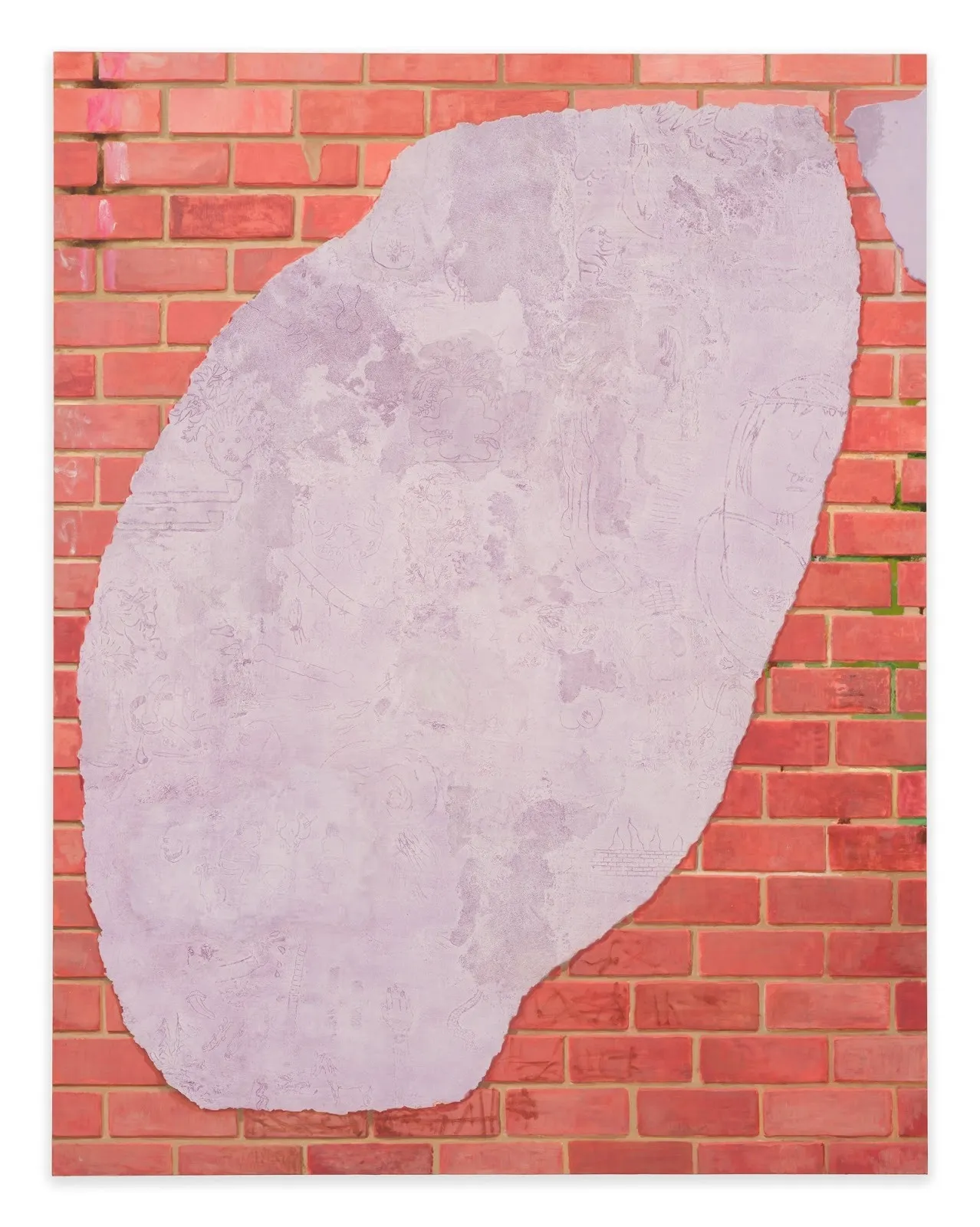
With these works, Baer contrasts two conflicting functions of painting: the pictorial, illusionistic surface, and flat, modernist, material abstraction. Ironically, what is represented by the illusionistic surface, which operates like a window, are bricks, obstructing our ability to see through the canvas rather than allowing it. The illusion of depth is utilized to depict flatness, whereas the flat, abstract, lavender surface creates a kind of opening, a way through. It is indiscernible whether the lavender surface lies underneath or on top of the brick; it appears both torn away and hovering in front. Thus, the monochromatic flatness is utilized to create and complicate depth. Baer slyly inverts painting’s presupposed historical operations with a comic twist, creating an irresolvable surface tension.
More layers unfold as the images hidden in the lavender texture reveal themselves. Drawings are scratched into the paint, depicting different faces, figures, disjointed body parts, animal hybrids, and scenes. In one, snakes with human heads slither in undefined space. In another, an angry woman appears to violently expel something from her genitals—maybe urine or amniotic fluid. Another shows a kind of fish-woman hybrid with four breasts. Phallic imagery is scattered throughout, like the wall of a public bathroom stall. Dicks, balls, mouths, snakes, naked women, someone shitting, horses—the images have a vulgar immediacy that imitates the language of vandalization.
This kind of line drawing does not appear in Baer’s previous painterly investigations; it’s quite new territory in the context of her oeuvre. There is an anonymity to her markmaking, accessing a public language rather than a subjective one—perhaps even a collective unconscious. The images mostly lack specificity, except in several instances, which include a somber-looking Jesus figure and a caricature of Trump riding a pig. This latter image in particular might direct our understanding in a more political direction: This image situates these paintings in greater dialogue with the present political upheaval and might suggest a kind of historical record being created. The anonymity of the drawings might create a kind of universal, transhistorical figure out of the vandal. The vandal is a rebel of sorts, who directs their frustrations, malice, or alienation into the defacement of public surfaces. Baer seems to conjure and embody this figure in her drawings, perhaps driven by angst, to use the German word for fear, which is resonant here in either language. The drawings are reminiscent of cave paintings, both becoming the historical records of a time that becomes inseparable from the surface it occupies. One has the feeling, when observing Baer’s work here, of witnessing the conjunction of a collective angst with a structural collapse.
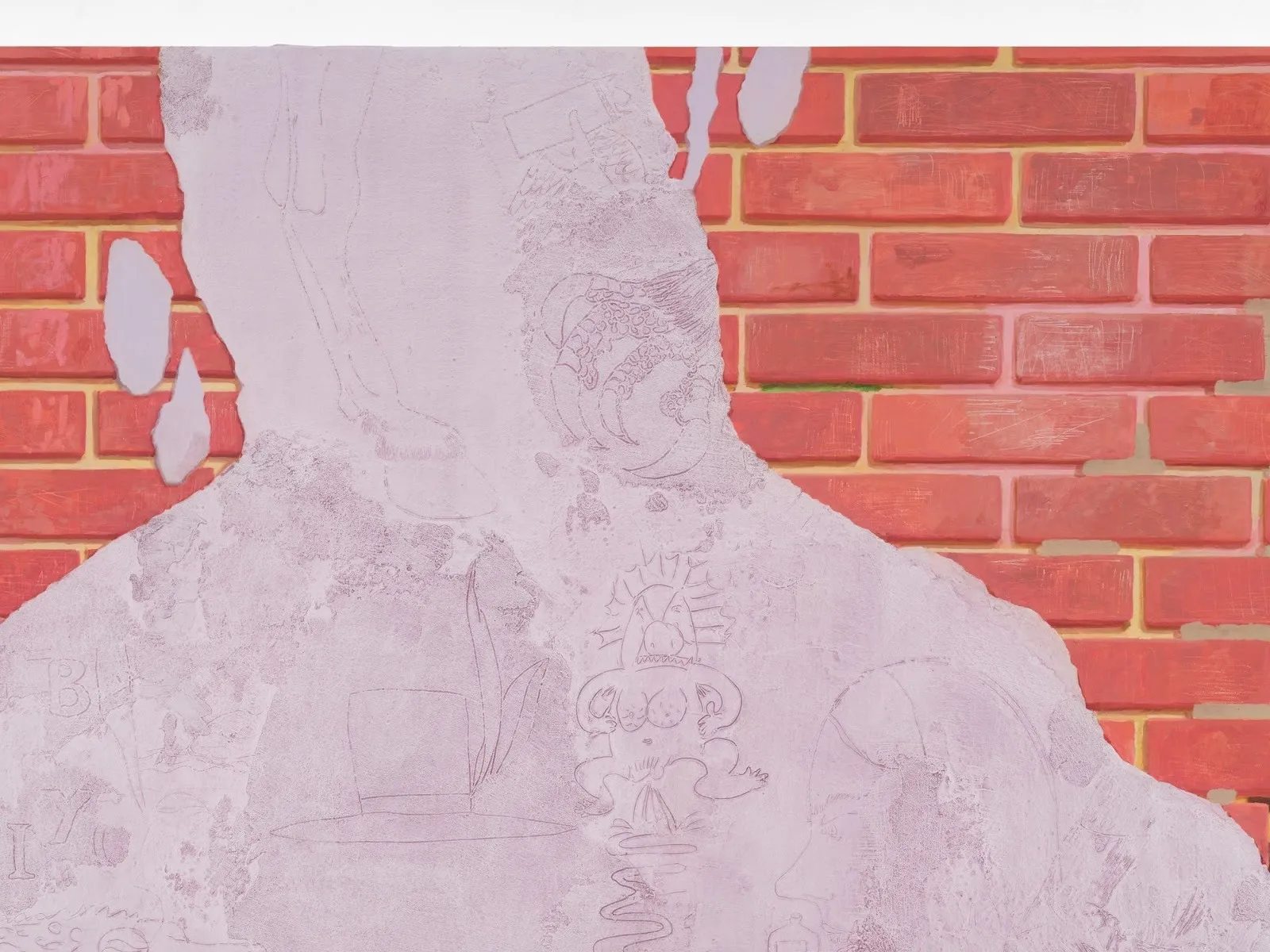
There is an irony, too, within the fact that these vulgar images only appear within the lavender zones, contrasting darker content with this playful color, and it is of no small significance that the doodles do not appear on the zones, or curtains, of brick. In this series, several dichotomies play out: depth versus illusion, vulgarity versus refinement, the mark versus the structure. The marks and imagery that constitute a structural part of the lavender areas stand in further contrast with the illusory brick boundaries. Could this place the vulgar, rebellious impulse in opposition to structural division? Is image-making assigned a rebellious quality against the political forces of oppression? Or, instead, is the dichotomy itself brought under question, and arranged so that its ironic inversion completely undoes itself?
To return to the title, Pigs Stones Shards, we can see its quite literal description of the elements at play in this body of work. There is the piggish pink color, the insinuation of pig-like political entities, which might inflect the entire pink-ness of the work with a subtle bite. Then there are the stones, the trompe-l'œil bricks that build imaginary obstructions and enforce an uncrossable boundary. The shard is that peculiar place where the Pig and the Stone meet, the torn off shape, the fragmentation, the indiscernibility of depth. With these few elements, Baer weaves a complex unfolding of dichotomies that traverse between the material, the aesthetic, and the political, and leaves one unable to differentiate between them. In the surface tension that exists across these works, we cannot tell whether we can break into the paintings, or if they break out at us.
Monika Baer: Schweine Steine Scherben is on view at Greene Naftali from November 7, 2025 through January 10, 2026.