The Wretched Unrest in a Room for One
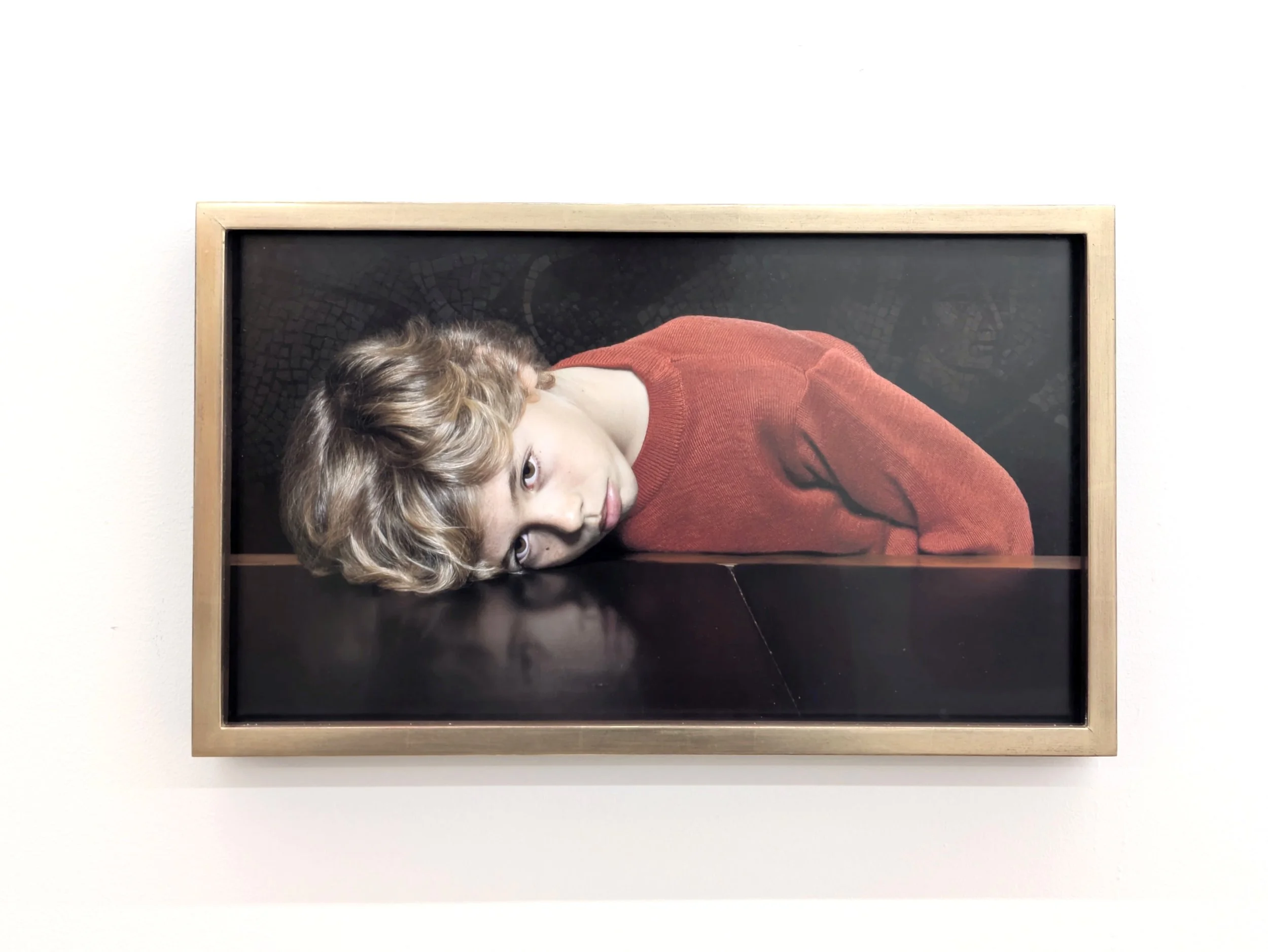
Jaime Welsh, Veil, 2025. Archival pigment print on baryta paper, museum glass, gilded frame. Photo by Fred Voon.
The bedsitting room, or bedsit, is a false promise of rest and relaxation. The term refers to a British apartment that merges bedroom and sitting room—like an American studio apartment without the kitchen and ensuite bathroom—but what sounds like double the opportunities for soft landings turns out to be too cramped for comfort.
In this spirit, The Bed Sitting Room, a group show at LOMEX in New York’s Chinatown, explores solitude, claustrophobia, and the various ways in which a room is not a home. The exhibition is named after the 1969 film about a postapocalyptic London where nuclear fallout causes worrisome mutations: a mother turns into a cupboard, a father into a parrot, and a man into a bedsit, thus becoming the title character. The mutations are curable, it is discovered, by “full-body transplants,” thanks to donors from South Wales.
The LOMEX show is organized by Freddie Powell of Ginny on Frederick in London and includes several UK and UK-based artists. Powell envisioned a “landscape of polite catastrophe,” where the survivors feign normalcy and attempt to regain some semblance of civilization. “Thinking about the film in the context of our ongoing global madness, the post-apocalyptic backdrop feels apt,” he says, “and all of the artists seemed to respond in the same way.” Fittingly, the works are mostly contained within a single room—although Rebecca Ackroyd’s Life and Death (2025), a small pastel piece featuring a monarch butterfly, seems to have fluttered into the back office area.
The animating force of the show seems to be Pandora’s Other Box (2026), an Alexandra Metcalf painting inspired by the 1892 short story The Yellow Wallpaper by Charlotte Perkins Gilman. In the story, a woman is shut up in a nursery by her physician husband to cure her postnatal hysteria. As her nerves unravel, she grows obsessed with the flaking wallpaper—its sickening color, its disturbing imagery, its mutations in moonlight—and starts to notice a woman trapped within. In Metcalf’s piece, tattered wallpaper peels away to reveal a public restroom with women gazing at their reflections, yellow floral prints giving way to cold pink tiles. It is a picture of an interior state: bombarded by social stressors, the walls of mental stability are thin and prone to crumbling.
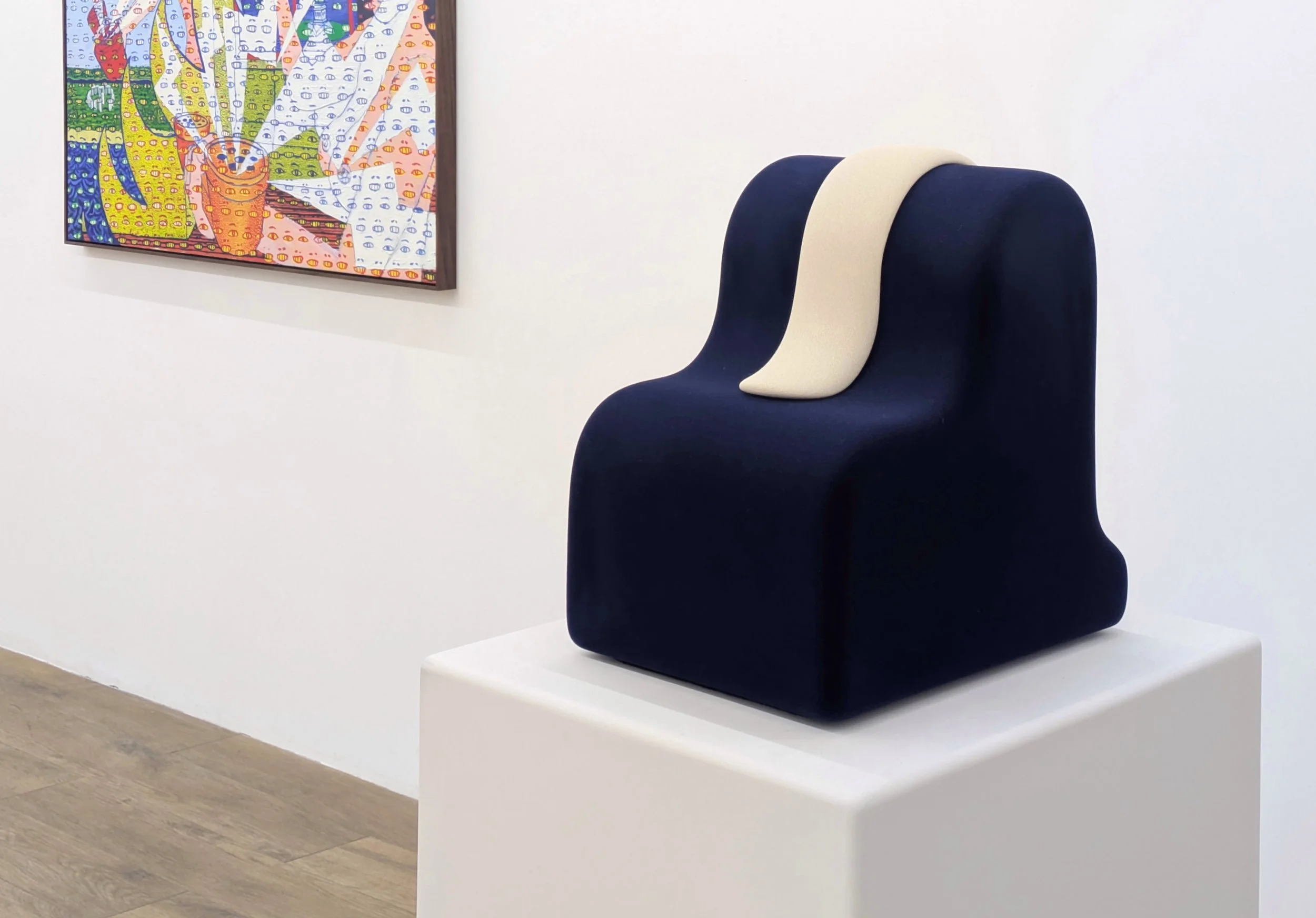
Installation view of The Bed Sitting Room, 2025, featuring Charlie Engelman, Traveler (Dawn), 2026. High-density urethane foam, flocking, acrylic paint, stainless steel hardware. Photo by Fred Voon.
Veil (2025) by Jaime Welsh hardly lifts the mood, but it evokes a more refined confinement. Welsh produces meticulously staged and edited photographs that place disenchanted young bodies within stately rooms of esteemed institutions. Here, it is the boardroom of the Museu Nacional de Arte Antiga, with mosaic elements from the former Banco Nacional Ultramarino headquarters in Lisbon slipped in. A boy is collapsed on the table with a vacant stare, unenthused about or uncomprehending of the world he inherits. The gilded frame suggests that all the grandeur is merely a veneer. Trained as a painter, Welsh retained a love for clean compositions when he switched to photography. His use of archival pigment print on baryta paper produces such vivid colors that one collector who was drawn to Veil walked away disappointed when he realized it wasn’t a painting.
Nowhere in this bedsit can you rest thy weary head or spinning mind, not even upon Charlie Engelman’s Traveler (Dawn) (2026), from a series of duotoned sculptures in high-density urethane foam that recall luxury seats on planes and trains. Good luck contorting your body or figuring out which limb goes where to enjoy the plushness of its flocked surface.
The exhibition’s sole source of warmth subtly emanates from the sculpture Division by Hamish Pearch. A pair of conjoined teacups holding up a starburst formation of matchsticks is surrounded by a scattering of peanut and walnut shells. Surprisingly, these homey accoutrements are solid metal: the teacups and matches cast in bronze, the walnut shells in silver-plated bronze, and the peanuts in aluminum. The fused cups speak of communion and conversation, and yet, do the matches signal warmth or volatility, and are the shells signs of vibrancy or disarray?
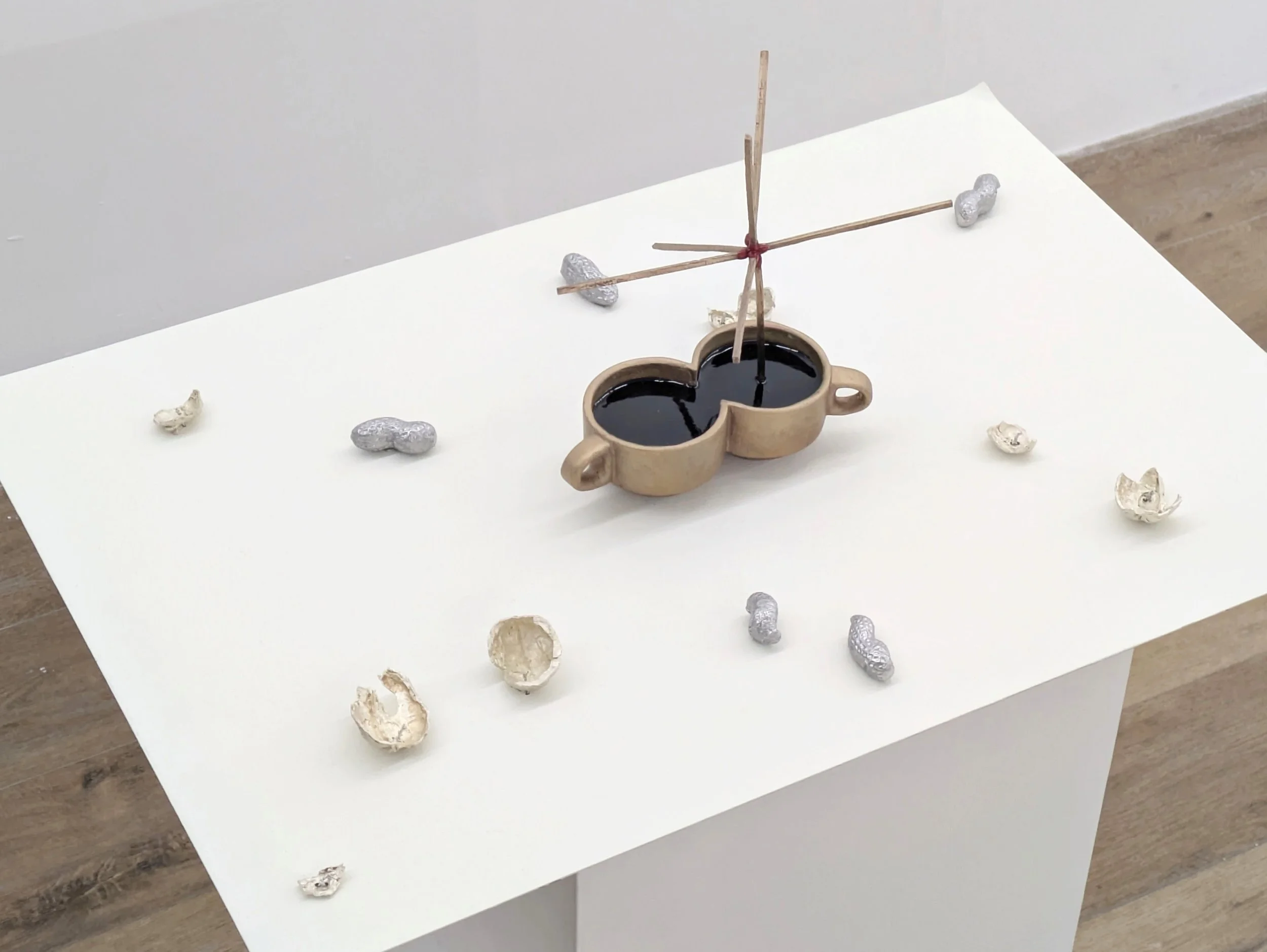
Hamish Pearch, Division, 2026. Bronze, silver-plated bronze, aluminum, pigmented epoxy, paint, fixings. Photo by Fred Voon.
In the end, the bedsit is designed for a solitary occupant, typically a young single or solo transient of limited means. It is a makeshift, make-do, make-it-work situation for people who can’t afford roomier lodgings. It is an unnatural merging under duress, a forced coupling of two entities that were meant to be separate.
An untitled oil painting by Phoebe Nesgos shows a female figure trapped in metallic scaffolding, as if the project of rebuilding, post-catastrophe, has gone awry. What’s more unsettling, after observing these solitary figures rendered by solitary artists, is the realization that devastation and despair live within us all, and that the lone person in the room is you.
The Bed Sitting Room is on view at LOMEX in New York from January 10 through February 14, 2026.