
Keeping a Legacy Alive: In conversation with Stamatia Dimitrakopoulos
Interview
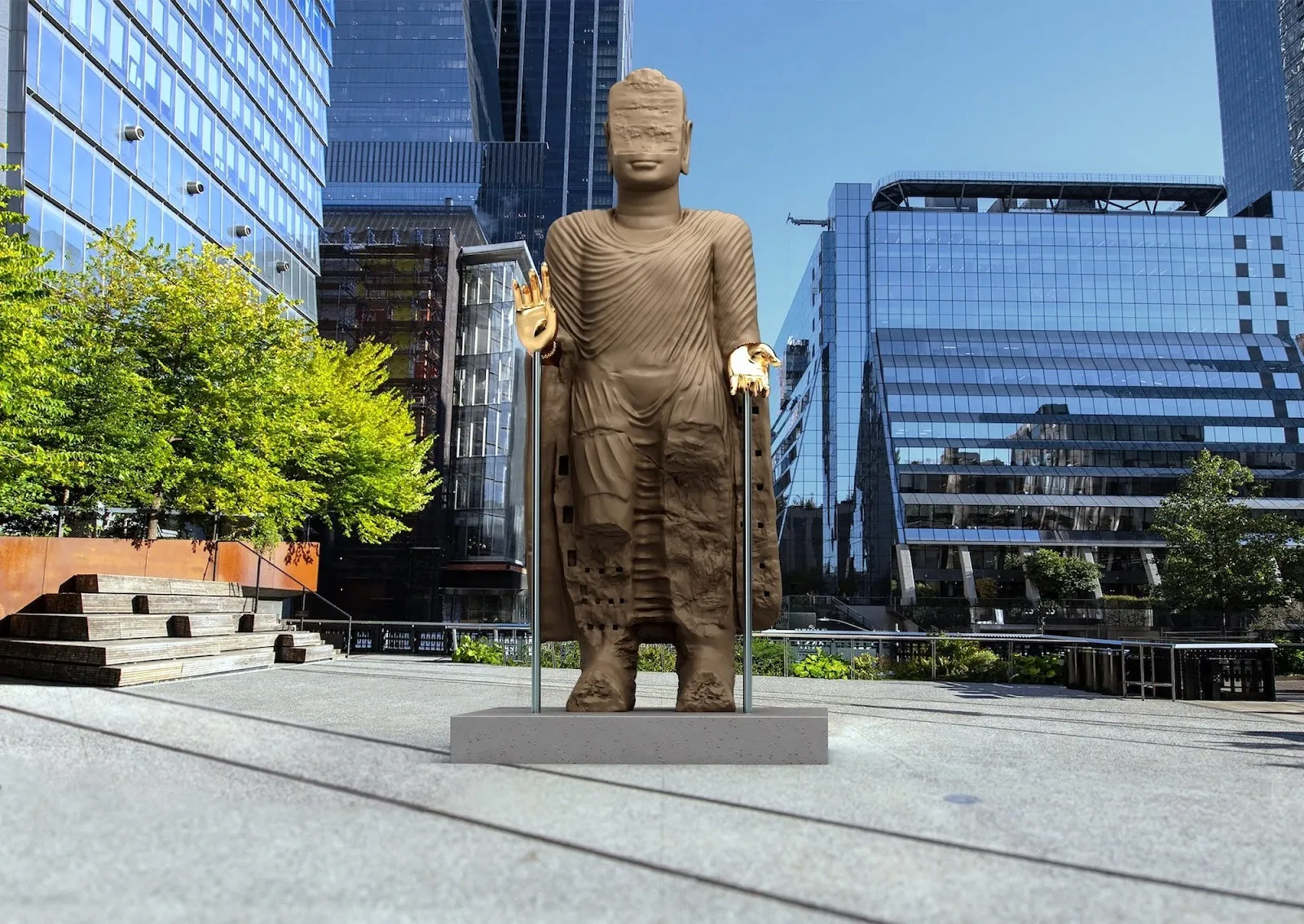
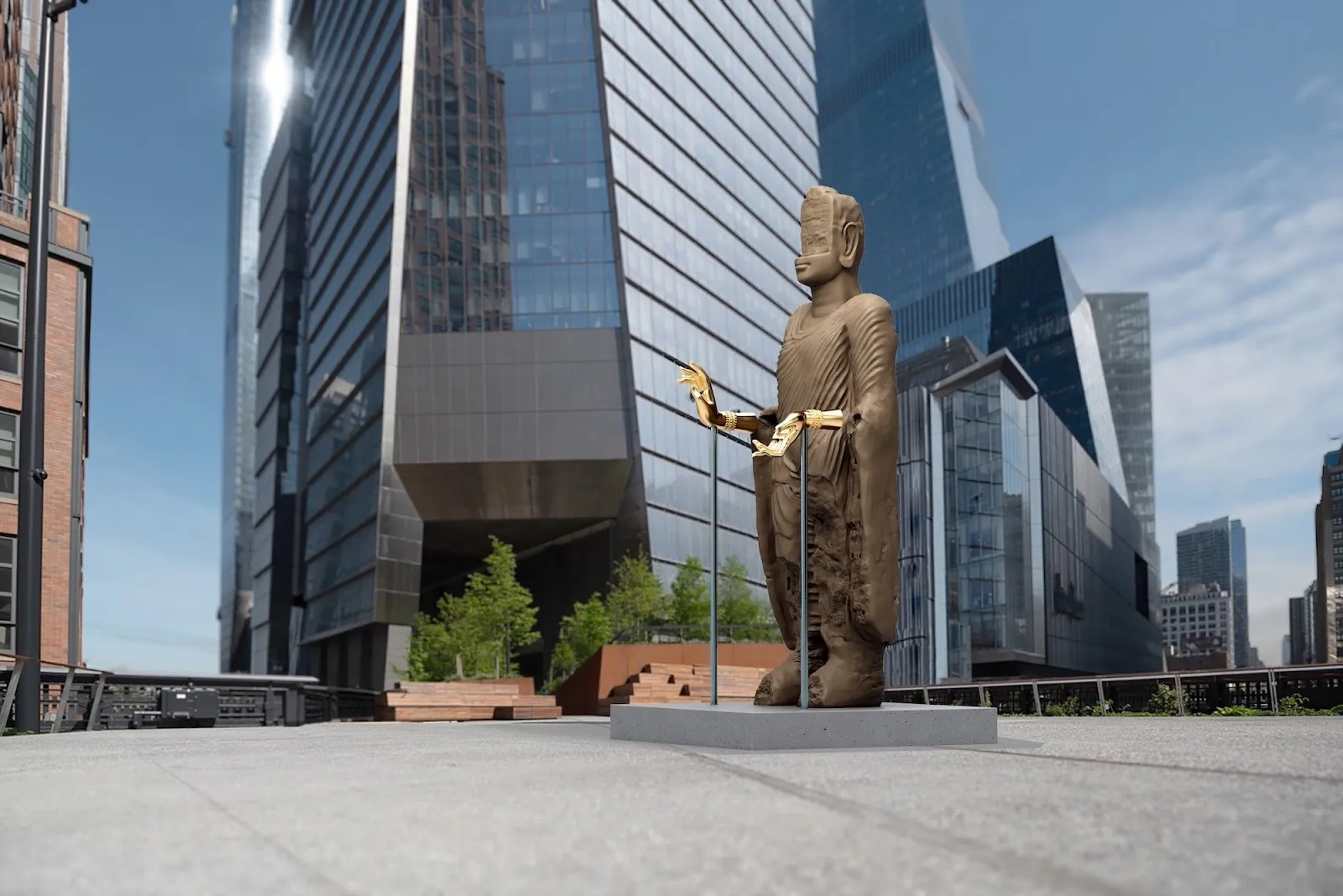
For the fifth High Line Plinth commission, artist Tuan Andrew Nguyen is developing a monumental statue, The Light That Shines Through the Universe, paying homage to one of the Bamiyan Buddhas destroyed by the Taliban in 2001. Standing 27 feet tall, with metal hands cast from found ballistic shells, the sandstone statue synthesizes historical memories of destruction with the possibilities of repair. In an interview with Xuezhu Jenny Wang, Cecilia Alemani, the Director and Chief Curator of High Line Art, discusses Nguyen’s engagement with cultural translation and collective healing, foregrounding the High Line’s mission to combat the erasure of history.
Xuezhu Jenny Wang: I’m interested in the methodology of cultural re-translation. As an artist coming from a Vietnamese-American background, how did Nguyen become interested in this piece of central Afghan history?
Cecilia Alemani: In most of his work, Tuan has been looking at the history of Vietnam, but he’s also trying to create parallels and connections that echo with other cultures. In his practice, he has worked with fragments of broken statues or the remains of sculptures after an act of destruction. He has worked with figures of the Buddhas before, just not in this format or at this scale.
He became interested in the Bamiyan Buddha because it was one of the most heartbreaking televised acts of destruction in his youth. He was in his mid-20s when it happened, and the memory of the event remained with him. It was a tragic event that touched upon some of the central concerns in his work: reparation, healing, and transformation. That historical event is both a personal memory and one that would resonate with many different communities. Tuan has a friend from Bamiyan who shared stories of growing up at the feet of those giant statues. One of the aspects that strikes me most about his practice is how he is able to intertwine a personal, intimate dimension of storytelling within broader universal histories.
XJW: I saw the New York Times coverage where he worked with local Bamiyan people to collect ballistic shells and recast them. How did the artist ensure faithful representation, and were there other Bamiyan community members involved in the production?
CA: The metal for the hands comes from discarded artillery shells collected in Afghanistan through a local contact. They were melted and recast into bowls to leave the country, going through Pakistan and then to Vietnam. Previously in his work, Tuan has used materials from armed conflicts, most notably unexploded devices from his own country, Vietnam, which still has the highest number of unexploded devices in the world. This process suggests an act of reincarnation or an alchemic gesture, in which he can translate an item of destruction into something that inspires hope and resilience. He does that both literally in the art he makes and metaphorically in the stories he evokes.
XJW: Which community is the sculpture meant to resonate with, and what kind of pathos do you foresee it evoking from those unfamiliar with this history?
CA: The High Line’s community is hard to define because it is both local and international. I believe one goal of this artwork is to speak to a broad audience, including younger generations who may not know the history of the Bamiyan Buddhas.
This work is not a mere replica of the original sculpture: Tuan adds to the historical facts. For example, the hands likely existed, but since the statues were victims of iconoclasm centuries ago, there is no evidence of what they looked like. By adding them in a completely different material, he creates a space for imagination. To me, this symbolizes a conversation about the power of art to create a space for imagination and to introduce concepts of compassion and acceptance.
Reactions will vary: some communities will recognize the figure immediately and hopefully be moved to see these artworks reincarnated on the High Line. For others, there may be surprise at the monumental scale and a desire to learn a piece of history, especially seeing such an image standing next to the skyscrapers surrounding the site.
XJW: Is there a secularization of the Buddha statue by placing it in an urban context, moving it from spirituality toward cultural symbolism?
CA: We talked a lot about it with him. The way he sees this statue is as an artwork. The Bamiyan Buddhas were incredible feats of the hand, carved into the cliff. His memory of those objects is an “art memory.” He thinks of them as artworks destroyed by the Taliban more than religious objects. It is not just any Buddha, but that specific statue of a Buddha destroyed in 2001.
XJW: He reconstructed the hands but left the face and legs incomplete. Is it intentional that he gestures towards the recreation of wholeness without fully getting there?
CA: Both the hands and face were destroyed centuries ago; there isn't even a drawing depicting what they looked like, so they are left to the imagination. He embraces this “'space in between” that is the lacuna or the empty niche left behind.
The original artworks were carved into a cliff and didn’t have a back; they weren't 360-degree sculptures. To detach the figure from the mountain, he had to imagine its back. He decided to leave it rough, as though physically detached from the stone. Similarly, there is a visible gap between the hands and the stone. That gap is the space of imagination where the viewer projects their own memories. He never calls this a replica; it is a reincarnation in another moment of time, so attributes may differ from the sixth-century originals.
XJW: Given the tension of global politics at the moment, what is the significance of showing it in the US? In this context of presentation, how do we uphold notions of healing and transformation while being cautious about the dominant but arguably fraught narrative of the US as the “world police”?
CA: It is hard to predict, but I see this sculpture as a symbol of hope and fearlessness more than just that moment in history. The historical context is important; I was born in 1977 and remember it as the most shocking act of destruction of an artwork I’d seen on TV. It resonated with me, as it did with the artist, but younger generations might not know it.
Growing up in Italy, the story resonated differently than it did on this side of the ocean. There are many connotations that cannot be summarized in one opinion. My hope is that this sculpture creates a moment of pause where people can gather, learn about a history they might not be familiar with, and understand that art can touch upon complicated stories of loss without shying away from them. By adding his own artistic input, like the metal hands, Tuan is not just making a replica but is rather pushing for a more universal message.
XJW: Has there been pushback? How does High Line Art ensure freedom of expression at a time when institutions tend to shy away from politics?
CA: There has been absolutely no pushback. We invest in supporting artists because we believe art has the power to uplift our souls. We want this work to create something beyond itself, which is what we try to do with every commission on the High Line. Sometimes works are pleasing or funny; other times they are conceptual, political, or social.
The piece is still in Vietnam, fabricated in four massive stone blocks. It has a metal core structure with each stone lofted on top of the other, and the hands are cast separately. It was very important for him to work in Vietnam, where he produces most of his work. Unlike previous High Line pieces that were craned up as a single object, this must be assembled from street level like a traditional colossal sculpture. We are finalizing those details now, aiming for a spring opening at the end of April.
This interview has been edited for clarity and length.