A Post-Collapse Commitment to Noticing and Preserving
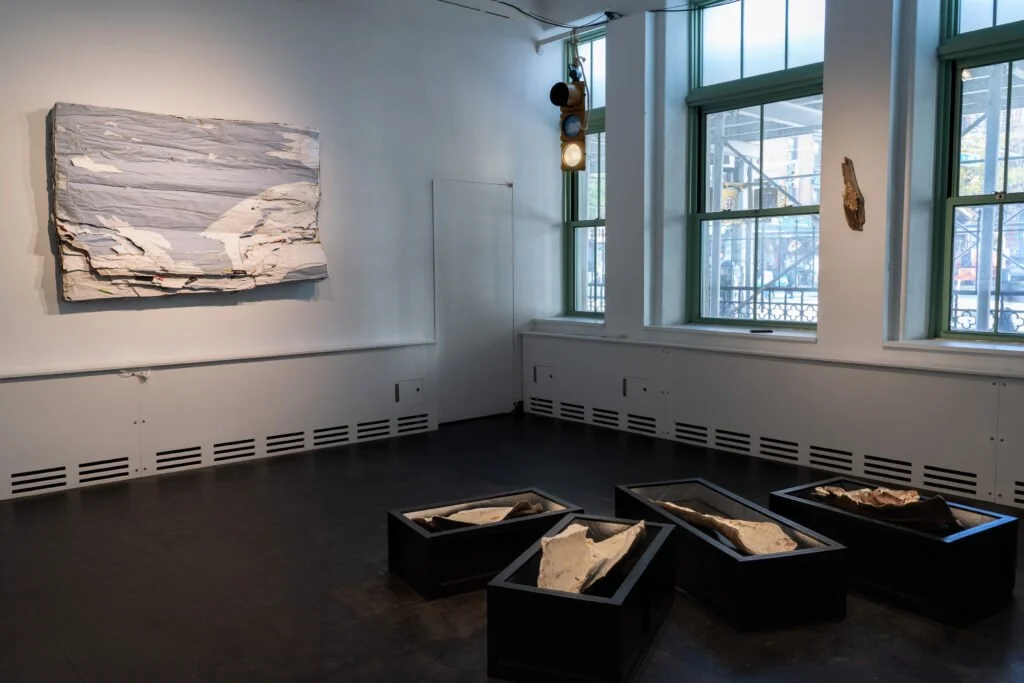
Synthetic Traces. Wall: Pavlos Liaretidis, Unposting no. 1, 2025; hanging: Lite Zhang, Obey, 2025; floor: Pavlos Liaretidis, After the Arrow, 2025. Courtesy the artists and PS122 Gallery.
Artists Lite Zhang and Pavlos Liaretidis, along with curator Alfonso Sanchez Herrera Lasso—hailing from China, Greece, and Mexico, respectively—met at the Maryland Institute College of Art. Through multiple studio visits and those inevitable late-night conversations about art and its meaning, they discovered a shared language in their practices that ultimately led to their collaboration. While they share a common language in art, they also recognize a shared experience as immigrants shaped by dislocation and separation. This deeply personal sensibility resonates within the collective unconscious when disaster strikes—whether in the 2024 collapse of the Francis Scott Key Bridge in Maryland, the 2023 Tempi train tragedy in Greece, or the global rupture of the pandemic.
Zhang’s Key Bridge (2024) and Liaretidis’s After the Arrow (2025) begin in loss and tragedy and then become memory and memorial. The collapse of Baltimore’s Key Bridge impacted Zhang’s thoughts of his new hometown as he repurposed found materials strewn across the shores—flashing yellow warning lights are held in a suspended crab pot tied by a rusty chain to a sink on the floor. The work combines fragments of Maryland’s crabbing culture, dilapidated infrastructure, and personal loss.
Liaretidis’s eloquent memento mori, After the Arrow, consists of four coffin-like black wooden crates resting upon the floor, each containing a plaster cast of a section of a dead animal. Captured within the plaster, one can see bits of hide and bloodstains on the inside, while the outside is covered with iron, graphite, and coal that is coarse to the touch, like a scab. As the title suggests, the animal could have been shot by an arrow or, as described in the exhibit pamphlet, died as the result of a roadkill. It almost doesn’t matter how the animal died—Liaretidis has created a reminder, a moment to take care of the fragile nature of all beings.
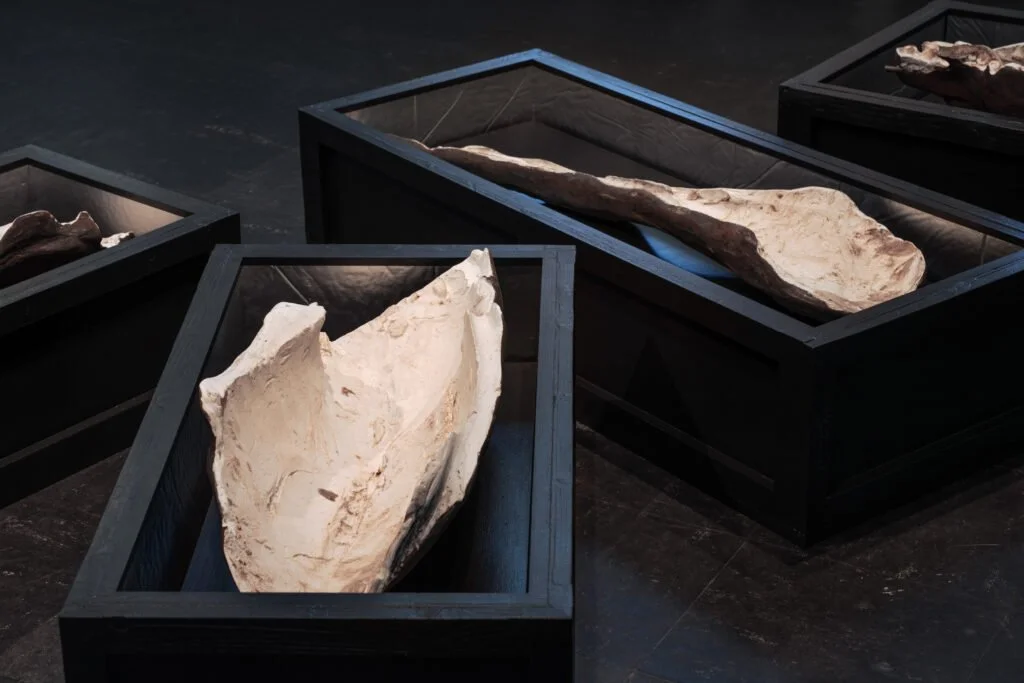
Pavlos Liaretidis, After the Arrow, 2025, detail. Plaster, wood, metal powders, animal hair, and blood. Variable dimensions. Courtesy the artist and PS122 Gallery.
Everyday objects of life—huge wheatpasted posters—form the raw material of Liaretidis’s series entitled Unposting (2025). The works consist of large, minimalist constructions made from reclaimed posters pulled from the streets of New York City. They are wonderful structures that are compressed and rigid with beautiful colors and textures, seemingly floating or hanging with ease. The series records time, as each layer adds something while also erasing the past. But what makes them even more intriguing is the full title: “no. 1 Greenwich Avenue, West Village, January 1 midnight, after new year’s eve heavy rain four of us in the emptied streets”; “no. 3 Bowery, Nolita, February 4, night retrieval before trash collection, with partner in crime”; “no. 5 West 25 Street, Chelsea, May 5, dense mist and thin light rain during a late-night drive.” The addition of descriptive texts makes the pieces specific and very personal, a keepsake, albeit rather large.
Zhang disrupts the familiar authority of the traffic light by overlaying each signal light with an image of a clouded sky. The operational logic remains intact—you can still tell which light is illuminated, even as the colors are altered—but the utilitarian object is transformed into something unexpectedly contemplative. Faced with this aesthetic substitution, the social contract embedded in the traffic light is at stake—an unspoken agreement to wait, to comply, to trust the system. To break this contract invites punishment, whether in the form of a ticket or a collision. Titled Obey (2023), Zhang’s work quietly but insistently interrogates our obedience to one of the most mundane yet authoritative objects of everyday life.
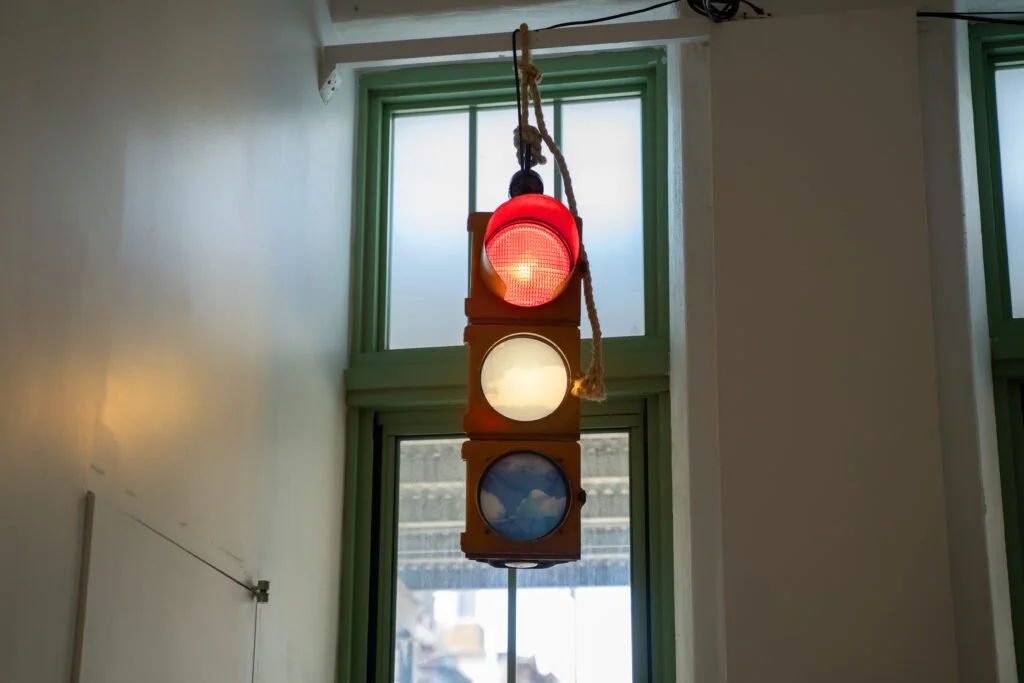
Lite Zhang, Obey, 2025. Traffic light, wallpaper, and plexiglass. Variable dimensions. Courtesy the artist and PS122 Gallery.
There are numerous riddles about time because it is something universally available and experienced, yet it slips away easily. Zhang and Liaretidis create a semblance of permanence for time in 996 (2025) and Curing Trace-2 (2025), respectively. A large wall projection documents Zhang’s site-specific work 996, referencing both a working-hour system in China (9 am to 9 pm, 6 days a week) and a sneaker by New Balance. The title and the work combine a harsh work system with a brand name for a leisure shoe, both very distinct types of time. Zhang deftly cut by hand “996” into grass and sowed it with wildflower seeds. The cycles of work/nature and of labor/leisure merge as the wildflowers come to life and then wither away. Referencing nature and time in a very different way is Liaretidis’s Curing Trace-2. Nature is purely an artist-contrived visual, while the metal powders, graphite pigment, and plaster are the content. The plaster slowly moves to fill the picture frame as it settles, leaving marks and outlines etched into it to denote a landscape. The metal oxidizes into warm earth tones, during which the graphite seeps into the plaster, creating various shades of grey; the plaster contains it all. The painting is a document of its time being created.
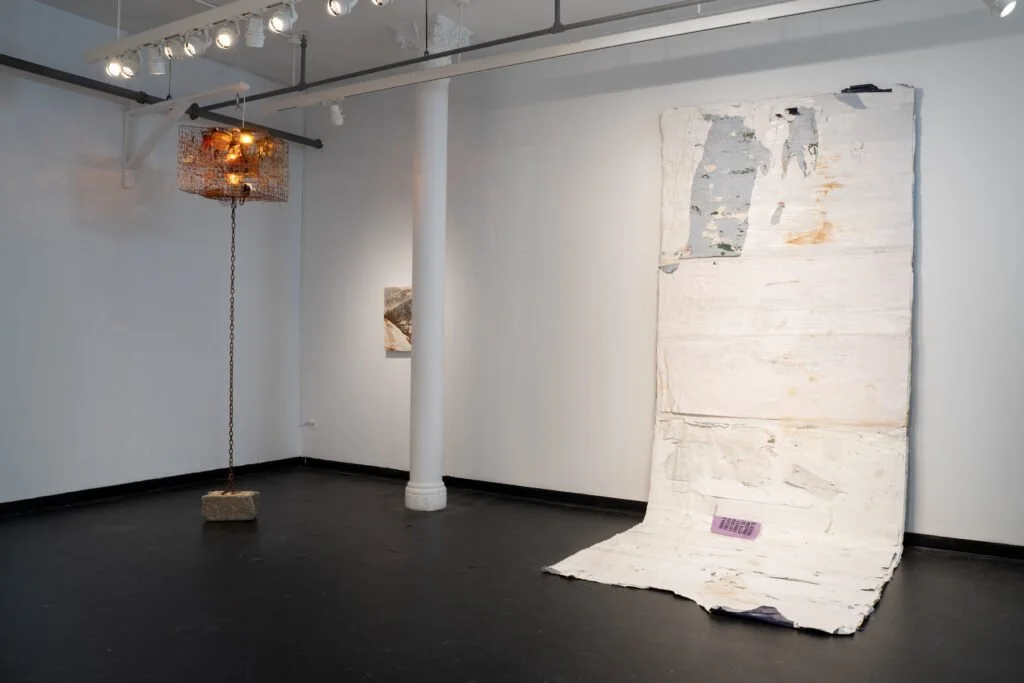
Installation view of Synthetic Traces. Courtesy the artists and PS122 Gallery.
The curator writes in the accompanying pamphlet to the exhibit: “The exhibition invites viewers to step into this terrain of fracture and perseverance, to witness how collapse leaves not only ruins but also echoes—traces that demand attention, care, and reckoning.” Taken together, the works in the exhibition do not seek resolution so much as attentiveness. Through fragments of infrastructure, animal bodies, posters, light signals, and shifting materials, time is neither abstract nor linear but lived, weathered, and accumulated.
Synthetic Traces was on view at PS122 Gallery from November 8th to 30th, 2025.