Behind the Scenes in CDMX: Work in Progress
During Mexico City Art Week 2026, a new mode of experiencing art is taking shape—more paused, grounded, and human-centered. Amid the art fairs, Work in Progress (WIP) is an interactive art festival that peels back the curtain on artistic process, allowing audiences to engage directly with artists and their raw, ongoing practices. Rather than centering finished objects, the project draws attention to everything that exists behind an artwork, proposing an alternative that invites visitors to meet artists and allows for community building. With process at its core, WIP involves fifty artists with programming across 20 satellite artist studios; here, five of them reflect on their studio routines, what it means to be an artist today, and the local creatives who inspire their work.
Anni Garza
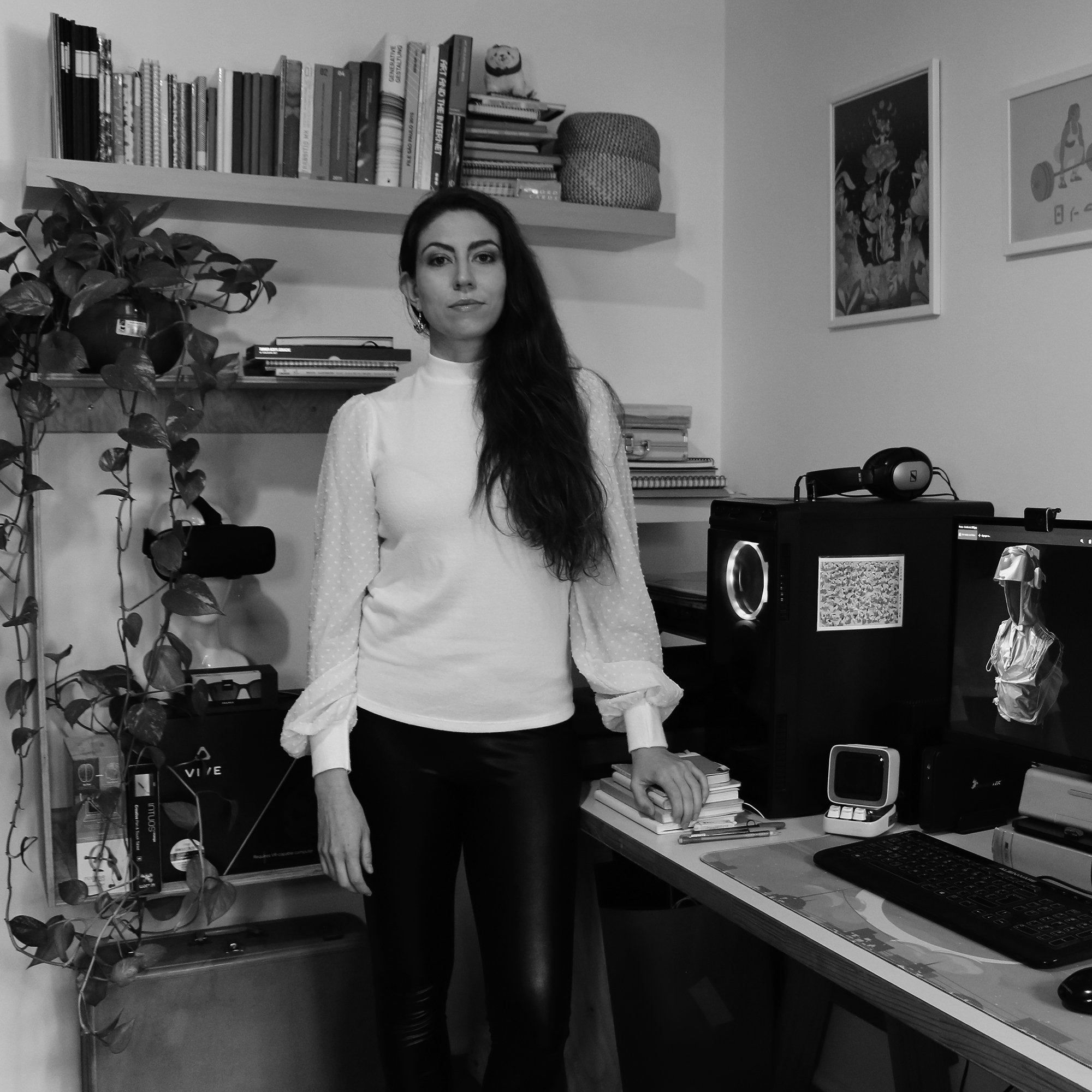
Anni Garza. Self-portrait, courtesy of the artist
Anni Garza presents Environmental Disturbances, a reworking of a brainwave-reading piece originally developed in 2012. In this iteration, real-time landscapes are generated through locally run AI—operating entirely on the artist’s computer—using data drawn from a climate-change database.
The work simultaneously captures live webcam footage to detect the emotional responses of viewers. Based on these emotions, every two minutes the system selects one of the one hundred sites most affected by climate change and its causes—including large-scale AI usage—and generates a news-style textual description modulated by the detected emotional tone. The result is a constantly shifting environment that merges live imagery, audience affect, and real data.
Indira Priscilla: Do you have a ritual when working at the studio?
Anni Garza: First, I think it’s very important to identify the time of day when you’re most productive. For me, it’s the morning—after working out, having breakfast, and drinking coffee. I usually start by reading for a few minutes to focus and get inspired by other people’s thoughts related to the themes I’m working on. I try to avoid emails or social media during that time, and then I make a list of the tasks I’d like to complete.
To be honest, it gets much harder after lunch, but sometimes I find renewed energy around 8 or 9 pm. I consider myself very disciplined, and this routine might not resonate with every artist. There are days when it becomes tiring, and on those days I try to go out and meet other artists and friends just to talk.
IP: What’s your favorite part about being an artist?
AG: I mostly enjoy the freedom to decide what I want to do, what I want to research, and who I want to collaborate with. Although deadlines exist, I can usually organize my time and give each part of the process the attention it needs. I’ve also enjoyed the places and people I’ve encountered along the way. Traveling has always been important to me, and for the past twenty years I’ve had many opportunities to do it. It really expands your world and your point of view.
IP: Name three local artists who inspire you.
AG: Diego Trujillo Pisanty, Malitzin Cortés, and Iván Abreu. I really admire their work, processes, and outcomes. I also deeply respect the work Amor Muñoz has been doing in recent years.
That said, there are so many names. Just last December, Minerva Hernández, María Antonia González, and Lena Ortega organized the LATAM Fem Lab, where more than forty women working in art, science, and technology gathered to share their research. It was incredibly inspiring.
Charles Osawa
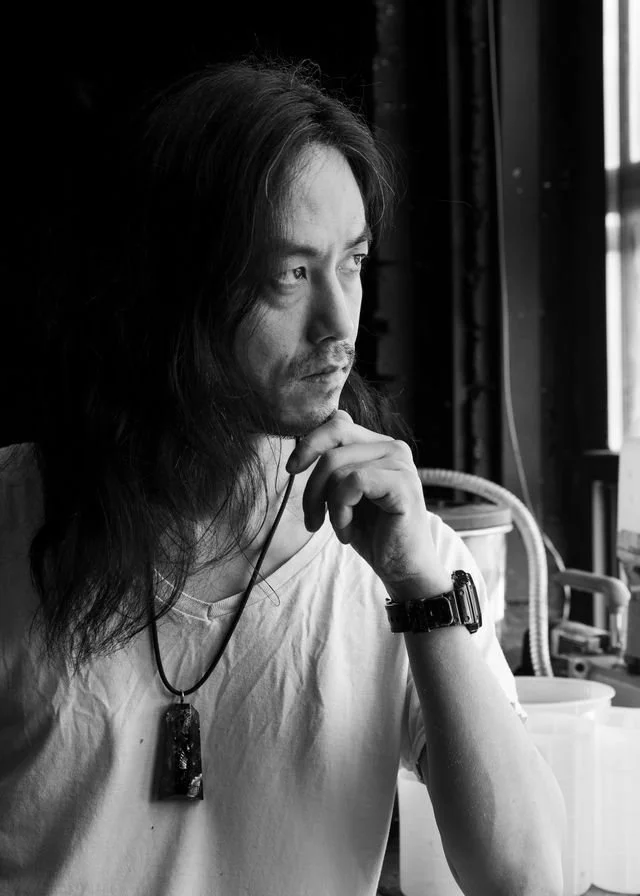
Charles Osawa. Self-portrait, courtesy of the artist
Charles Osawa presents a resin-based work that layers collected urban debris into a horizontal frame, transforming discarded materials into a preserved portrait of the city. By sealing trash within resin, the piece functions as an anthropological record, capturing everyday narratives of consumption and the material traces of contemporary life.
Indira Priscilla: Do you have a ritual when working at the studio?
Charles Osawa: Yes. I usually take about 15 to 20 minutes to focus and go over every step in my mind before working with resin. I can’t make mistakes, and there are many steps and tools involved. I walk in circles, play music or podcasts, and turn my phone off—or at least put it on airplane mode or “Do Not Disturb.”
I put on my eye protection first, then my gas mask. I usually already have my chef’s hat on; sometimes I add a headlamp, depending on the process. Gloves and apron come last, and then the journey of mixing resin begins.
IP: What’s your favorite part about being an artist?
CO: My favorite part of being an artist is having absolutely no schedule, no clear idea, and no restrictions. That freedom has taken me to unexpected places—like Mexico—and into situations where I get lost in expectations. I’m currently at a beginner level in French and Spanish, working toward mastering four languages. It took me a while to realize that having no plan or restrictions was actually a blessing.
IP: Name three local artists who inspire you.
CO: Luis Barragán has been my favorite Latin architect for decades. Frida Kahlo is my favorite female artist and, more broadly, my favorite Latin artist. I’m still learning about local artists in Mexico City, and while I’m not particularly drawn to Rivera, Orozco, or Tamayo, I’m excited to continue discovering the scene here.
Paulina Moncada
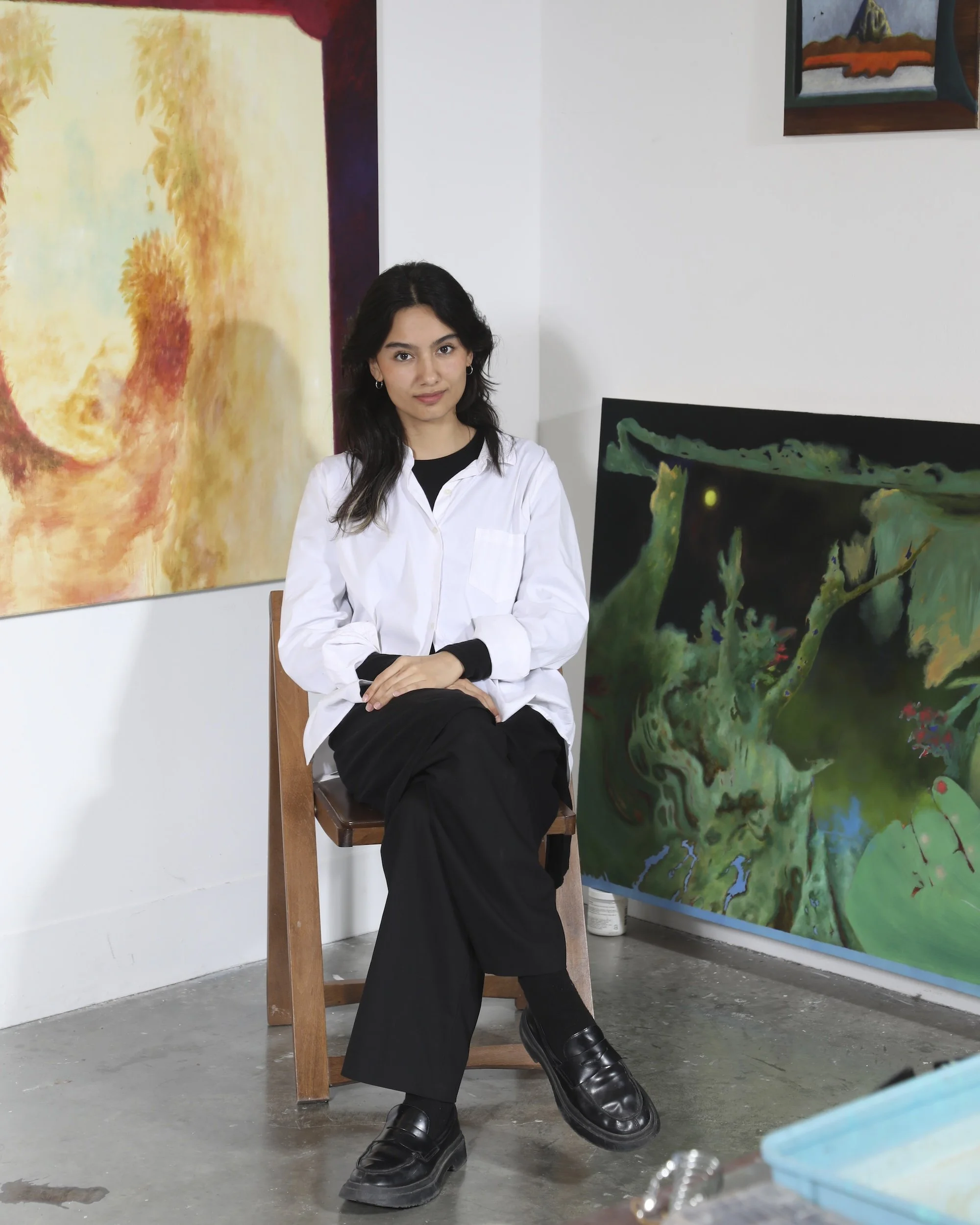
Paulina Moncada. Photo by Pat Garcia
Paulina Moncada presents a series of paintings that explore the notion of landscape and the frame in relation to the pictorial and the picturesque. These ideas, brought from Europe to the Americas during the colonial era, are revisited through a contemporary lens.
The works coexist and inform one another, functioning less as isolated paintings than as a constellation of images. Within Work in Progress, Moncada conceives the presentation as a single, expanded composition—a collage where images resonate and remain open to transformation.
Indira Priscilla: Do you have a ritual when working at the studio?
Paulina Moncada: I once read an interview with Andrew Cranston where he talked about having multiple paintings going at the same time, like a garden with many plants. He said caring for them meant understanding their timing and needs. Since then, I’ve worked that way.
I also leave books open in front of my paintings or sculptures so they can “read” and be nurtured by other artists I admire while I’m not in the studio. I’d say it’s a ritual of being present even when I’m not physically there, and letting the work have its own secret life.
IP: What’s your favorite part about being an artist?
PM: It’s the freedom to always become someone—or something—else. Even when thinking about consistency, what excites me is when the work surprises you and opens a path you weren’t expecting. Material and time do that for me.
Sometimes the work becomes quiet, and that’s when you know you have to give it time to change and allow a new question to form. I also value being able to have a conversation with both the past and the future—imagining the artists of the year 3000 alongside those of the first centuries. That way of thinking gives artists hope and the ability to imagine a future where art remains possible.
IP: Name three local artists who inspire you.
PM: I’m currently obsessed with Delcy Morelos. I don’t think anyone understands the kind of art we need today as deeply as she does. I’ve also been looking closely at Sergio Chavarría, a Mexican artist whose work excites me, and María Roldán Ruiz, who works with very fragile and poetic materials. I’d also add Sara Fernández, who works with photography and books.
Pia Watson
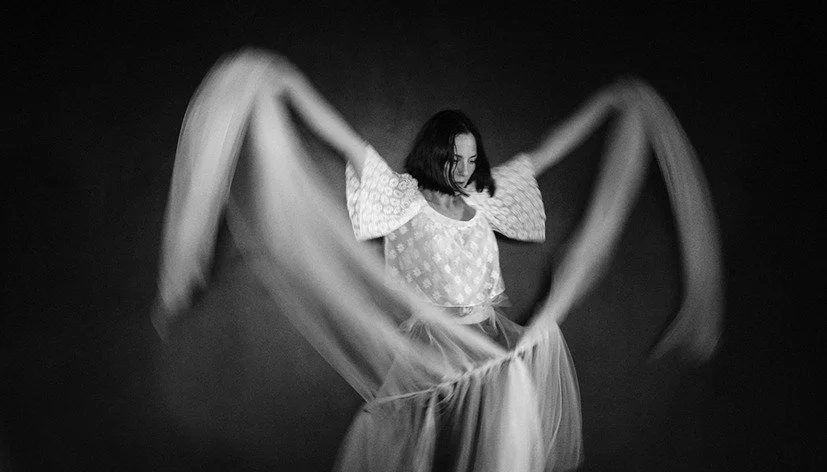
Pia Watson, Oracular Dance, video still, 2025
Pia Watson presents Telepática Universal and Cluster Cloud, two interconnected works in progress that explore subtle perception, collective intuition, and shifts between immersion and distance. Through participatory action and spatial experience, the projects examine how intention, coincidence, and sensory awareness shape shared perception.
Indira Priscilla: Do you have a ritual when working at the studio?
Pia Watson: I don’t have a fixed ritual—every day asks for something different, and I try to stay as present as possible to tune into that. When I work with movement and the body, I usually begin by sensing my physical and emotional state. I pair that with a song I’ll play on loop for days, and move, shake, and allow the body to fully embody the sensation. From there, symbols arise and guide the work.
IP: What’s your favorite part about being an artist?
PW: I love being able to obsess and hyperfocus on themes that excite me for long periods—reading about them, traveling for them, and talking about them—and then watching how those interests shift and materialize. Sometimes they lead to writing, other times to dance or photography.
My favorite outcome, though, is interaction. There’s an openness that can emerge between people through art, a kind of key that bypasses the rigid, protective structures people often carry.
IP: Name three local artists who inspire you.
PW: Sebastián Hidalgo, María José Petersen, and Adriana Medina, a clown artist.
Pablo Delgado
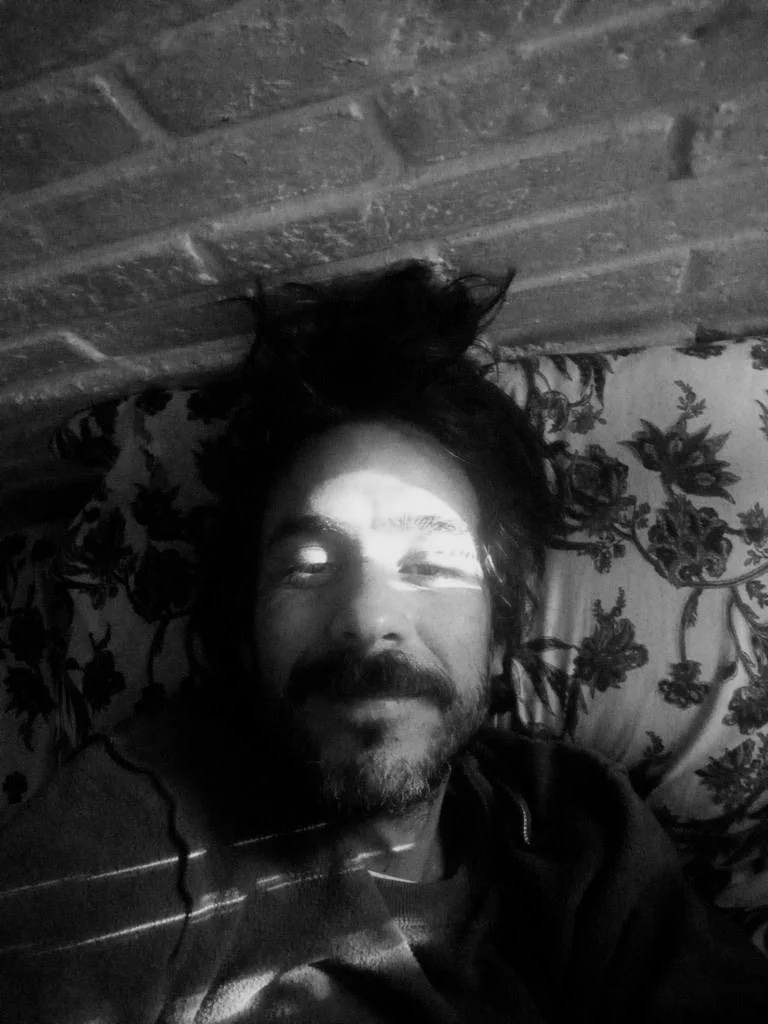
Pablo Delgado. Self-portrait, courtesy of the artist
Pablo Delgado presents Pequeñas verdades, where audiences are invited to witness artistic production in real time. Rather than offering full visibility, the artist deliberately obstructs the view of his workspace using boards or newspapers, allowing only partial glimpses through small openings.
Not all apertures lead to clarity—some reveal distractions, inverted truths, or visual obstacles. Inside the space, a character intervenes in the newspaper pages, censoring and altering information. The work reflects on mediation, visibility, and the instability of truth within processes of observation.
Indira Priscilla: Do you have a ritual when working at the studio?
Pablo Delgado: I wouldn’t call it a ritual so much as a necessary routine—something that gets me out of the house and into the studio. I had to build discipline to stay proactive even when there isn’t a specific project at hand, to show up on time without anyone checking on me.
The constants in my day are coffee and music. I usually revisit whatever I was working on the day before and continue from there, but if I’m not feeling it, I allow myself to step away until I reconnect. It’s often in that space that new ideas begin to surface.
IP: What’s your favorite part about being an artist?
PD: The feeling of an idea becoming real.
IP: Name three local artists who inspire you.
PD: Eder Salas, Hilda Palafox, Boris Viskin, and Francis Alÿs.
Work in Progress took place in Mexico City from February 1 to 8, 2026.