The Birth Control Tapestry: In Conversation with Alexandria Masse
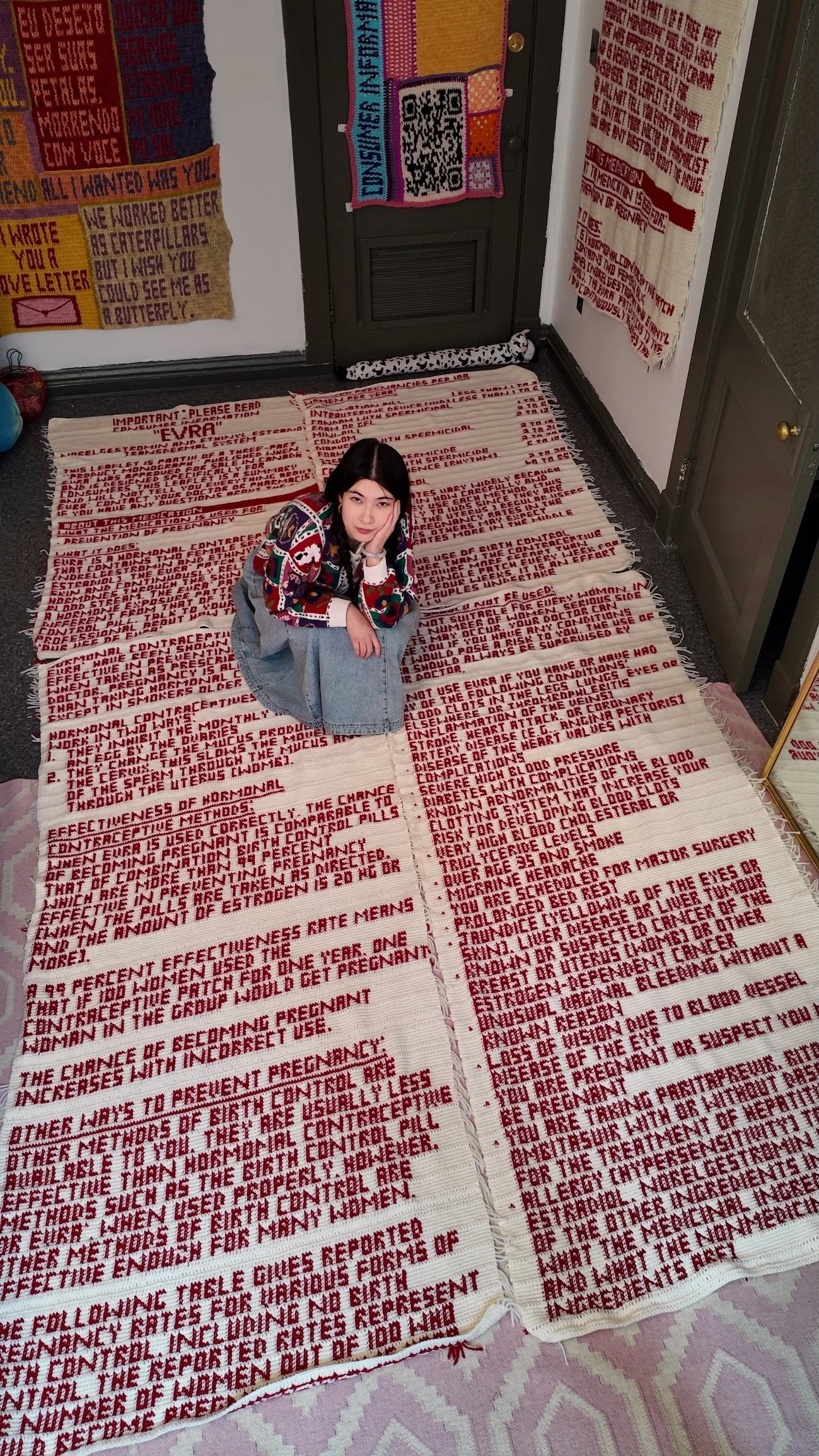
Alexandria Masse, Birth Control Tapestry, 2025. Courtesy of the artist
The National Women’s Law Center stated at the end of December 2025 that birth control rights and access are increasingly threatened in the US due to various measures introduced in the 2025 legislative sessions. In response to this, Alexandria Masse, a 25-year-old Canadian textile artist, has taken on an artistic endeavor to start a conversation about reproductive rights: each month, she spends her menstruation week working on an ongoing project, the birth control tapestry, in which she crochets her birth control information sheet word-for-word. Masse says, “I’m looking forward to this part of my cycle. Normally it’s the one you hate the most, but now I’m just like, oh, this is great.” In an interview with IMPULSE journalist Jill Webb, Masse discusses the journey of syncing an art project to biological processes and confronting a reality where discourses around reproductive healthcare are imbued with a renewed sense of urgency.
Jill Webb: In your own words, what is this project about?
Alexandria Masse: I started this project because I wanted to do something very large that really encapsulates what we are experiencing in this current era. I love art history, and I find that so many moving, inspiring pieces in history are ones that are an exact snapshot of their time.
I decided to start crocheting my birth control information sheet word for word. I actually hadn’t read it word for word until I started crocheting it, and I didn’t graph it out. I’m figuring it out as I go, which has been really fun.
It’s been interesting to see people’s reactions and the conversations that were started online, especially because algorithms right now really push for right-wing content. Putting something out there with a more positive take on reproductive health has been really interesting.
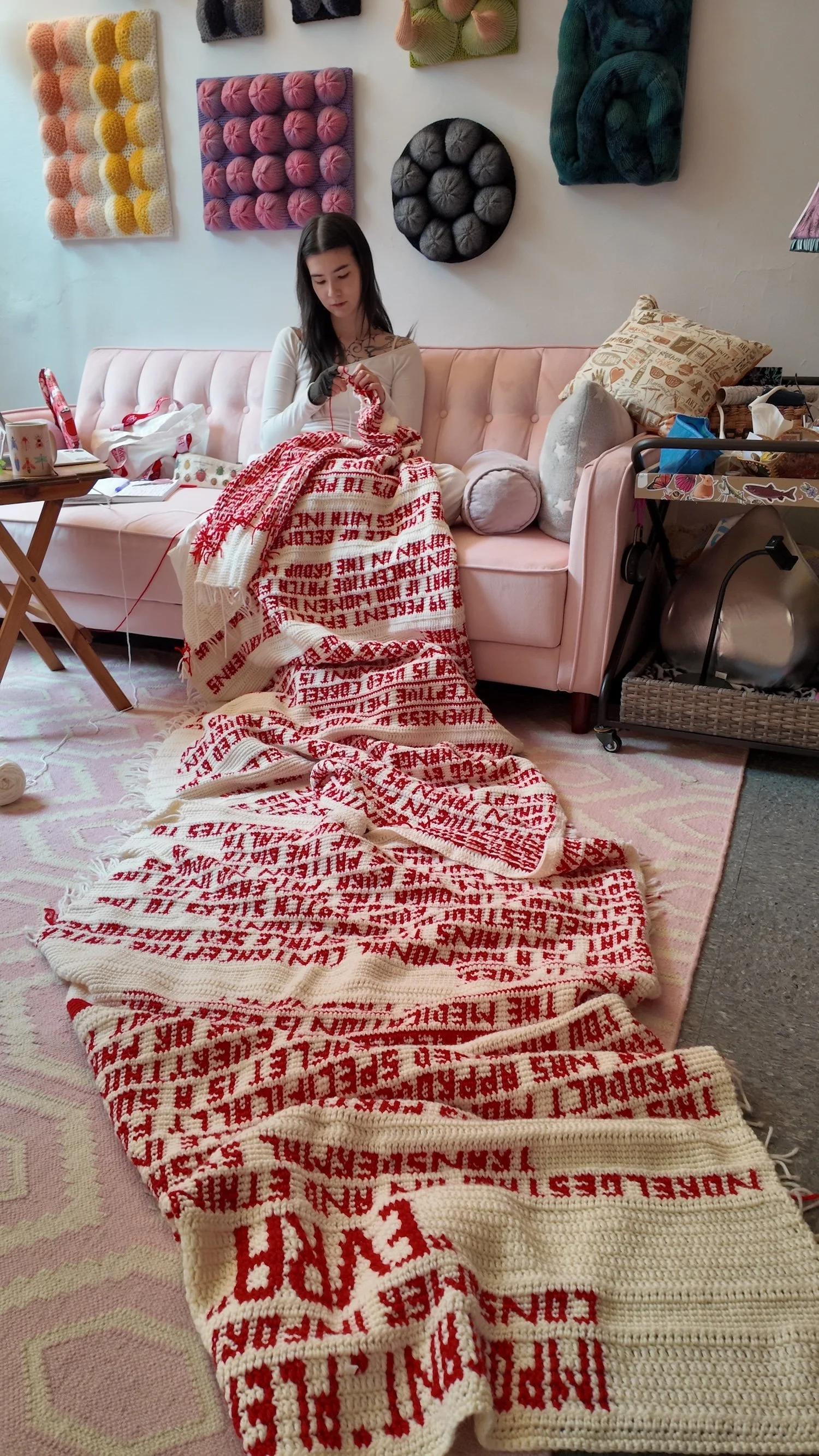
Alexandria Masse, Birth Control Tapestry, 2025. Courtesy of the artist
JW: You give a social media video update each time you get your period. What has it been like linking up an art project with a menstrual cycle?
AM: It’s actually been really fun, and it started a whole new relationship between me and my bleeding cycle. Sometimes I get a little frustrated when I post something online and find that many people misconstrue my message. I believe several things can be true at once . . . Are there a lot of side effects to birth control? Yes. But are there as many as people make it out to be? A very small percentage of the sheet is actually side effects.
A lot of people in my comments are advocating against birth control, like it’s poison for the body, etc. There are a lot of people complaining that options are limited, and it’s great that they recognize that. But instead of saying get rid of all the options, you should be saying, come on, let’s find better options for everyone. Let’s make sure everyone has access to reproductive healthcare.
I also get a lot of messages like, “I went to a gynecologist for the first time” or “I’m talking to my doctor about birth control for the first time, and it was because I was watching your videos.”
JW: What's the most interesting thing you’ve learned from the information sheet?
AM: That birth control changes your mucus, which helps prevent sperm from moving around.
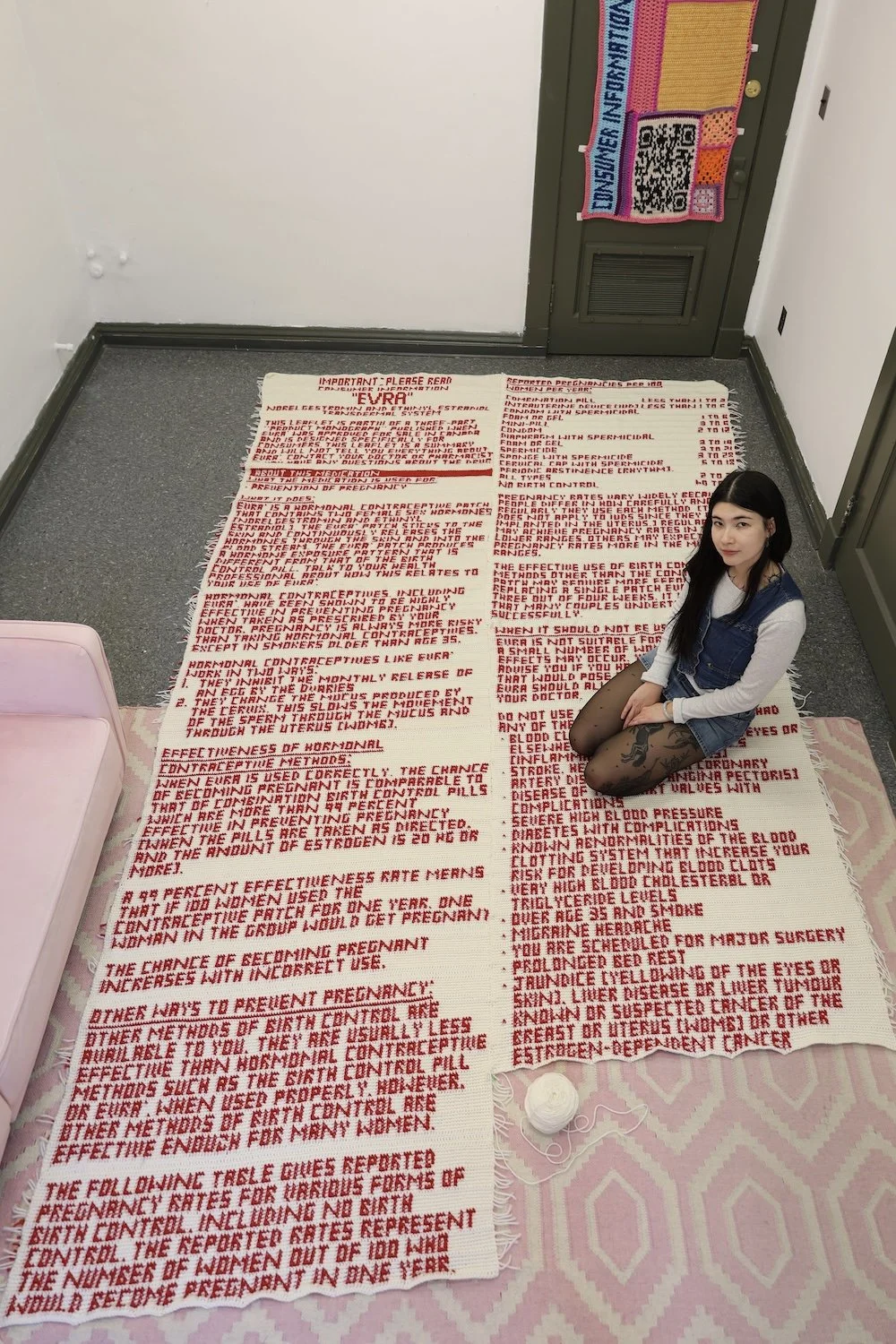
Alexandria Masse, Birth Control Tapestry, 2025. Courtesy of the artist
JW: What’s your timeline to completion? After you finish it, what do you want to do with it?
AM: I keep saying four years, but at the pace I’m working at right now, it’s looking more like six years. We’ll see once I get to like the illustrations—I’m sure I can go through those pretty fast.
Once it’s finished, I would love to display it at a museum or a gallery. I totally envision having it sewn together like one giant pamphlet and hanging it on a wall. Displaying it on the ground, having people look over a balcony, and seeing the whole sheet would be really cool too.
I think it’s about 17 pounds right now, which is pretty heavy. I am assuming that at the end of it, it would be at least 200 pounds. I'm going through a lot of yarn, too. Luckily, Knit Picks, the yarn company, has been gracious enough to gift me the yarn for this project, since yarn is quite expensive. When I’m working on this tapestry, I go through like a ball and a half a day.
JW: You are weaving this tapestry together at a time when birth control access is being unraveled. What's it like to deal with the juxtaposition of that?
AM: It’s very sad and frustrating to turn on my phone every day and see so many agendas being pushed online that are against reproductive healthcare. I get a lot of people who are just like, “Well, birth control is poison, and if you are a real feminist, you wouldn’t want to be on birth control.”
It’s like, no, women fought and died a hundred years ago to make sure they could have access to birth control. Women were having so many kids, and they were performing abortions on each other at home. They created and fought for medical birth control so women could have autonomy over their own bodies. Watching that be misconstrued and twisted online to fit a specific right-wing agenda is very frustrating, and it’s very disrespectful, I think, to the woman who fought so hard for this medication to be available for us.
This interview has been edited for clarity and length.