Scene Missing, Still Sounding
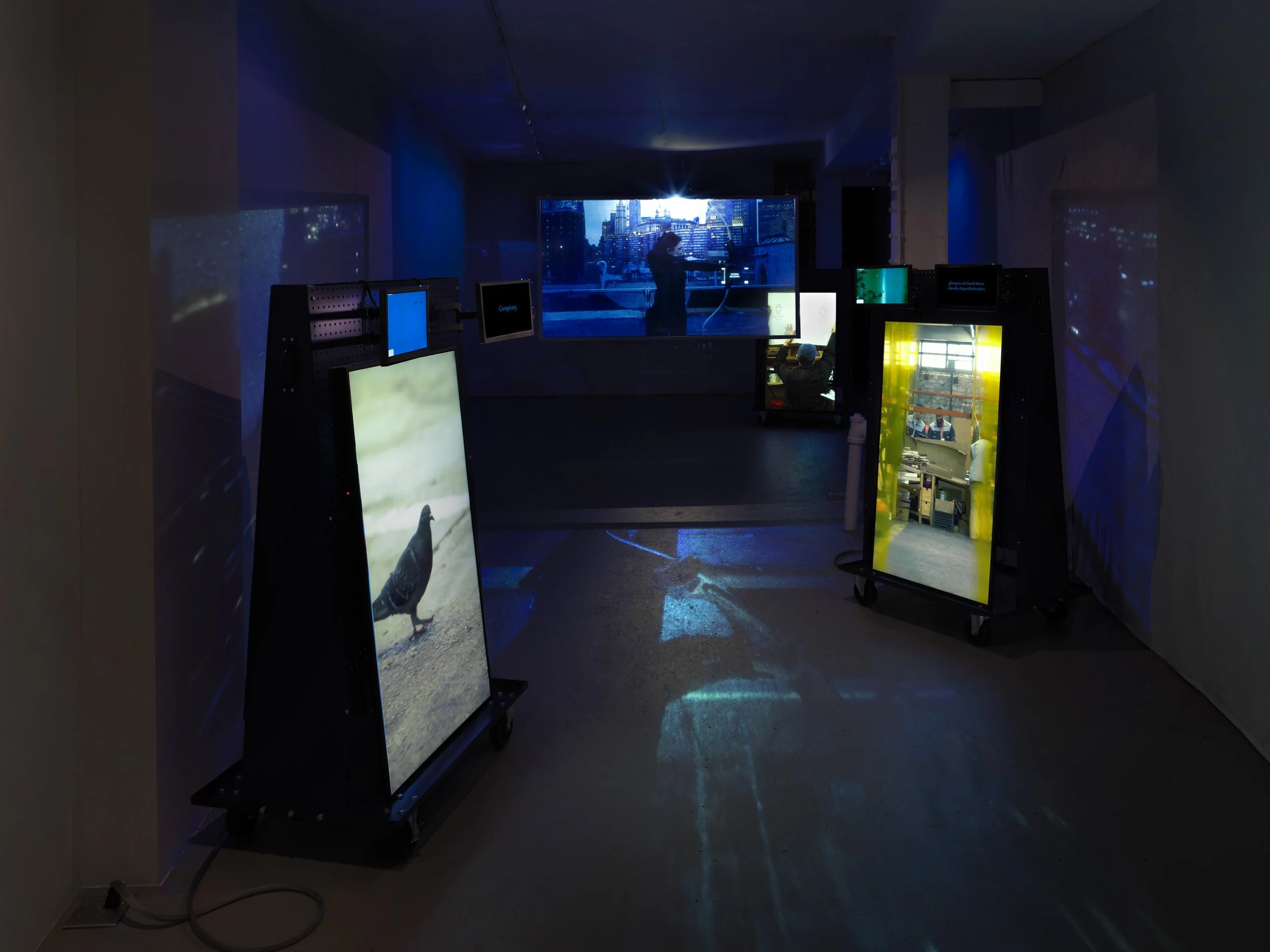
Alison Nguyen, Perforation, Ellipse, 2026. Multi-channel video, color, sound, glass screen, steel, casters, gold on aluminum, colored gels, 11' 16" loop. Exhibition view of Alison Nguyen: Perforation, Ellipse, Storefront for Art and Architecture, New York. Courtesy the artist and Storefront for Art and Architecture. Photo: Dario Lasagni.
A ten-channel moving-image installation infiltrates the narrow triangular strip of Storefront for Art and Architecture. Populating both ends, the installation evades a single capture; its time does not unfold in a single direction. Screens of varying scale flicker in shifting constellations, most mounted on perforated industrial carts, echoing the factory setting of Alison Nguyen’s latest film, Aisle 9 (2026). The largest of all screens hangs from the ceiling. Translucent, the projection bleeds beyond its screen onto walls, floors, and the bodies of viewers, while the projector’s own light is laid bare. On it, an archer—played by Nguyen herself—is more than a performer; she is the conductor shifting the time and space of the media choreography. The arrow’s audible release reconfigures the screen constellations, shifting pairs and larger alignments across the nine channels. Each viewer enters Perforation, Ellipse mid-loop, encountering a different arrangement of footage and sound cycling between Aisle 9 set in a speculative future, nhạc vàng singers in contemporary Vietnam, and cinematic apparatus exposed. Nguyen’s multi-channel media choreography at Storefront for Art and Architecture stages affective conditions of censorship registered corporeally, not cerebrally.
First entry upon Perforation, Ellipse can be disorienting: sensation arrives before meaning, image before narrative, music before source. In one footage, figures in workware move through a warehouse—working, scheming, and playing cards. On smaller monitors, suited men gathered around card tables—figures that implicitly recall the Cold War political backrooms that haunt the film’s speculative backdrop. These, confirmed by the artist, were from newsreel footage surrounding the 1973 Paris Peace Accords, which aimed to end direct US military involvement in the Vietnam War. Nguyen’s metrically configured multimedia choreography is characterized not by sequence, but circulation. Whether atmospheric or deliberate, the rhyme between the workers scheming in Aisle 9 and these archival figures introduces a sense of historical return—a reverberation not only between the Cold War past and the projected present, but into the speculative future the film inhabits. The carts carry this hunch further: under certain lighting, the gaps between two adjacent monitors recall the perforations of 16mm film.
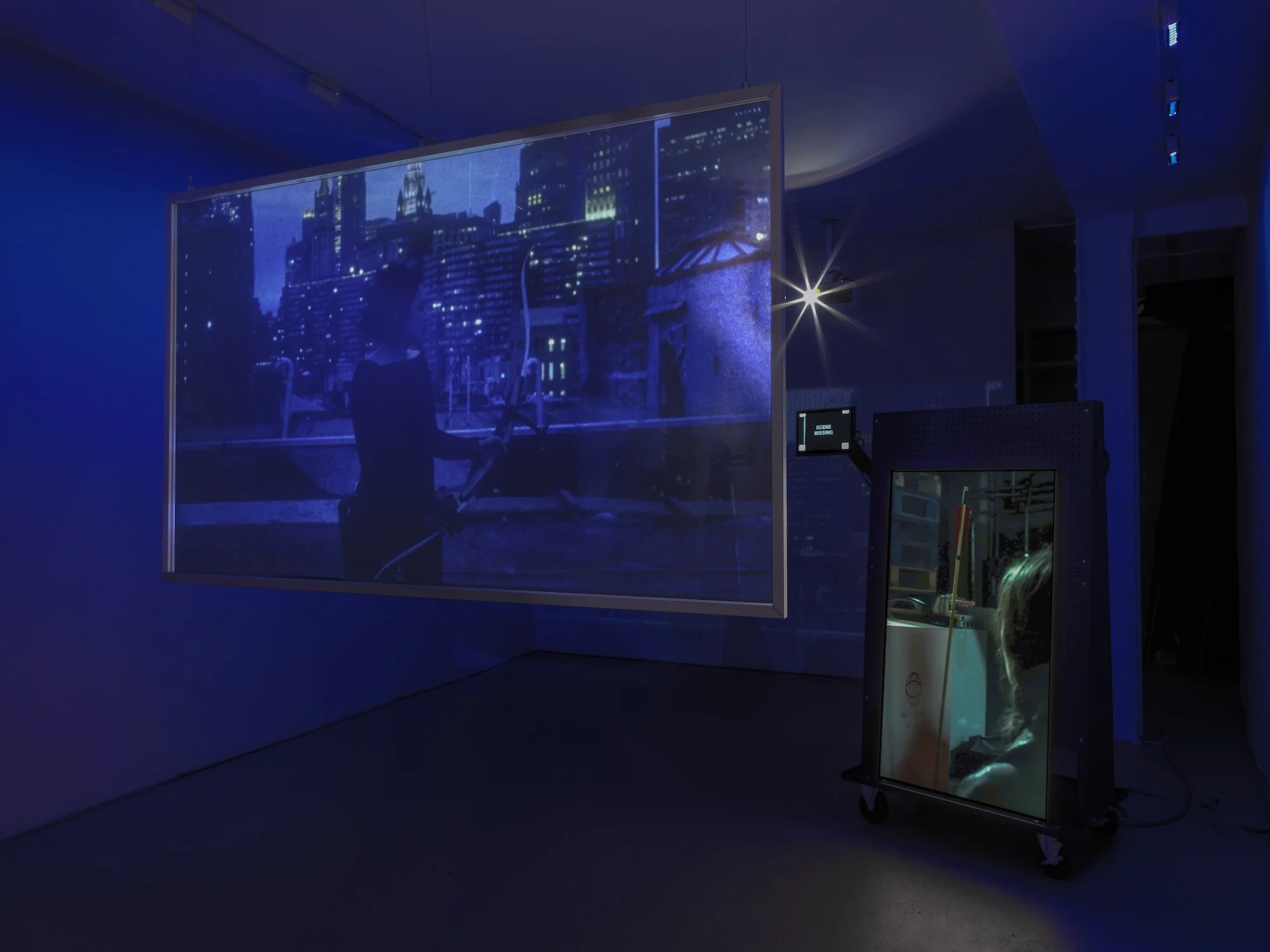
Exhibition view of Alison Nguyen: Perforation, Ellipse, Storefront for Art and Architecture, New York. Courtesy the artist and Storefront for Art and Architecture. Photo: Dario Lasagni.
At intervals, stark intertitles appear in all caps: “SCENE MISSING.” In film production, the phrase marks what has been cut, removed from archives and circulation, and thus from public memory. Here, absence is not documented but performed. The censored part is filled instead with heterogeneous footage: contemporary nhạc vàng (Vietnamese bolero music) performances drawn from the internet—archives of a genre that survived draconian suppression—alongside painted celluloid strips and film leads that expose the materiality of film. Silvia Federici, Pope L., and Takahiko Iimura, among others, gather across various corners of the gallery, the handout, and the public program as direct citations or homage.[1] Federici’s 1985 poem “In Praise of Conspiracy Theory” appears across the small monitors as part of the media choreography; the poem and excerpts of Pope.L’s Hole Theory (2022), alongside other texts, are reprinted in the exhibition newsprint. A collection of seminal artists’ works is invited as interlocutors for Nguyen’s own “conspiracy theory” of Cold War censorship, its logics made visceral through the very apparatus of cinema.
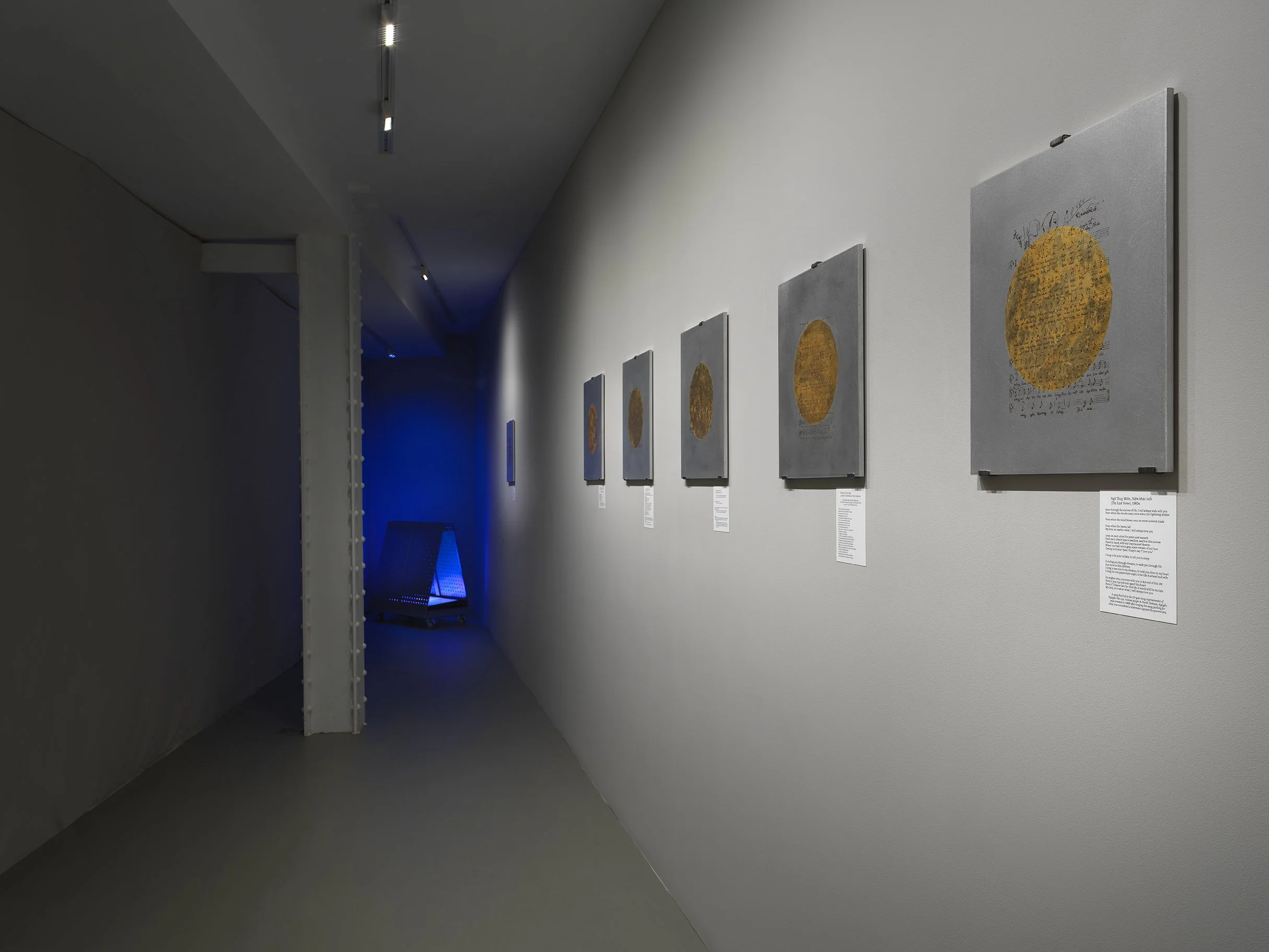
Exhibition view of Alison Nguyen: Perforation, Ellipse, Storefront for Art and Architecture, New York. Courtesy the artist and Storefront for Art and Architecture. Photo: Dario Lasagni.
“Ellipse” finds its most literal form in the series of six eponymous aluminum panels lining the corridor—the only fixed points in an installation of mobility. At the center of each, a large, gold circle is juxtaposed with fragments of nhạc vàng sheet music and lyrics. The genre, pejoratively referred to as “yellow music” or “gold music,” was banned in 1975 with the establishment of the Socialist Republic of Vietnam for lyricism and musicality that the state deemed as too romantic and ideologically poisonous.[2] Nguyen hand-gilded each circle—a slow, meditative process of repeatedly applying gold leaf,[3] imagining them as counter-archives: records of not what has been state-sanctioned but of what survived through informal circulation, a consecration for what it survived, and accountability for what was severed from public memory. To inscribe its lyrics in gold is to honor and withhold simultaneously: using a material historically reserved for the consecration of sacred and canonical objects reflects this yearning, a gesture of recuperation for what political history has severed from public memory for far too long.
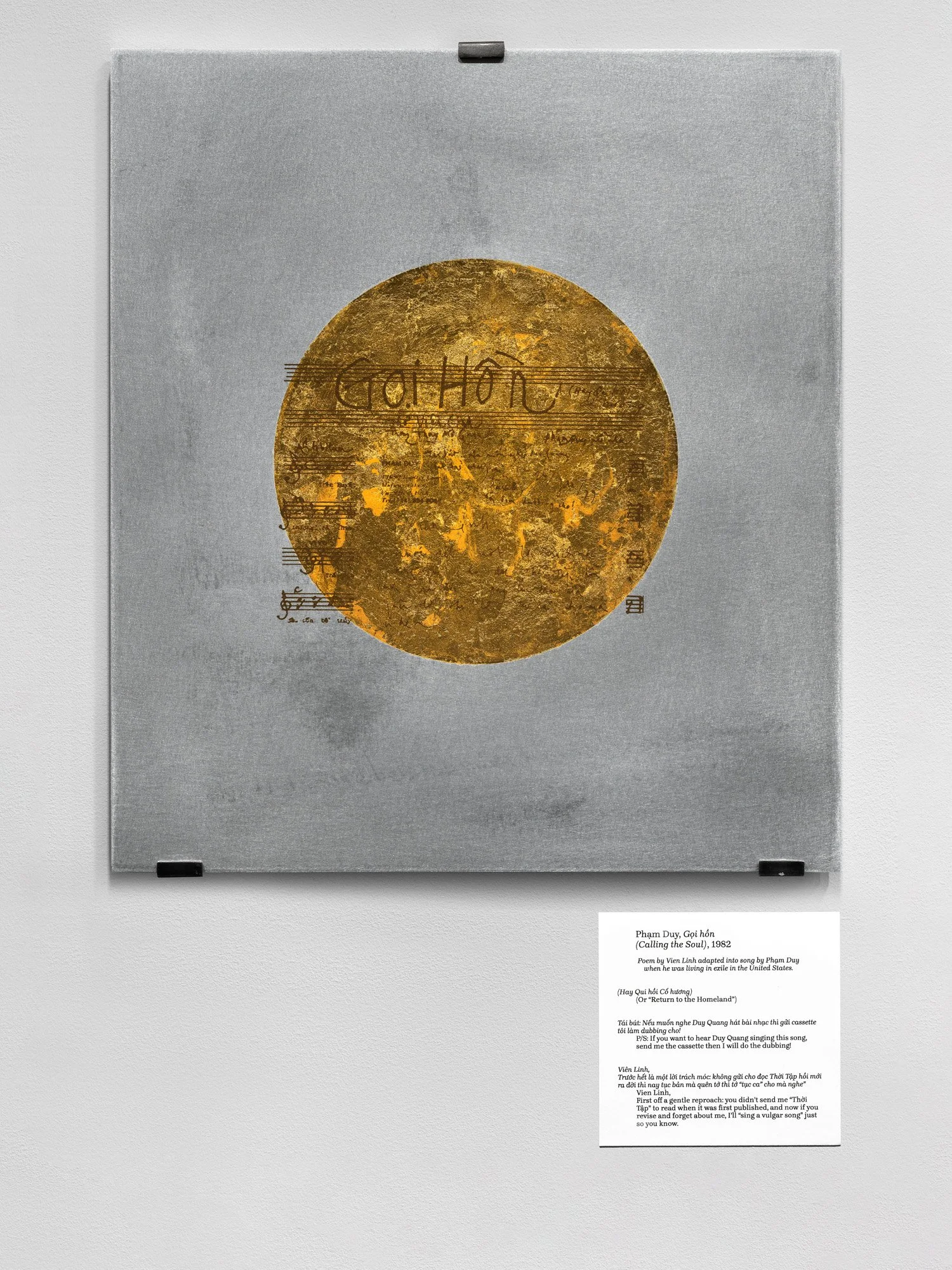
Alison Nguyen, Ellipse 3, 2026, gold on aluminum, 16 x 18 x 3/8 in.; 40.64 x 45.72 x .95 cm. Courtesy the artist and Storefront for Art and Architecture. Photo: Dario Lasagni.
Each work in the series is accompanied by captions listing metadata, translations, and the material consequences of its song’s performance and circulation.[4] What the state could not permit, in each case, was not ideology, but affect: as ethnomusicologist Barley Norton observes, authorities censored these songs because they “encapsulated people’s powerful emotional responses to the tragedy of war and their yearning for peace.”[5] Following John Street, this music did not just carry political expression—it was that expression, embodied in its affective texture.[6] In addition to the gilded sheet music, Ellipse 3 preserves handwritten notes by prolific songwriter Phạm Duy from 1982. Written while living in exile in the US, he wrote: “If you want to hear Duy Quang singing this song, send me the cassette, and I will do the dubbing!” Quotidian acts of exchanging tapes and cassettes became material infrastructures of survival.
Henri Bergson understood the inextricable relationship between lived experience and memory: “There is no perception which is not full of memories. With the immediate and present data of our senses, we mingle a thousand details of our past experience.”[7] To encounter nhạc vàng visually and sonically in Perforation, Ellipse is not to hear it for the first time. Here, it arrives already carrying everything it has passed through.
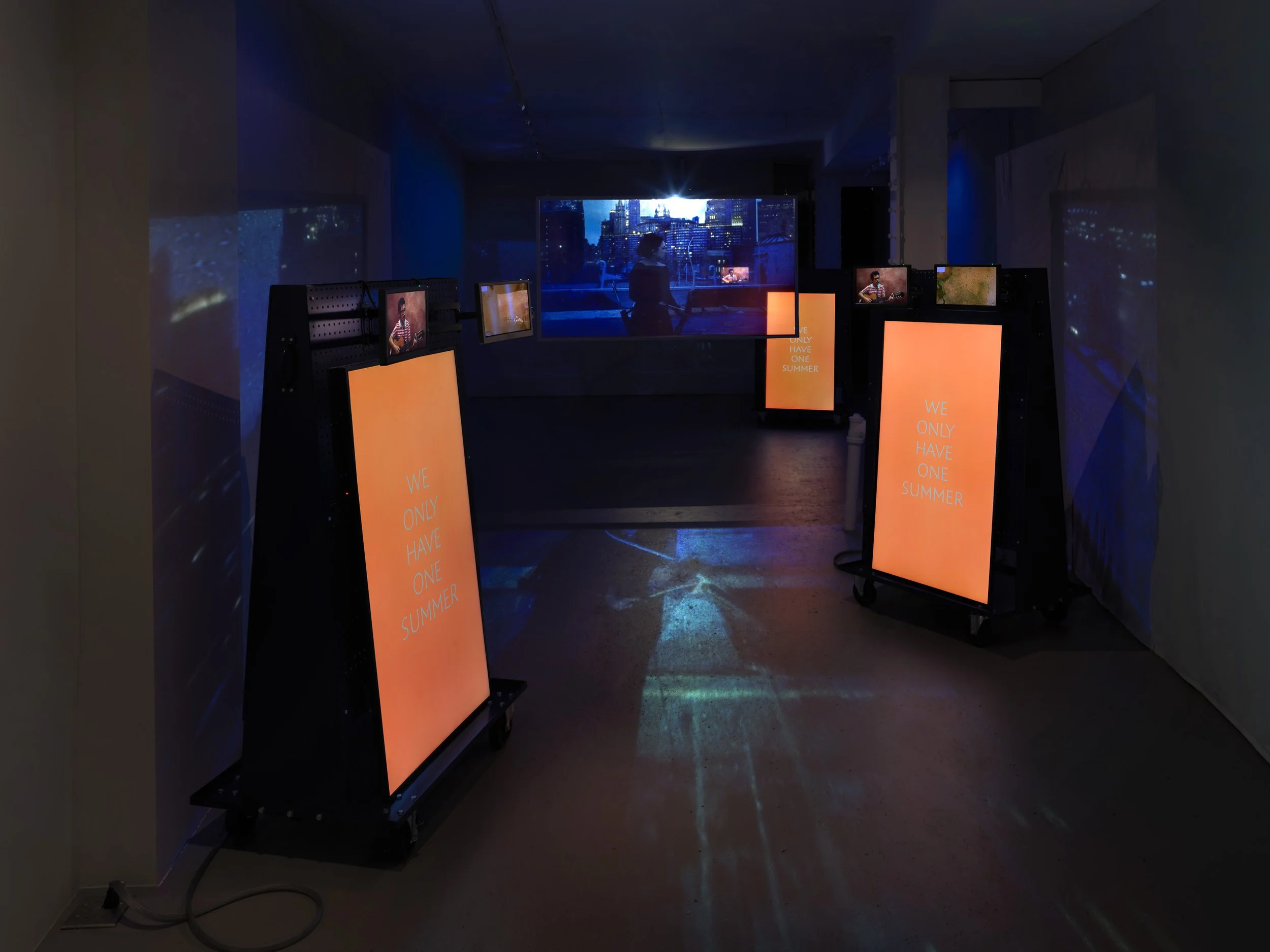
Alison Nguyen, Perforation, Ellipse, 2026. Multi-channel video, color, sound, glass screen, steel, casters, gold on aluminum, colored gels, 11' 16" loop. Exhibition view of Alison Nguyen: Perforation, Ellipse, Storefront for Art and Architecture, New York. Courtesy the artist and Storefront for Art and Architecture. Photo: Dario Lasagni.
In cinematic time, the loop enacts Zeno’s arrow paradox: arrival is infinitely deferred. Unlike the vitrine-bound presentation common to archival-based practices, Nguyen’s media choreography is undeniably embodied—it does not separate the corporeal from the cerebral. Nhạc vàng survived its oppression not through preservation but through transmission: in pirated tapes circulating through black market channels and through cover songs embodying a longing, a quietly resistant spirit of love, a yearning for peace, transmitted across generations. Perforation, Ellipse operates on the same logic. In connecting multiple spaces and temporalities, activating internet sources and creating her own counter-archive, Nguyen creates a space to, in Federici’s words, conspire—“etymologically breathing together,” resisting monolithic, government-constructed narratives of histories far more complex.[8] At a time when the promise of free movement is fracturing as never before, a disorientation like this acts not as aesthetic strategy, but survival.
Alison Nguyen: Perforation, Ellipse is on view from January 27 through March 28, 2026.
[1] See Perforation, Ellipse exhibition newsprint for full program.
[2] Barley Norton, “Music and Censorship in Vietnam since 1954,” in The Oxford Handbook of Music Censorship, ed. Patricia Hall (Oxford University Press, 2017), 314–315.
[3] To learn more about Nguyen’s practice, see Alison Nguyen and Lumi Tan, “Perforation, Ellipse,” The New Social Environment #1326, Brooklyn Rail, online event, March 4, 2026.
[4] Nguyễn Văn Lộc, a blues singer in North Vietnam, was arrested in 1968 and sentenced to ten years in prison for publicly performing Ngô Thụy Miên’s Niệm khúc cuối—a love song. Trịnh Công Sơn's Ta thấy gì đêm nay, banned in 1969, was not licensed for performance until 2013. His Ngủ đi con—a lullaby for a son who died at twenty—was banned the same year.
[5] Norton, “Music and Censorship in Vietnam,” 325.
[6] John Street, Music and Politics (Polity, 2012), 1.
[7] Henri Bergson, Matter and Memory, trans. N. M. Paul and W. S. Palmer (Dover Books, 2004), 152, quoted in Lisa Baraitser, Enduring Time (Bloomsbury Academic, 2017), 152.
[8] Silvia Federici, “In Praise of Conspiracy Theory,” in Midnight Notes #9 (May 1988), 41. Reprinted in exhibition newsprint for Alison Nguyen: Perforation, Ellipse, Storefront for Art and Architecture, New York, 2026.