Reanimating the Archives with Polina Osipova
Against exhibition openings that prize the sterile and impersonal, visiting A Living Inheritance feels like coming home: earnest and unostentatious. Set against the hybrid and domestic gallery space of JO-HS Gallery in SoHo, Polina Osipova’s New York City debut offers a tender intimacy and care that the mainstream often misses.
A woman in the lobby catches me scanning the keypad and invites me in. In the elevator, I ask how long she’s worked with the gallery. “I actually just met the gallerist earlier today. We got to chatting about the opening, and she realized they’d need someone to let people in, so here I am!”
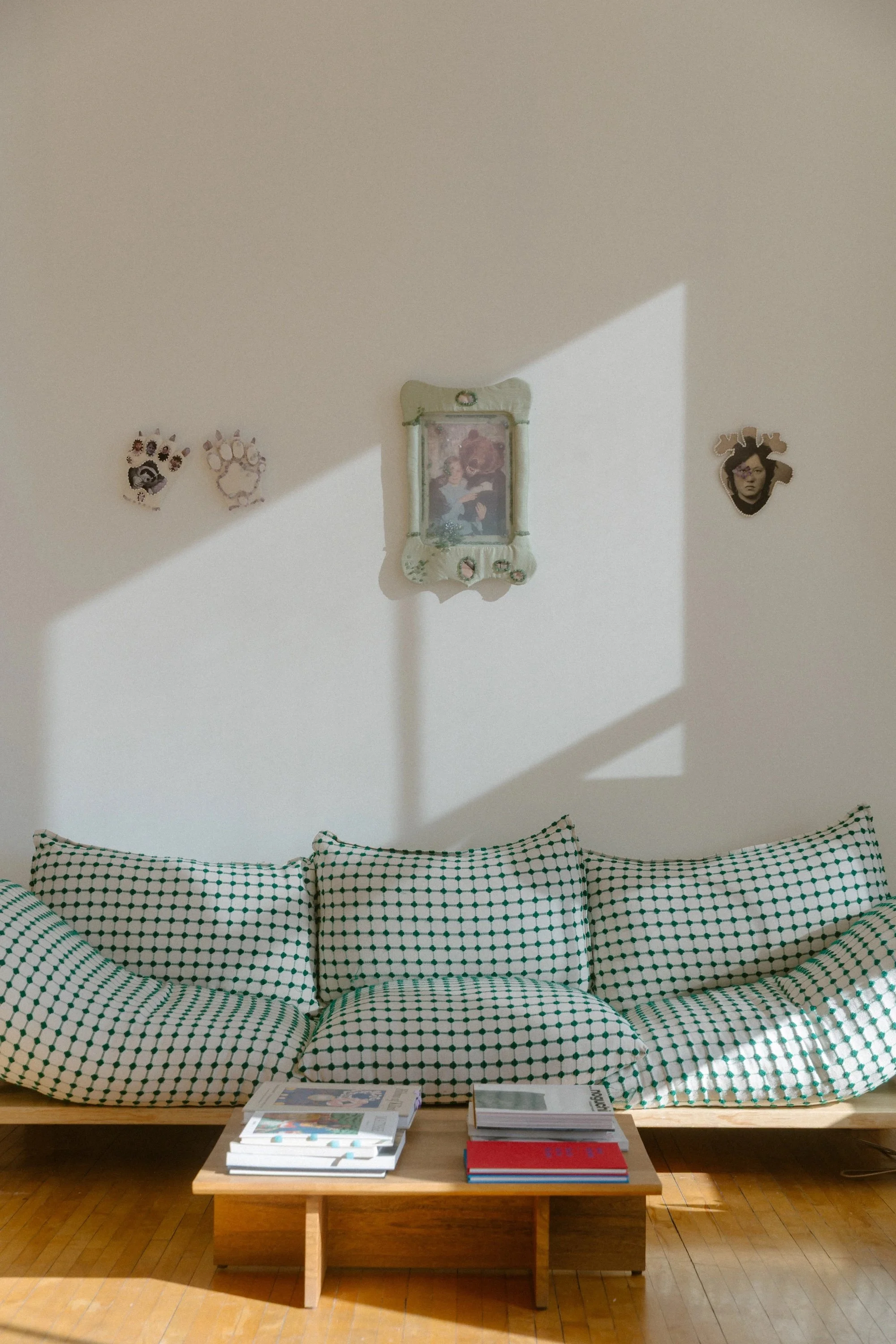
Installation view of Polina Osipova: A Living Inheritance. From left to right: Paw (2025), Crystallised Paw (2025), Soft Dream (2025), Crystallised Heart Portrait (2025). Photographed by Nikita Gorlov, courtesy of the artist and JO-HS gallery.
I drop my coat with the others on a green patterned couch framed by several small works. Among them is Soft Dream (2025), which features a photograph of the artist as a young girl posing with a taxidermy bear, set in a frame of glacial green silk. Paw (2025) and Crystallized paw (2025) expand the bear’s presence in the room, giving it crystal claws and toe pads printed with family photographs, one featuring a child’s stuffed bear toy.
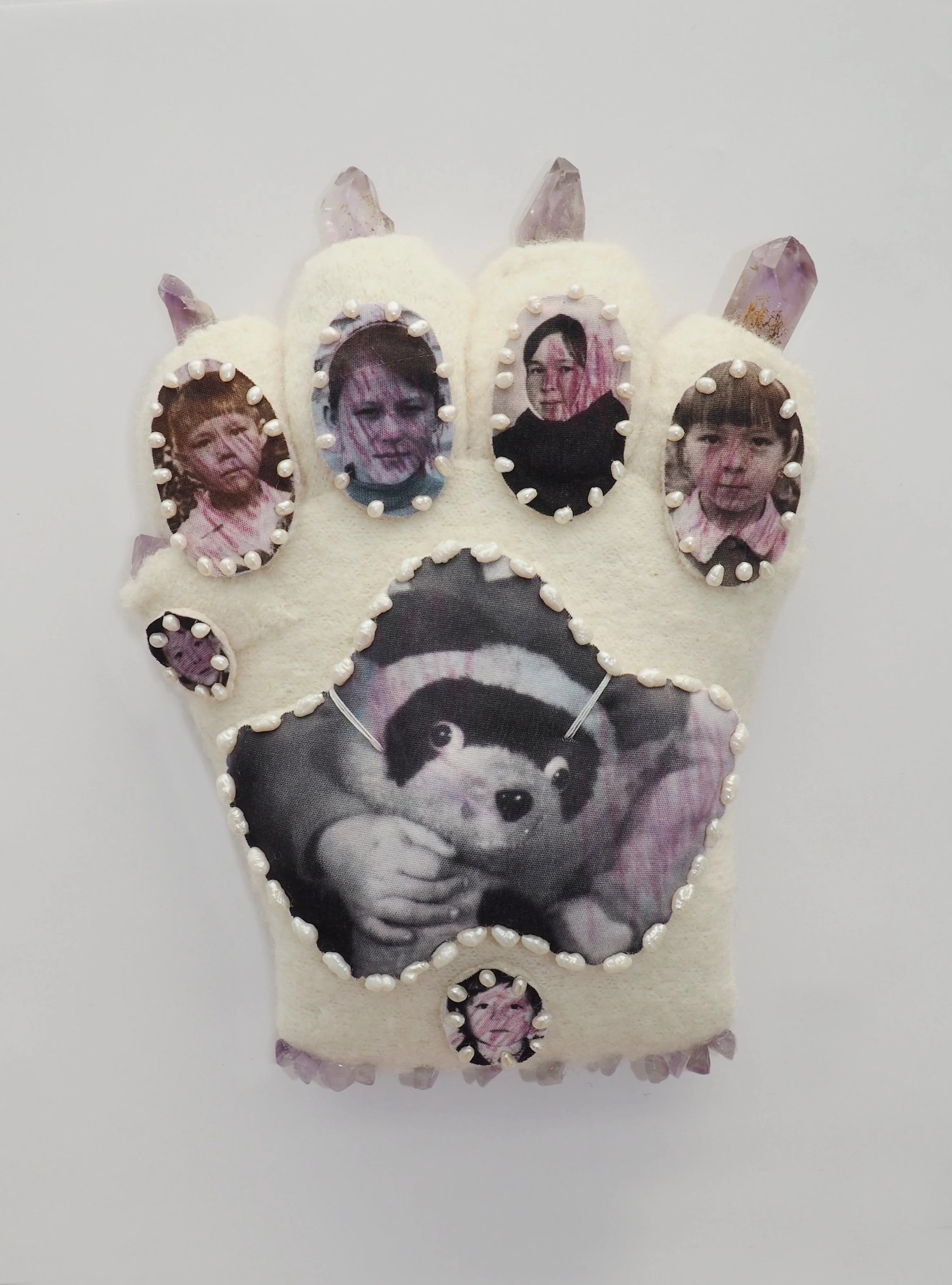
Polina Osipova, Paw (2025). Photographed by Nikita Gorlov, courtesy of the artist and JO-HS gallery.
The room is rich in mystic and nostalgic symbols, which reappear throughout the artist’s body of work to weave together the past and present. Heart of memories (2025), Cave mask (2025), and Crystallised heart portrait (2025), for example, each present their subjects in the shape of an anatomically correct heart. Made from fabric and photographs, each work beats with devotion, its stitches serving as proof of the loving and often invisible labor of keeping ancestral memory woven into the fabric of our lives.
The convergence of these two accessible and somewhat undervalued mediums is a hallmark of Osipova’s practice. Textile has been historically associated with “women’s work” and reduced to functional craft. The vernacular and archival photography that Osipova employs is similarly considered documentary rather than conceptual: many of the photographs she incorporates commemorate formal portraits and blurry moments of children at play, likely taken by a caregiver’s loving hand.
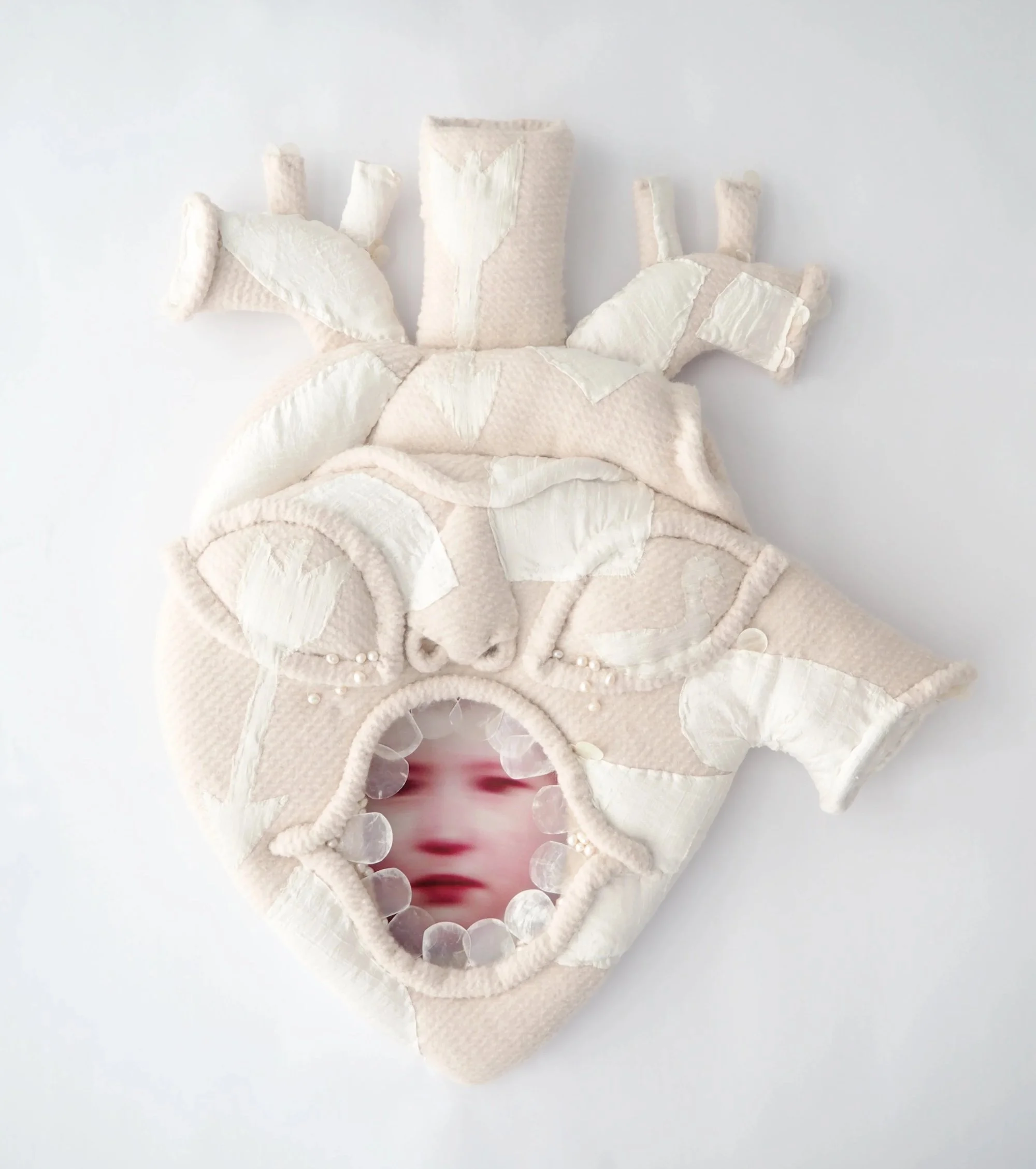
Polina Osipova, Cave Mask (2025). Photographed by Nikita Gorlov, courtesy of the artist and JO-HS gallery.
Osipova often brings these two historically disparaged mediums together at the site of her body: pictures of eyes and ears are braided into a necklace of blonde hair; a matriarch’s commanding gaze emanates a quiet power from the center of a white cotton dress. By wearing and documenting her interactions with this self-referential work, the artist honors photography and needle arts not only as meaningful, accessible tools for historical authorship and preservation, but also as avenues for childlike play and folkloric imagination. These pieces go beyond venerating or preserving the past to build—and celebrate—a joyful, magical future.
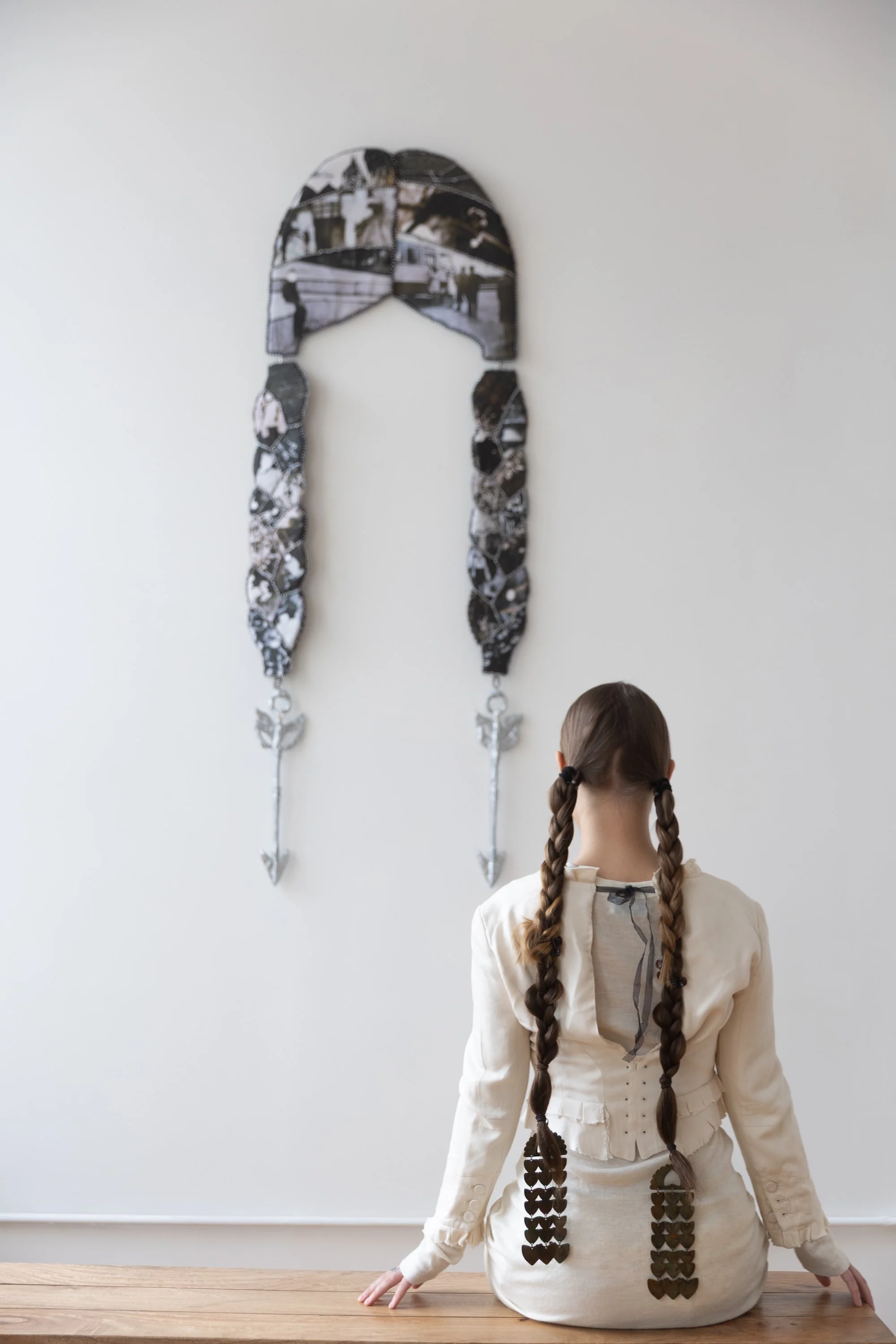
Portrait of Polina Osipova wearing Chuvash braid adornments in front of Braids of Remembrance (2025). Photographed by Nikita Gorlov, courtesy of the artist and JO-HS gallery.
Tucked into an alcove of its own, Braids of Remembrance (2025) is a continuation of this gesture. Photos from the artist’s oft-mined family archives are arranged into the shape of her recognizably long, braided hair, finished at each end with silver arrows to represent the Chuvash hair adornments she frequently sports, sometimes referred to as Shashbau.
While this braid jewelry is often referred to as shashbau (şaşbaw) or sholpi (şolpị̈) across Turkic languages, their Chuvash titles can be translated to mean “flowers” and “stones,” enriching Osipova’s use of beaded crystals and floral imagery with hereditary symbolism (see: Birthplace (Roots) 1 (2024).
Osipova’s work has been unmistakably inspired by Chuvash garments, embroidery, and cultural history on both an individual and collective scale. The Chuvash people represent just one of many ethnic minorities whose traditions and stories have been persecuted, erased, and pushed to the periphery of dominant narratives of Russian identity. In this light, the artist’s continuation and innovation of traditional craft offers a narrative anchor for the cultural legacies of her distant and immediate lineage, bringing these stories out of the archives and birthing them into a living, breathing contemporary materiality by stitching, braiding, and shaping.
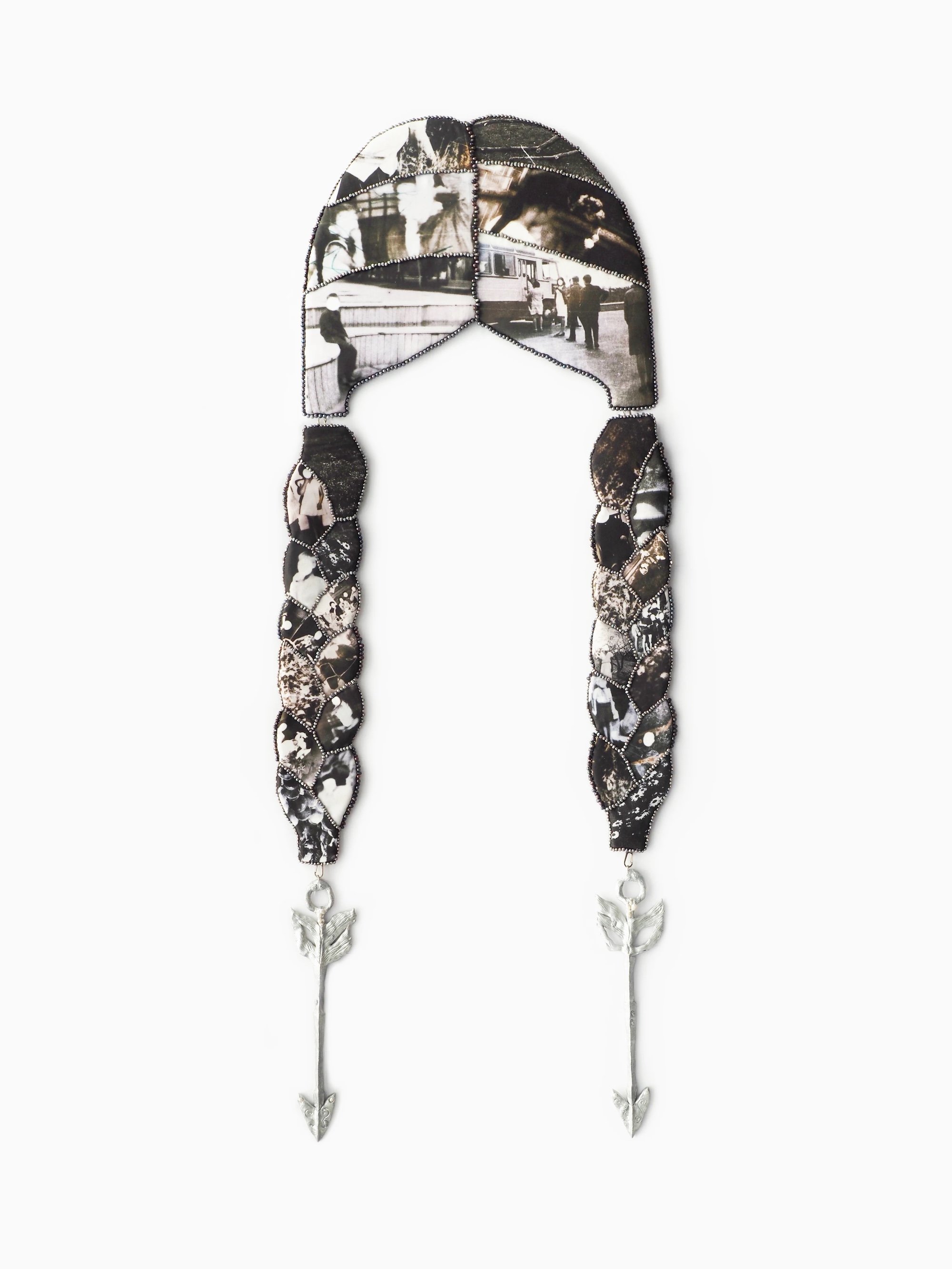
Polina Osipova, Braids of Remembrance (2025). Photographed by Nikita Gorlov, courtesy of the artist and JO-HS gallery.
Gazing into the interlocking images which are sectioned into the Braids of Remembrance (2025), I notice something I haven’t seen in Osipova’s work before: bright white voids mark the fabric where faces should be. She explains that in some ways, this evolution not only affords anonymity to her family members but also universalizes the work. While accounts of Chuvash inheritance may have appeared distant to some viewers, now anyone can see themselves in the archive.
Osipova’s early works have criticized authoritarian surveillance practices, as evidenced by masks that weep blood beneath crowns of pearl CCTV cameras, so it feels natural that she introduces the protection of obscurity to the subjects she depicts with such reverence.
Often encrusted with amethyst and pearls, Osipova’s pieces read as self-contained altars, talismans enchanted with the strength and tenderness of the past. In another early work, The Armor of Memory (2021), the protective presence of one’s ancestors materializes into a physical shield, demonstrating the power of the consciousness contained within one’s ancestral archives. In Crystallized Memories (2025), this narrative extends past the need to protect and expands towards the desire to fly, evoking the wings of a guardian angel that ushers us towards our destination.
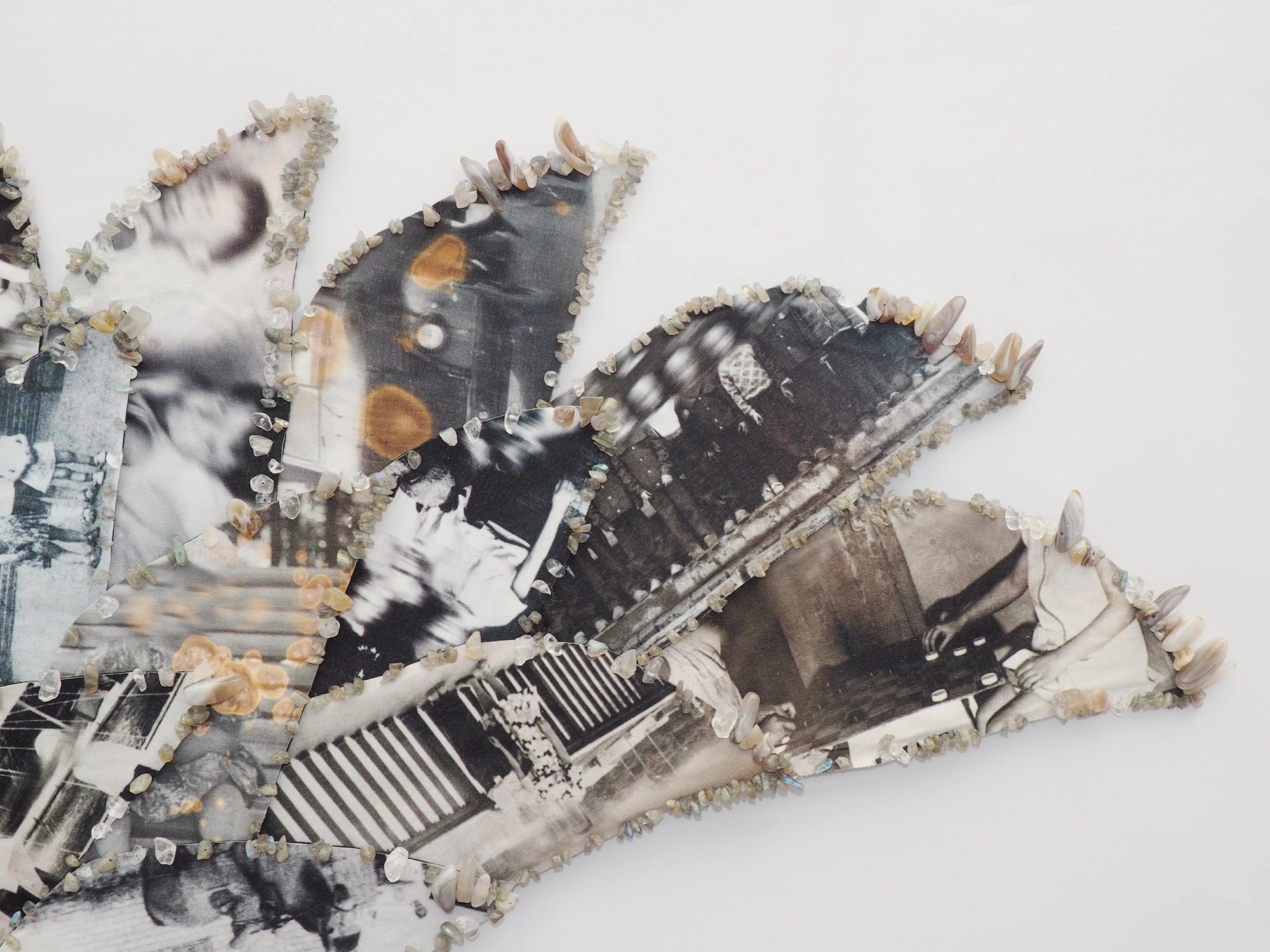
Details of Crystallised Memories (2025) by Polina Osipova. Photographed by Nikita Gorlov, courtesy of the artist and JO-HS gallery.
Despite their elegance and symbolic complexity, Osipova’s sculptures remain meaningfully approachable at JO-HS, offering visually recognizable narrative threads to follow through the collective unconscious. The gallery’s domestic aura—with chic, comfortable couches, a kitchen table, and a wine bar hidden behind a partition—lets visitors imagine these pieces living alongside them in their own homes. In a similar fashion, Osipova’s work invites viewers to locate the memories that build their own personal mythologies. The blank faces in Braids of Remembrance ask: what stories are you made of, who wrote them? And who will tell them, if not you?