.jpeg)


“That Was Then” at Picture Theory
Review
Danspace Project’s double-bill of new works by Malcolm-x Betts and Dominica Greene lives in the coda, considering everything that emerges after the end. Inside the sacred space of St. Mark’s Church, both performances question how to defy the constraining logic of linear time to persist in the here and now.
Performed by Malcolm-x Betts, Molly Lieber, and GENG PTP, fly baby fly (2025) honors Betts’s older cousin Michael, who died of AIDS when Betts was a child. Yet, as Betts repeatedly insists, “This isn’t about you.” Betts, perhaps, is not only mourning the loss of Michael, but also naming the collective grief and instability he feels in the midst of an ongoing pandemic. “Don’t die for community dick,” Betts yells into the mic over and over. The undercurrent of his monologue at the piece’s midpoint warns of the risk: the devouring potential of loving and wanting too much.
Michael’s presence is embodied by a harp, which Betts cradles in his arms at the start of the performance. He plucks and strums its divine strings, increasing the speed and intensity at which he moves his fingers until he is desperately yanking at the body of the instrument. As the music beautifully swells and crashes over the audience, Betts crumples onto the ground in a momentary state of prayer before rising and falling to his knees again in quick succession.
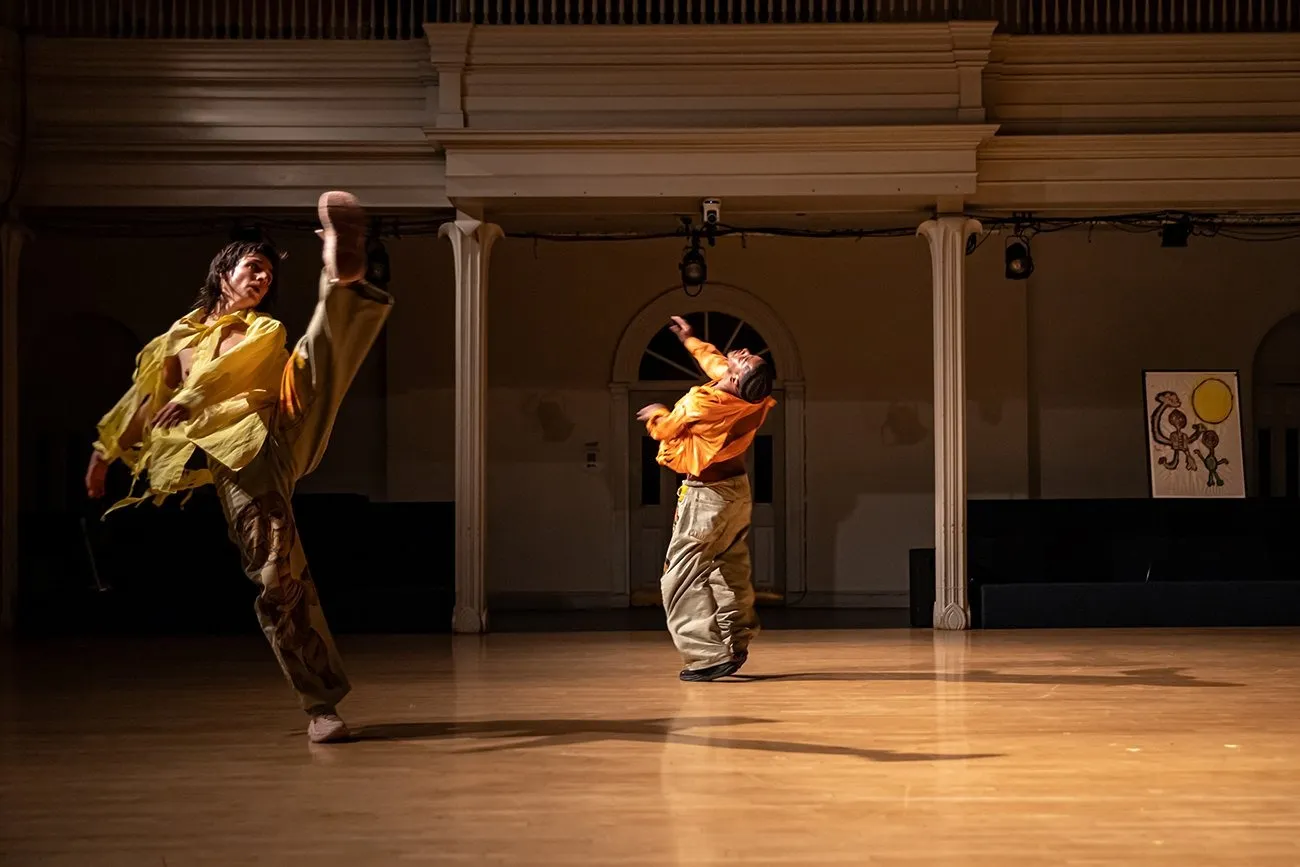
Betts and Lieber vibrate around each other, moving with such fluidity and speed that they seem to take flight. They ragefully dance through the rapture beside unseen angels. The pair’s propulsive movements are amplified by GENG PTP’s charged sound design. At one point, Betts wraps his arms around a column and leans forward, allowing Lieber to climb onto his back and reach an energy drink that is perched on the ledge above. Planting her sneakers onto Betts’ shoulder blades, Lieber opens the metal can and gulps. And for a moment, the audience believes that the drink has truly given her wings.
Dominica Greene’s endlessend (2025) extends the evening’s holy service. At the start of the performance, Greene rolls out into the center of the room and rests on her back, basking in the glow of the spotlight that frames her body. She savors its warmth, leisurely lifting her torso in the direction of a white pedestal stand fan. Visualizing her grandparents’ home in Guyana, she transports her body back to the island and retells the story of how she discovered the fan on a not-so-distant summer day.
Greene first noticed the “rickety, rackety” fan in her grandparents’ den because of its syncopated, unpredictable clink. Its sound, like a pulsating club beat, hooked Greene, and after persistent conversations with her aunt and grandmother, she received permission to bring the fan back to New York. Weeks later in Brooklyn, the fan’s telltale sound disappears. Its blades stop moving; the motor breaks down. Only after a failed visit to the local electrician does Greene discover a way forward: while carrying the fan in her arms outside, she realizes that it can still operate as long as there is enough wind to move its blades. Greene demonstrates this to the audience, running and spinning fast enough to move air through the machine herself. Her body reanimates the lifeless fan. “You didn’t have to be dead. I just had to create the right conditions for you to live,” Greene breathlessly pants. She cannot run forever, though, and eventually she must place the fan down onto the floor.
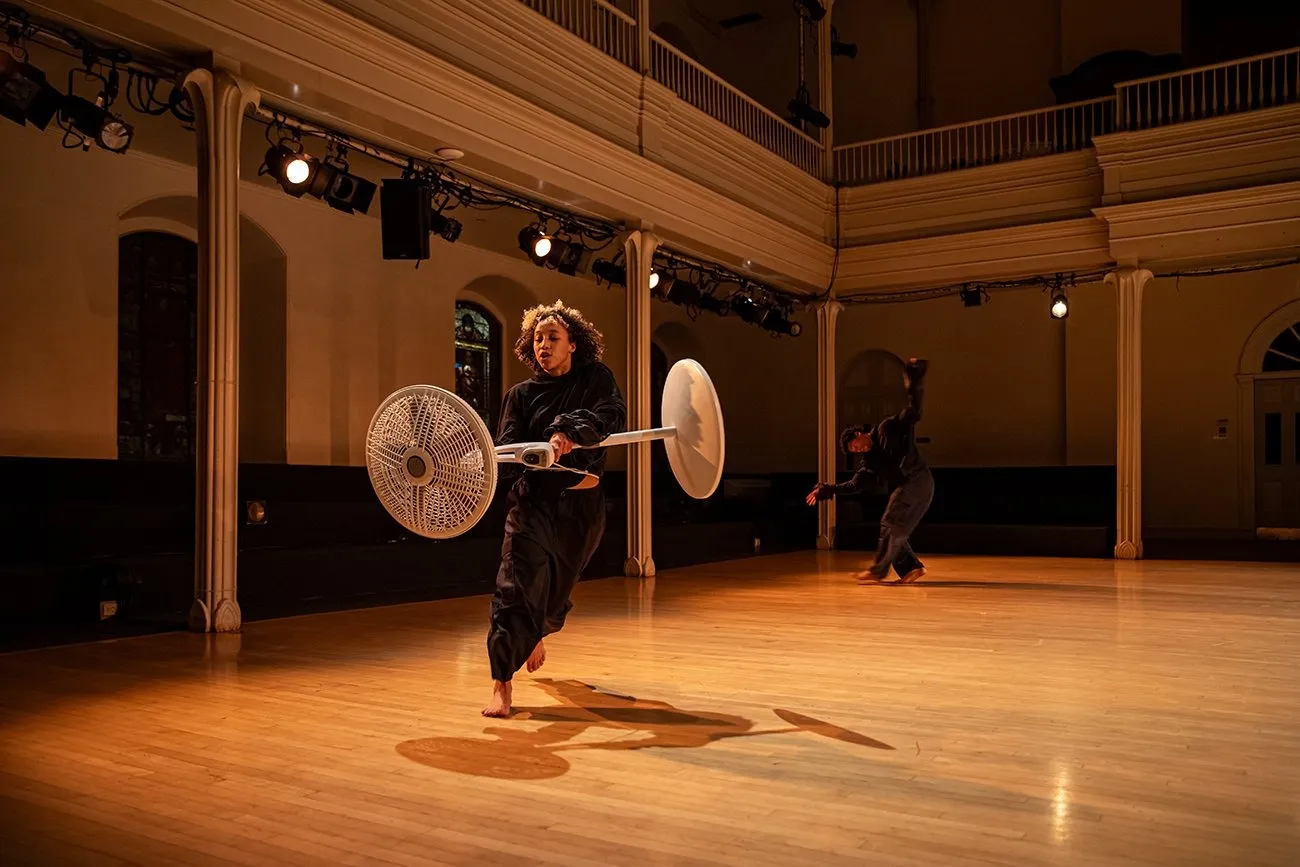
Alongside collaborator Garrett Allen, Greene delivers a tender, earnest performance. The two glide in circles, creating a sense of boundlessness whenever they embrace and melt into each other. During their final tableau, yards of black fabric (created by costume designer James Gibbel) cascade from Allen and Greene’s sleeves. Limbs stretched across the room, Allen and Greene hold each other. Their bodies form an unending infinity loop.
Even after the lights fade to a blackout, the conventional signal of a scene or show’s end, Greene continues to speak. “How about we transcend the end a little bit?” she quietly asks. The premiere of endlessend takes place only a couple of weeks after the passing of Greene’s grandfather, to whom the piece is dedicated. His presence is felt in the work and in the performance’s insistence that even after you lose someone or something, you can breathe life into their memory. Though we may not be able to deny death, it does not have to be final. Movement sustains legacy; the dance can always start over again.
Malcom-x Betts: fly baby fly and Dominica Greene: endlessend ran from December 11 through 13, 2025 at Danspace Project.





.jpeg)