On Escaping Time: A Conversation with Jay Darden & Marc Thivierge
Every summer in New York, you can view art made in prison in one of those charming, withering houses built for the US military on Governors Island’s Nolan Park. A banner reading “Escaping Time: Art from US Prisons” might draw you in—or perhaps it will be the three prison cells installed by the side of the house. When you step inside, you will find a life-affirming collection of artworks responding to incarceration with tender visions of life beyond prison walls—odes to nature, pop culture, and the home.
This conversation with Escaping Time founder Marc Thivierge and curator Jay Darden delves into the decade-long history of this non-profit organization for currently and formerly incarcerated artists. It addresses the complications of exhibiting art from prison, the role of the curator, the state of ‘prison art,’ the question of funding, the political climate, and the value of artmaking in times of turmoil.

James Meyer, Institutional Tan, 2018. Painted Steel and Plastic Chairs, 8 x 5 x 4 feet. Photography by Nicolas Poblete, 2025.
Nicolas Poblete: I’d like to start by discussing James Meyer’s Institutional Tan (2018), because those prison cells were my introduction to Escaping Time, and I assume that’s the case for most of your visitors here. Can you tell us about them?
Jay Darden: It’s the second time that we’re showing them, and according to James, maybe the last time. As to the origin of the piece, while he was in prison, one of his tasks was doing metalwork, and he made these therapy cells. He wasn’t forced to do it, but for people to receive therapy in solitary confinement, they needed to be in those cells. For him, it was a dilemma to make cells for people already stuck in a big cell. But he knew that if he were in solitary confinement, he would welcome going into a therapy cell just to interact with other people. Even though he’s out of prison now, he continued to make them.
For James, it was therapeutic—making these by choice. After showing them, he realized they had an impact on people outside. It forced people to think about what their life would be like in a cell. Now when people come visit us on Governors Island, it’s always a shock to them because they see James’s cells and see that banner, and expect to see very grey images that reflect life in prison. But instead, they see vibrant colors and everything but prison life.
NP: I’ll backtrack slightly. Can you introduce yourselves and speak on how Escaping Time came together?
Marc Thivierge: My name is Marc Thivierge. I was a CFO for an engineering firm in the city, and I’m the founder of Escaping Time.
JD: My name is Jay Darden, artist, formally incarcerated, and curator of Escaping Time.
MT: This started on a whim in 2012 when I saw an exhibition at Museo del Barrio in New York, which featured a whole room of art from prisons in Mexico. They were basically pen drawings on handkerchiefs. The level of intricacy, detail, and quality of the work blew me away. I knew nothing about the issues of the prison system or the judicial system.
After I saw this, I started pursuing art from prison. I found a non-profit organization in D.C. managed by someone who’d been incarcerated. When I came back to the city, I convinced him to show them in New York. I just had to find an exhibition space. The next step was coming here and learning that there were exhibition spaces on Governors Island that were reserved for non-profits. That was 2013—the first year they gave us the space here on Nolan Park—and that was our first formal show. Jay entered the picture in 2016, initially to show art, and became very engaged with the organization.
JD: My first year with Escaping Time, I was just a guy with some art. My girlfriend at the time sent me art supplies when in prison, so I taught myself like most of our artists. But I did see the importance of Escaping Time. We show artworks that would never be seen publicly without us, and demand that people recognize that there are human beings behind each piece. That’s crucial in a society that uses prison as the solution to all of society’s problems, and treats us as if we’re not human—just numbers—instead of fixing our issues with education, employment, mental health, and drug addiction. We resist that.
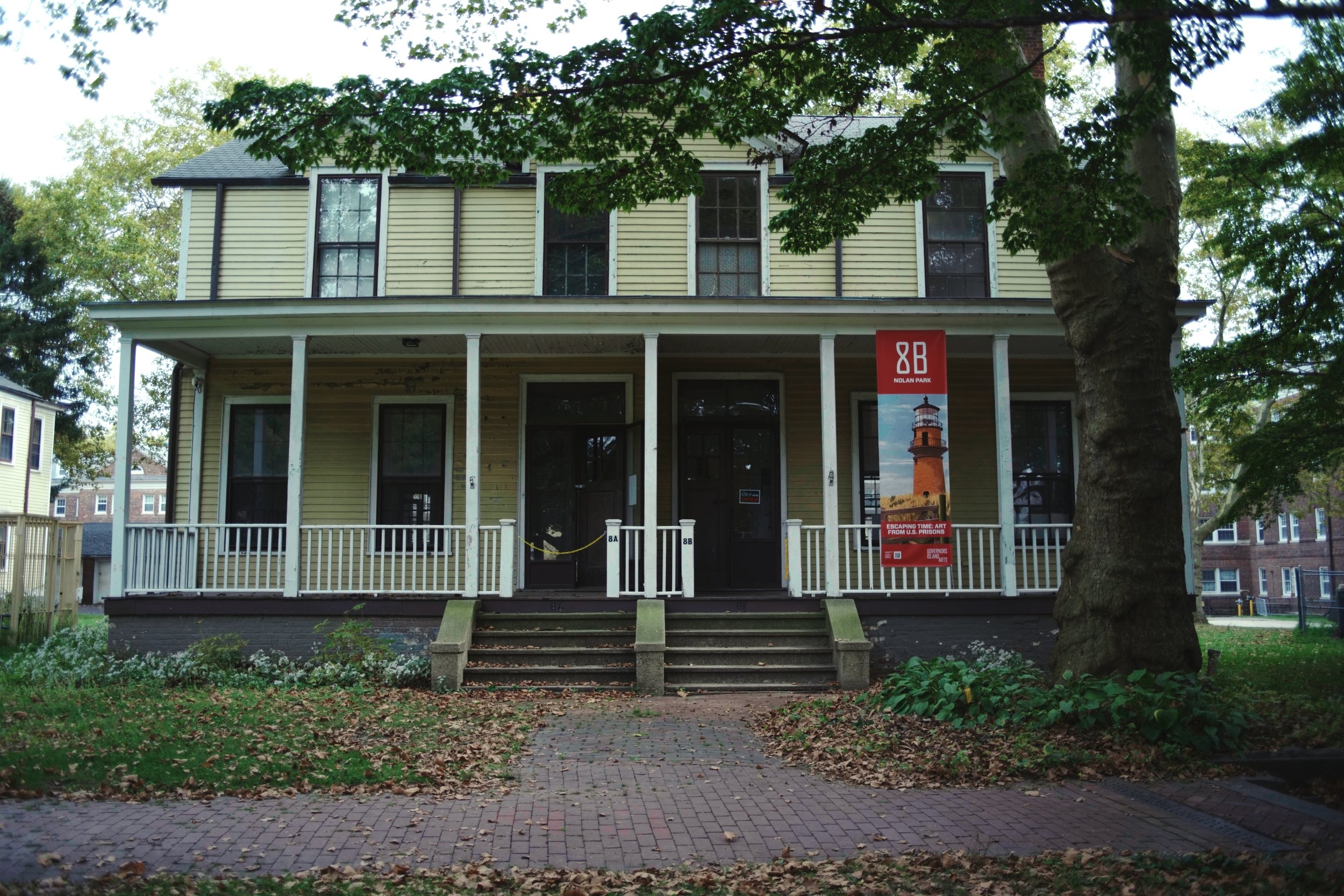
Installation View of Escaping Time: The Ripple Effect, 2025. Photography by Nicolas Poblete, 2025.
NP: In museum work, we often debate the role of the curator. I like to look back to the Latin root of the word, cūra, which translates to care—curation as caretaking. I wonder, Jay, what does it mean to be a curator for you?
JD: For me, it’s literally what you just said: we’re caretakers. It’s a responsibility I welcome but that I also take very seriously. These artists trust me—they trust that I’ll respect their work and care for it. My priority as curator-caretaker is ensuring that everyone has visibility. Even though I have work on view here, it’s the first thing that gets taken down to make room for someone else. I’ve also been staffing the exhibitions, and it’s very important to me that everyone on-site has been impacted by the carceral system so they can share their stories—because being a curator is also being a storyteller. That’s why I always include extensive artist statements next to the work.
People who visit this place—who come from different ethnic backgrounds, socio-economic status—seeing them learn, care, and sometimes identify with the work is beautiful. That’s what I love about Governors Island: we get such a cross-section of people that it makes each interaction so unique and powerful.
MT: The narratives sometimes catch even more attention than the actual work, because they educate our visitors about these facilities and the lives of the people in them. I’m sometimes surprised by people spending over an hour reading all of them.

Installation View of Escaping Time: The Ripple Effect, 2025. Photography by Nicolas Poblete, 2025.
NP: There seems to be more general interest in “prison art” than ever before. In New York alone, we’ve seen major exhibitions on incarcerated art within the past few years—like Marking Time: Art in the Age of Mass Incarceration (2021) at MoMA PS1 or, recently, Jesse Krimes’s Corrections (2024) at the Metropolitan Museum of Art. There are also emerging projects and institutions like Project Reset with the Brooklyn Museum, or the Center for Art and Advocacy, founded by Krimes. Have you felt a shift? Has that changed Escaping Time’s relationship to the art world?
JD: I look at Escaping Time more as social justice through art, and I don’t feel the need to keep banging on that door to the art world. But I do see that progress: seeing Krimes at the Met and having the Center for Art and Advocacy—that’s huge. A lot of it comes from the publication of Nicole Fleetwood’s book Marking Time: Art in the Age of Mass Incarceration (2020). So while “prison art” has long existed, it’s more visible than ever.
MT: Most of the organizations that have developed an interest in “prison art” didn’t even exist 10 years ago. These days, we’re not alone doing this. But when we started Escaping Time, we tried to collaborate with non-profit organizations providing help for formerly incarcerated people, but they had absolutely no interest in what we were doing. Their mission was to find full-time employment or full-time housing, and they saw little value in peripheral aspects of life for these people. It was almost like a turf issue.
JD: In terms of working with art institutions, we’re our own entity, and we’re fine on our own. But since art is integral to our social justice work—our advocacy for prison abolition, transformative justice—we like to share our work with initiatives on the periphery of what we do. For example, we’ve partnered with Bronx Community College for a panel conversation with students. It allowed the students—some artists, some not— to tell their stories about the carceral system and how they got out of it. It was great to see young people speaking to other young people to promote that one bad decision shouldn’t end their life.
We also worked with the American Institute of Architects. We met an architect who designs courthouses, jails, and prisons—someone who’s part of the problem and part of the solution. He explained how he tries to bring humanity to the design, trying to transform the system from the inside. Change doesn’t always come overnight, but meeting people like that gives me hope. Allies that bring new ideas for change. Not everyone must—or has the privilege to—bring it to the streets. Not everyone is going to get petitions signed. There are so many other ways to build community.
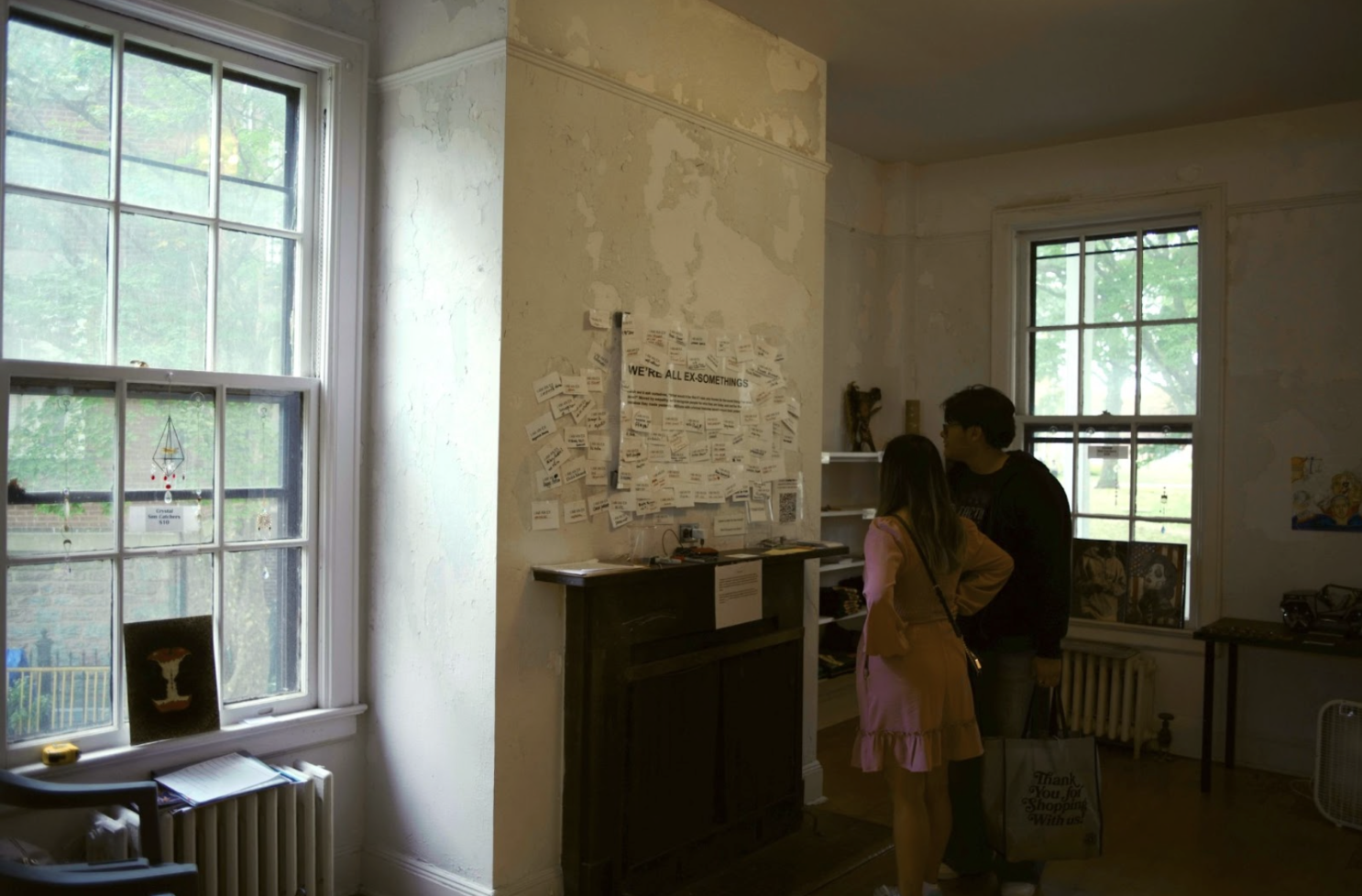
Installation View of Escaping Time: The Ripple Effect. Photography by Nicolas Poblete, 2025.
NP: We’re nearly a year into a second Trump administration running on anti-DEI initiatives, federal cuts in the arts and humanities, and immigration detention, all of which have fortified the carceral system. Has Escaping Time been affected by this?
JD: As an organization, it has not affected us. But I know many people who can no longer do their work because of those cuts, and especially with DEI being targeted. That’s one thing I like about us not having any grants and relying on volunteers and donations: we’re not beholden to anyone. Even museums have lost that political freedom. So we continue.
We know that what we’re doing—our core messaging—goes against all the white nationalist, patriarchal, capitalist policies coming out of D.C. right now. It’s been good to see that our visitors realize what’s happening—especially with immigration detention and deportations. For example, there was a prison close to Nashville that closed years ago because the prison population had decreased. Now it’s open again as an ICE detention center, and the mayor tried to convince his people that it’d be good because it would bring more jobs. The saddest thing I see in response to this is marginalized people affected by this violence saying, “We need more police.” It pains me to hear that, so we’re trying to fight against this narrative. We’re engaging with tourists and US citizens from different states here, and we hope they’ll go back to their families, communities, and voting booths with this new standpoint.
MT: At least the general population seems more aware than ever about the impact of mass deportations. Or at least, it’s harder to ignore than ever before. Hopefully, that’ll create more empathy for the prison population. However, one of my disappointments, currently, is the media’s disinterest in incarceration at the moment. They are unwilling to address those issues as core problems with the carceral system.
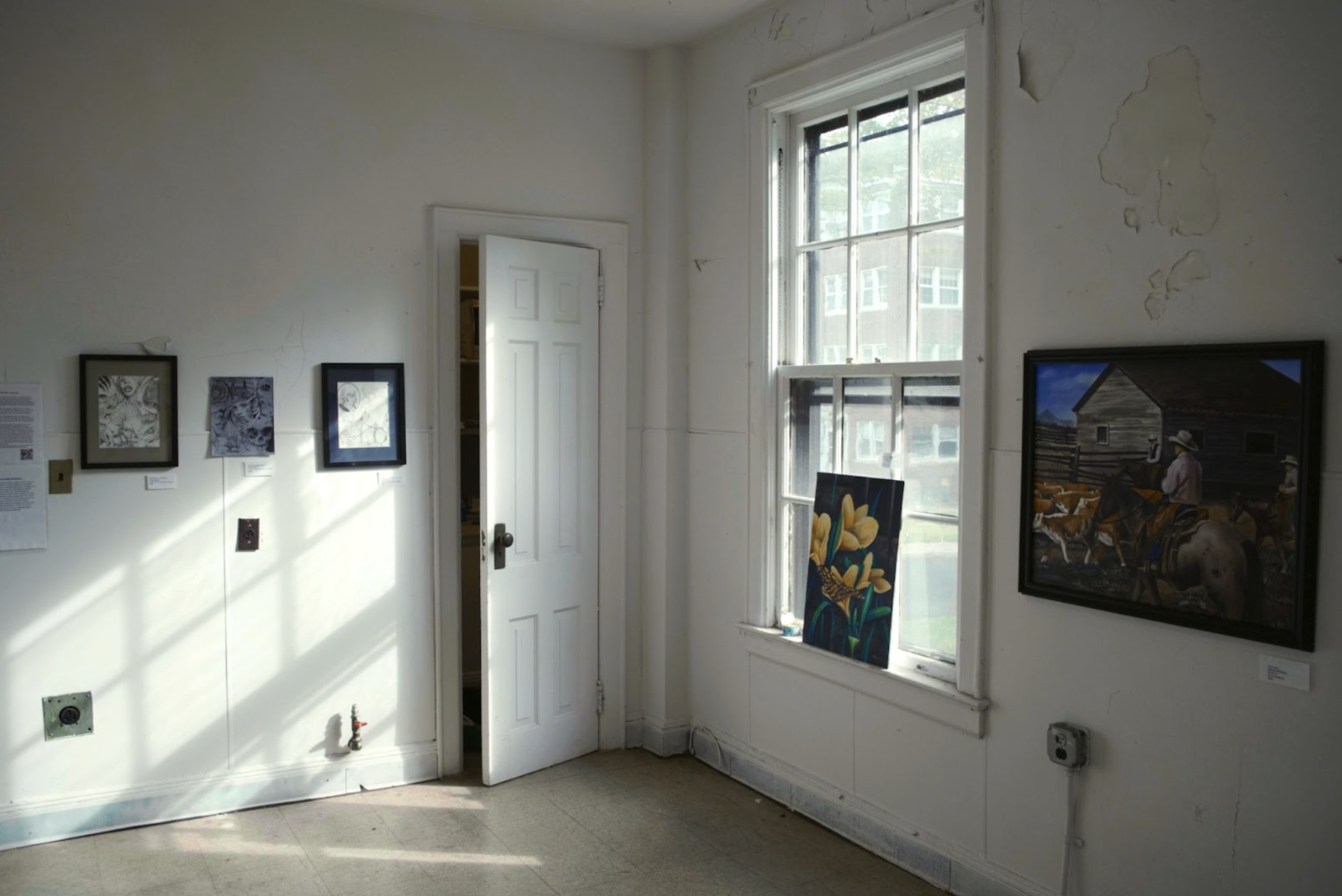
Installation View of Escaping Time: The Ripple Effect. Photography by Nicolas Poblete, 2025.
NP: I’d like to leave things by coming back to art. Why is it valuable to create art in prison? What does it mean to escape time?
JD: We’ve always agreed that truly escaping time is avoiding the carceral system in the first place. But when you’ve been caught, the art becomes an escape, and that’s clear from what the people paint.
MT: From what I’ve seen, incarcerated people paint remembrances of what life with freedom was—or what it could be. Or they’re doing abstract work. They don’t want to portray that violence. They want to portray where they dream to be. They have literally and figuratively escaped some of their prison time in doing that. During that they are somewhere else. They could be in any room, anywhere on the planet, because they’re entirely consumed by what they’re doing.
JD: Some do landscapes, not because that’s what they experience, but because they miss seeing rivers, trees, and mountains—those things they wish that they had. If someone’s painting horses or flowers, it’s their way of disappearing into the canvas for hours. That’s their escape.
This interview was edited for clarity and length.