
.webp)


Marie Lorenz and Jeff Williams: "Roll, Pitch, and Yaw" at International Waters
Review
Muffled voices, trembling vibrational articulation. Lovers’ discourse. Charged space, atmospheric fog, haze, unclear movement. Sound as Body. Heavy, charged, erotic. Spray of fog; violence, climax, expulsion. Spasmodic rhythm, relational materiality. Giving substance to dialogue, to speech.
An immediate dialectical interpretation doesn’t befit In Practice: Coco Klockner at SculptureCenter. Null Dialogue (2025) enacts relational, auditory form as a substance: an obscured conversation between two lovers as its seed. The authors of the voices are erased, the words are muffled and subdued. Sculpting sound, Klockner hammers the metallic shells of language into hollow drums. She flattens the syllables, melting them into a resonant bass. The signifier is severed from the signified through its illegibility, and the vocal material that attaches them lies writhing in the vibrational sound. In its movements, volume rises and dips, heavy with half-imaged sentences, phrases, exclamations. We feel our narrative impulse swell to fill the vacuous discourse, to identify with characters and emotions. Submerging the viewer in affective sound, Klockner catches us in a kind of trap, exposing our erotic cravings.
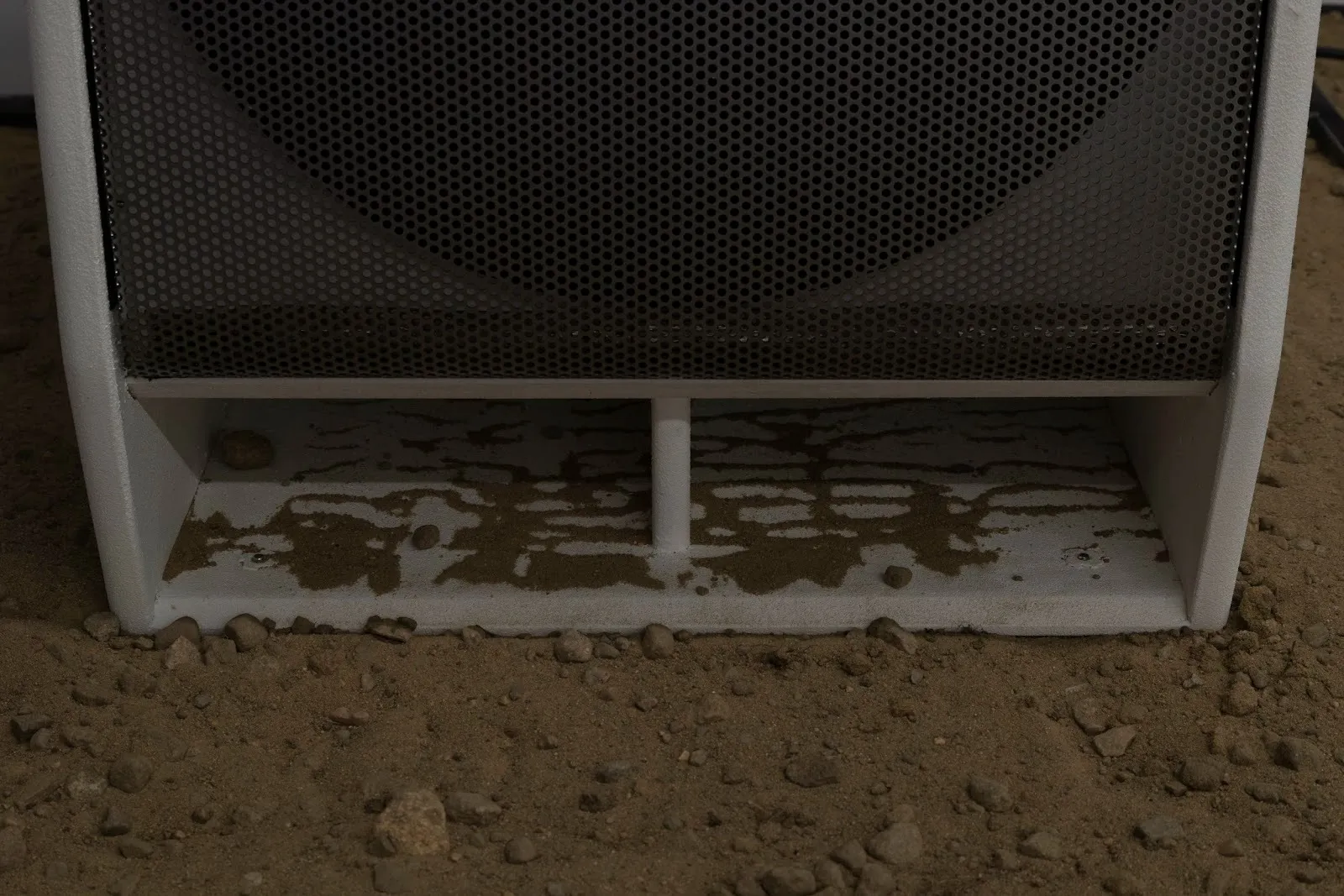
How lustful does one have to be to attribute romance to the unintelligible voices of specters? The Other is a void which Klockner conjures through two unruly subwoofers perched on beds of sand. Motion-activated to play once we enter, the audience and the subwoofers engage in something like a ritual summoning. The auditory conditions of the gallery, its acoustics and the frequencies of its steel ceiling, are implicit in the reverberations which reach our ears; we are inside the sculpture. The subwoofers themselves, featuring custom steel panelling and grilles by Klockner, are both performers in this drama and surrogate bodies. They are given delicate attention, their material needs attended to like reclining figures upon their daybeds. But they exist as figures in the posthuman sense—inorganic, mechanical, brutalist. The sound they project is thus filtered through their specific material lens, displacing the voice into the language of objecthood.
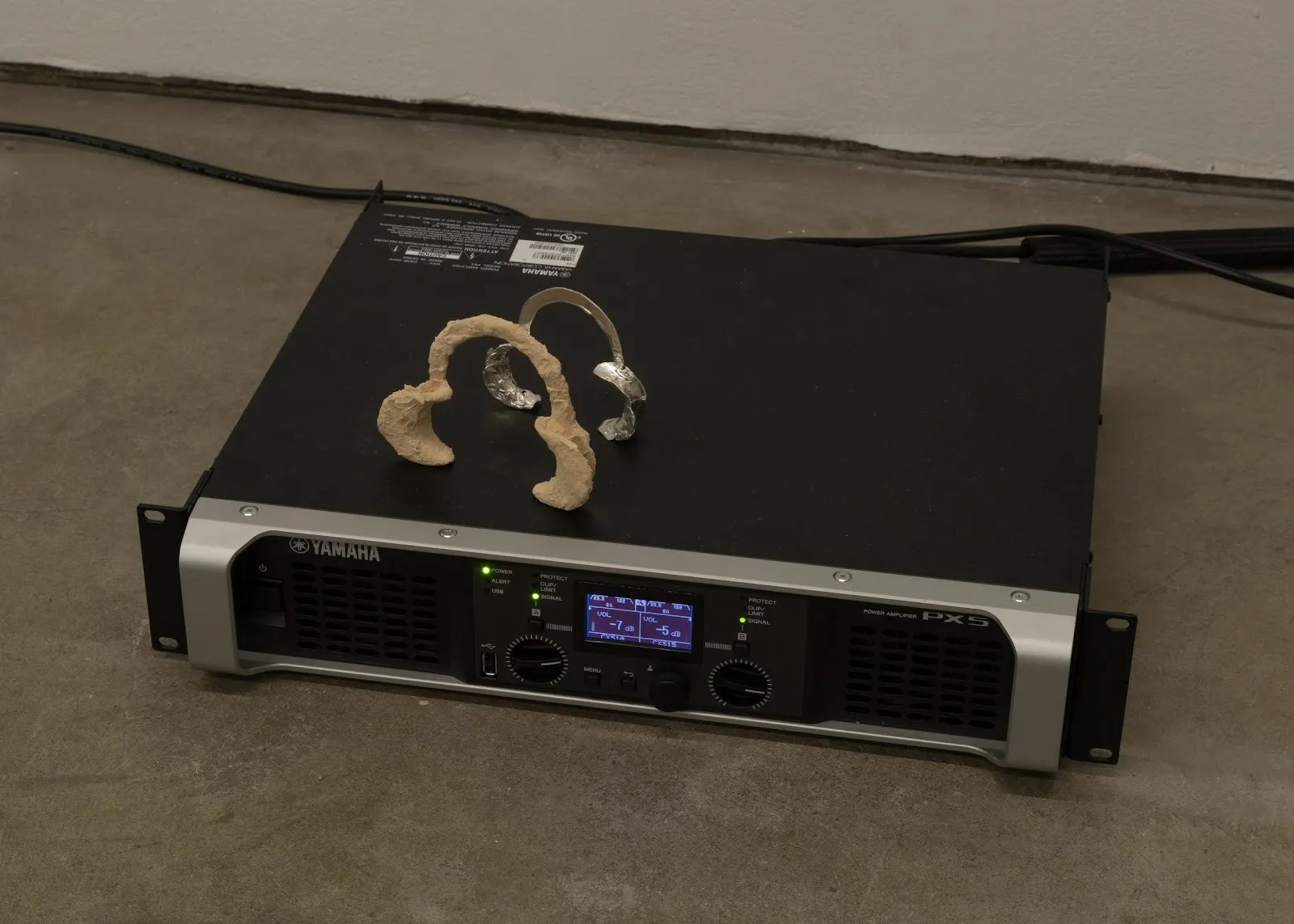
The sandbeds are littered with detritus—small stones, strips of cardboard, wax—like dystopic Zen gardens. The sand in the subwoofer’s grille slowly shifts, guided by the bass: the only physical record of its resonance. The shallow platforms are precariously perched on steel scaffolds, overhanging their supports. The wiring snakes across the floor and conjoins with an amplifier, upon which Untitled (2025) sits—two mouth retractors, one plastic and one cast in silver. The instrument of the mouth is hollowed, widened, and extracted. Atop the left bed sits a fog machine which sprays a bout of fog every three minutes, creating a lingering, dense haze in the gallery. While the mouth retractors mirror the auditory manipulations of the amplifier, the fog machine seems to embody a much more visceral, bodily reaction. Its abrupt spray, which can catch unwitting viewers in its stream, is an ejaculatory gesture, a climax.
In Practice can be seen through the lens of object-oriented ontology, which investigates the autonomy of objecthood. Here, the subwoofers oscillate between functional devices, aesthetic objects, and relational agents; their low vibrations produce a resonance that is felt more than heard, exceeding the limits of auditory perception. In doing so, they withdraw from full access—their inner mechanisms and projected sound remain partially concealed. We cannot wholly access the subwoofers, but we become co-agents in their function simply by entering the gallery, setting in motion a web of dependence and autonomy in which subject and object are entangled. Like the famous query “If a tree falls in a forest and no one is around to hear it, does it make a sound,” the work exists through its encounter with an observer, though that encounter never exhausts what the object is.
Klockner’s emphasis on autonomous objects places our subjecthood on uneven grounding, sculpting perception itself into a site of investigation; the vibrations move through our bodies, producing a physicality that is less sexualized than sexuated in the Lacanian sense—implicating desire independent of anatomical or binary distinctions. Sexuation, grounded in fundamental lack and relational differentiation, mirrors the object’s withdrawal from complete apprehension, and the impossibility of full access fuels our desiring. Eroticism here does not stem from representation or the sexualized body, but from the ambiguity that sound enacts: the deep bass becomes a pulse of the Real, creating a nonhierarchical affective field in which our sexuation is laid bare.
In opposition to intersectional gender narratives, which locate gender in social categories, Klockner situates transness within a field of affective and sensorial forces that erase binary distinction. In this vibrational intercourse, the work intimates a primal eroticism inherent in the auditory exchange—an erotics of resonance rather than representation. By suspending signification, Klockner leaves us in this uncomfortable gap that Lacan identifies as the place of lack and desire, and stages identification in reciprocal relation with semi-autonomous objects. From this erotic structure, a sonic transness emerges untethered by social categories or anatomical distinctions.
What Klockner may reach in her treatment of sound as body, past representation, is a kind of Body without Organs, as Deleuze puts it. The vibrational field of sound is organized by varying flows and intensities, which perpetuate a continual becoming rather than a being. Klockner elucidates the relationship between sound and transness by emphasizing immanent sensorial perception over systematic, hierarchical, or structured orientations. Witnessing, or sensing the interaction between two vibrational bodies, may let us glimpse an erotic discourse unmediated by sexual difference. As agents in this vibrational field, we are encouraged to leave behind the gendered structures that exist outside of the gallery. As Klockner herself put it, she hopes to invite viewers into their own abjection.
In Practice: Coco Klockner is on view at SculptureCenter from October 18 through December 22, 2025.