
“Are you lonely tonight?” at the Australian Centre for Contemporary Art
Review
Eli Sudbrack of Assume Vivid Astro Focus (AVAF) and I sat down this past October on the occasion of Amaze, Vogue, Ascend, Flourish, AVAF’s latest roller skating rink, accompanied by a billboard on the High Line and a monumental mural on the facade of Faena Hotel in Chelsea. We talked about the history of AVAF’s roller dancing rinks from New York to Miami and back, this project’s tribute to both iconic and undersung drag, queer, and trans icons, and the incredulousness that critics never contextualize the collective’s work as queer.
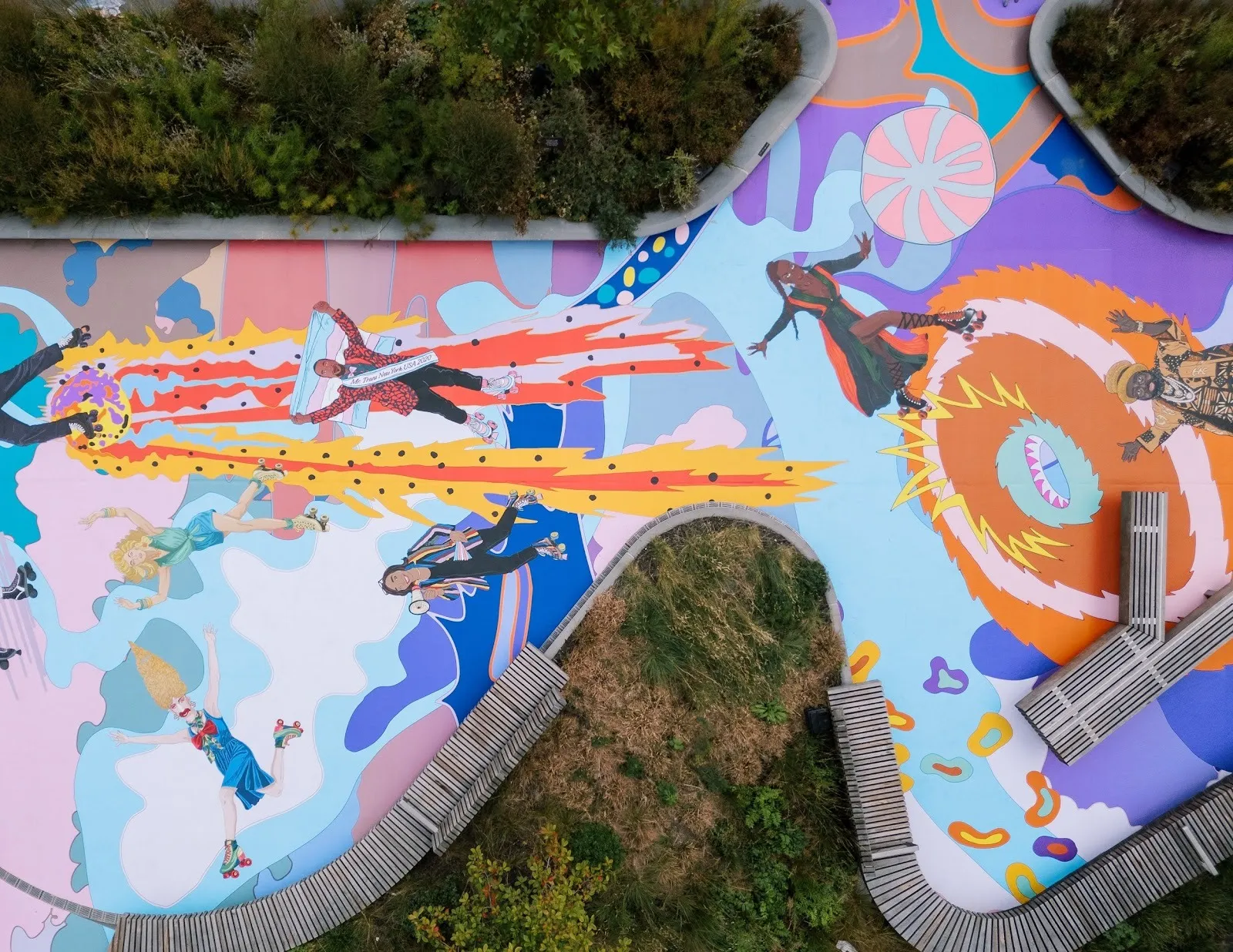
Maureen Sullivan: Being in your fantastical installations always feels like being in motion and spinning round. In your roller skating rink installations, that actually becomes a reality. I’m here with you for the latest iteration, Amaze, Vogue, Ascend, Flourish (2025). This is again presented by Faena Art, across from the site of Roxy, the legendary former nightclub and roller disco, and apropos to your project’s celebration of nightclub icons. How did you first become interested in creating such an unusual type of kinetic art installation?
AVAF: It actually started in New York. When I first moved here from Brazil in 1998, I’d walk all through the city, and I would always take my friends to Central Park just to watch the roller skaters. They’re very hypnotic, and they have so much style and energy. They reminded me, in a different way, of the Vogue Balls we’d go to uptown in the early ‘90s.
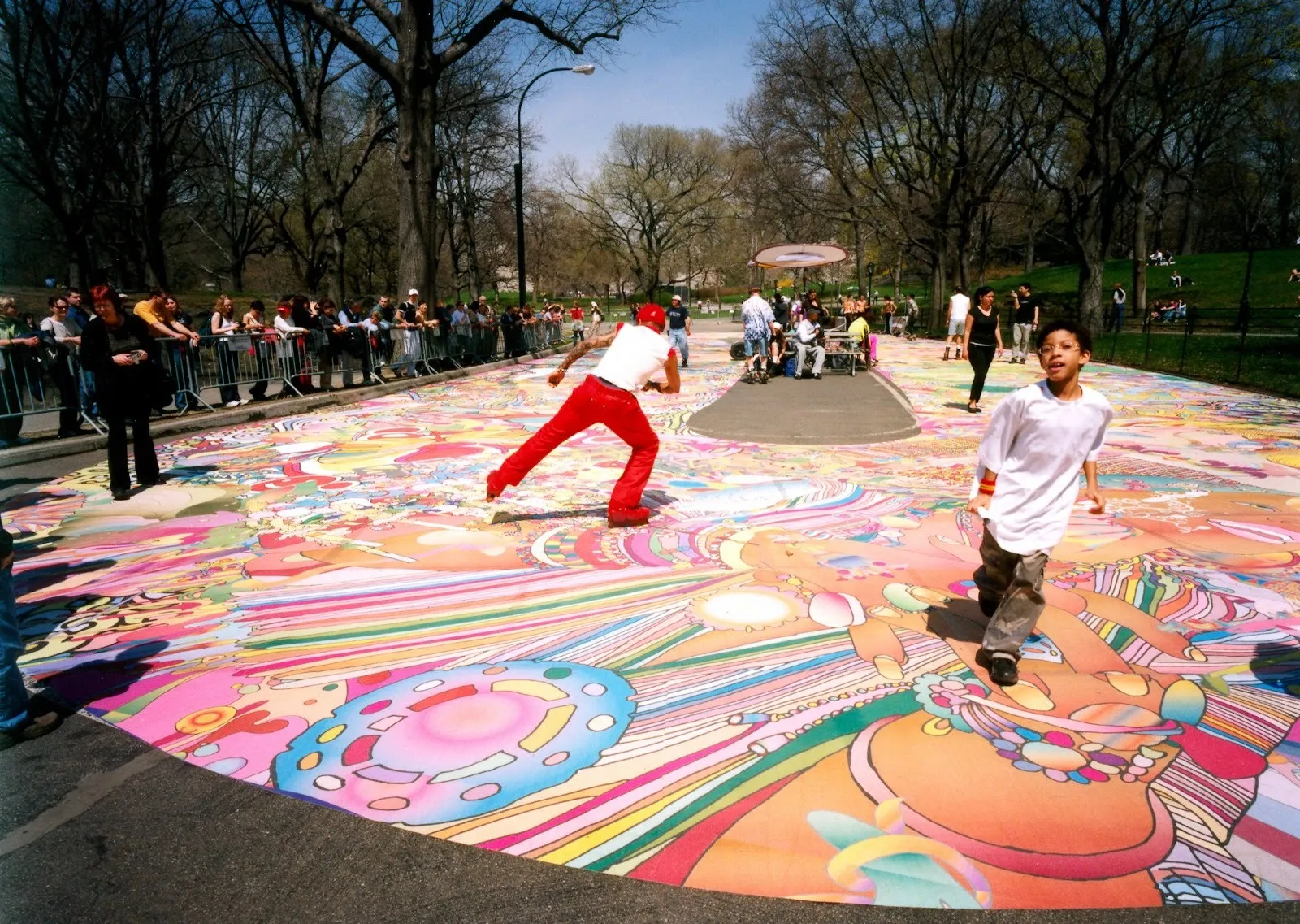
We got invited by the Public Art Fund to submit a proposal for their program, In the Public Realm in Central Park, which became part of the Whitney Biennial for the first time. We wanted to pay tribute to and collaborate with the skaters of Central Park, officially called the Central Park Dance Skaters Association. Being a recent immigrant, the skaters were symbolic to me of utopian New York City with people from different places, races, sexualities, and ages, and all of them dancing on skates together, like in the musical Hair.
But there was so much red tape and challenges from permits, to weather being too cold and rainy to install, to making a 9,000 square foot vinyl. The Central Park commission really didn’t like the skaters, thinking they attracted a “bad element” to the park, of drug dealers and pickpockets. It seemed like the project would never happen. But Tom Eccles and everyone at the Public Art Fund kept fighting for us, through the Giuliani administration that was against it, to Bloomberg, who likes public art. Then we had to figure out how to print a vinyl this big. Now it’s easy, but not back then. We asked 3M to sponsor, but they turned us down. We found an amazing guy in Tribeca who came up with bath mat material, as the surface had to have a bit of roughness so it wouldn’t be too slick and mimic the pavement they were used to skating on. The skaters even had to fight to play music, which had been prohibited in public spaces during Giuliani’s time, and won. So Rama Chorpash built a DJ booth that we left afterwards for the skaters. All our projects have music and dancing, and one of our regular collaborators, Los Super Elegantes, performed for the opening.
This was our very first public art project, and it set the tone for our future public projects. By creating projects in a public environment, you reach viewers who don’t know you or anything about your practice. Public projects focused on an existing community promote spontaneous participation in which the art itself is the least important part of it. We realized then two very important elements that have been intrinsic to everything we do: first, the public is always the centerpiece, and everything we make is centered on the sensorial experience of the viewer; and second, we aim to create energy.
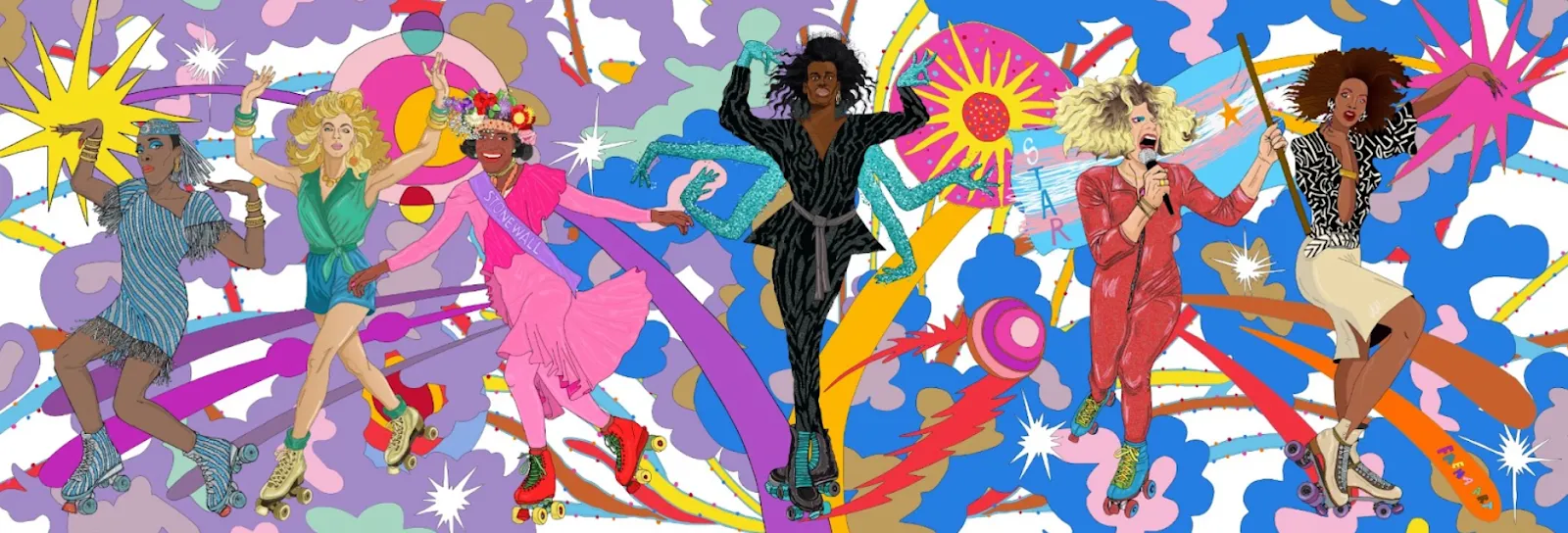
MS: Amaze, Vogue, Ascend, Flourish, featured 43 individual figures rendered in motion skating surrounded by your signature cacophony of abstract, patterned, and geometric imagery. In previous projects, I recall more of a focus on faces, disembodied like masks, as well as what you’ve referred to as the “armor of drag”—fishnet stockings, bejeweled nails, big hair, heavily made-up eyes and lips, but this places more of an emphasis on the individuals. Why the shift?
AVAF: We wanted to pay tribute to an iconic mix of New York City, people from the past and present, people who have been under-recognized, mostly, not all of them, with a special focus on BIPOC, trans, and ballroom communities. When I moved to New York City, one community that was very present for me was the Ballroom community. Trajal Harrel, an early and long-time AVAF collaborator, and I would go to Vogue balls all the time. In the early ‘90s, it was all about voguing—you had Madonna, Malcolm McLaren, Paris is Burning, etc. By the late ‘90s and early 2000s, voguing had gone back underground, but Trajal and I found this amazing scene that took place in Harlem on 3rd Ave between 123rd and 124th streets, every Thursday starting at 2 am.
For this artwork, we wanted the people to be extremely recognizable, for their likeness and legacies, even though we’d be depicting them dance skating. To make faithful representations of the characters, we did a lot of research on their images and what they wear in their daily lives through archives, Instagram, and social media. We then used ChatGPT to make versions of the characters and used that as a base to hand-draw each figure.
MS: Do you know how many of the people represented in the artwork came to see and maybe even skate over themselves?
AVAF: We tried to get in touch with everyone, all who are still with us, and some who couldn’t make it sent their kids! I caught up with Lady Bunny, Lypsinka, Linda Simpson, Justin Vivian Bond, Zahara Bassett, Sasha Alexander, Kia LaBeija, Lala B-Holston Zannell, and Jevon Martin.
MS: Yes, I met Jevon in 2020 at your opening, proudly greeting people with his vinyl portrait!
AVAF: Jevon is amazing. He founded Princess Janae Place, supporting trans New Yorkers transitioning from homelessness.
MS: Speaking of collaborators, people are often confused about who’s in AVAF—I know that’s intentional. You are the main spokesperson, and it’s your alias, but it’s also an ever-fluid collective. The confusion is further fueled by the way you create exhibition titles and email sign-offs with GIFs, from the initials AVAF.
AVAF: From the beginning, we knew we didn’t want to operate under something that was just our names; we wanted to keep it open to collaborations. We had this crazy idea, apparently, to have different pseudonyms for each show we were involved in. My partner and gallerist at that time, John Connelly, hated that idea. He said, “It’s already difficult to understand who you guys are. You're gonna have different names for every single show, people are going to go crazy. I'm gonna go crazy.” And at that point, we were more strict about trying to be anonymous. We would not show our faces, we would not give out our names, and that's when we started wearing masks.
We like to have everything evolving, never finished. Our practice and media are always fluid and changing. We never wanted to have one face; we wanted to have multiple faces and multiple strategies. But we realized, later on, that it would undermine what we wanted to do with the work and understood where John was coming from. So instead, we created different titles and sentences with the initials AVAF—a very anxious feeling, always vacationing among flamingos, and so on.
And then we also started signing our emails with constantly changing sentences and in different languages. When people noticed they were changing, they started creating their own and sending them back to us.
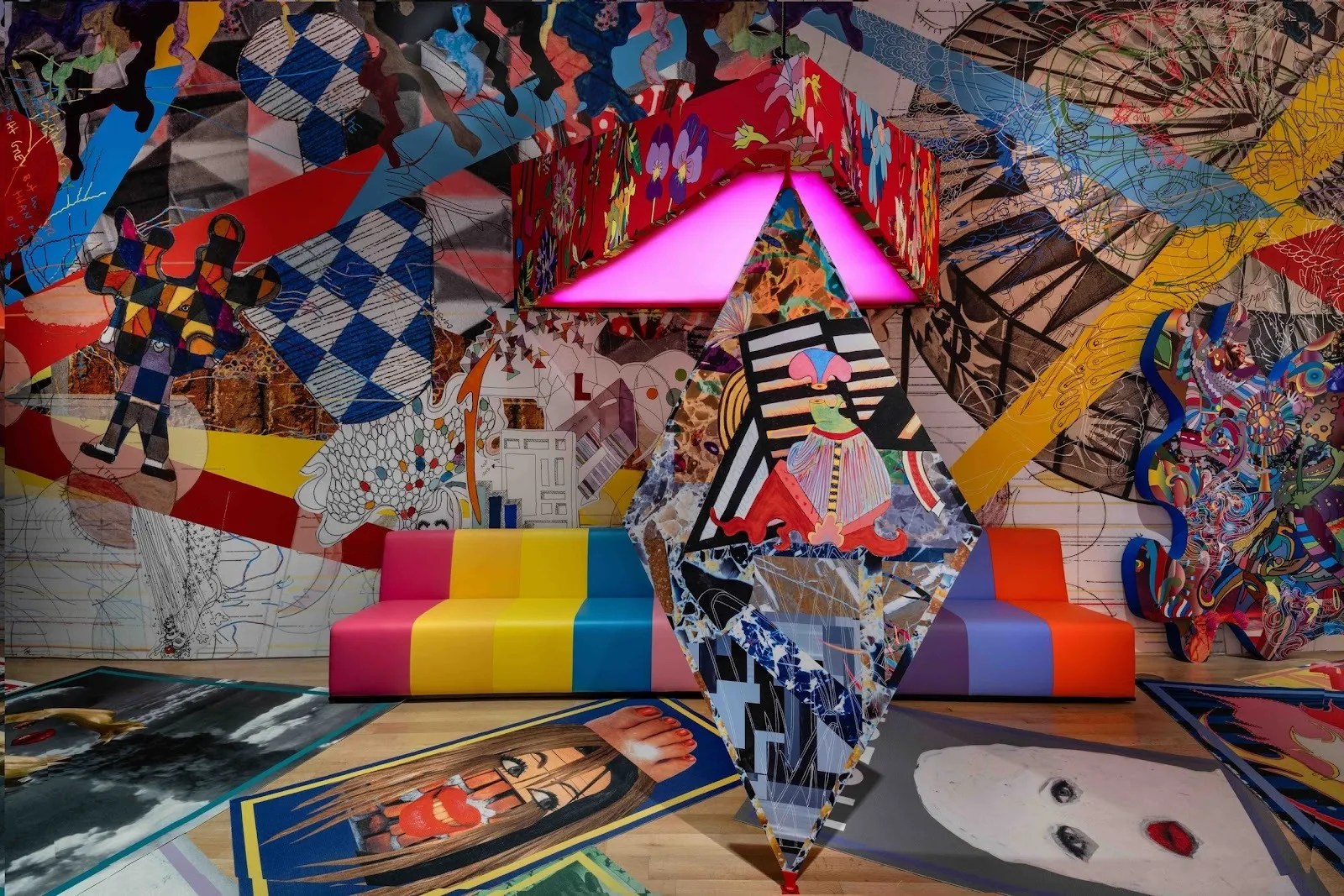
The thing with AVAF is that all the collaborators are people with whom we have emotional connections and friendships, not people we just run into. Some aren’t artists, but they’re all creative. We are fluid with our existence, no fixed members. We always called ourselves a collective because the centerpiece of everything we make is the public, and the public is also part of the collective. It’s never just me. For this project, I collaborated with April Hunt, researching, DJing, and helping with all the music; Lady Bunny and Sofi Tukker, who also played music; and we included everyone from the printers to the installers who helped produce and make such an amazing project. The thing is, we are all potentially part of this collective, so it doesn't really matter who is part of the collective.
MS: When I think of AVAF, the first words that resonate are engagement and joy. The word utopia is also often associated with your work.
AVAF: We use utopia a lot. It’s hopeful. It's energizing in a way. And I do believe in creating your own utopia and trying to bring it into existence somehow. It’s very important to create.
MS: What’s coming up?
AVAF: There’s a kids’ park at Museu Oscar Niemeyer in Curitiba, Brazil, opening this December. We always wanted to do something just for kids; in every single installation we’ve done, the kids were immediately in there dancing and listening to music. This will be a permanent outdoor park called afenufu vivalulu amulufu fufulufu. It will have a slide, like we’ve created in various installations, two swings, a climbing wall, and a jumping net.
We’re going to have a solo show at Leslie-Lohman Museum sometime in the near future. This will be an amazing opportunity for us to finally present the work in a queer context. I was looking through my Instagram and, my God, everything we do is so fucking queer — our installations, neon words, wallpaper, and paintings. But not a single critic ever talked about our art in the queer context. Really. Nobody. How is that even possible?
Ongoing at The Bass in Miami, assume astro vivid focus: XI (2004–) is a massive installation that was donated to the museum by Rosa and Carlos de la Cruz, after being on view at their foundation for 20 years.
Unfortunately, we had rain on the weekend we presented Amaze Vogue Ascend Flourish, so this project never really functioned as an actual roller skate rink, other than the performances on opening night. People mostly just got to walk through it, unless they had their own skates. So we’re having a conversation with Faena Art to possibly bring it back next year, hopefully during Pride.
This interview was edited for clarity and length.
Assume Vivid Astro Focus: Amaze, Vogue, Ascend, Flourish was presented at the plaza next to Faena New York from October 11 through 12, 2025.