

Alex Carver: “The Knot”
Review
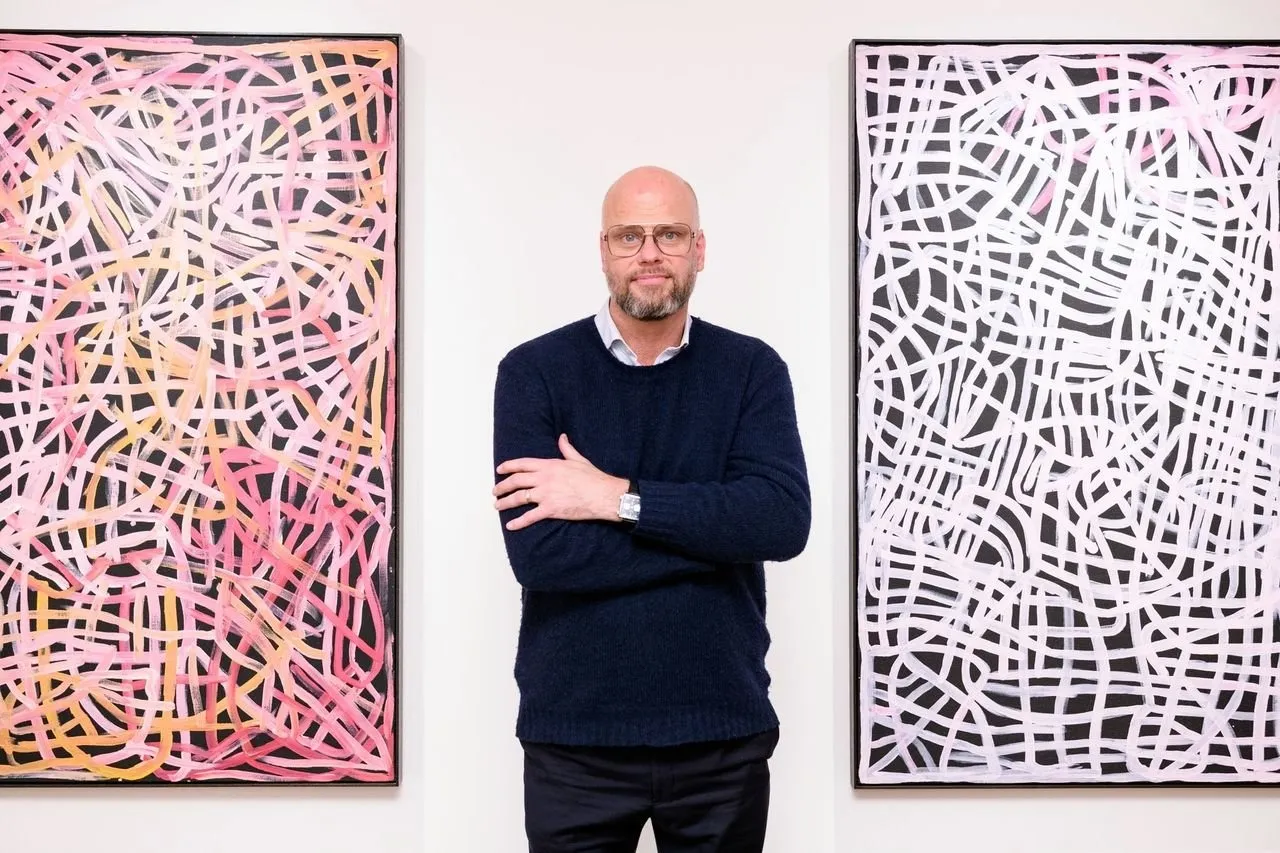
D’Lan Davidson had worked as an artist, art dealer, and art advisor for decades before he became acquainted with the slice of the art world he has the greatest taste for. In the early 2000s, Australian Indigenous art was experiencing a revival, and Davidson took the opportunity to build a reputation for himself as a careful handler of Indigenous works, first earning an esteemed position as Head of Aboriginal Art at Sotheby’s in 2010, and then continuing to found a gallery of his own, D’Lan Contemporary, in 2016.
Known equally for its collection of some of the most innovative contemporary art as for its strict acquisition ethics, D’Lan Contemporary pushes industry standards in both artistic quality and scholarship. With its New York opening in 2023, the gallery eagerly meets international interest in the appreciation and acquisition of the art of Australian Aboriginals—the oldest continuous living civilization, which Davidson believes, remains increasingly relevant to contemporary art and thought.
Lilly Jenner: After more than twenty years of experience as a leading international Australian Indigenous art consultant and dealer, what led you to open the gallery in your name, D’Lan Contemporary, in 2016?
D’Lan Davidson: I had already established longstanding relationships with many collectors as an art consultant and advisor, and was trading under my name before opening the gallery. As the business evolved, it became clear to me that I needed to establish a physical space—with a link to my private sales through the connections I had already built with clients and collectors, and of course, to my expertise in Indigenous art, which is what I’m best known for. This was when D’Lan Contemporary was born.
The business has grown much further since then. We are in the process of a brand refresh, which will include a slight tweak to the name, to become a more globally recognized brand with respect to our tremendous team that helped build the company to what it is today.
LJ: What drew you initially into the Aboriginal art market, and why have you stayed with it? Over the last two decades, how have you seen that market shift?
DD: I was first introduced to Australian Indigenous art in 1999 when I was working as a trained and practicing artist in America. Upon my return to Australia, a wonderful collector friend asked me to put together an Aboriginal art collection for him. I soon became completely immersed and was introduced to Sotheby’s—where this market was already in full swing. I was astonished at not only what I had overlooked, but what we have in Australia. The talent is overwhelmingly good, unfettered, and natural, unlike what I had ever experienced whilst working in the broader contemporary sphere, where we were all just trying to be this good.
The Australian Indigenous art market is now in a steady growth phase, led by the awakening of the international market through the same realization that I had in 1999: there can be no question that the artists of First Nations Australia have created some of the most compelling contemporary works of modern time.
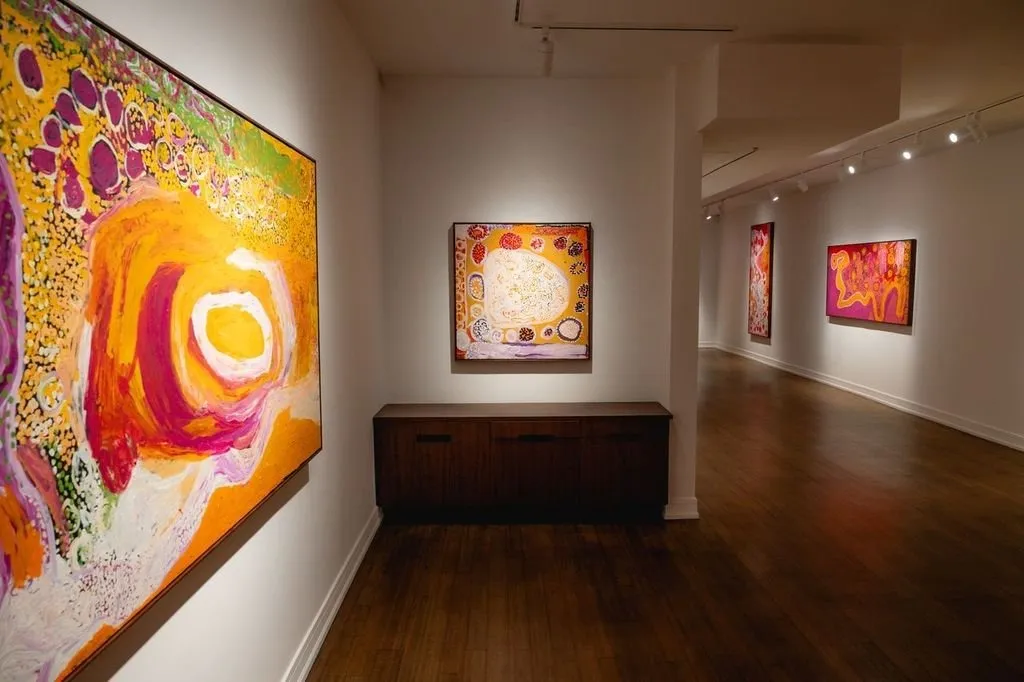
LJ: How does D’Lan Contemporary ensure that the interests of Australian First Nations and Indigenous artists are met at every decision? How do you responsibly and respectfully display something like an artefact or object within the white walls of a gallery space?
DD: Integral to our mission as a gallery is connoisseurship, scholarship, and education. We aim to raise awareness of and appreciation for Australian Indigenous art and artists, and the stories and the culture they represent. We ensure that every work is presented within an academic and appropriate art historical context and handle every piece as a museum-quality work of art should be, with care and respect. Our carefully considered spaces are designed—from lighting to wall color to the accompanying academic notes—to showcase the quality in every work.
Our company has also initiated an industry first by contributing 30% of our net profits to the community from which they came. This ensures that, not only our artists, but their broader communities are seeing a return on their commitment to the arts—not only by living and practicing artists of today, but also the hard work of their forefathers.
LJ: All works of art exhibited and sold by D’Lan Contemporary have a traceable line of provenance. How do research and transparency help to guide your gallery in better practice for acquiring Australian Indigenous artworks?
DD: We maintain strict provenance protocols—the same as those followed by national and international museums and institutions—as it is also integral to our mission as a gallery to create a sustainable marketplace in terms of consistent quality and traceable provenance for every work we handle. Every work of art we handle has a traceable line of provenance, which impacts the value of the work and provides confidence to collectors and buyers.
This strict policy has forged the foundation of this market, and it is relied upon both academically and in sales. In early 2026, we will launch an accessible handbook guide that will clearly articulate this important policy. If adhered to, this market and industry will become much easier to navigate.
LJ: Does a line of provenance also provide prominence, or how do you determine the value of Aboriginal artworks?
DD: The value of Aboriginal art is determined by historical significance, quality, and provenance, which includes the history of exhibition, literature, and, of course, the market itself.
Provenance, in the context of Australian First Nations art, links the work of art directly to the artist and/or art center and community, and not only offers assurance to buyers and collectors, but also ensures every work is ethically sourced, so that the artists and their communities are appropriately acknowledged and remunerated.
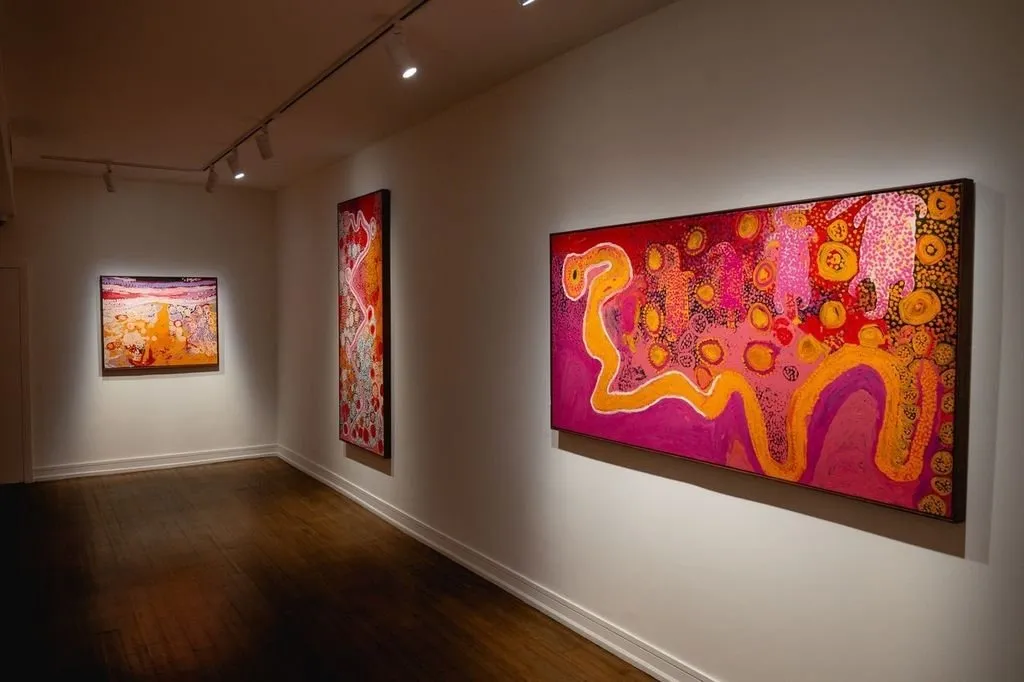
LJ: You’re representing Australia’s modern and contemporary art by First Nations artists at gallery spaces in Melbourne and Sydney. Why did you install a New York location in 2023?
DD: We opened a space in New York to meet our many existing clients in the U.S., and in response to increasing international interest in Australian First Nations art. Australian Indigenous art has always been admired in America, and in New York in particular. But it has always come and gone—whether that be at auction once a year, or with other dealers that couldn’t quite make it. We endeavor to have a constant presence in America so that we don’t lose our market’s focus again.
LJ: Stylistically, what do you think Australian Aboriginal art is bringing to the international art market? What else could Americans gain from visiting your New York gallery?
DD: In my opinion, Australian First Nations artists have and are still producing some of the finest and most exciting art in the world. And, although its history spans many thousands of years, and represents the oldest continuous living civilization, Australian First Nations contemporary art and culture is relevant, which we can learn from and experience for ourselves, particularly about sustainability. Our business model and growth are built directly on this cultural sharing and learning that is evident in these artworks. It flies in the face of what I learned in business school in the US, and we credit our sustained growth to this business philosophy.
LJ: D’Lan Contemporary has featured countless exhibitions at its various locations, partner venues, and international art fairs. What types of shows are your favorites to host, and why?
DD: Whilst major international art fairs are always fun because you get to share with a far broader audience that is still craving market education, the collaborations with other major gallerists can be greatly rewarding, as well. Whether with Gagosian or, more recently, with Pace, we do these exhibitions for the greater awareness of our artists. And it is great that these major galleries are finally taking notice and providing the recognition that these artists deserve. Rather than focus on what we may perceivably be losing by doing these exhibitions, I focus on what is gained: not only the recognition for the artists, but also, in the “updraft” for the broader market in this genre. It is also great brand alignment for our company.
LJ: As the preeminent representative of modern and contemporary art by First Nations artists, what is something exciting you’re seeing now in the contemporary Australian Indigenous arts?
DD: Great innovations are coming through in this area of collecting, particularly with the younger generation of artists. With artists from Daniel Walbidi, who uses an incredibly individual technique, to Gunybi Ganambarr, who was the first to be credited for using found metal objects on the land, there is always an exciting discovery to be made on country. And I believe that our greatest discovery in this area of collecting is yet to come.
This interview was edited for clarity and length.
D’Lan Contemporary’s New York gallery is located at 25 E 73 St, New York.






.webp)