.jpg)

.webp)


Brussels Art Week 2026
Review
Emmelines is a contemporary art gallery located in the MTA station mezzanine newsstand at 5th Ave and 53rd St, in New York City. The space opened last September and is run by the artist William Wiebe. Alongside such spaces as Benny’s Video in Bushwick and Turquoise in Lower Manhattan, Emmelines contributes to the emerging network of artist-run spaces in New York City.
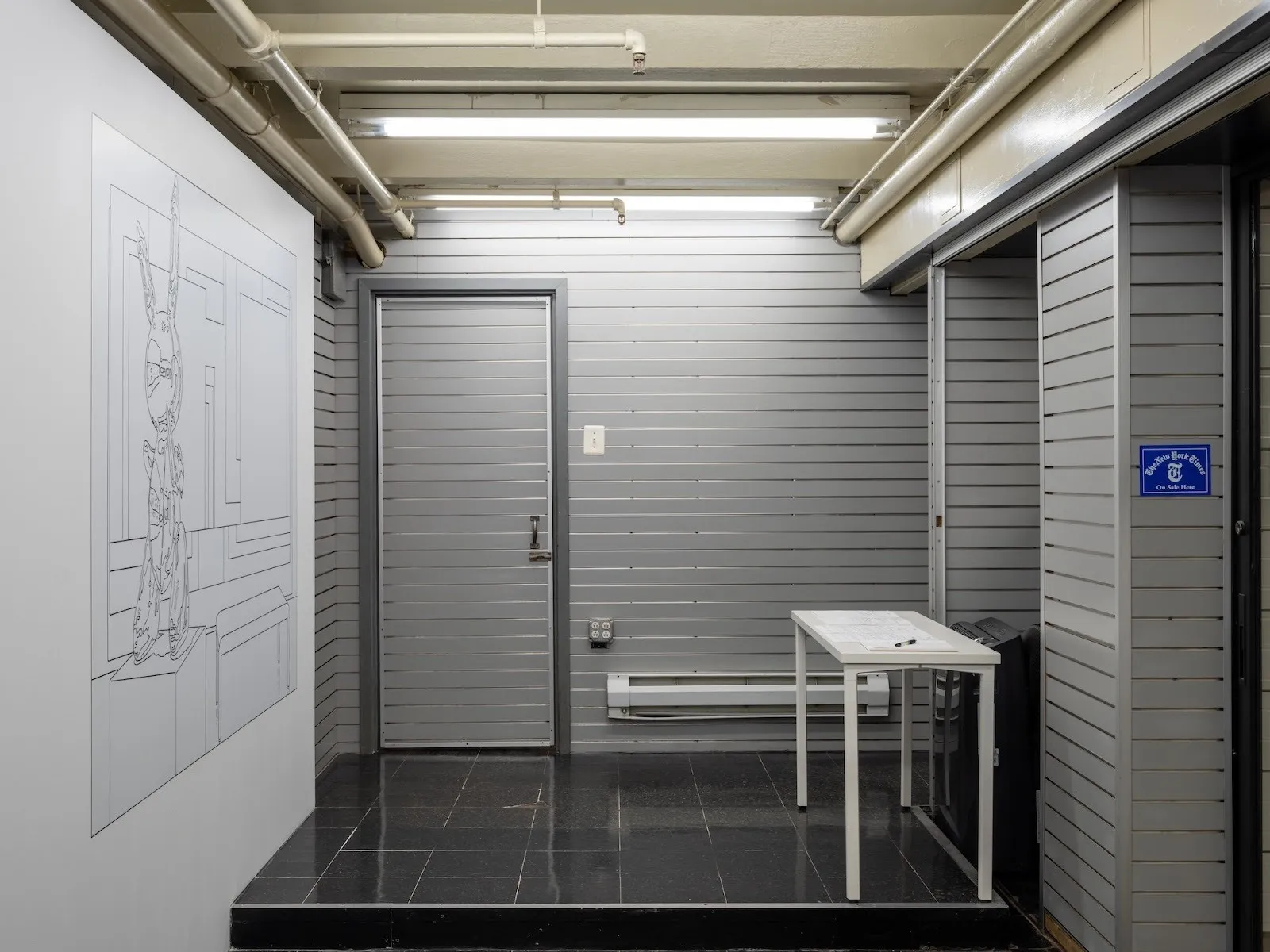
Its inaugural exhibition, Denkmalpflege, presented Harun Farocki’s public video installation Übertragung (Transmission) for the first time in another public space since its commission at the Limmatplatz tram shelter in Zurich. In direct dialogue with Farocki’s piece, the exhibition also included photographs of the same square from the Swiss Social Archives captured by social photographer Gertrud Vogler. The gallery has since shown artists such as Pierre Leguillon, Pierre Huyghe, Emily Jacir, David L. Johnson, Nina Könnemann, and Craig Jun Li. Its program, so far, feels dedicated to the idiosyncrasies of its specific location and context, as well as its architectural layout—exhibitions are often visible from the outside of the newsstand, accessible to MTA passengers and pedestrians. The current exhibition, Tracings and Arrangements, arranged and presented under the name of Los Angeles-based artist Harrison Kinnane Smith (b.1997, Pittsburgh, PA), is no exception.
Kinnane Smith co-directs Morning Star Research Center for the Afterlife of Slavery (MSRCAS), a non-profit that supports research, curatorial inquiry, and public programming on the legacies of Atlantic slavery. His artistic and collaborative work develops mainly through site-specific interventions that critique public institutions and financial systems.
In Tracings and Arrangements, although the exhibition checklist states that five or more artists, including Felix Gonzalez-Torres, Peter Halley, and Jeff Koons, have contributed to the exhibition, only works by Louise Lawler and Harrison Kinnane Smith are displayed, and the presentation is announced as a solo exhibition under Kinnane Smith’s name.
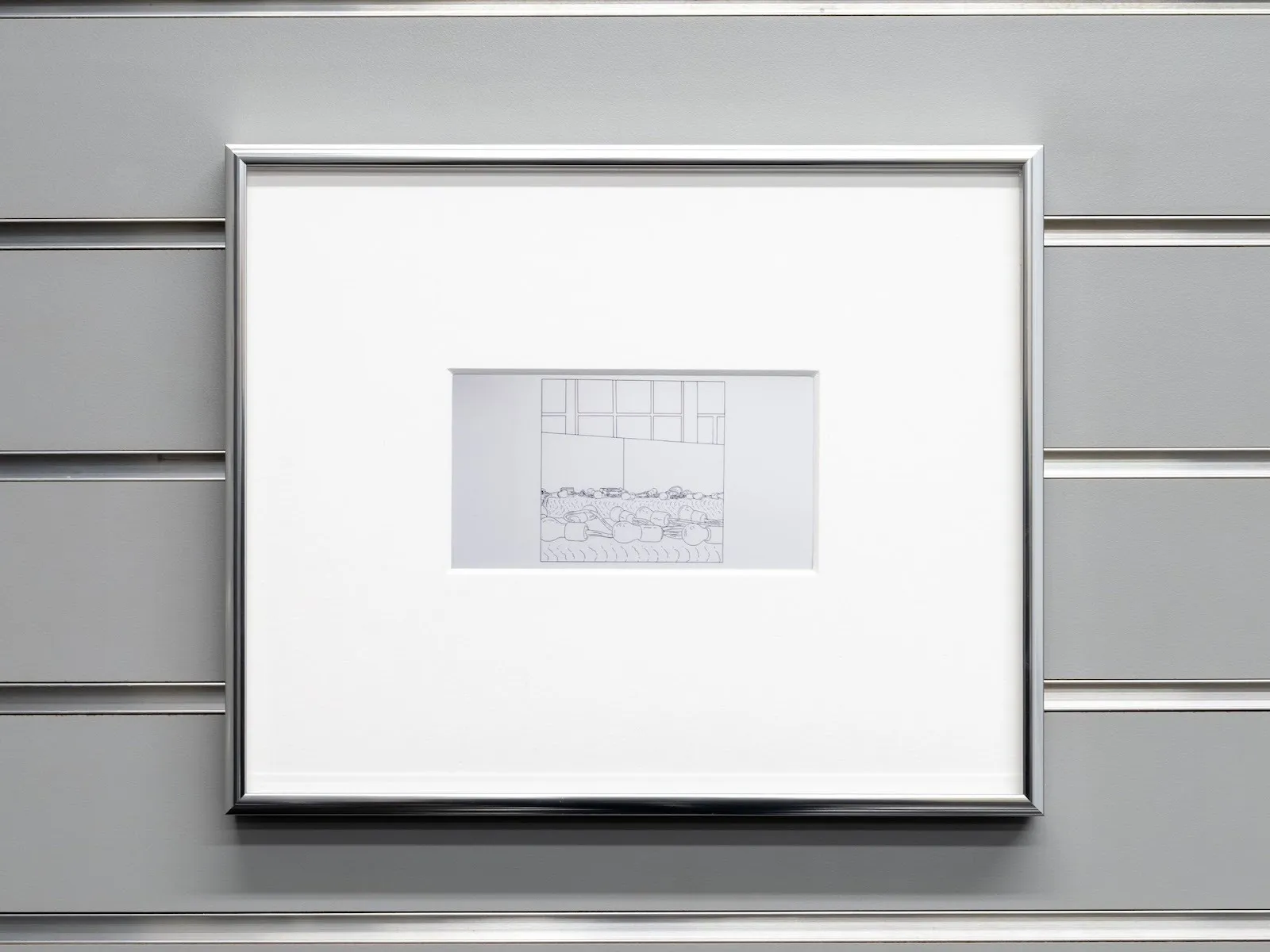
Upon entering the exhibition space, visitors encounter several copies of a Sale and Purchase Agreement with Hope Certificate, as well as a Sale-Leaseback and Purchase Agreement for Kinnane Smith’s framed inkjet prints: Lawler, Arranged at Brookfield Properties, NYC (Photographer Unknown) I and II (2016). These images, which document Louise Lawler’s artworks in the Brookfield Properties Permanent Art Collection, were captured by an unidentified photographer and were printed by Kinnane Smith from Brookfield’s website at the maximum resolution permitted and carefully framed, matching the recognisable newsstand’s wall display system.
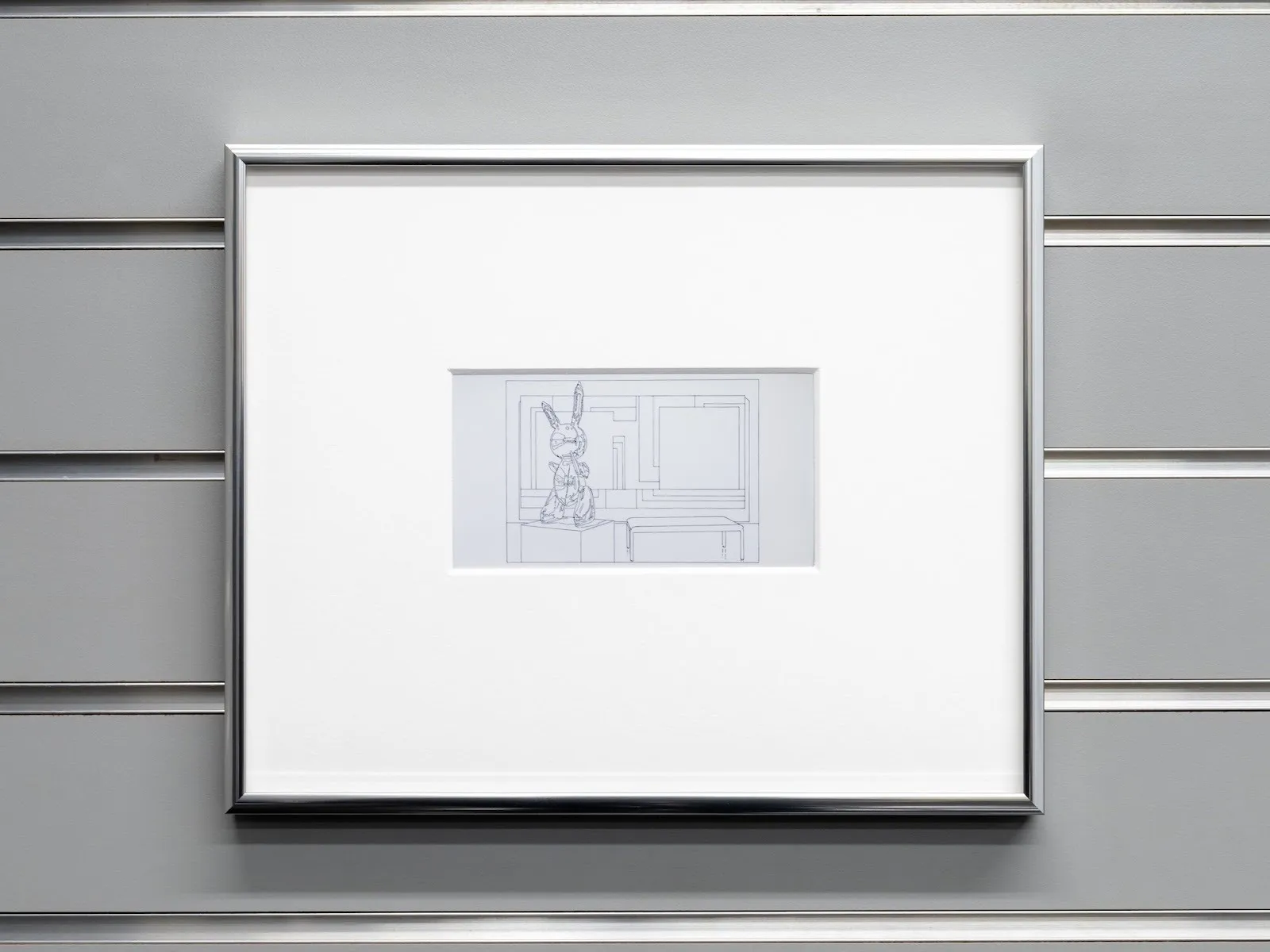
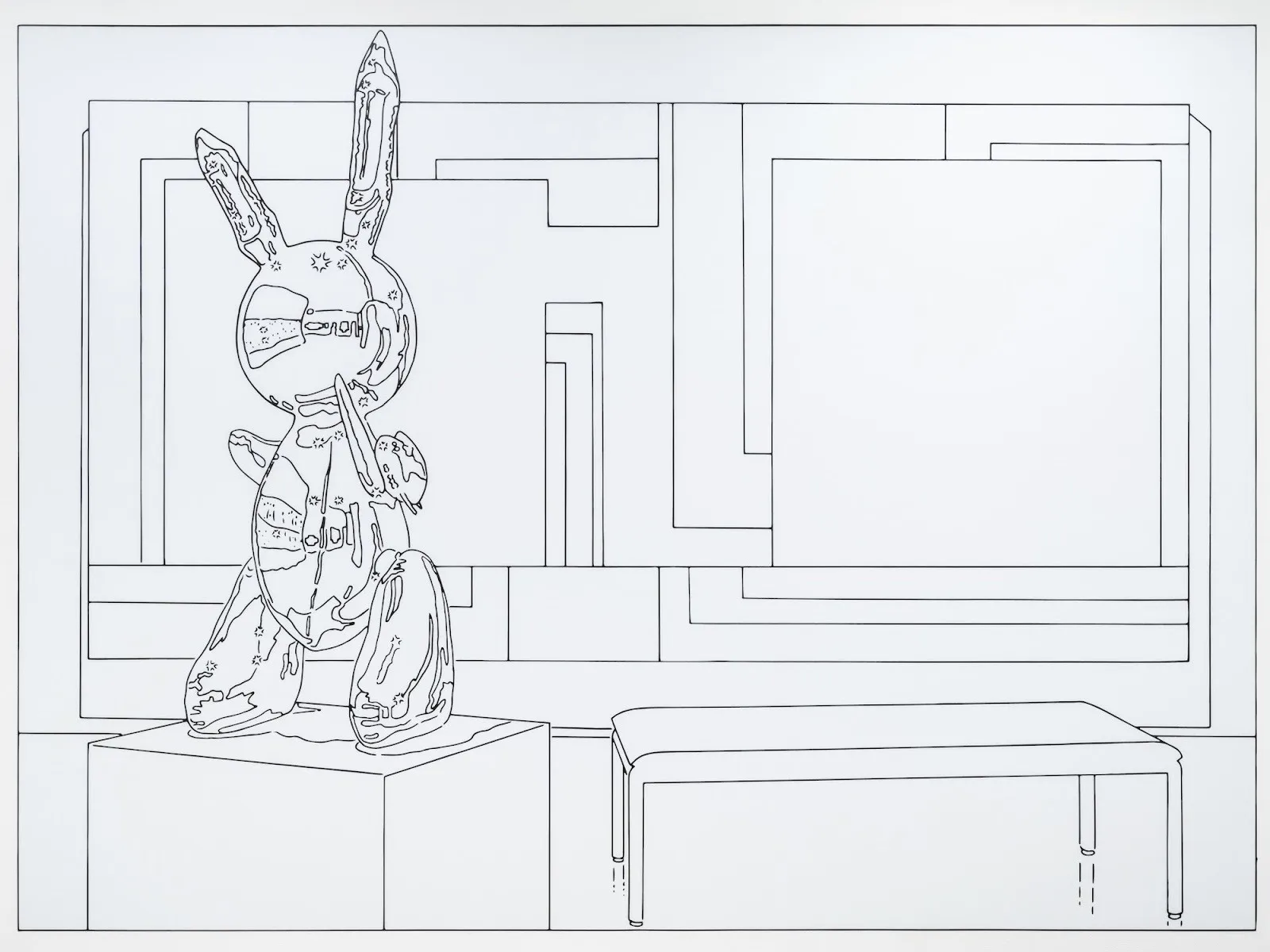
Louise Lawler’s artworks Bulbs (traced) (2005/2006/2019) and (Bunny) Sculpture and Painting (traced) (1999/2019) clearly outline Felix Gonzalez-Torres’s installation Untitled (North) (1993), Jeff Koons’s sculpture Rabbit (1986), and Peter Halley’s painting The Acid Test (1991–1992). The works were rearranged and installed on a purpose-built white wall using adhesive wall material for this exhibition. Lawler’s (traced) works do not have fixed dimensions; their scale is determined by the collector or curator. The dimensions exhibited at Emmelines, 60 x 60 inches and 60 x 83 7/16 inches, were selected to correspond with the scales used by Brookfield's curators for editions in their private collection.
Tracings and Arrangements employs institutional critique to address how contemporary international real estate and property laws are significantly rooted in 15th-century colonial doctrines [1] based on practices by the Portuguese colonizers, particularly those in Brazil and Angola. Property law served as a primary mechanism of colonialism and colonial accumulation of capital, fundamentally altering the use and control of land and resources. This transformation also reshaped social relations, economies, and cultural practices associated with land use. The ongoing entanglement of property rights, including the freedom to use, alienate, and contract over property, as well as the right to security, is evident in the available printed documents: “Sale and Purchase Agreement” and “Sale-leaseback and Purchase Agreement.” These agreements, derived from Emmeline’s original contracts and now presenting two distinct purchase and sale agreements for Kinnane Smith’s work, reflect the enduring racial and colonial legacies embedded in the legal structures behind them.
As property laws and racial subjectivity developed in relation to one another, racial regimes of ownership [2] have retained their disciplinary power in organizing territory and producing racialized subjects through a hierarchy of value constituted across the domains of culture, science, economy, and philosophy. These racial regimes of ownership persist as hegemonic juridical formations even in liberal democratic settler states and beyond, as Johnson v. McIntosh (1823) [3] remains a foundational legal precedent in the United States.
By analyzing how the techniques of ownership that remain a primary mode of dispossession in settler colonies cut across the economic, cultural, political, and psychic spheres of colonial and postcolonial life, Harrison Kinnane Smith’s practice demonstrates that deconstructing contemporary property laws is central to ongoing anti-racist and decolonial struggles.
As a result, this exhibition interrogates conventional assumptions about ownership and prompts a reconsideration of how individuals relate to commodities, in this case, artworks and intellectual property rights outside the framework of ownership. What changes could allow us to resist and reject ownership as a commodity? How can we imagine new ways of relating to things that do not depend on this idea?
Such advocacy of “property abolitionism” [4] draws upon Ruth Wilson Gilmore’s concept of “abolition geography,” which envisions a radical restructuring of economic and social relations free from the constraints imposed by the property form. Both Louise Lawler’s and Kinnane Smith’s works, featured in Tracings and Arrangements, reflect on the refusal of private property ownership and the racial and colonial systems that underpin this relationship. Their works propose the necessity of a comprehensive transformation of capitalist political economies and the social and cultural relations that structure our society.
Harrison Kinnane Smith: Tracings and Arrangements is on view at Emmelines from February 7 to March 21, 2026.
References:
[1] The Doctrine of Discovery, implemented by Spain and Portugal, helped justify European rights to land. Portuguese colonizers erected stone padrões along the west coast of Africa and crosses in Brazil to prove where they had allegedly arrived first and operated as markers of possessions. In colonial Brazil, the sesmaria system—conditional land grants requiring recipients to cultivate the land—helped organize agricultural production and territorial settlement.
[2] Brenna Bhandar, Colonial Lives of Property: Law, Land, and Racial Regimes of Ownership, Durham, NC, 2018.
[3] Johnson v. McIntosh (1823) is a landmark Supreme Court case in which Chief Justice John Marshall articulated the “Doctrine of Discovery” within American law. The decision held that European nations acquired ultimate title to lands they discovered, while Native Americans retained only a right of occupancy, thereby prohibiting them from selling land directly to private individuals.
[4] Ruth Wilson Gilmore, “Abolition Geography and the Problem of Innocence,” Futures of Black Radicalism, edited by Gaye Theresa Johnson and Alex Lubin. London: Verso, 2017.