.jpg)

.webp)


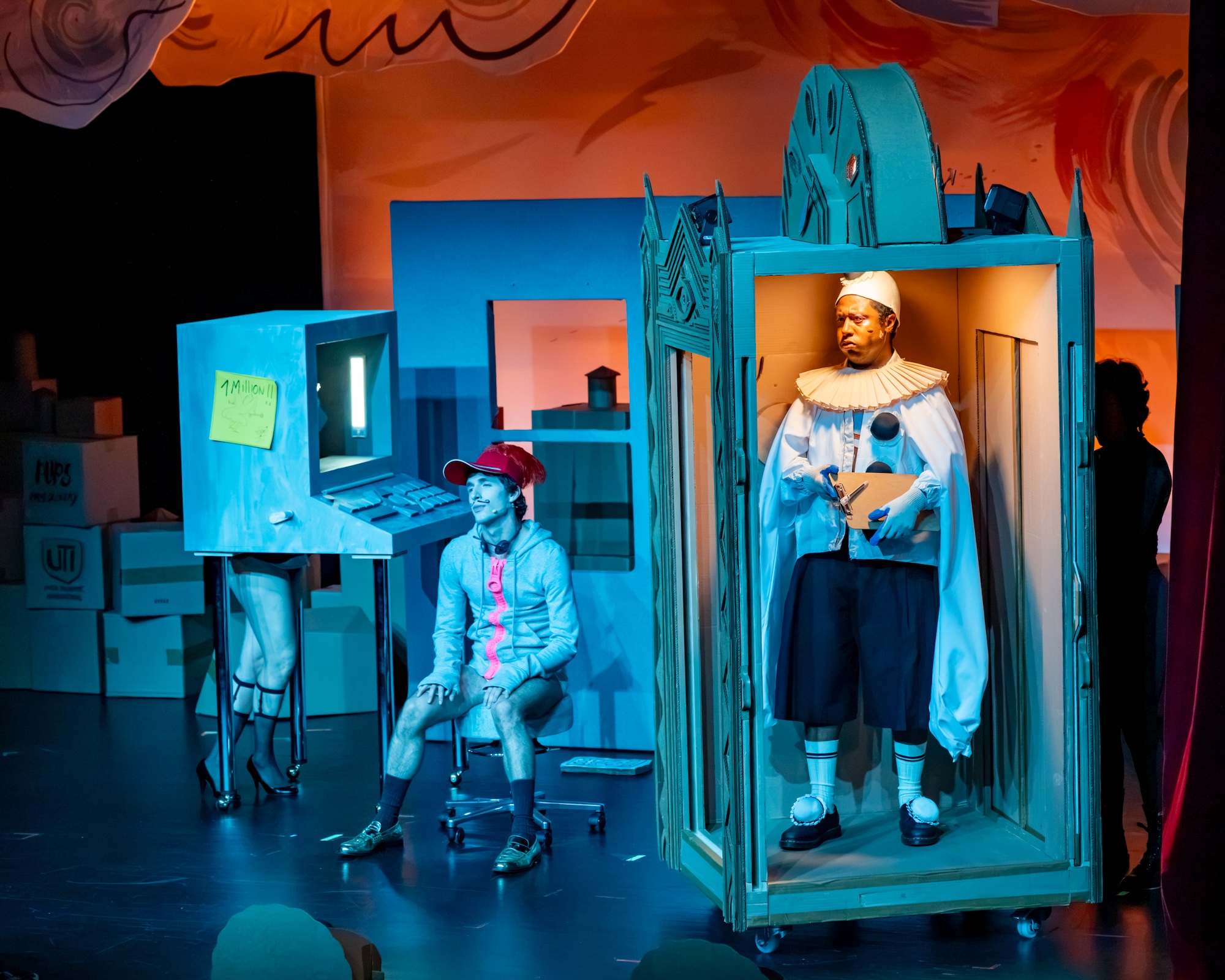
“Thucydides Fever Dream” at Hill Art Foundation
Review
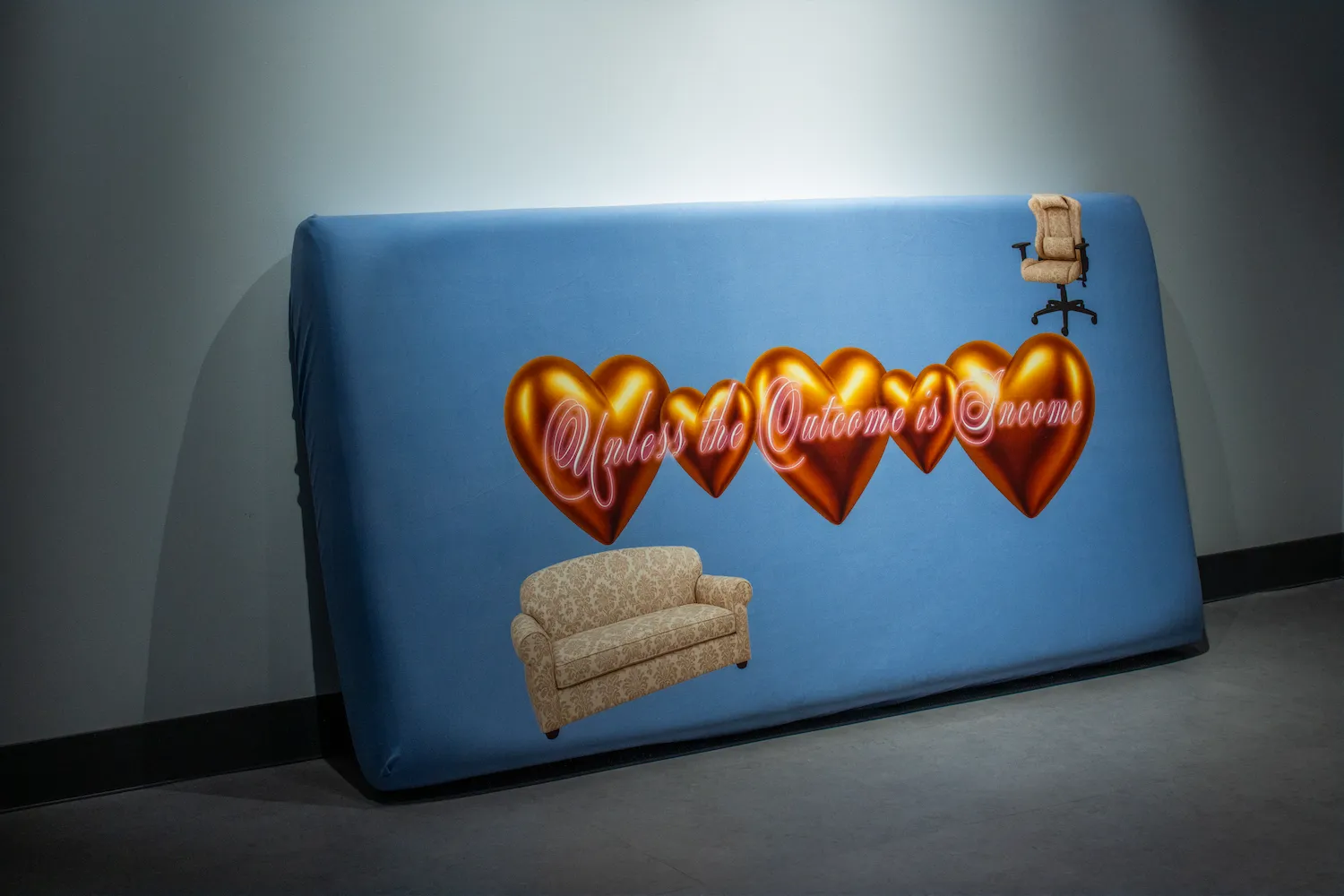
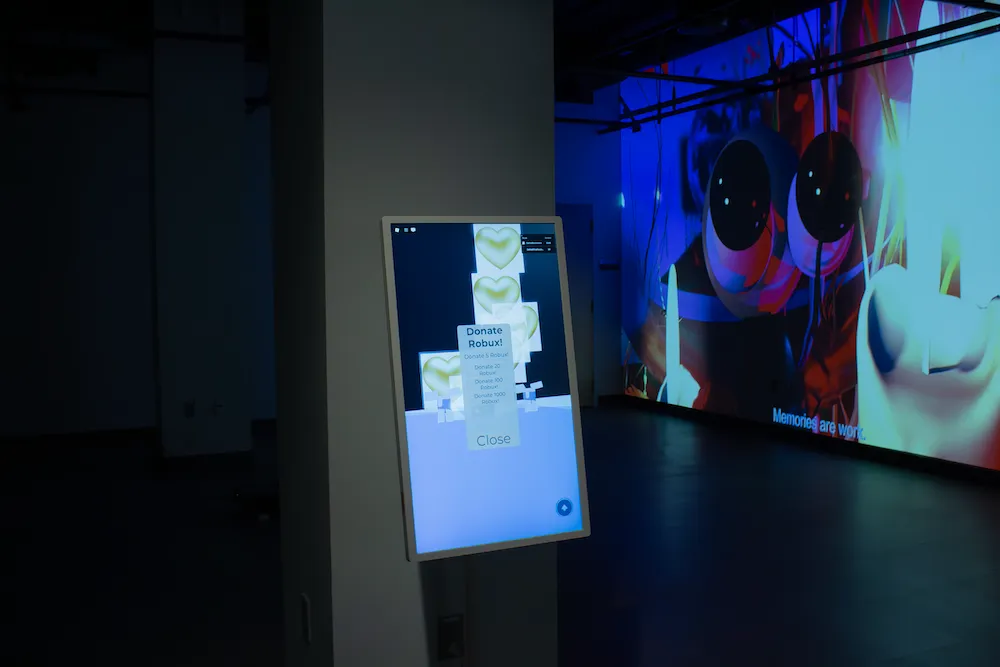
Unless the Outcome is Income at the State University of New York (SUNY) at Oswego is the first institutional solo exhibition by Dahlia Bloomstone, presented as part of the University’s artist-in-residence program. The exhibition includes a large-scale projected 3D-animated video, a playable Roblox game displayed on two human-sized tablets, and a dorm bed laid horizontally against the wall fitted with a custom sheet. The show thinks through morality as material. In this interview with Alex Schmidt, Bloomstone discusses the exhibition, moral equivalence, content guidelines on child-frequented sites, fables, and more.
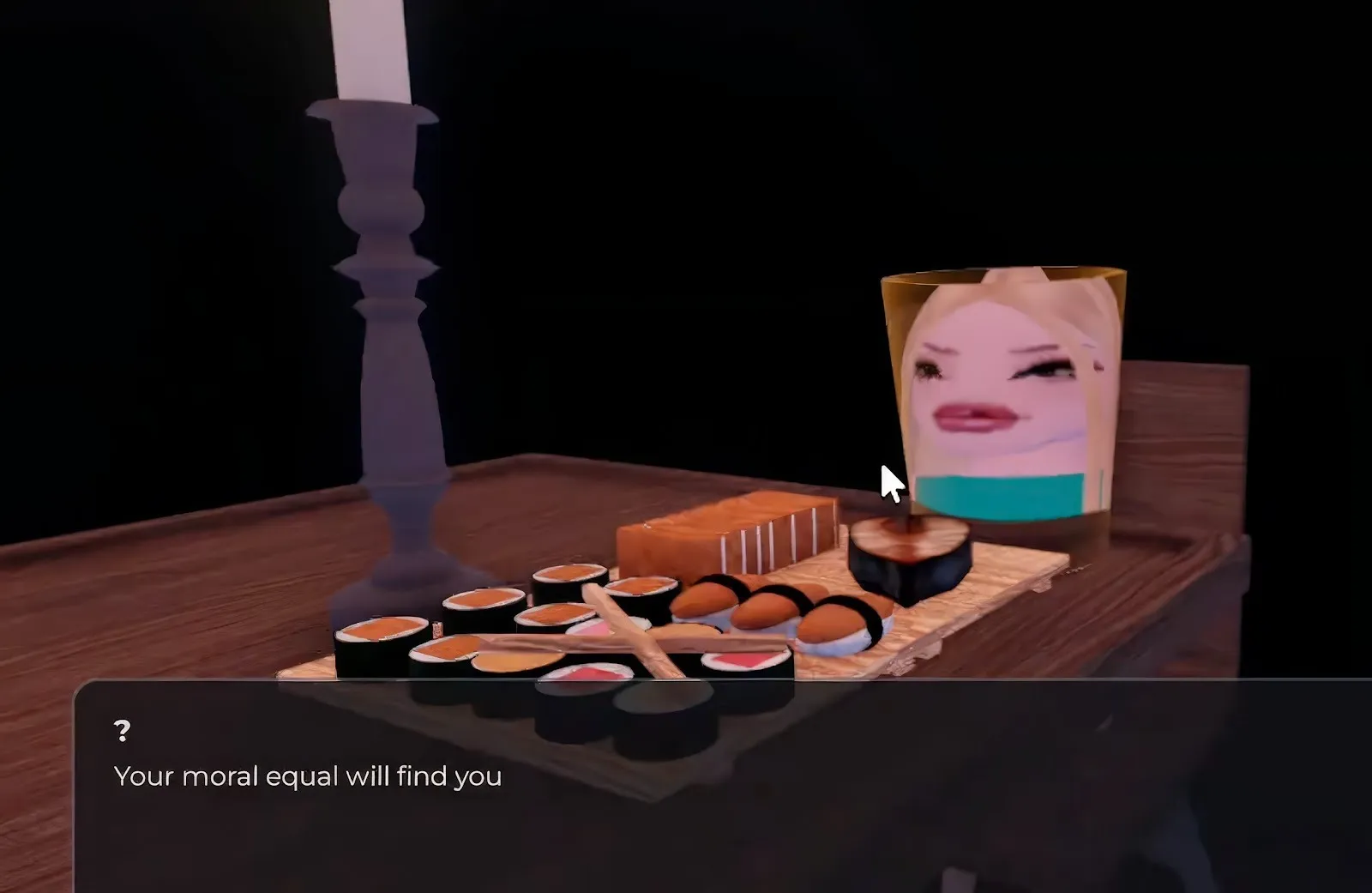
Alex Schmidt: The avatar in Unless the Outcome is Income: Roblox says “Your moral equal will find you” to a lobster NPC at a low-lit sushi dinner. How do you define morality?
Dahlia Bloomstone: I was thinking about morality in relation to labor and love. In the Roblox game, the avatar is tasked with a few moral choices that amount to arbitrary scores. Based on her choices, she will be transported to different rooms, where she engages with either romantic connections or is being paid for them. How is empathy distributed? In the animation, I tell this through a contemporary fable of an older loveless worker in her 60s named “O.” O’s best friend can only access genuine empathy for O, an erotic worker, after finding out her partner was a bachelorette-party stripper in his youth.
AS: Do these stories reflect your broader social concerns?
DB: I am thinking about NSPM-7, the National Security Presidential Memorandum 7, which defines these themes as indicators of violence: anti-capitalism, extremism on gender, hostility towards those who hold traditional American views on family, and hostility towards those who hold traditional American views on morality. In my practice, I am always thinking about the act of donating as a moral intervention to subvert stereotypes of amoral work. It’s hard to find your moral equal living within hope and despair. Finding your moral equal is a search for love.
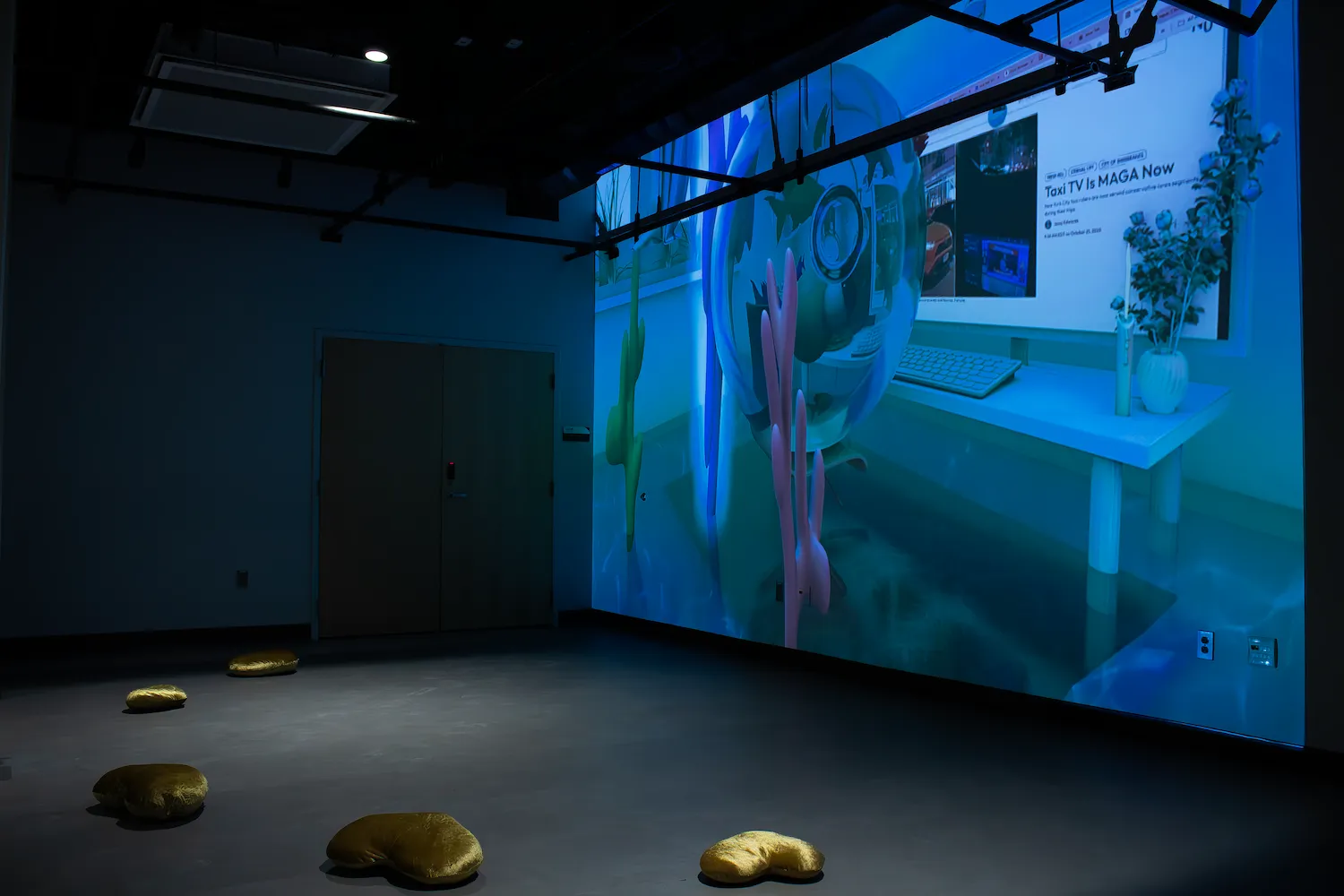
AS: You are both personified as a fish and a lover of fish. How do you relate to real fish? Do they engage in the same forms of labor as you / for you?
DB: In Hermann Hesse’s novel Narcissus and Goldmund, the protagonist, Goldmund, discovers his humanity and empathy through fish. Goldmund is at a market; he looks at the fish offered for sale. Why are people so numb and crude, so insensitive? Why didn't they see the mouths of these fish in pain, their deathly frightened eyes? These people saw nothing, knew nothing, and nothing touched them. I have continued to lean into this theme of shifting ideology and learning empathy with “the other” through fish. While a resident at Skowhegan [in 2023], I began focusing on real and imagined fish care. One project involved a contractual agreement archiving visits to measure the pH of the local Wesserunsett lake to ensure optimal conditions for the resident fish and sculptural work, where I “unhooked” the fish bait, gave them shoes, and spray-painted them bright gold.
AS: A friend of mine teaches at a [redacted school], where there has been the policy to no longer “discuss current events.” What are we protecting children from?
DB: [Redacted school] then has the same new content guidelines that Roblox does. Unless the Outcome is Income: Roblox is a Roblox game that engages with the history and politics surrounding the popular children’s gaming platform and considers Roblox’s new content guidelines, where a game is 17+ if it has romantic themes, including “non-sexual expressions of love or affection,” or if it has what’s considered a sensitive issue, which is defined as “a current social, political, or religious issue that is both polarizing and emotionally charged.” Roblox has an enduring “sex problem,” as strip club games and predators continue to appear despite “heavy moderation,” revealing broader cultural politics.
AS: Whoa . . . are you abiding by their rules?
DB: In the games, visitors can donate either on my behalf (both games are on my Roblox accounts) or use their own accounts on their own devices using Robux (Roblox’s in-world currency) by interacting with the dancing avatar NPCs at the end of the game. Fundraising and donations are against the platform’s policies. The platform itself has become a site for protest, as young players have organized digital demonstrations for Palestine and against ICE. So far, approximately 20,000 Robux has been donated both on my account and via other players’ accounts, which converts to about $200, which will go to Palestinian and ICE detainee aid as long as the game is up on the platform (as long as Roblox doesn’t find out!) and players continue to engage. They can donate 5, 20, 100, or 1,000 Robux at a time.
AS: I’m so curious how young people experience this work. You’ve been teaching a gaming course at Oswego . . .
DB: My class talked often about the politics and issues around Roblox (one student has a brother who works at Roblox; another worked at a Roblox camp for kids!). This was a huge gift. We discussed “sensitive issues” in every class. We discussed the political ecosystem of Oswego, an extremely conservative area. We made games that would fail the “Woke Content Detector” on Steam. All of their game work was incredible, and so were our conversations. They all inspired the show.
AS: I’m so jealous of your students. Can we please peek at the syllabus?
DB: We read Ruha Benjamin’s Imagination: A Manifesto and her edited volume Captivating Technology: Race, Carceral Technoscience, and Liberatory Imagination in Everyday Life; C. Thi Nguyen’s Games: Agency as Art; Constantina Zavitsanos and Park McArthur’s essay “Other Forms of Conviviality”; Elizaveta Shneyderman’s “Parameterization: On Animation and Future Corporealities”; Exploring Imaginary Worlds by Peter Burr; and Mindy Seu’s Cyberfeminism Index as well as A Sexual History of the Internet.
AS: What is a fable? Can you describe how it relates to your work?
DB: If I’m thinking about digestible aesthetics like big-eyed cuteness, fable-telling is this, plus morality. I learned about conjugating morality in animated video through Hong Kong artist Wong Ping’s work, which I have consumed religiously, especially his work Jungle of Desire (2015, 7 minutes, 2D animated video), which I begin every semester with. In Jungle of Desire, a husband and wife live in a small home in Hong Kong, and she becomes a sex worker. The husband watches her have sex with a policeman client who exploits her and never pays. Ping’s work reflects what he sees in Hong Kong, where prostitution itself is legal, but most related activities, such as organized prostitution, pimping, and public solicitation, are illegal. This legal framework leads to the prevalent "one-woman brothel" model, where a single sex worker operates alone in a private apartment, which has been widely documented to leave workers especially vulnerable to police exploitation and abuse of power.
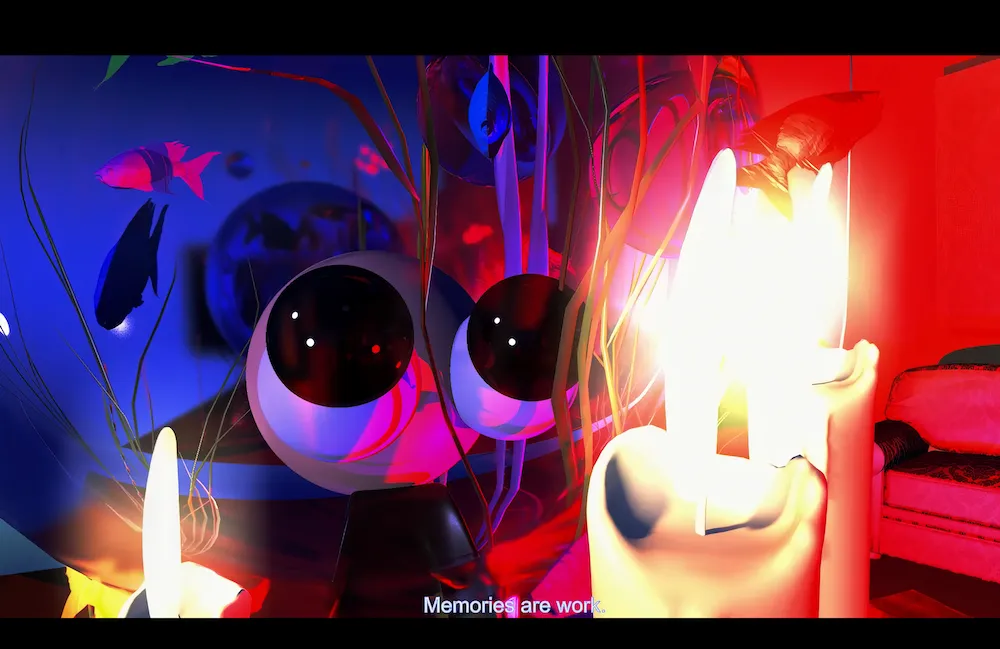
AS: Sometimes I think about how affective labor isn’t just hourly. Its impact is so bodily and extends into the future; the trauma of doing it yanks me into the past. I thought of this when I read this line in Unless the Outcome is Income: Animation: “Memories are work.”
DB: Memories are work. The game is framed around ideas, language, and my favorite idioms surrounding work, survival, and capital: “taking your work home with you” or “becoming your work,” using different visual signifiers like the damask patterns on the couch and gamer chair.
AS: I’ve known you across so many contexts now—we’ve overlapped at work and outside of work, but neither of us is ever truly off the clock.
DB: Not to moralize, I’m in no position to moralize, but you are my moral equal. I love being on the clock with you.
This interview was edited for clarity and length.
Unless the Outcome is Income is on view until December 6th, 2025. Watch Unless the Outcome is Income: Animation here. Play and donate in-game with a verified 17+ Roblox account here.