The Limits of Autonomy in Emerald Fennell’s “‘Wuthering Heights’”
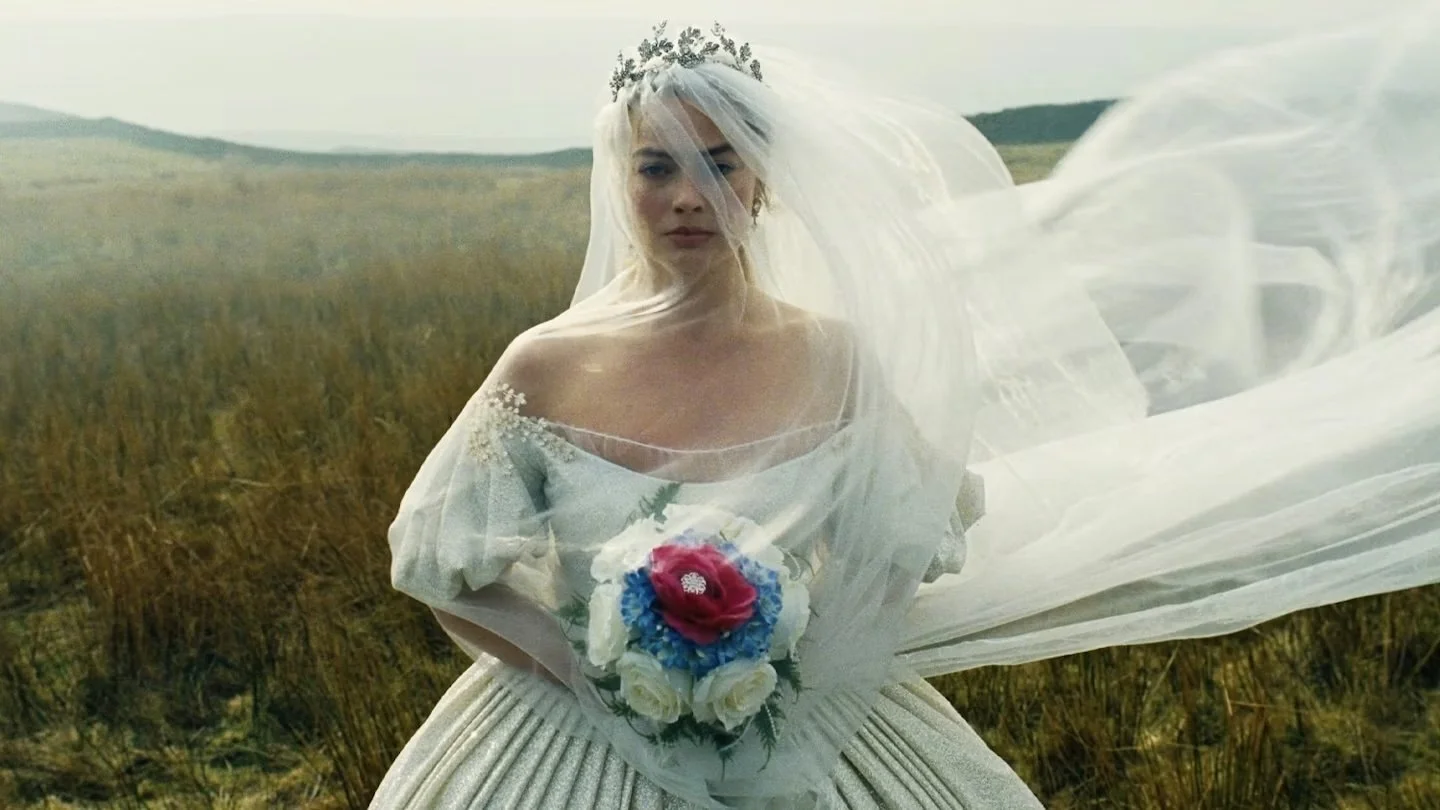
Margot Robbie in “Wuthering Heights” (2026). Warner Bros. Pictures.
When Emily Brontë’s Wuthering Heights was published in 1847, critics called it “strange.”[1] The characters, they wrote, were powered by a strange logic, a strange passion. While the word was used to both describe and denigrate, it also pointed to the novel’s singular, primal mystique. In Emerald Fennell’s new adaptation “Wuthering Heights”, the title is stuffed inside quotation marks to emphasize an unfaithfulness to the source material, and the film occasionally gestures toward a similar strangeness. Yet more often, it is focused on expanding the autonomy of its central figure, Catherine Earnshaw (Margot Robbie). And by increasing her autonomy, the story becomes clearer and more conventional as well.
From its first moments, Fennell grants Catherine greater agency than the novel does. In this adaptation, after her father brings home a boy of mysterious origin, Catherine names him herself: Heathcliff (played as an adult by Jacob Elordi). Fennell’s Catherine is excited to keep him as a pet and sometimes treats him like one. She and Heathcliff develop a close bond, but Catherine also actively inserts herself into the lives of their wealthy neighbors, the Lintons. Then, after she accepts Edgar Linton’s proposal and Heathcliff flees from her life, she delays her marriage for a year in case he returns.
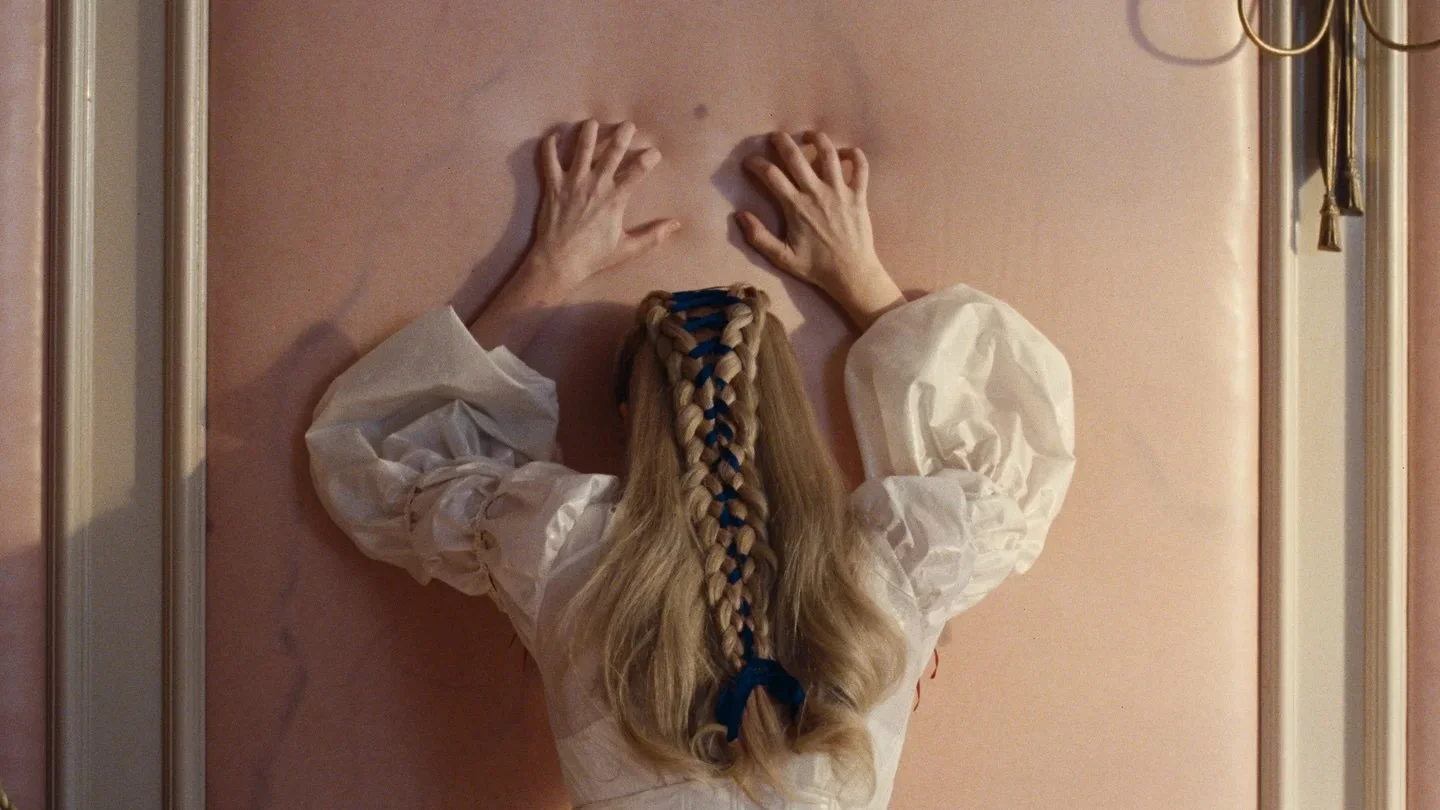
For large stretches, this added self-determination powers the film. And with it, Fennell begins to thread a promising, unusual theme into her source material, expanding Catherine’s control over the story as if to grow her into an entity that extends beyond herself. At points, Fennell seems to be exploring how much Catherine can transform the world into a literal version of herself. If she is naming and creating Heathcliff, how much of him is Catherine? This serves as an inventive riff, echoing and subverting Catherine’s famous realization in the novel—“I am Heathcliff”—to position him as her creation instead of something like her double. The symbolic set design also flirts with the extent of Catherine’s influence. In one of the film’s most purposeful uses of its lush, on-the-nose interiors, the Lintons upholster Catherine’s bedroom in a material the same color as her skin, complete with her freckles and veins. In these brief moments, Fennell’s Catherine is enlarged, and it is thrilling to consider how big she might become.
Margot Robbie in “Wuthering Heights” (2026). Warner Bros. Pictures.
Yet that mostly marks the end of the film’s interrogation of the allure and weight of agency. Throughout much of the adaptation, the swollen autonomy of Catherine and the other major female characters leads to overexplanations of motivation and plot. As if worried that audiences would be confused by the inexplicable, otherworldly passion of Brontë’s Catherine and Heathcliff, Fennell treats autonomy as a problem-solving device, using it to eliminate ambiguity wherever it appears. Robbie’s Catherine, Isabella Linton (Alison Oliver), and Nelly Dean (an underutilized Hong Chau) charge toward what they want with unmistakable transparency. Elordi’s Heathcliff, albeit with a certain sexy danger, asks for Isabella’s consent to degrade and abuse her, over-clarifying his motives and boundaries.
Again and again, Fennell reduces the novel’s strange forces to simple actions that adhere to easily graspable logic. The story’s type of logic is so simple that the film inevitably becomes conventional. And when the film becomes conventional, the romance turns general, the emotion flattens out, and agency begins to seem boring, even undesirable. That is to say, focusing on increased agency begins to look like a trend the film is jumping on.
To Fennell, the agency of women is clearly not a trend but a driving force behind all her work. Yet especially in “Wuthering Heights”, she never finds a sustained type of self-determination that feels nuanced and emotionally true for her ill-fated characters. Fennell’s adaptation doesn’t have the ambiguity or murkiness of Brontë’s version, but that’s not necessarily what it needs. What’s missing is a similarly tangled, throbbing reason for existing, whether that would’ve come from a less limited exploration of autonomy or from something else.
“Wuthering Heights” succeeds most consistently as a compilation of thoughtful, seductive images, memorable for their somehow sleek yet maximalist quality. After an alcoholic’s death, bottles are piled up behind his body like Christmas trees. The exterior design of Wuthering Heights, Catherine and Heathcliff’s childhood home, is particularly strong. It looks alien and inhospitable, as if built out of tiny versions of the monoliths from 2001: A Space Odyssey (1968).

Jacob Elordi and Margot Robbie in “Wuthering Heights” (2026). Warner Bros. Pictures.
Like most film adaptations of Wuthering Heights, Fennell ends hers halfway through Brontë’s story. A notable exception to this is the spectacular and emotionally poetic 1992 version by Peter Kosminsky, which let the second part play out. Traditionally, truncating the story seems like a choice made to keep the focus on the lovers’ passion and to evade the subsequent destruction. Yet in Fennell’s case, she finds a deeper purpose for the premature ending.
In the film’s final moments, Fennell’s initial interest in agency as a way to expand Catherine beyond the confines of her self reemerges. This gives a glimpse of how compelling a more complete exploration of that thread would’ve been. Though it possibly wasn’t her intention, Fennell’s version of the ending invites a striking interpretation: that the film seems to stop because Catherine’s story stops. It is as if Fennell’s Catherine has a presence so large and active that the adaptation couldn’t continue without her. As a result, we begin to get a Wuthering Heights that is subtly and poignantly Catherine’s, not Catherine and Heathcliff’s. The conclusion’s suggested solipsism is one of the film’s most unique and provocative elements. If only Fennell had built a world specific enough to support it.
“Wuthering Heights” is now playing widely in theaters around the United States.
[1] Jacke Wilson, “763: Emily’s Desk Drawer,” January 1, 2026, in The History of Literature, produced by The Podglomerate, podcast, 00:56:00.