
.webp)
Chia-Yun Wu: “Elsewhere” at Nunu Fine Art
Review
Every year, the India Art Fair incites Delhi into action. Galleries open new shows, auction houses do previews, foundations organize events, magazines do awards, and the entire community of artists and art workers across the country comes together for a rejuvenation. Delhi might not have a biennale, but collective and diverse projects spread across the entire city over the fair’s run. IAF was in many ways slower than Art Mumbai in terms of sales, wading into the pool rather than jumping in the deep end: the start was slower yet assured as sales rolled through and booths changed displays.
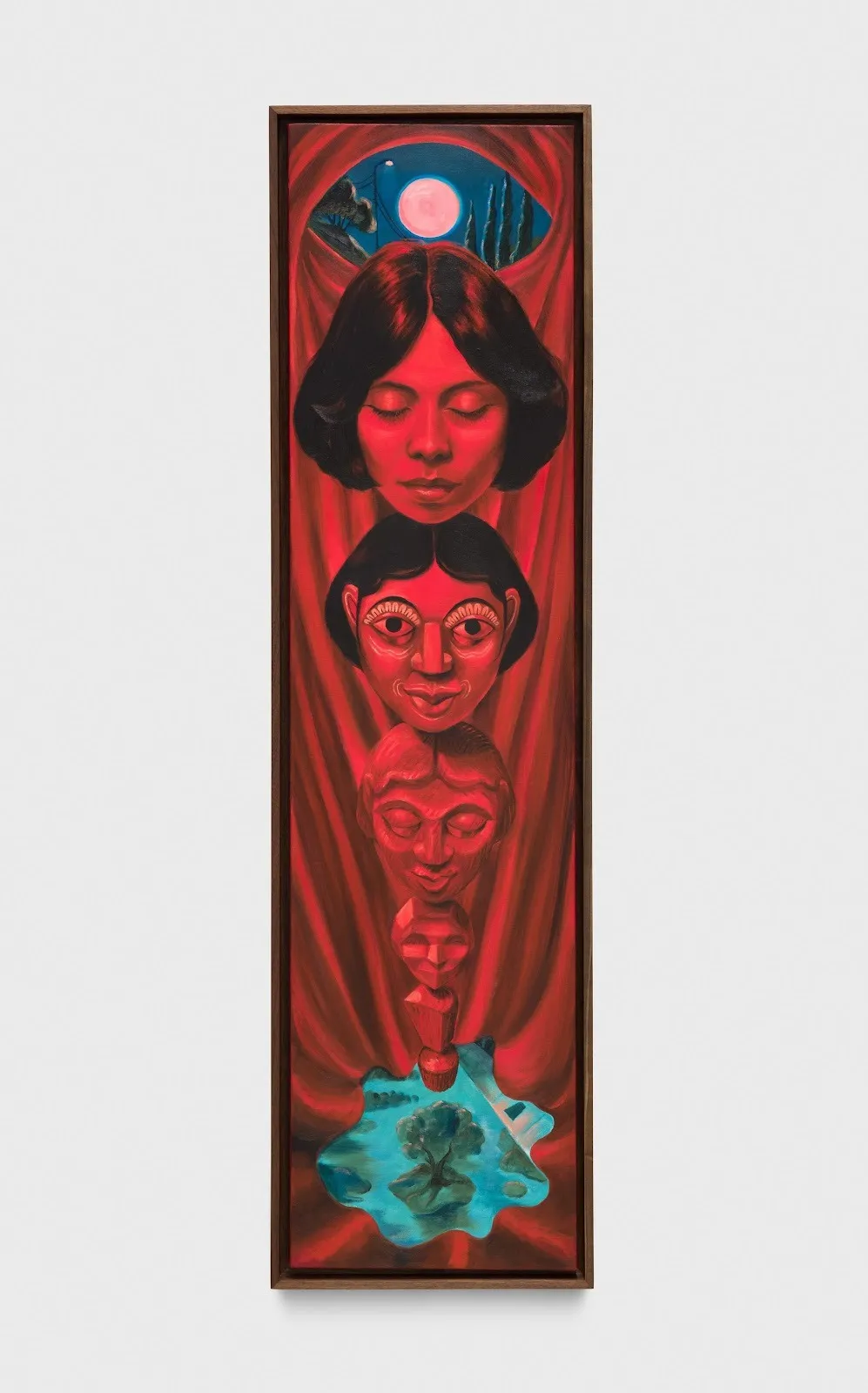
Rajiv Menon Contemporary had a smaller booth than one would’ve hoped for from the Los Angeles giant debuting at the fair. Still, they are piercing in their statement: We must increase diasporic visibility. Menon holds himself to this responsibility, charging his roster with both recognizable names, such as Tarini Sethi and Melissa Joseph, and more emerging ones, such as Maya Seas, Nibha Akireddy, and others. The gallery also introduced works by Gisela McDaniel, a diasporic indigenous Chamorro artist. McDaniel’s works, situated within ideas of bodily autonomy, indigeneity, and diaspora, felt significant and well placed within the larger context of artists and artworks being championed by Menon and his gallery. A gallery dedicated to a diaspora in the US is a statement in itself, especially at a time like this, but in India, it performs a different role: acknowledging a greater community of South Asians beyond borders and brands of nationality. Sri Lankan American artist Shyama Golden stole the show with her painting Treebirth, 2024. Golden is one of those artists who truly understands the use of monochrome, and she does so while playing with dimensions, textures, and perspectives in an acutely naturalistic rendition.
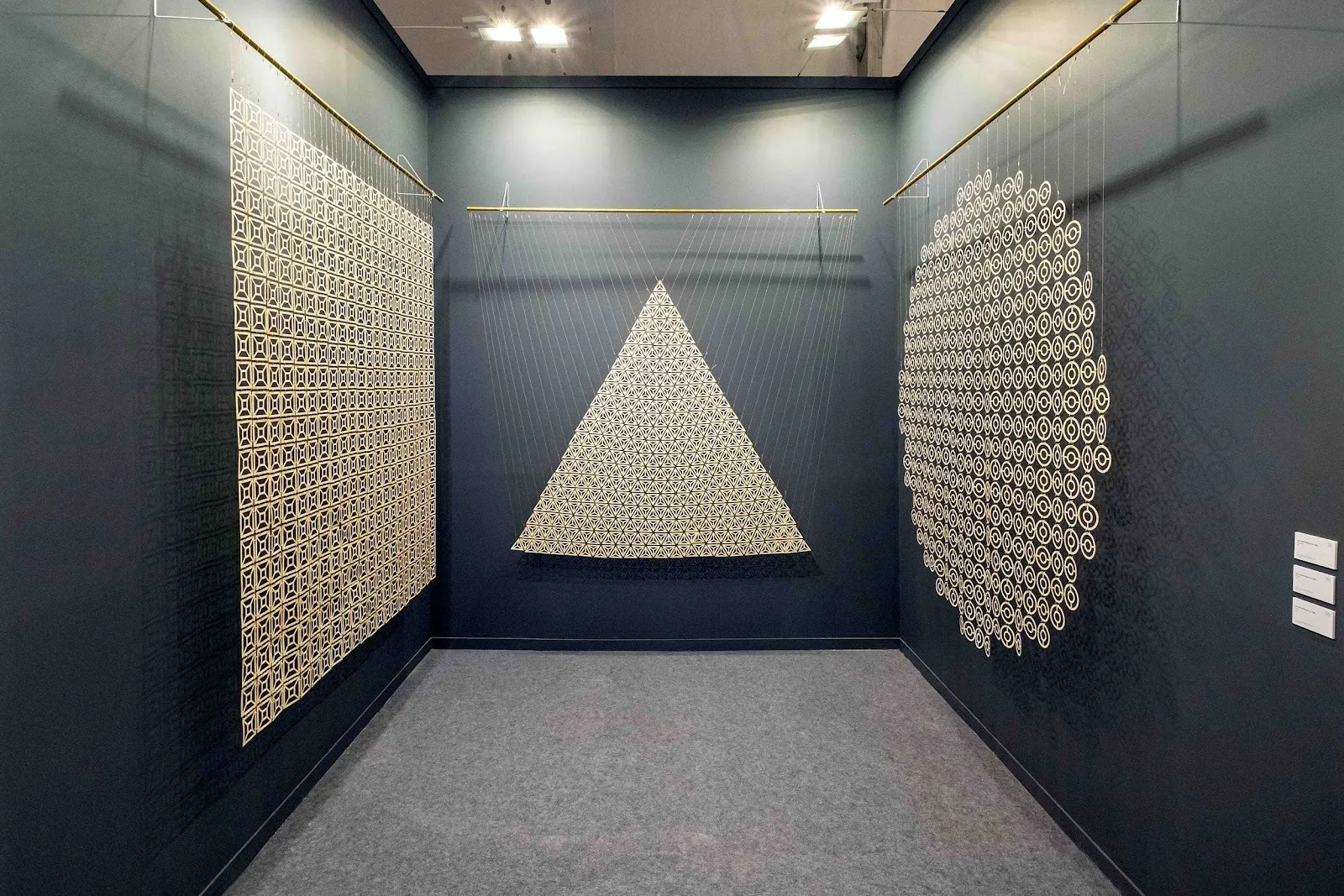
Runjeet Singh Gallery, based in London, comes to India after its debut at Art Mumbai last year. Although the gallery announced its participation quite late, it was a welcome addition with an impressive selection of artists. Karl Singaporewala’s sculptural works were sure to stop people in their tracks: made out of cotton rag paper, the suspended laser-cut shapes are inspired by teachings in the artist’s Zoroastrian faith. Rati Devi Sivyer was the other star; having shown at the gallery’s booth at Art Mumbai last year, she was one of the veterans this time around. With a practice founded upon a dedicated process in Indo-Persian miniature techniques, she has a unique way of forming mystical and collective images on multiple handmade hemp papers, installed together as diptychs, triptychs, or larger collections.
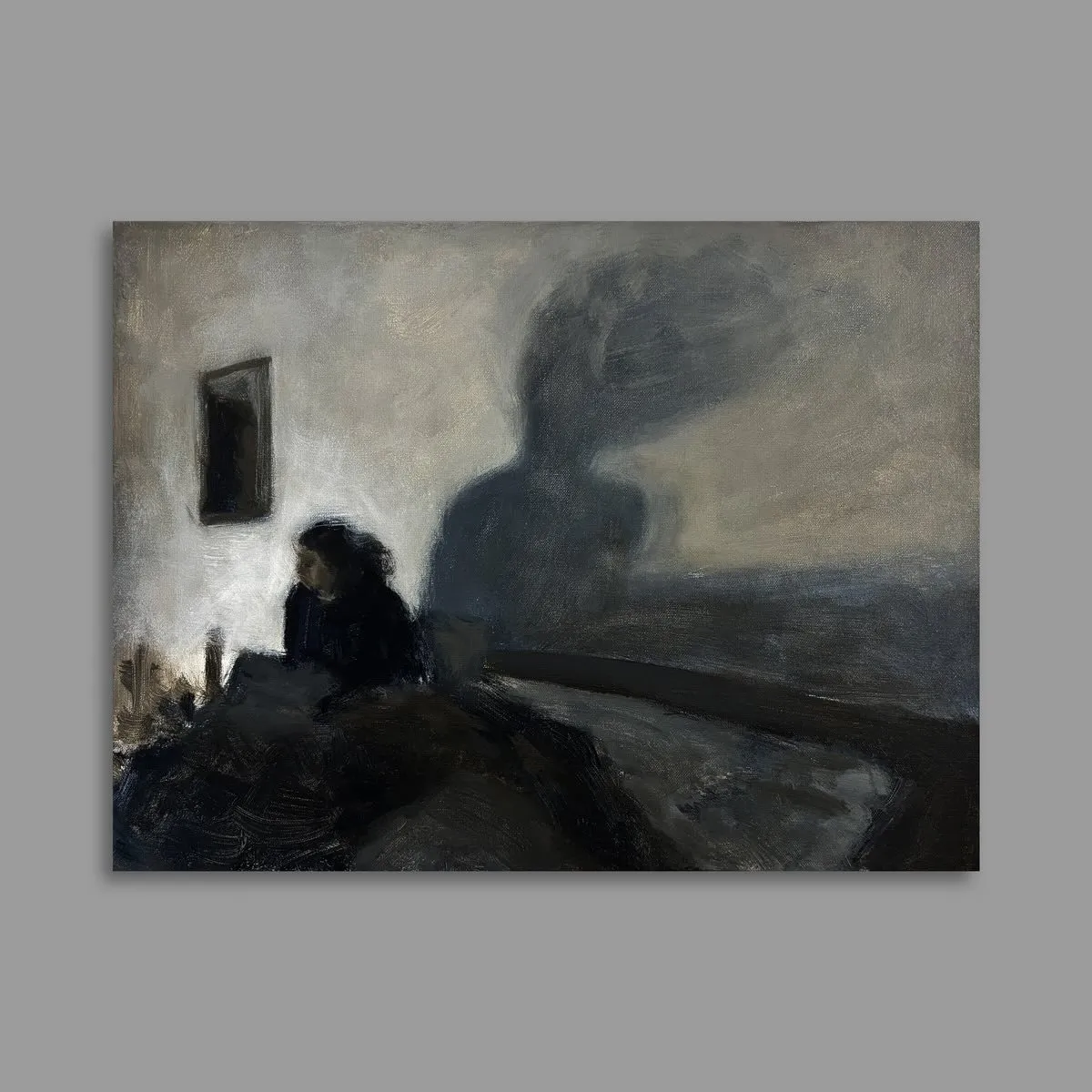
Art Incept, one of the younger galleries, showed itself to be a hub of interest, earnestly pushing emerging and early-career artists. Although there was no particular theme, domesticity and personal history did seem to be the more dominant narratives, such as in Rajat Kumar’s All in the Head. The softly rendered painting is a hauntingly intimate scene, playing with perspective and chiaroscuro; it captures a quiet and solitary moment, yet pulls the viewer in as if to break that loneliness.
Another younger Indian gallery, MAG Contemporary, was one of the more decisively curated booths, catering to a particular set of traditional styles and their contemporary mutations, rather than the extremely diverse rosters of some of the larger galleries. Their selection of artists, including Arinjoy Sen and Sachin Shankar, took the visitors into a game of worldbuilding. While Sen’s works are dramatic and vibrant, loud with a flair for the dramatic, and Shankar’s works are quiet, delicate, and minimally invasive architectural explorations, both are masterful subversions of Indo-Persian miniature paintings. Together with others, the gallery set a direction through curating a specific genre and its periphery—always a good indication that one will not get lost in the chaotic noise of fair hustle.
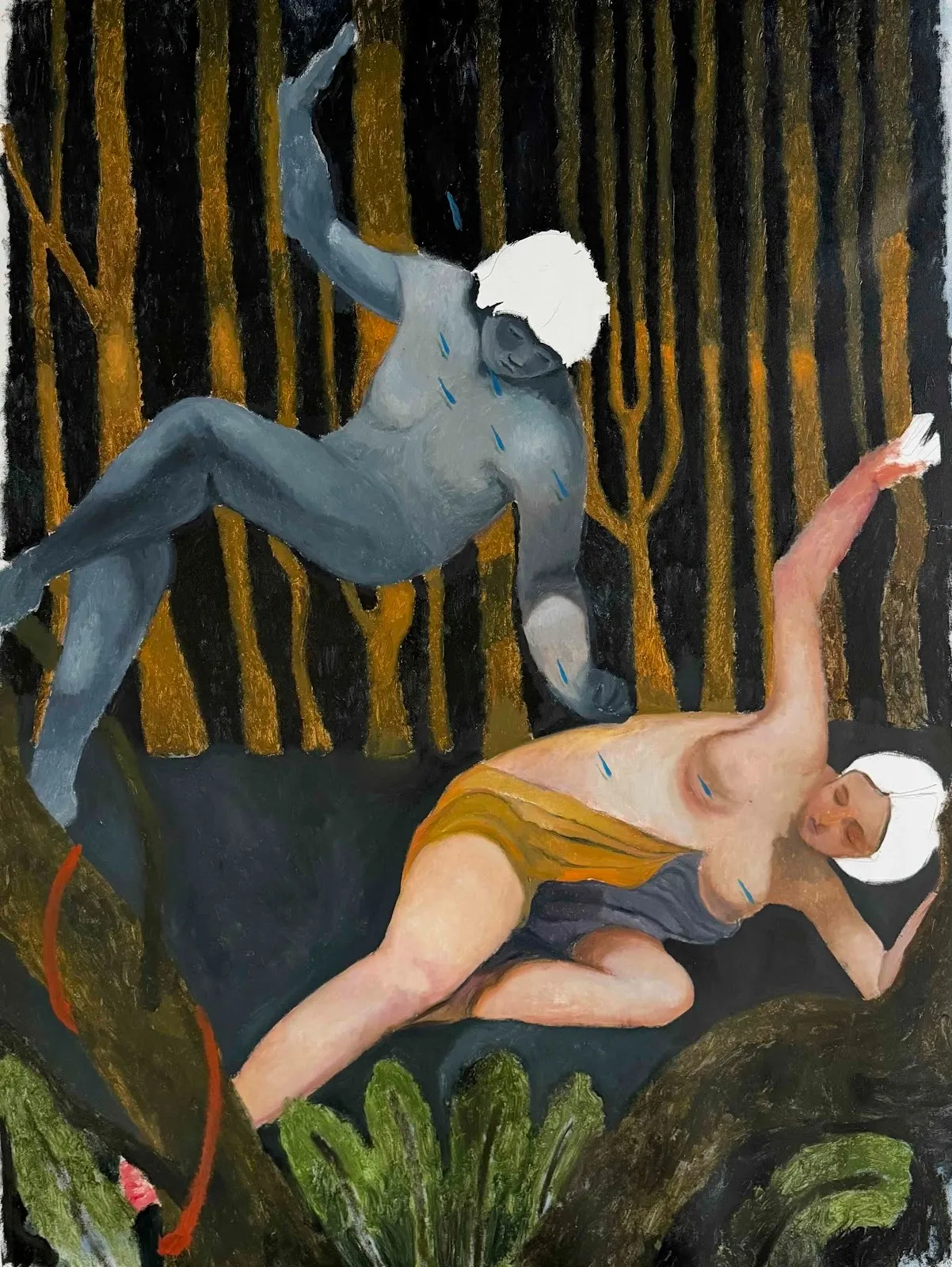
Delhi may not have been as fast-paced as Mumbai, but it surely was more assertive. Swiss gallery Gowen embodied this spirit with a solo booth showing, as the gallery puts it, a “significant evolution” of Giuliano Macca’s practice, who was recently in residence at Hampi Art Labs in Karnataka. The Amsterdam-based artist’s paintings were all done while in India, revolving around environments and Hindu myths and legends. Rife with imaginary landscapes and human figures emerging out of them, his new work does change these forms to fit more classical narratives out of Hampi, specifically in his use of indigo blue for these figures, a first time in his practice. While not so conceptually different from his earlier practice, Macca’s recent formal inspirations are different, shifting from classical European masters to his experiences of Hampi.
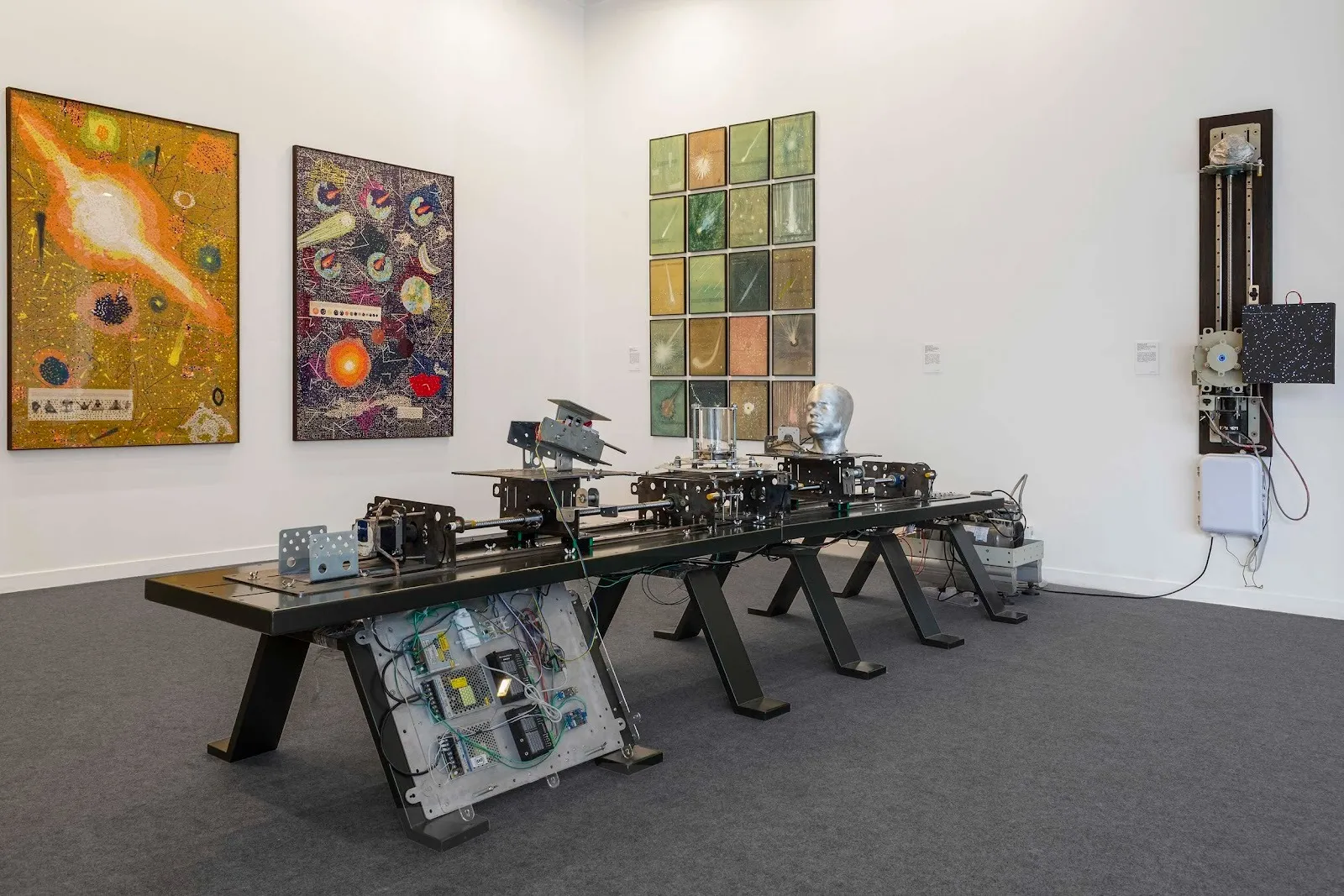
Unlike some of the galleries having a solo booth, Vadehra Art Gallery took it a step further, having mounted an entire second space for multidisciplinary Delhi-based artist Shailesh BR—and he didn’t disappoint. The presentation, titled New Moon, focused entirely on the artist’s exploration of philosophical questions surrounding cosmology, life cycles, and the mysteries of the universe while grounding the viewer within a spectrum of recognizable symbols. These explore solar systems, shooting stars, constellations, and zodiac characters. Two of his machine works–kinetic electronic sculptures with steel, glass, and plastic components–receive special attention. Of these, You will become a Star and Philosophy Machine 2.0, the latter is integral for the exhibit’s conceptual foundation—a meditation on the phases of the moon through the sculpture’s repetitive motions of two heads synchronized with the steady lighting and extinguishing of a lamp. A selection of both earlier works and newer ones, with a central focus on his kinetic sculptures, provided not only a large spectrum of options for collectors but a context for his practice that stretched out beyond the booth and connected a set of artworks to the vigorous studio practice behind it.
The real magic, though, was performed by the institutions section, and IAF made a point of highlighting their inclusion by making them the first stop upon entry. The Kiran Nadar Museum of Art, with a mission to bring art to the public, initiated workshops, events, and exhibitions. The first of the museum’s spaces was given to Assam-based Anga Art Collective, activating it with workshops in addition to presenting paintings and sculptures. More spaces for collective working and drawing preceded a second exhibition: Extinction Archive by artist Kulpreet Singh. A magnificent visual installation of a project investigating the social and ecological consequences of the Green Revolution in India, it references over 900 endangered species of plants, animals, and fungi. Fresh out of his monumental success at the current Kochi Biennale, this earlier project gets a new life here, guided by KNMA curator Srinivas Aditya Mopidevi.
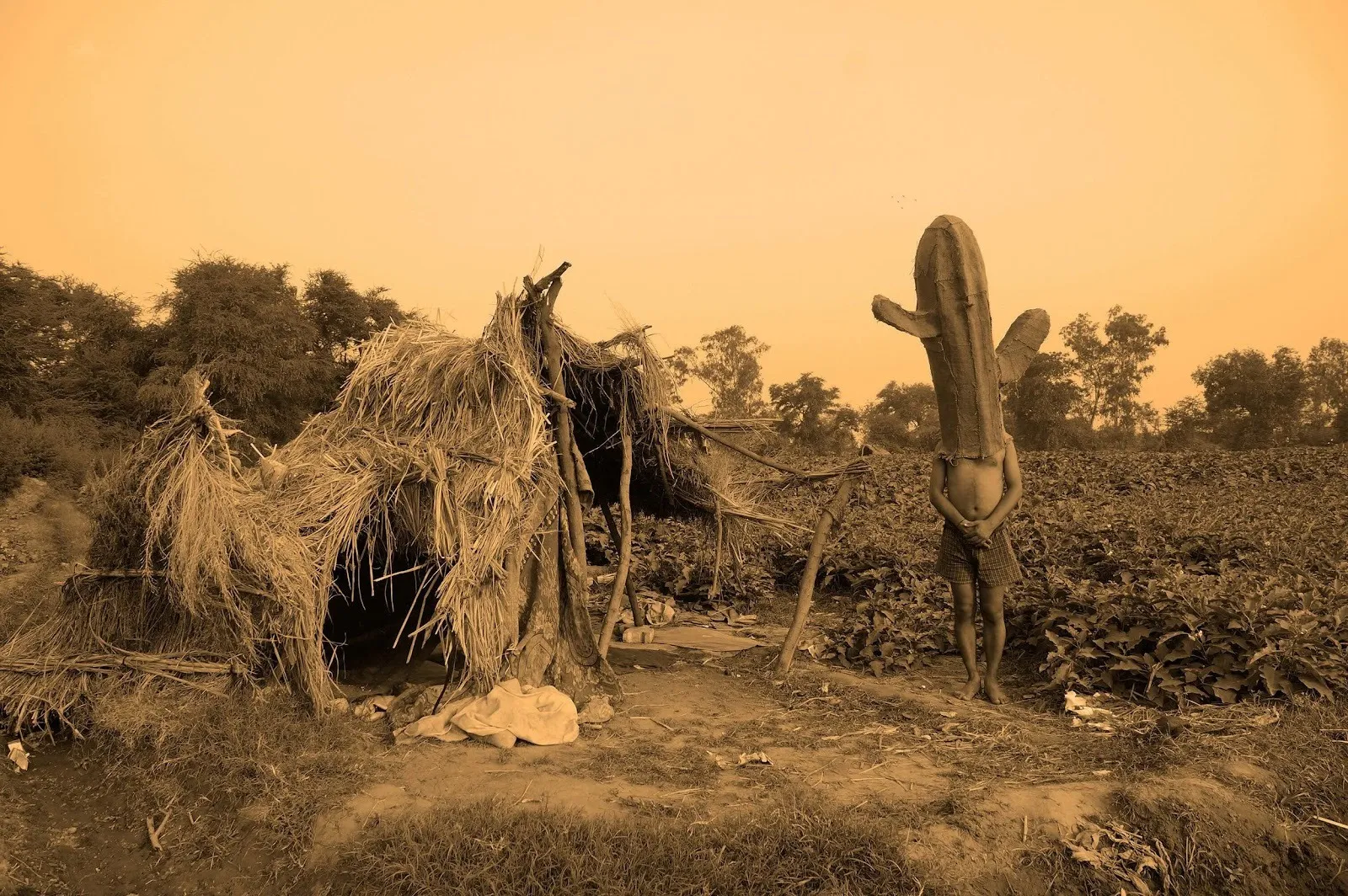
Among other significant institutions, Prameya Art Foundation, in collaboration with IAF, provided a space for recent Discover grantee Sidhant Kumar to build and exhibit his project. This brought to light the problematic realities of small-scale farming—expressed brilliantly in visuals and discourse, through research documentation, performance, installation art, and staged photography. Ardee Foundation also made waves, bringing together young artists in a joint exploration of Manjit Bawa’s legacy. Two of the students among the cohort, Abhishek Kolapudi and Nikhil Ramesh Chavan, both also currently showing at the Student Biennale in Kochi, showed promise. The artists managed not only to work with archival documentation from Bawa’s practice and comment on a formidable legacy, but also to produce works that stood out on their own.
Some artists of special note included Zurich-based textile artist Marie Schumann showing with Aicon Contemporary. Fresh out of a research residency at Arthshila Santiniketan in West Bengal spent researching traditional textile art, her work explores textiles as experimental structures, including as part of architecture or even conceptual realms, where it performs as a second skin. At Gallery Maskara, T. Venkanna remained as impressive—and sexually explicit—as ever. Some of his smaller, postcard-sized paintings proved to be the epitome of what he is celebrated for, most of them having sold within the first half of the VIP previews. Huma Bhabha could not be overlooked: whether it is the singular visual language of multimedia sculptures in cork, wood, and clay, or a greater and undefined mystical aura, her two sculptures at David Zwirner singularly held as much weight as the rest of the booth—and yes, this included the gigantic Yayoi Kusama pumpkin sculpture in the center. Among the many international and recognizable artists, Ai Weiwei’s works were prolifically spread across many booths showing in tandem with his ongoing exhibition in the city at Nature Morte.
IAF has proven itself more than a market; it is a site where a larger understanding of how the art world functions, which keeps it running, unfolds, from the teams that install and maintain the event to the industry’s most prominent patrons and leaders. It becomes a field of exposure and non-linear learning, a place that can feel as alienating as providing a sense of belonging. Paired with guided walkthroughs in multiple languages, ISL interpreters, braille handbooks, wheelchair ramps, and diverse information booths, the fair was a truly accessible point of convergence for all who love art in whichever form they prefer.
This year’s depth of concept and creative agency was made apparent in the attention to detail in making booths feel like exhibitions. This felt invigorating and demonstrated how Indian institutions and collectors are looking at art, pushing artists’ studio practices, histories, research projects, and conceptual foundations into the spotlight. This happened through special attention to concept notes and catalogs accompanying checklists at certain booths. The eagerness to explain artworks, paired with the general audience’s growing interest in learning about what goes on behind the artwork itself, opens the door to a larger ecosystem of artists, art workers, and students rather than just high-profile collectors. Institutions showcasing complete projects and series rather than singular artworks also provide a fuller picture of what lies beyond the immediacy of the fair. This edition of India Art Fair wasn’t by any accounts more exceptional than its previous ones, but it definitively prioritized the involvement of visionaries keen to challenge, adapt, and evolve with an art world that is growing ever more hungry.
India Art Fair’s 18th edition ran from February 6 through 9, 2026.